

Integrated Rate Law Calculator
Determine reaction order (0th, 1st, or 2nd) from time-concentration data by linearizing [A], ln[A], and 1/[A] vs. time t, comparing R² and RMSE, and calculating rate constant k and half-life.
Open toolCalculate the rate of reactant disappearance (`-Δ[A]/Δt`), stoichiometrically normalized reaction rate (`-Δ[A]/(a·Δt)`), integrated rate constant `k`, and half-life `t₁/₂` from initial and final molarity.
Enter the inputs, then select Calculate Reaction Rate.
Result will appear here
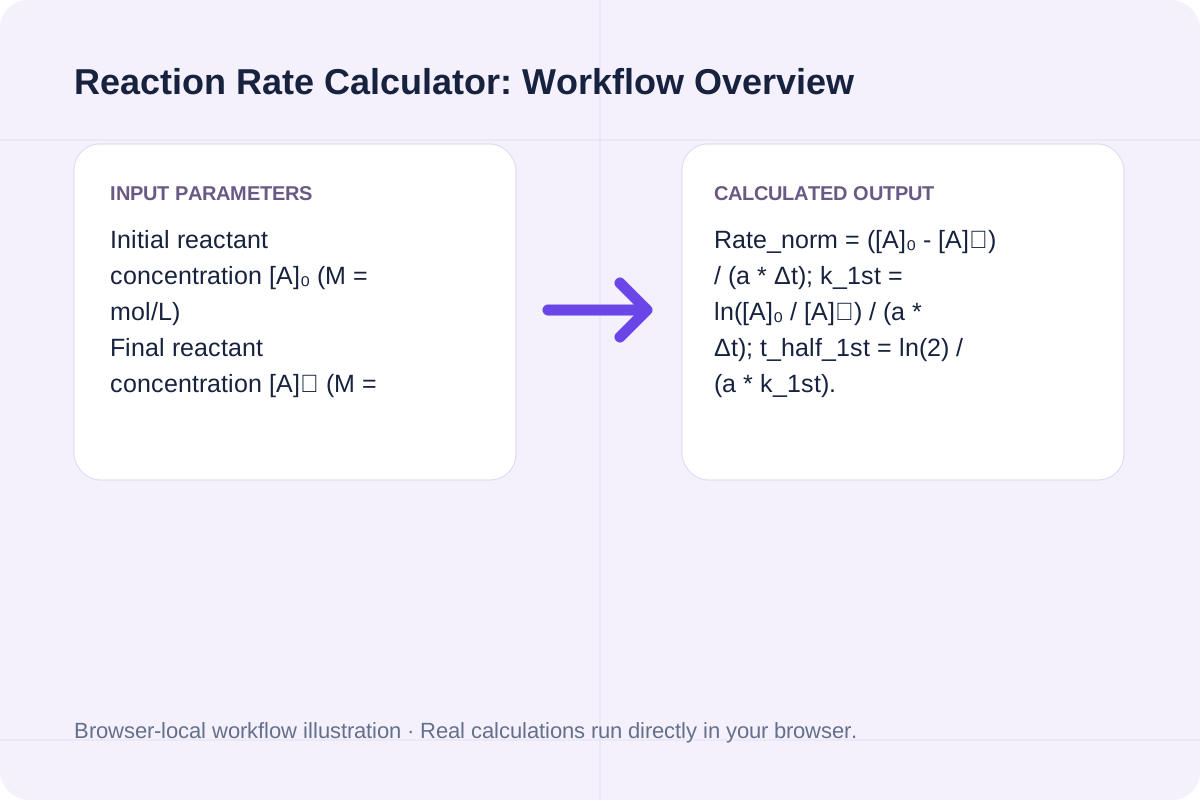
The calculator evaluates the concentration change `Δ[A] = [A]ₜ - [A]₀` over elapsed time `Δt`, normalizes by the balanced equation's stoichiometric coefficient `a`, and solves the integrated rate law for your chosen reaction order `n`.
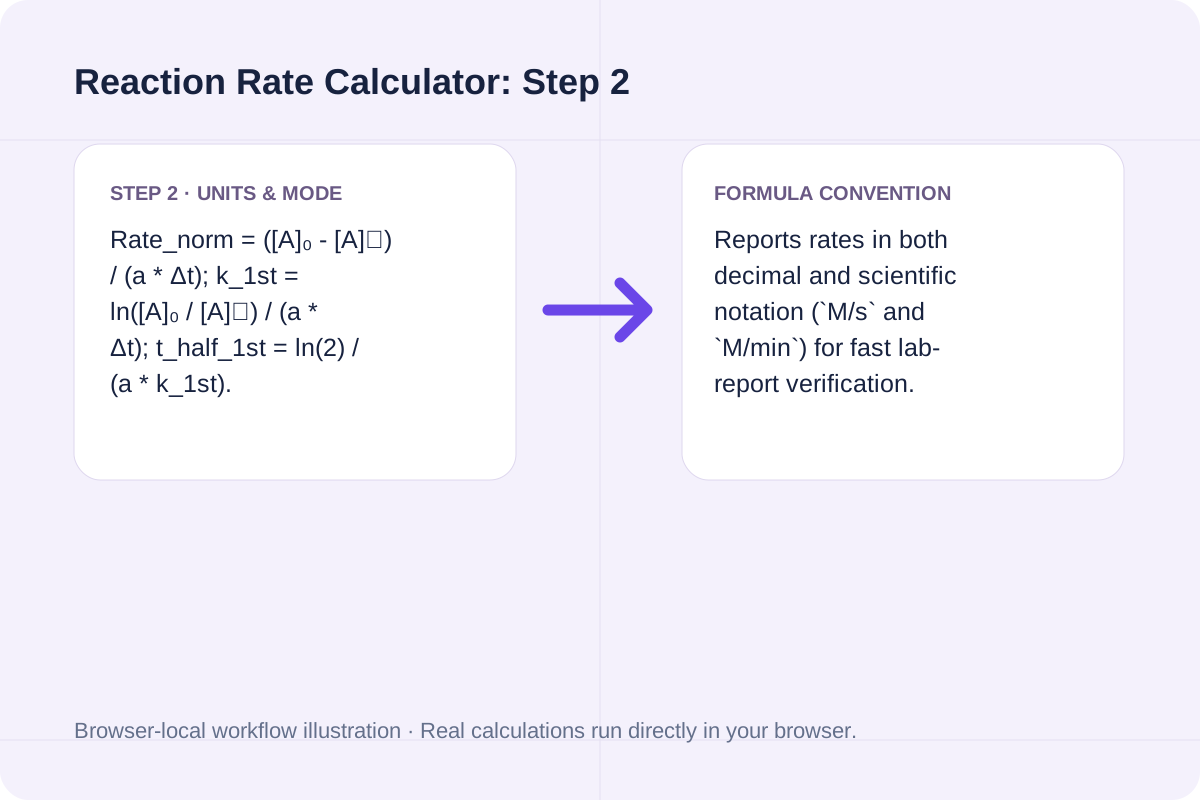
Rate_norm = ([A]₀ - [A]ₜ) / (a * Δt); k_1st = ln([A]₀ / [A]ₜ) / (a * Δt); t_half_1st = ln(2) / (a * k_1st).
Reports rates in both decimal and scientific notation (`M/s` and `M/min`) for fast lab-report verification.
Compare differential rate laws, integrated concentration equations, linear graph plots, and half-life formulas for 0th, 1st, and 2nd order reactions (`A -> Products`).
| Order (n) | Differential Rate Law | Integrated Rate Law | Units of k | Half-Life (t₁/₂) |
|---|---|---|---|---|
| Zero-Order (`n = 0`) | `Rate = k` | `[A]ₜ = [A]₀ - k·t` | `M·s⁻¹` (`mol·L⁻¹·s⁻¹`) | `[A]₀ / (2k)` |
| First-Order (`n = 1`) | `Rate = k[A]` | `ln([A]ₜ) = ln([A]₀) - k·t` | `s⁻¹` | `ln(2) / k ≈ 0.693 / k` |
| Second-Order (`n = 2`) | `Rate = k[A]²` | `1/[A]ₜ = 1/[A]₀ + k·t` | `M⁻¹·s⁻¹` (`L·mol⁻¹·s⁻¹`) | `1 / (k·[A]₀)` |
Solve kinetics homework and spectrophotometry lab data in three steps.
Supply the starting and ending concentrations in `mol/L` (`M`).
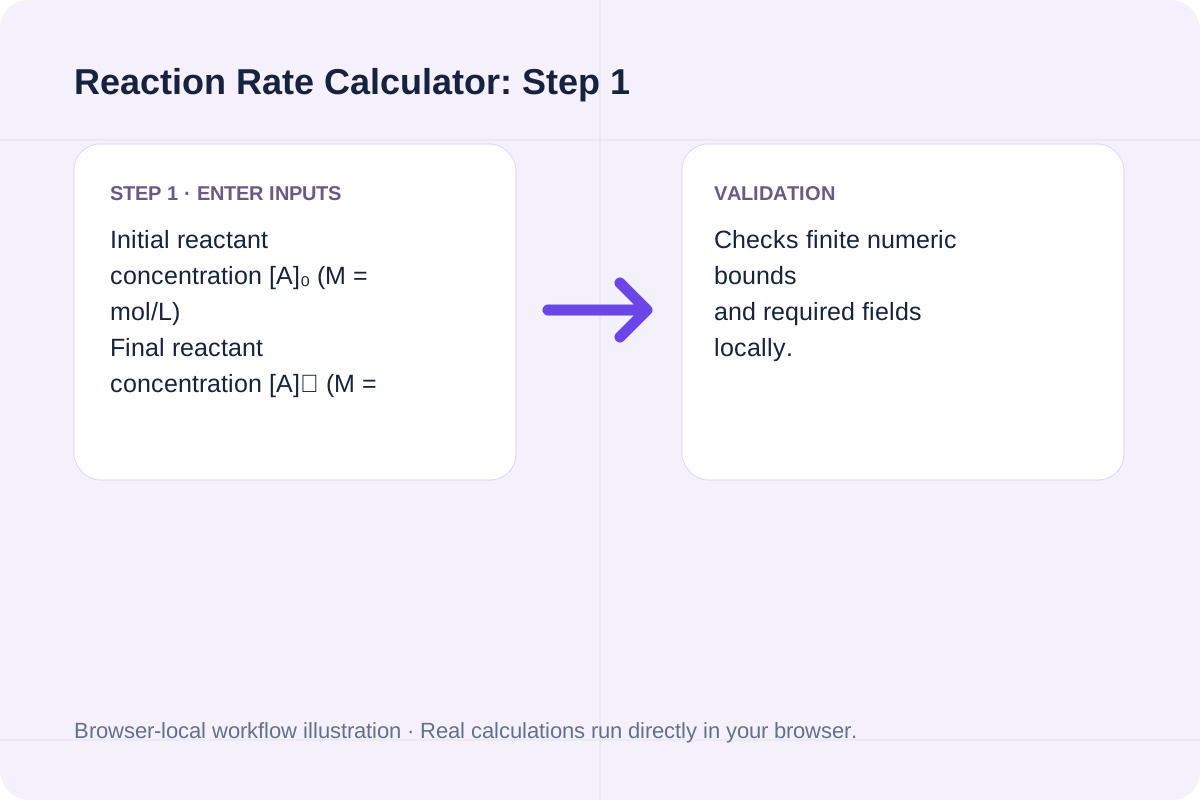
Enter the time interval `Δt` in seconds and the reactant's balancing coefficient `a` from `aA -> products`.
Click Calculate Reaction Rate to view the rate of disappearance, normalized reaction rate, integrated rate constant `k` with exact units, and half-life `t₁/₂`.
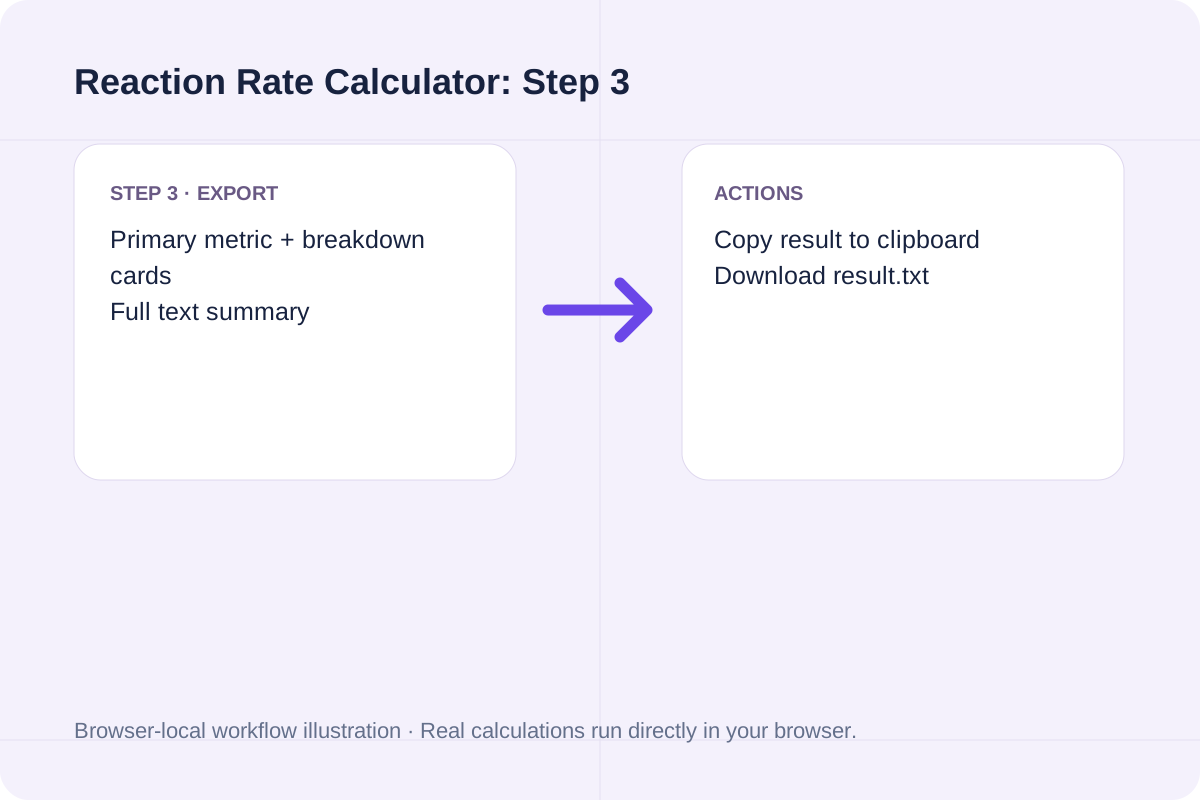
Compare baseline and alternative runs for Reaction Rate Calculator before exporting the result.
Calculate average chemical reaction rate, reactant consumption rate, apparent rate constant k, and half-life from initial and final molarity and Δt.
Rate_norm = ([A]₀ - [A]ₜ) / (a * Δt); k_1st = ln([A]₀ / [A]ₜ) / (a * Δt); t_half_1st = ln(2) / (a * k_1st).
Reports rates in both decimal and scientific notation (`M/s` and `M/min`) for fast lab-report verification.
Review the calculated output alongside your entered parameters and unit conventions.
Reports rates in both decimal and scientific notation (`M/s` and `M/min`) for fast lab-report verification.
Check the model scope and boundary conditions before applying the numbers to a real project.
Rate_norm = ([A]₀ - [A]ₜ) / (a * Δt); k_1st = ln([A]₀ / [A]ₜ) / (a * Δt); t_half_1st = ln(2) / (a * k_1st). Reports rates in both decimal and scientific notation (`M/s` and `M/min`) for fast lab-report verification.
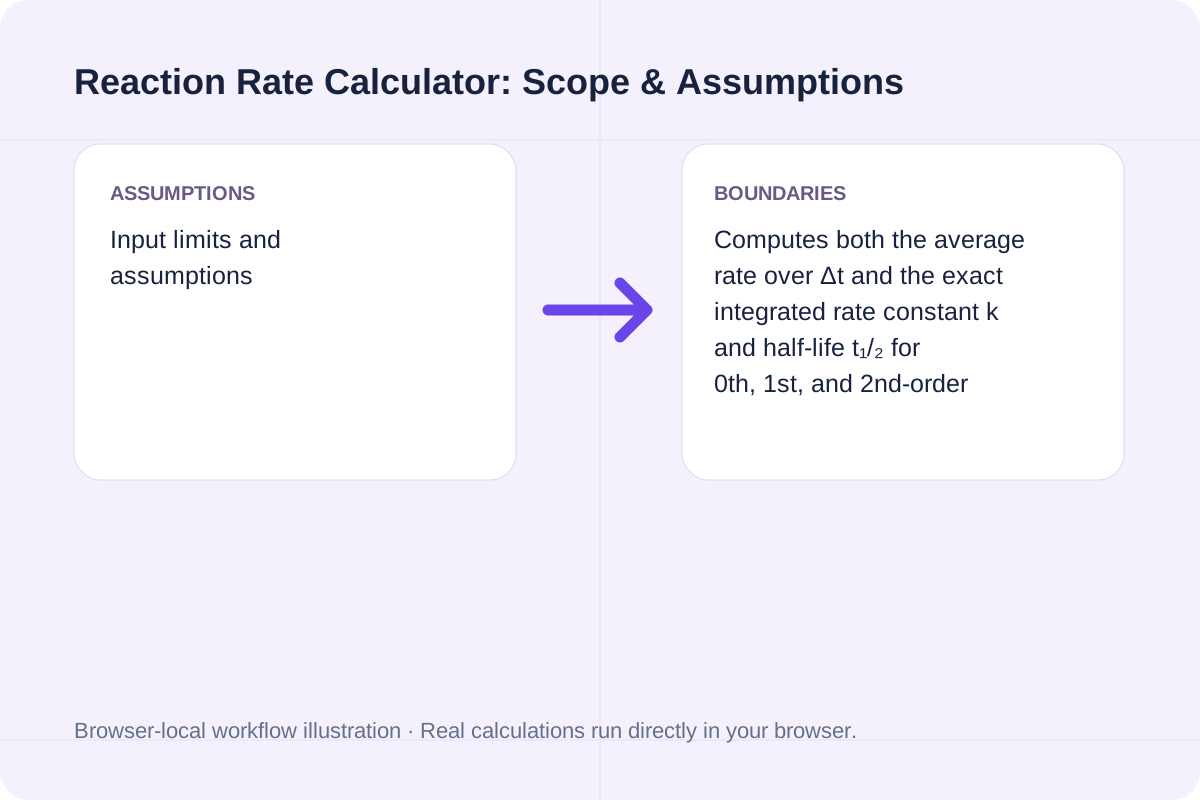
Determine reaction order (0th, 1st, or 2nd) from time-concentration data by linearizing [A], ln[A], and 1/[A] vs. time t, comparing R² and RMSE, and calculating rate constant k and half-life.
Open tool
Calculate CNC milling and turning Metal Removal Rate (MRR in cm³/min and in³/min), estimated spindle power (kW / HP), and chip load.
Open tool
Calculate bottleneck cycle time, Takt time margin, hourly and shift throughput, line balance efficiency, flow efficiency, and Little's Law WIP from workstation times.
Open toolChoose another tool for your next calculation, conversion, or text task.

Calculate room reverberation time (RT60) using Sabine (0.161 V / A) and Norris-Eyring formulas from room volume and surface absorption coefficients.
Open tool
Convert ring inner diameter (mm) or finger circumference (mm) to US/Canada, UK/Australia letter, EU/ISO, and Japanese ring sizes with wide-band sizing guidance.
Open tool
Calculate oligonucleotide primer melting temperature (Tm) using SantaLucia 1998 Nearest-Neighbor thermodynamics, Salt-Adjusted Marmur-Doty, and Wallace rules.
Open tool
Calculate hiking time from trail distance, elevation gain, elevation loss, base flat pace, and terrain difficulty using Naismith's Rule, Langmuir descent adjustments, and Tobler's function.
Open toolAnswers about using Reaction Rate Calculator and understanding its results.
For a balanced reaction aA + bB -> cC + dD, the unique normalized reaction rate is Rate = -(1/a)*(Δ[A]/Δt) = -(1/b)*(Δ[B]/Δt) = +(1/c)*(Δ[C]/Δt) = +(1/d)*(Δ[D]/Δt), expressed in M/s (mol·L⁻¹·s⁻¹). The negative sign for reactants ensures the overall reaction rate is always positive when reactants are consumed.
In a reaction like 2 N₂O₅ -> 4 NO₂ + O₂, NO₂ is produced four times as fast as O₂ and twice as fast as N₂O₅ disappears. Dividing each species' rate of change by its stoichiometric coefficient (1/2 for N₂O₅, 1/4 for NO₂, 1/1 for O₂) yields a single, unambiguous reaction rate regardless of which species is measured.
Because Reaction Rate always has units of M·s⁻¹ and Rate = k·[A]ⁿ, the units of k are M^(1-n)·s⁻¹: M·s⁻¹ (mol·L⁻¹·s⁻¹) for zero-order (n=0), s⁻¹ for first-order (n=1), and M⁻¹·s⁻¹ (L·mol⁻¹·s⁻¹) for second-order (n=2).
The average reaction rate is the secant slope -Δ[A]/Δt between two time points t₁ and t₂. Because reactant concentration drops over time, the instantaneous rate -d[A]/dt (the tangent slope at time t) starts higher than the average rate and decreases as the reaction proceeds (for n >= 1).
Choose another tool for your next calculation, conversion, or text task.