
Audio Latency Calculator
Estimate buffer duration and theoretical round-trip audio latency from supplied parameters.
Open toolCompute room reverberation time (`RT60`) in seconds from room volume (`m³`) and surface absorption coefficients (`alpha`): compare **Sabine** (`0.161 V / A`) and **Norris-Eyring** decay times, total metric Sabins, critical distance (`d_c`), and extra acoustic treatment needed.
Enter the inputs, then select Calculate RT60 Reverberation.
Result will appear here
Every time a sound wave strikes a wall, ceiling, or floor of area `S_i`, a fraction `alpha_i` of its acoustic energy is absorbed and `1 - alpha_i` is reflected back into the room.
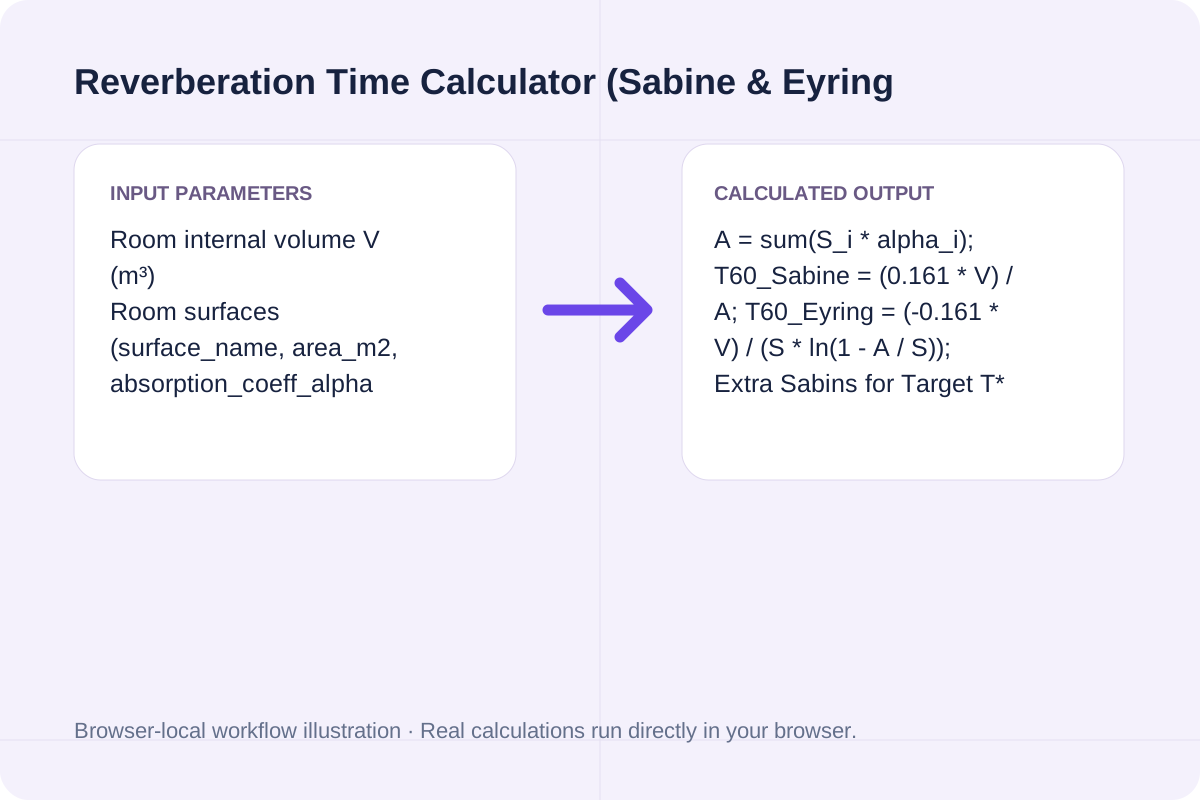
A = sum(S_i * alpha_i); T60_Sabine = (0.161 * V) / A; T60_Eyring = (-0.161 * V) / (S * ln(1 - A / S)); Extra Sabins for Target T* = (0.161 * V / T*) - A.
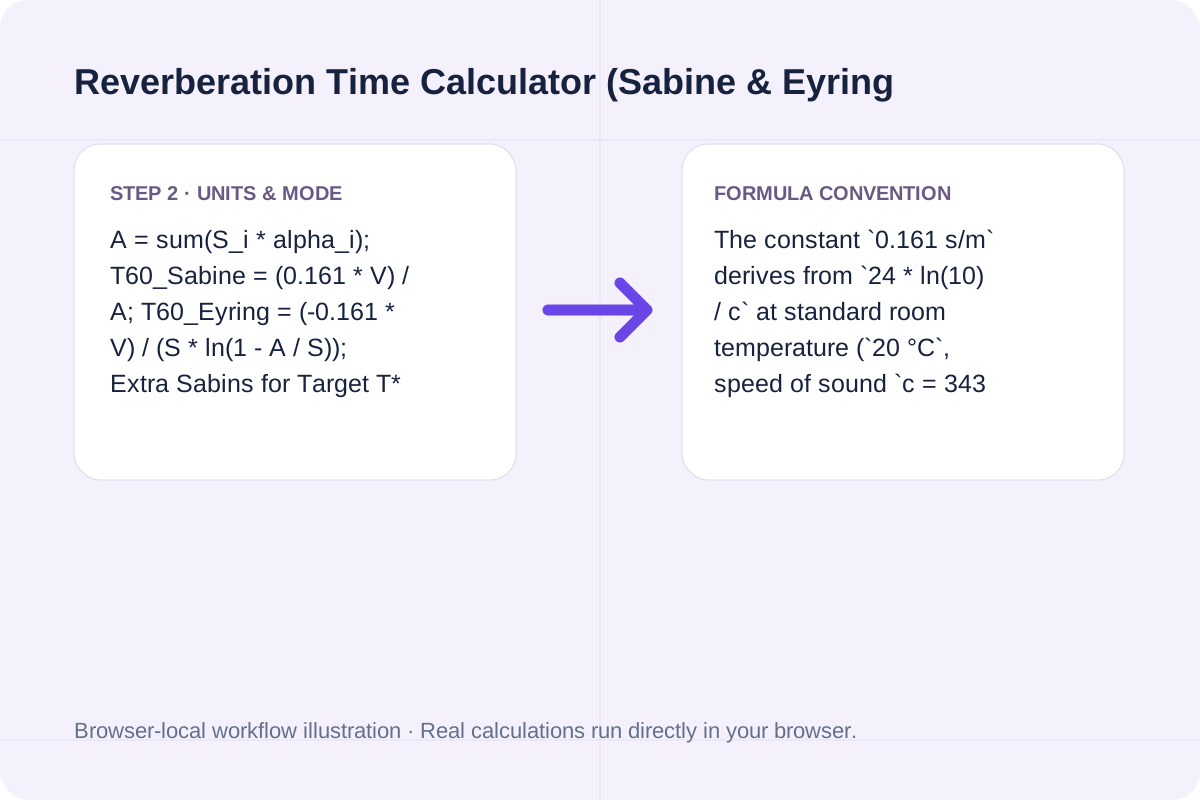
The constant `0.161 s/m` derives from `24 * ln(10) / c` at standard room temperature (`20 °C`, speed of sound `c = 343 m/s`).
Typical `500 Hz / 1 kHz` absorption coefficients (`alpha`) and exact breakdown for the default `180 m³` room (`198 m²` total boundary surface).
| Room Surface / Acoustic Metric | Area (S_i) & Alpha (α_i) | Absorption Area (A_i) | RT60 & Acoustic Interpretation |
|---|---|---|---|
| **Gypsum Board Walls** | `108.0 m²` × `α = 0.06` | `6.48 m² Sabins` | Reflective boundary (`94%` energy reflected) |
| **Smooth Concrete Floor** | `45.0 m²` × `α = 0.02` | `0.90 m² Sabins` | Hard floor surface (`98%` energy reflected) |
| **Acoustic Ceiling Tile** | `45.0 m²` × `α = 0.65` | `29.25 m² Sabins` | Provides `79.9%` of total room absorption |
| **Total Room (`V = 180 m³`)** | `S = 198.0 m²`, `ᾱ = 0.1850` | **`36.63 m² Sabins`** | **Sabine `0.79 s`** • **Eyring `0.72 s`** (`d_c = 0.86 m`) |
Measure your room volume and list its major boundary surfaces.
Multiply length × width × height in meters (for example, `7.5 m × 6.0 m × 4.0 m = 180 m³`).
Enter one row per surface (`name, area_m2, alpha`), such as drywall (`0.06`), glass windows (`0.10`), carpet (`0.25`), or 50 mm fiberglass acoustic panels (`0.85`).
Compare your Sabine and Eyring `RT60` values against the target range and check the exact additional `m² Sabins` required to reach the upper target limit.
See how adding broadband acoustic panels brings an echoey room into ANSI/ISO compliance.
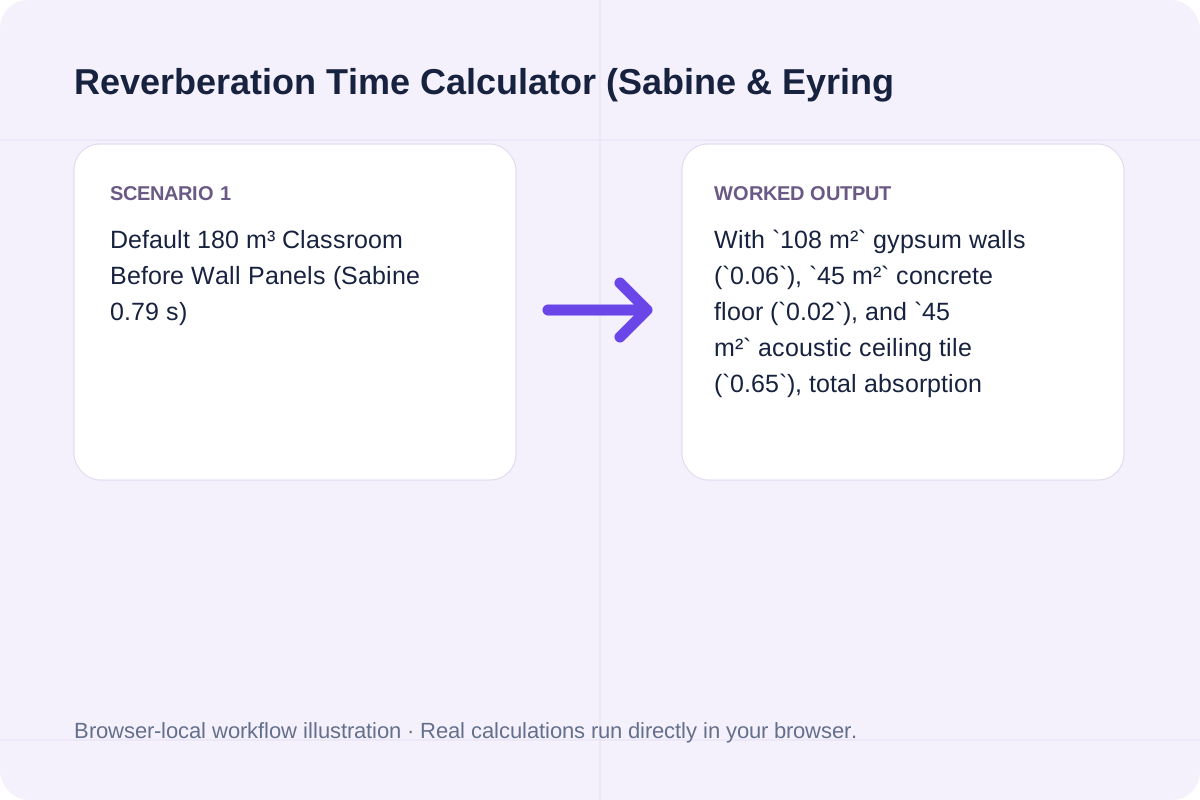
With `108 m²` gypsum walls (`0.06`), `45 m²` concrete floor (`0.02`), and `45 m²` acoustic ceiling tile (`0.65`), total absorption is `36.63 m² Sabins` (`Sabine RT60 = 0.79 s`, `Eyring RT60 = 0.72 s`). To reach the `0.60 s` ANSI classroom ceiling, the room needs `+11.67 m² Sabins` (about `14 m²` of `alpha = 0.85` wall panels).
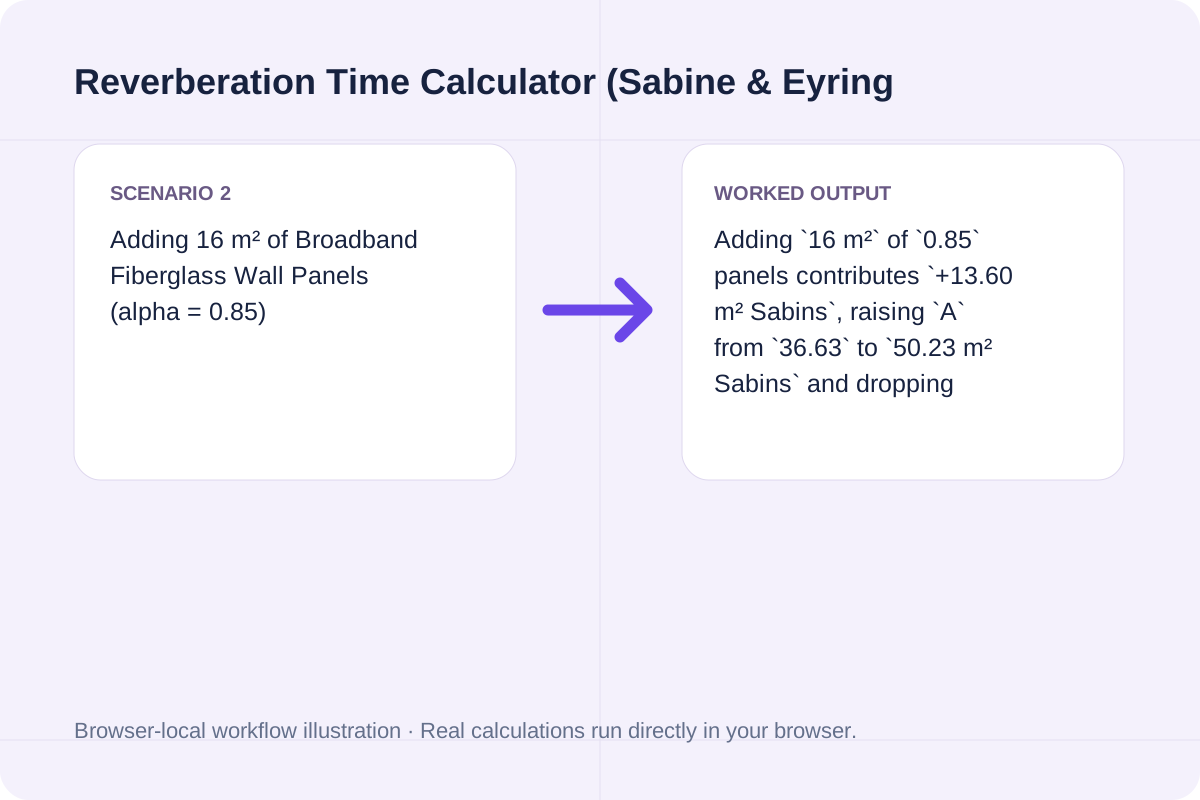
Adding `16 m²` of `0.85` panels contributes `+13.60 m² Sabins`, raising `A` from `36.63` to `50.23 m² Sabins` and dropping Sabine `RT60` to `0.58 s` (Eyring `0.51 s`), meeting ANSI S12.60.
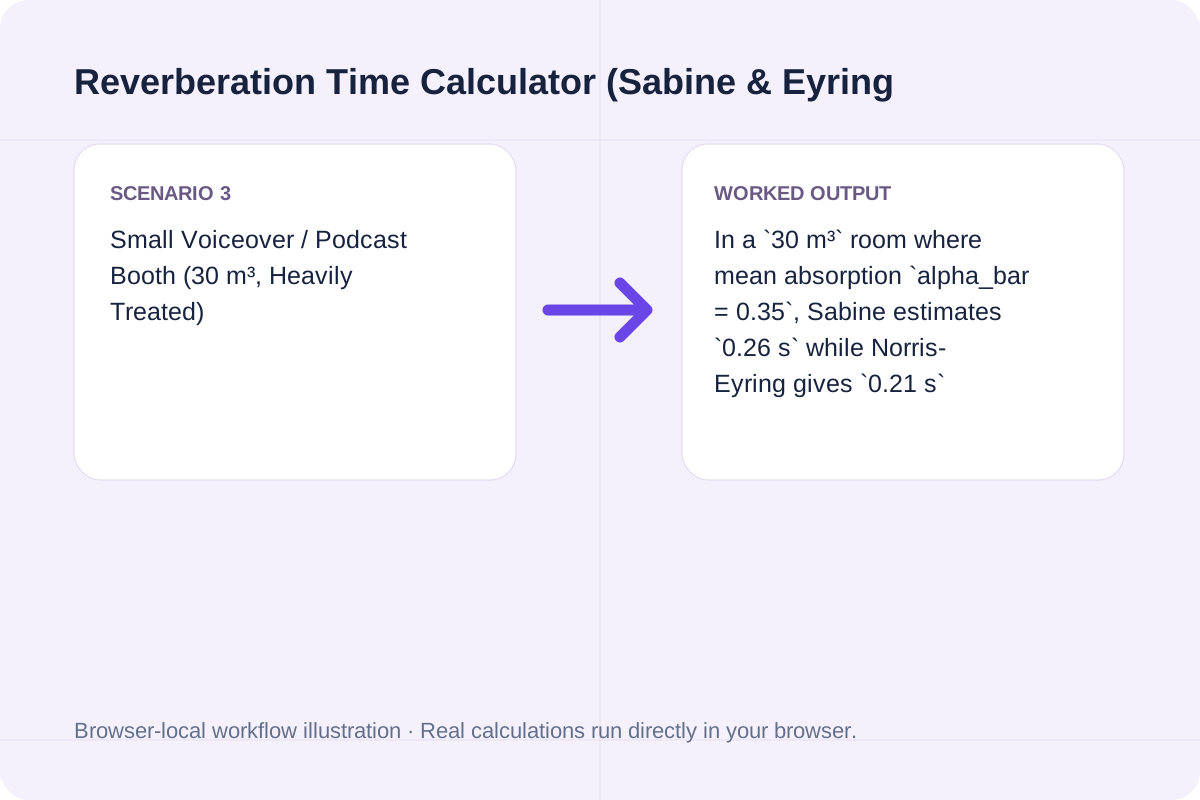
In a `30 m³` room where mean absorption `alpha_bar = 0.35`, Sabine estimates `0.26 s` while Norris-Eyring gives `0.21 s` because Eyring accounts for rapid discrete reflection loss.
Knowing both `RT60` and `Critical Distance (d_c)` tells you where to place microphones and acoustic absorbers.
In the default `180 m³` room (`Sabine RT60 = 0.79 s`), the omnidirectional critical distance is `d_c = 0.86 m` (`~1.5 m` for a directional cardioid microphone or human voice). Listeners seated beyond `1.5 m` hear more room reflection than direct voice energy unless absorption `A` is increased.
If you are also configuring digital audio interfaces for a studio, pair your acoustic decay check with our Audio Latency Calculator (/tools/audiolatencycalculator) to keep round-trip monitoring below 10 ms.
Sabine and Eyring equations assume an approximately diffuse sound field.
A = sum(S_i * alpha_i); T60_Sabine = (0.161 * V) / A; T60_Eyring = (-0.161 * V) / (S * ln(1 - A / S)); Extra Sabins for Target T* = (0.161 * V / T*) - A. The constant `0.161 s/m` derives from `24 * ln(10) / c` at standard room temperature (`20 °C`, speed of sound `c = 343 m/s`).
Estimate buffer duration and theoretical round-trip audio latency from supplied parameters.
Open tool
Calculate aquarium water volume in US gallons and liters, substrate displacement, and filled water weight from interior tank dimensions.
Open tool
Calculate carpet needed in square feet, square yards, and square meters, linear roll length, and cost from room dimensions and waste %.
Open toolChoose another tool for your next calculation, conversion, or text task.

Convert ring inner diameter (mm) or finger circumference (mm) to US/Canada, UK/Australia letter, EU/ISO, and Japanese ring sizes with wide-band sizing guidance.
Open tool
Compute signed tetrahedral volume, surface area, bounding box dimensions, watertight edge warnings, and estimated 3D printing part weight from ASCII STL mesh geometry.
Open tool
Calculate bottleneck cycle time, Takt time margin, hourly and shift throughput, line balance efficiency, flow efficiency, and Little's Law WIP from workstation times.
Open tool
Calculate hiking time from trail distance, elevation gain, elevation loss, base flat pace, and terrain difficulty using Naismith's Rule, Langmuir descent adjustments, and Tobler's function.
Open toolAnswers about using Reverberation Time Calculator (Sabine & Eyring RT60 Acoustic Formula) and understanding its results.
RT60 is the time in seconds required for the sound pressure level in an enclosed room to decay by 60 decibels (to one-millionth of its initial acoustic energy) after a sound source stops. Wallace Clement Sabine's formula calculates RT60 as T_60 = 0.161 * V / A, where V is room volume in cubic meters and A = sum(S_i * alpha_i) is the total equivalent absorption area in metric Sabins (m²).
Sabine's equation assumes a continuous, low-absorption sound field and over-predicts reverberation time in heavily treated rooms (In fact, as alpha approaches 1.0, Sabine fails to reach 0 seconds). The Norris-Eyring equation replaces alpha_bar with -ln(1 - alpha_bar), correctly approaching T_60 = 0 in an anechoic chamber (alpha_bar -> 1). Whenever mean absorption alpha_bar exceeds 0.20, acoustic engineers prefer Eyring RT60.
ANSI/ASA S12.60 recommends RT60 <= 0.60 seconds for core learning classrooms and conference rooms so consonant sounds do not blur across syllables. Podcast, voiceover, and mixing studios target 0.25 to 0.40 seconds, whereas concert halls target 1.40 to 2.00 seconds for musical envelopment.
Critical distance d_c = 0.057 * sqrt(Q * V / RT60) is the distance from a speaker where the direct sound level equals the reflected reverberant field level. Sitting closer than d_c ensures high speech clarity; beyond d_c, room reflections dominate.
Choose another tool for your next calculation, conversion, or text task.