

Aquarium Substrate Calculator
Estimate uniform aquarium-substrate volume and mass from tank-bottom dimensions.
Open toolEnter your tank's interior length, width, water fill height, and hardscape displacement in the Aquarium Volume Calculator below to find gross and net water capacity in US gallons and liters plus filled water weight.
Enter the inputs, then select Calculate Tank Volume.
Result will appear here
The Aquarium Volume Calculator computes interior cubic volume for rectangular, cylindrical, or bowfront tanks, converts cubic inches (divided by 231) or cubic centimeters (divided by 1,000) into gallons and liters, and deducts your substrate displacement percentage.
Gross US Gal = (L_in * W_in * H_in) / 231; Net Water = Gross * (1 - Displacement% / 100); Water Weight = Net Liters * 1.0 kg.
Also outputs surface area (L * W) for gas-exchange assessment and recommended weekly 25% water change volume.
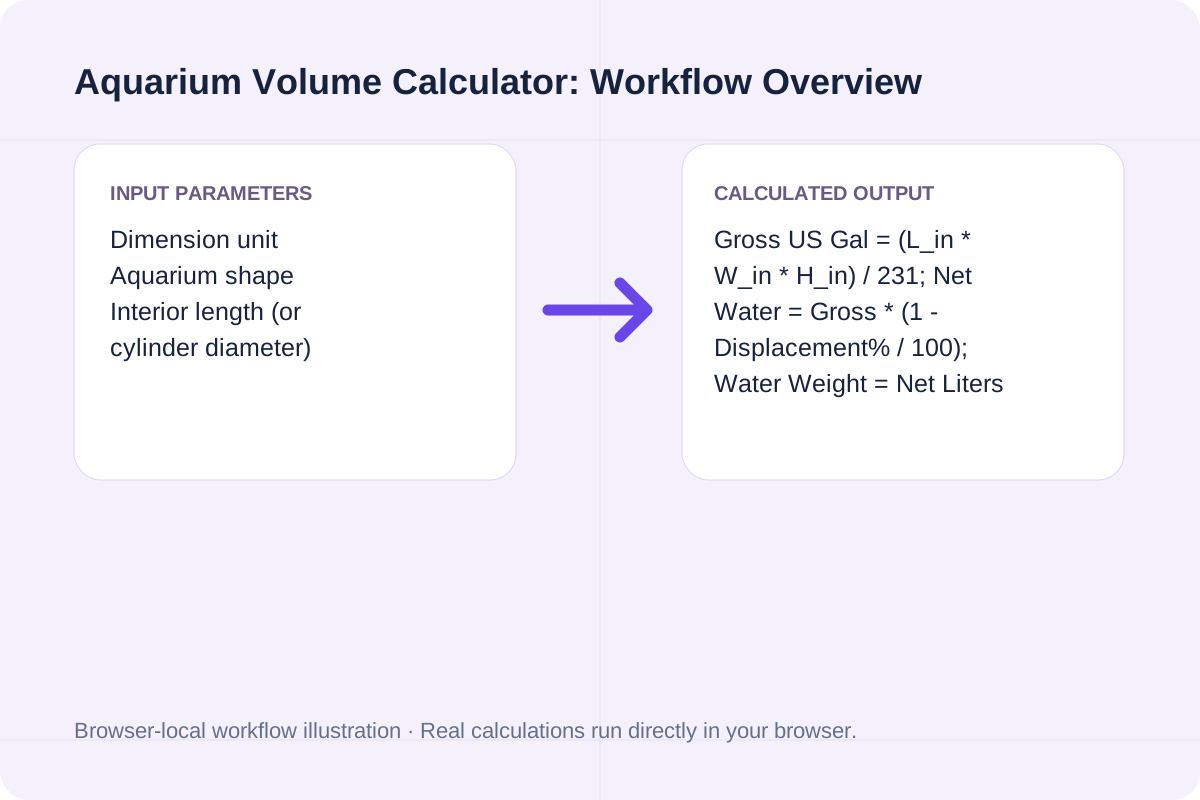
Review the input parameters, allowed value ranges, and worked reference cases for the Aquarium Volume Calculator below before running your calculation.
| Parameter / Scenario | Default / Sample Value | Rule or Allowed Range | Output / Usage Note |
|---|---|---|---|
| Input: Dimension unit | in | Options: Inches (in), Centimeters (cm) | Required workspace parameter |
| Input: Aquarium shape | rectangular | Options: Rectangular / Cube, Cylinder (Length = Diameter), Bowfront (Width = Side Width, +25% center bow) | Required workspace parameter |
| Input: Interior length (or cylinder diameter) | 48 | Range: 1 to 1000 | Required workspace parameter |
| Input: Interior width (front to back) | 18 | Range: 1 to 1000 | Required workspace parameter |
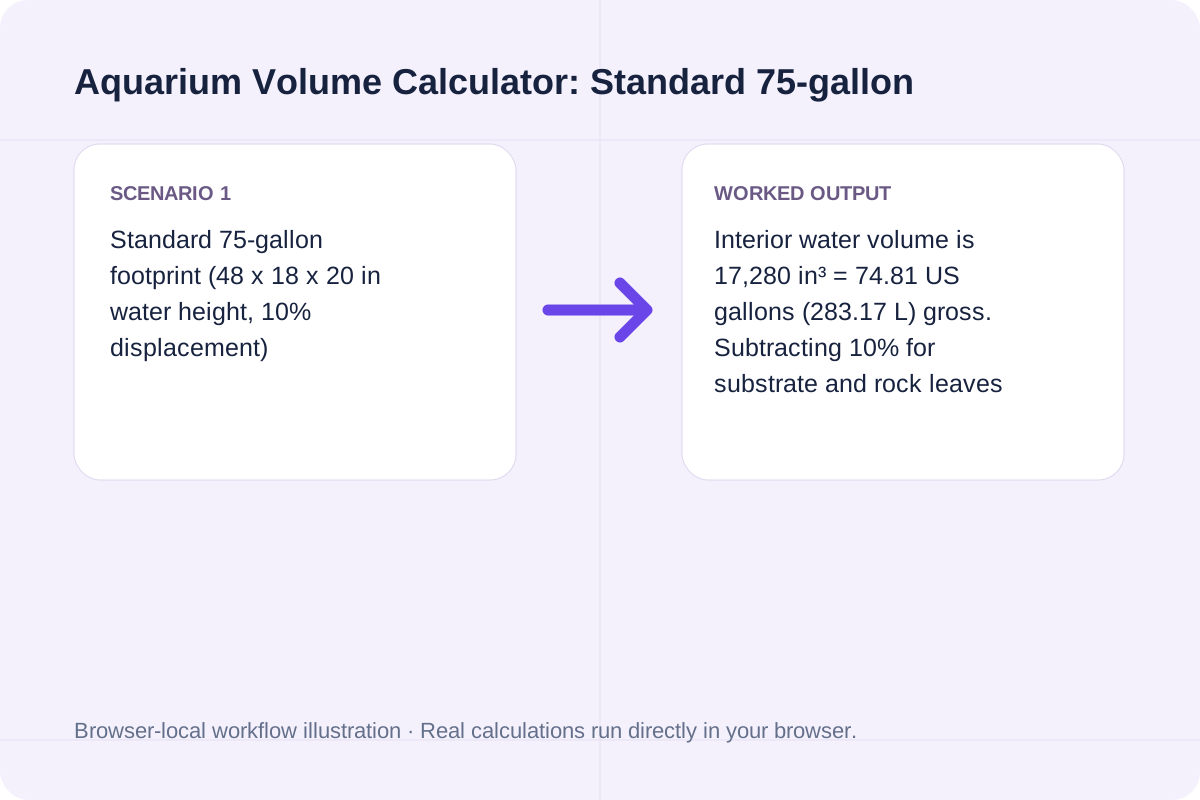
| Worked Case 1: Standard 75-gallon footprint (48 x 18 x 20 in water height, 10% displacement) | Preloaded / test values | Rectangular Volume = L * W * H; US Gallons = Cubic Inches / 231; Liters = Cubic Centimeters / 1000; Net Volume = Gross Volume * (1 - Displacement% / 100) | Interior water volume is 17,280 in³ = 74.81 US gallons (283.17 L) gross. Subtracting 10% for substrate and rock leaves 67.32 US gallons (254.85 L) of net water weighing 561.8 lb (254.9 kg). |
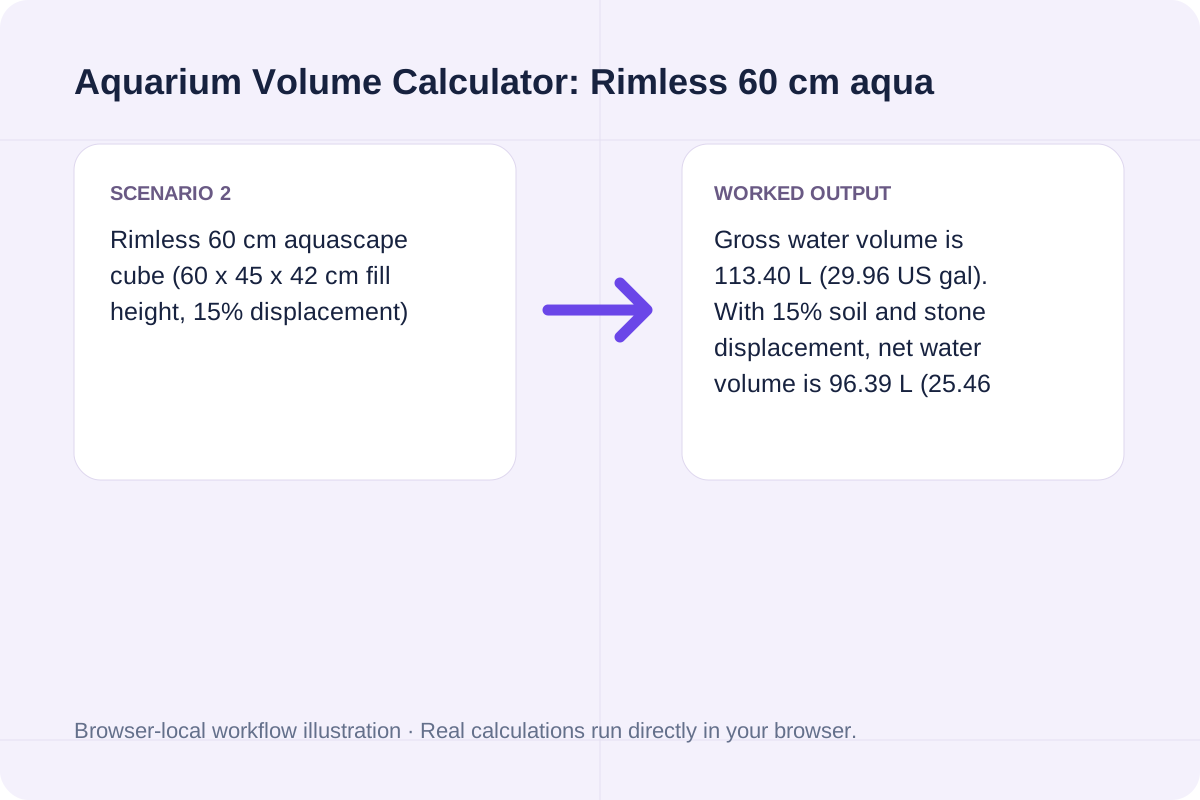
| Worked Case 2: Rimless 60 cm aquascape cube (60 x 45 x 42 cm fill height, 15% displacement) | Preloaded / test values | Rectangular Volume = L * W * H; US Gallons = Cubic Inches / 231; Liters = Cubic Centimeters / 1000; Net Volume = Gross Volume * (1 - Displacement% / 100) | Gross water volume is 113.40 L (29.96 US gal). With 15% soil and stone displacement, net water volume is 96.39 L (25.46 US gal), requiring a 24.10 L weekly 25% water change. |
Use a tape measure on the inside of the glass (or subtract twice the glass thickness from outer measurements) before running the calculation.
Choose Inches or Centimeters and select Rectangular, Cylinder, or Bowfront geometry.
Input the inside length, front-to-back width, and actual water column height from bottom glass to the waterline.
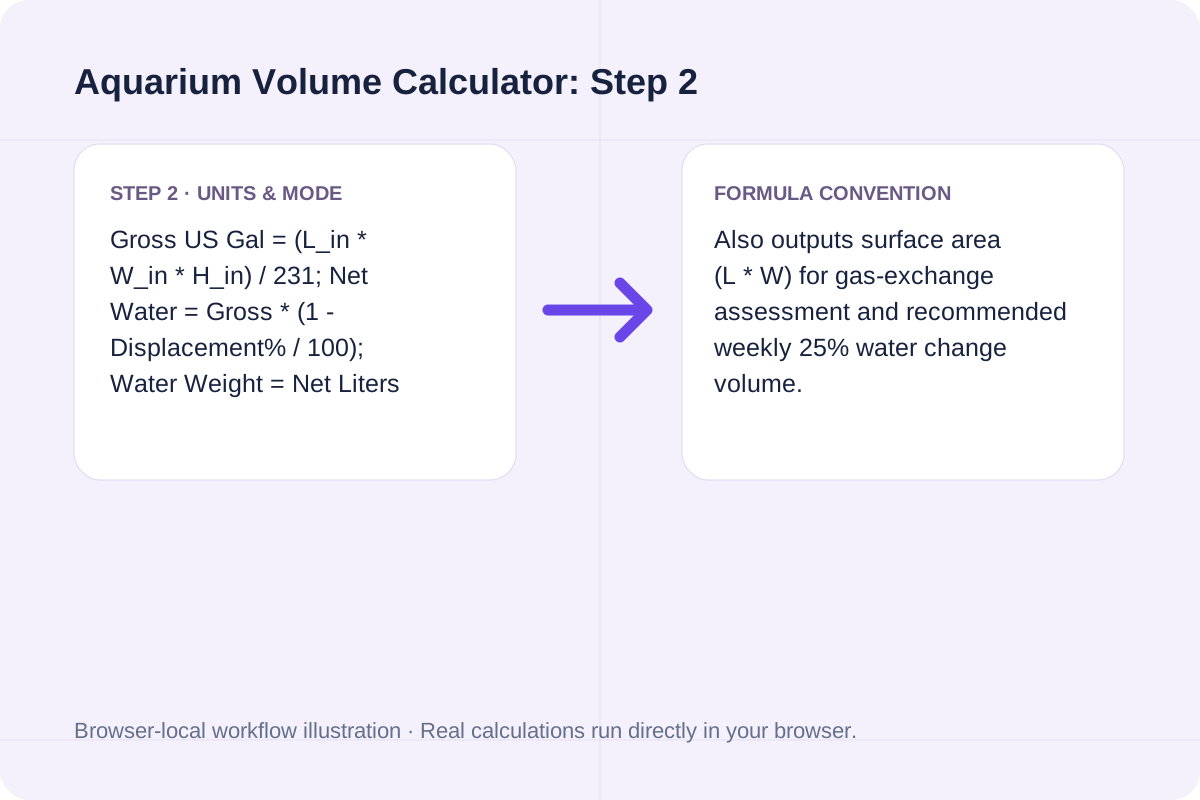
Enter a displacement percentage (typically 10% for planted gravel tanks or 20% for heavy reef rock) and click Calculate Tank Volume.
Compare a standard 48-inch tank against a rimless cube to see net dosing volume.
Interior water volume is 17,280 in³ = 74.81 US gallons (283.17 L) gross. Subtracting 10% for substrate and rock leaves 67.32 US gallons (254.85 L) of net water weighing 561.8 lb (254.9 kg).
Gross water volume is 113.40 L (29.96 US gal). With 15% soil and stone displacement, net water volume is 96.39 L (25.46 US gal), requiring a 24.10 L weekly 25% water change.
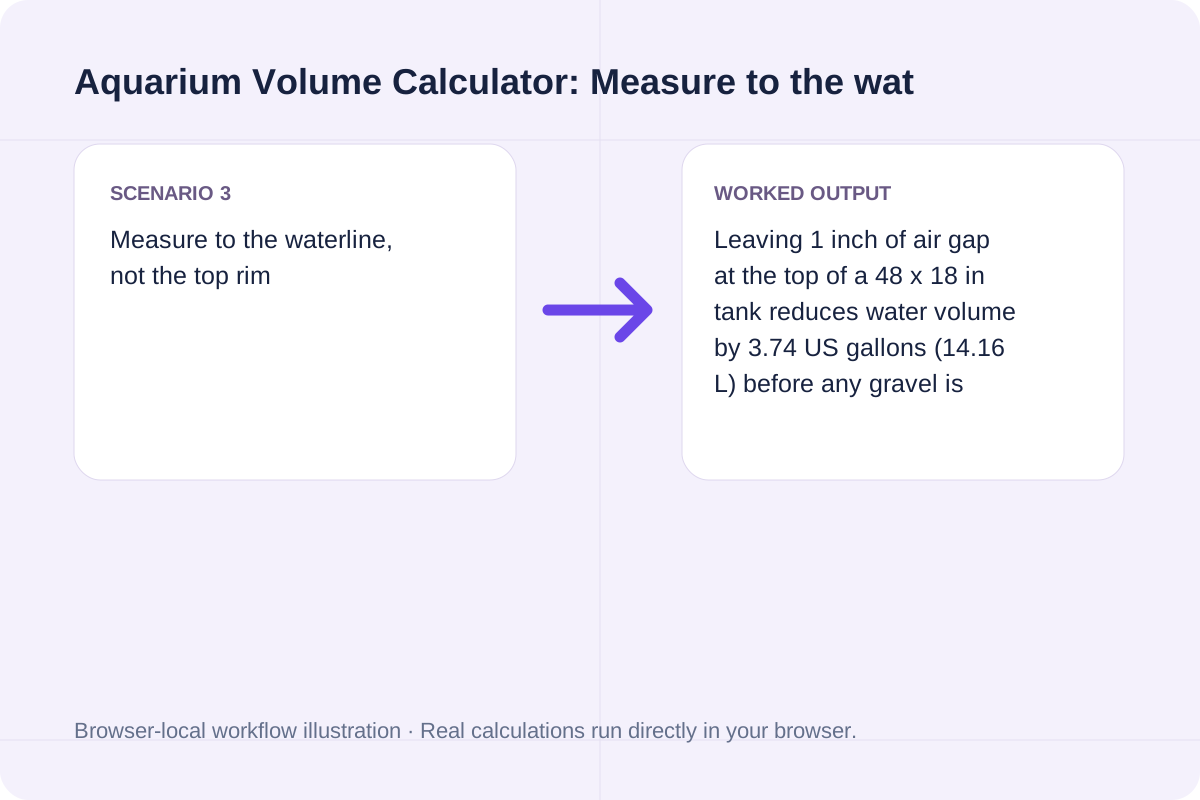
Leaving 1 inch of air gap at the top of a 48 x 18 in tank reduces water volume by 3.74 US gallons (14.16 L) before any gravel is added.
Use Net Water Volume for chemical dosing and Gross + Hardscape weight for floor load checks.
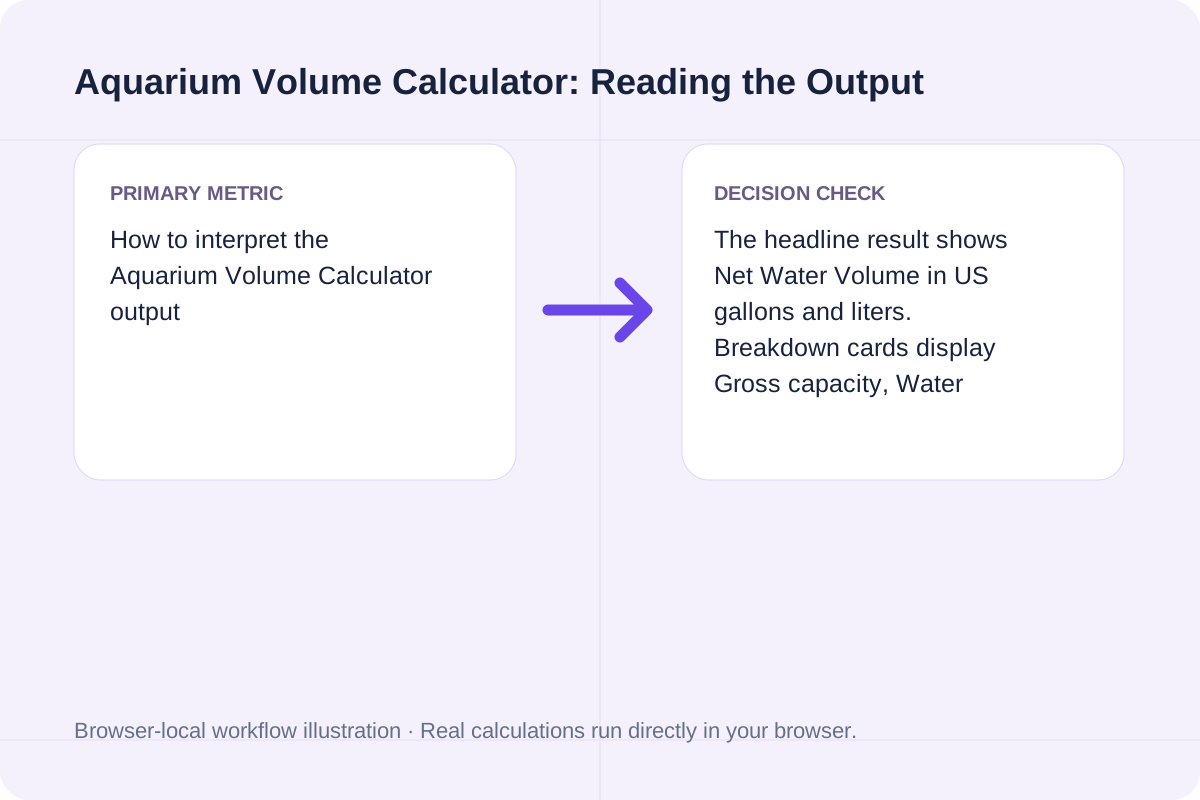
The headline result shows Net Water Volume in US gallons and liters. Breakdown cards display Gross capacity, Water weight (freshwater at 8.345 lb/gal), 25% water change volume, and Top water surface area.
Keep saltwater density and glass weight in mind when estimating structural load.
Water weight figures reflect only the net liquid water at 1.00 kg/L (8.345 lb/gal). Marine saltwater at 1.025 specific gravity weighs ~2.5% more, and the empty glass tank plus wet sand or rock typically adds 20% to 35% on top of the water weight.
Estimate uniform aquarium-substrate volume and mass from tank-bottom dimensions.
Open tool
Calculate how much water to add and total final volume when diluting spirits or alcohol from initial ABV to target ABV.
Open tool
Calculate dry candle wax weight and fragrance oil weight in ounces and grams from jar water weight, wax specific gravity, and fragrance load %.
Open toolChoose another tool for your next calculation, conversion, or text task.

Multiply the input by the source unit factor and divide by the destination factor.
Open tool
Calculate package and shipment volume in cubic meters (CBM) and cubic feet, plus sea/air volumetric weight and standard container fit.
Open tool
Compute shipment volume in cubic feet and cubic meters, freight density in PCF (lb/ft³), and reference NMFC density freight class from pallet dimensions and weight.
Open tool
Calculate bias strip cut width, continuous bias fabric square dimensions, and bolt yardage for single-fold or double-fold bias tape.
Open toolAnswers about using Aquarium Volume Calculator and understanding its results.
Manufacturers label aquariums using exterior dimensions including glass thickness, plastic trim, and full rim height. Subtracting glass thickness, 1 inch of top headspace, and 10% substrate displacement typically leaves 80% to 85% of the nominal label volume.
One US liquid gallon equals exactly 231 cubic inches (3.785411784 liters). Dividing interior L * W * H in inches by 231 gives gross capacity in US gallons.
Freshwater at room temperature weighs approximately 8.345 pounds per US gallon (1.00 kilogram per liter), not counting the weight of the glass tank itself, stand, gravel, or rock.
Use net water volume (after subtracting substrate, rockwork, and headspace) so you do not overdose sensitive fish or invertebrates.
Choose another tool for your next calculation, conversion, or text task.