

CBM Calculator
Calculate package and shipment volume in cubic meters (CBM) and cubic feet, plus sea/air volumetric weight and standard container fit.
Open toolEnter your pallet or crate length, width, total loaded height, gross weight, and unit count below to calculate shipping density in lb/ft³ (PCF), total cubic feet, and estimated NMFC density freight class.
Enter the inputs, then select Calculate shipping density.
Result will appear here
The Shipping Density Calculator converts your handling unit dimensions into cubic feet, totals gross weight in pounds, divides weight by volume to find PCF, and maps the density to the standard 11-tier NMFC density scale.
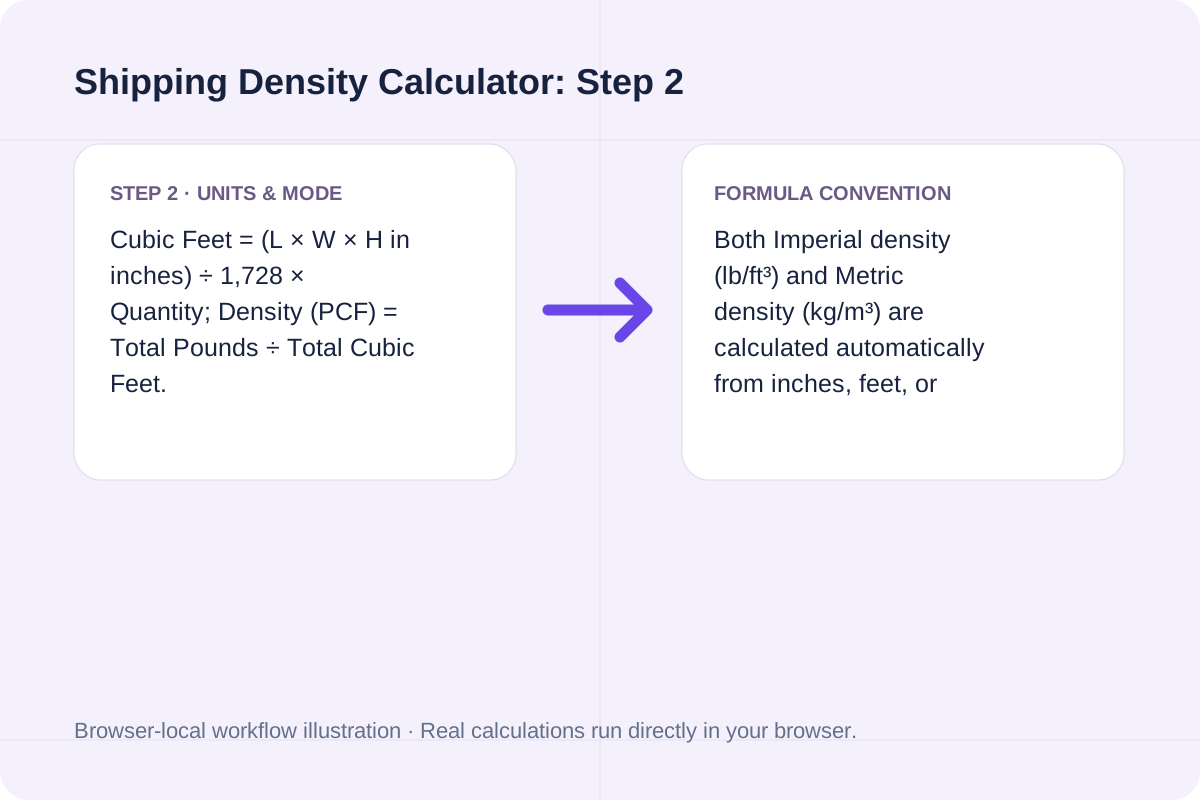
Cubic Feet = (L × W × H in inches) ÷ 1,728 × Quantity; Density (PCF) = Total Pounds ÷ Total Cubic Feet.
Both Imperial density (lb/ft³) and Metric density (kg/m³) are calculated automatically from inches, feet, or centimeters.
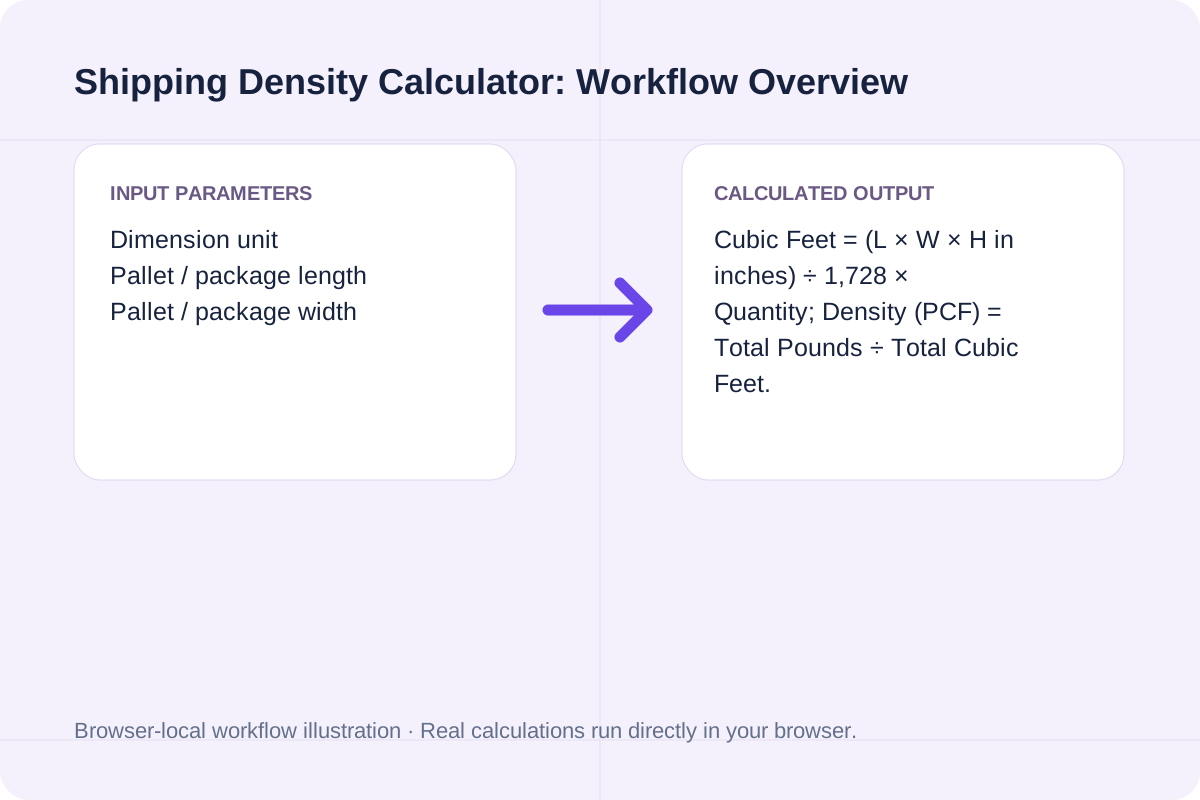
Review the input parameters, allowed value ranges, and worked reference cases for the Shipping Density Calculator below before running your calculation.
| Parameter / Scenario | Default / Sample Value | Rule or Allowed Range | Output / Usage Note |
|---|---|---|---|
| Input: Dimension unit | in | Options: Inches (in), Feet (ft), Centimeters (cm) | Required workspace parameter |
| Input: Pallet / package length | 48 | Range: 0.1 to 10000 | Required workspace parameter |
| Input: Pallet / package width | 40 | Range: 0.1 to 10000 | Required workspace parameter |
| Input: Total loaded height | 60 | Range: 0.1 to 10000 | Required workspace parameter |
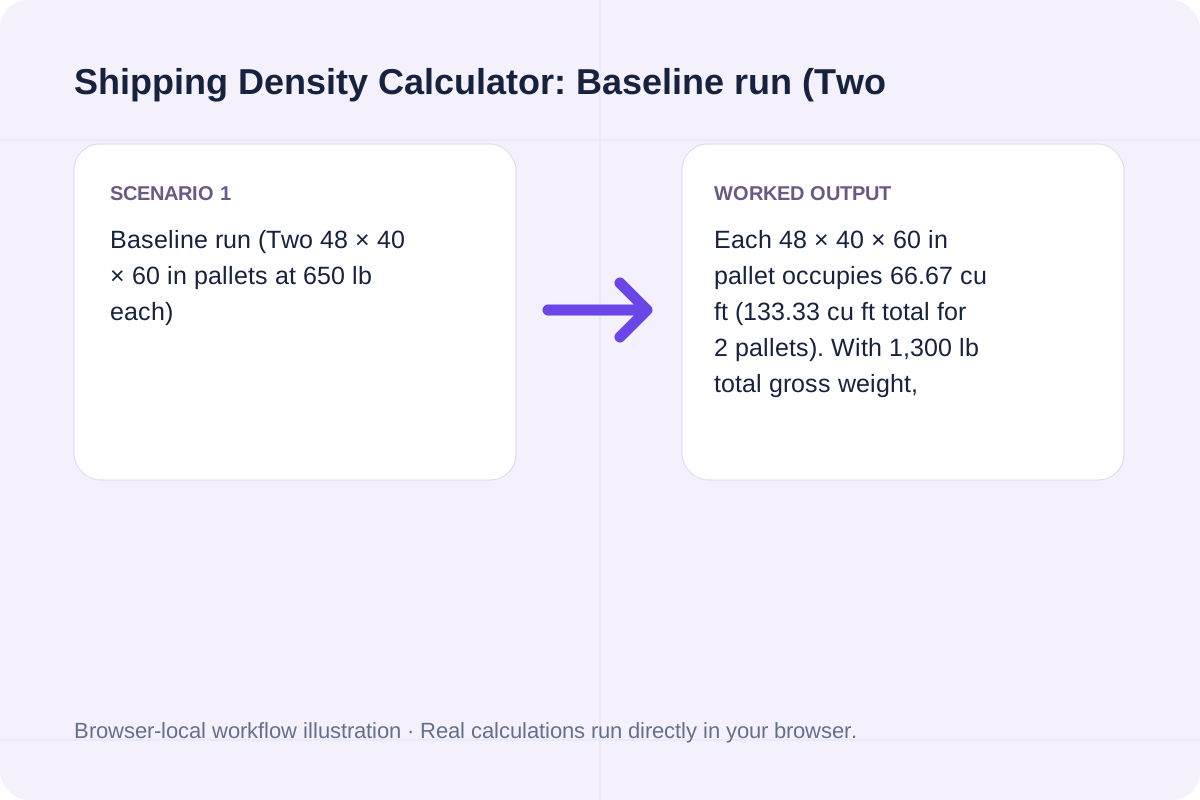
| Worked Case 1: Baseline run (Two 48 × 40 × 60 in pallets at 650 lb each) | Preloaded / test values | Volume per unit (ft³) = (L_in × W_in × H_in) ÷ 1,728; Shipping Density (PCF) = Total Weight (lb) ÷ Total Volume (ft³) | Each 48 × 40 × 60 in pallet occupies 66.67 cu ft (133.33 cu ft total for 2 pallets). With 1,300 lb total gross weight, shipping density is 9.75 lb/ft³ (156.18 kg/m³), which falls into the 9 to < 10.5 PCF bracket (Reference Class 100). |
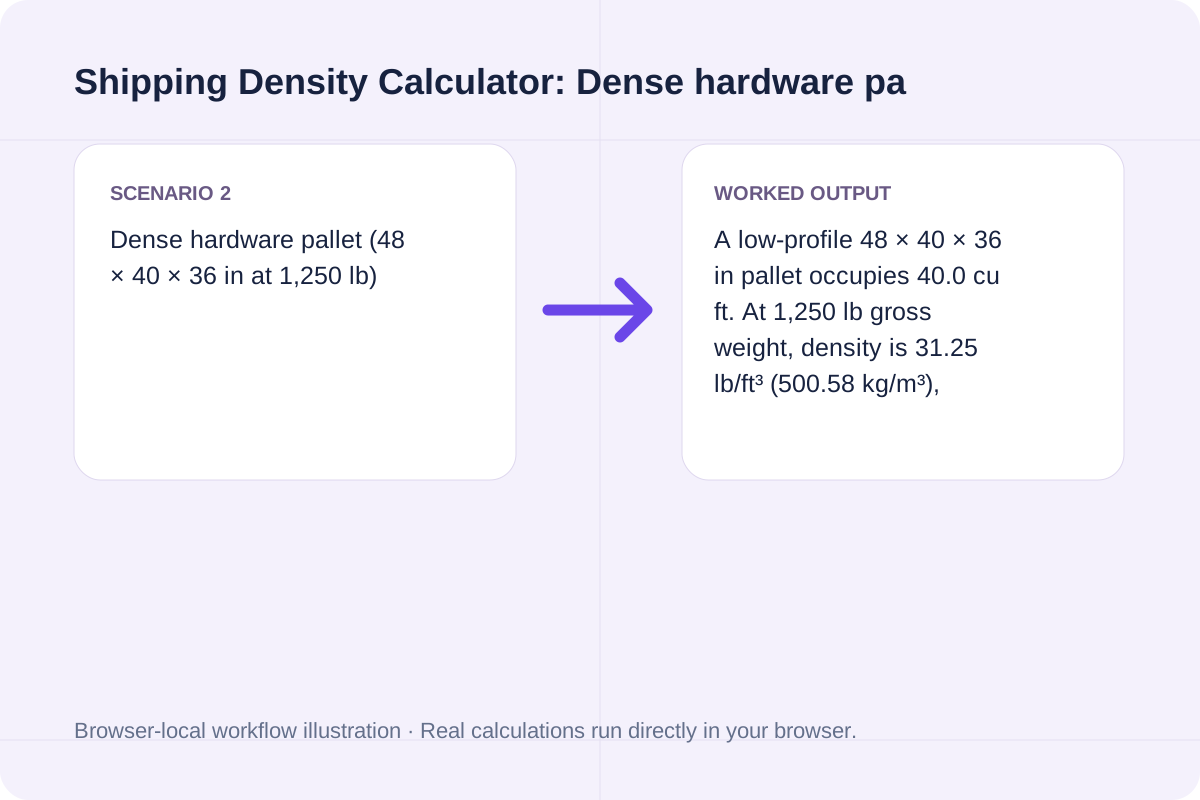
| Worked Case 2: Dense hardware pallet (48 × 40 × 36 in at 1,250 lb) | Preloaded / test values | Volume per unit (ft³) = (L_in × W_in × H_in) ÷ 1,728; Shipping Density (PCF) = Total Weight (lb) ÷ Total Volume (ft³) | A low-profile 48 × 40 × 36 in pallet occupies 40.0 cu ft. At 1,250 lb gross weight, density is 31.25 lb/ft³ (500.58 kg/m³), placing it in the ≥ 30 PCF bracket (Reference Class 60). |
Measure your stretch-wrapped pallet from the warehouse floor to its highest point and weigh the complete handling unit.
Select inches, feet, or centimeters and enter the longest length, widest width (including any carton overhang), and floor-to-top height.
Choose pounds or kilograms, enter the gross weight of one loaded pallet (cargo plus pallet tare), and set the number of identical pallets.
Select Calculate shipping density to view PCF, kg/m³, total cubic feet, and the corresponding density-based freight class.
Compare a standard 650 lb pallet load against a dense machinery crate.
Each 48 × 40 × 60 in pallet occupies 66.67 cu ft (133.33 cu ft total for 2 pallets). With 1,300 lb total gross weight, shipping density is 9.75 lb/ft³ (156.18 kg/m³), which falls into the 9 to < 10.5 PCF bracket (Reference Class 100).
A low-profile 48 × 40 × 36 in pallet occupies 40.0 cu ft. At 1,250 lb gross weight, density is 31.25 lb/ft³ (500.58 kg/m³), placing it in the ≥ 30 PCF bracket (Reference Class 60).
If you mark a pallet 'Do Not Stack' or use a cone on top, many LTL carriers calculate cubed density using a 96-inch vertical height instead of your actual load height. Test 96 in as the height to see your worst-case re-class risk.
Check how close your PCF is to the next NMFC density threshold before wrapping the pallet.
LTL dimensioners measure pallets to the nearest tenth of an inch. If your shipment sits at 9.95 PCF (just shy of the 10.5 PCF cutoff for Class 92.5), restacking the top layer to lower pallet height by 4 inches can push density over 10.5 PCF and prevent a costly carrier re-classification fee.
Verify commodity-specific NMFC items and carrier cubic capacity rules before tendering LTL freight.
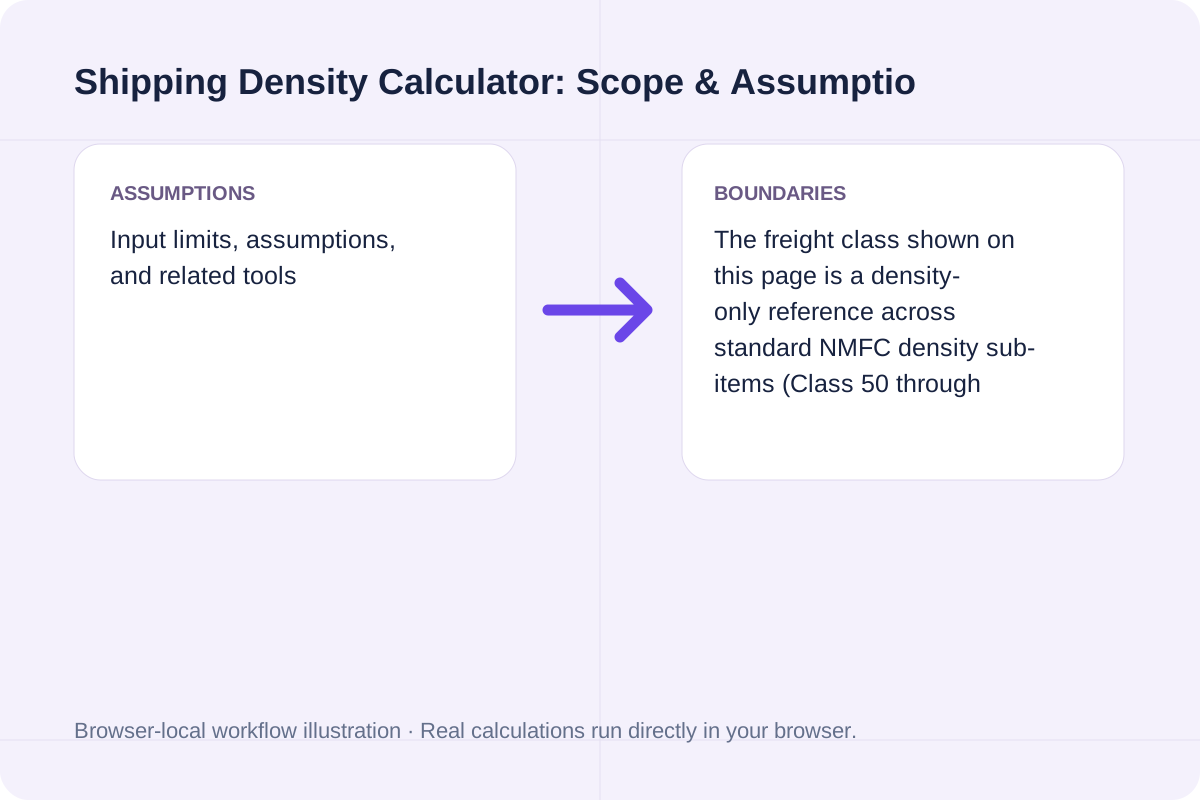
The freight class shown on this page is a density-only reference across standard NMFC density sub-items (Class 50 through Class 400). Hazardous materials, fragile glass, or high-value electronics may carry a fixed NMFC class regardless of density.
Calculate package and shipment volume in cubic meters (CBM) and cubic feet, plus sea/air volumetric weight and standard container fit.
Open tool
Calculate aquarium water volume in US gallons and liters, substrate displacement, and filled water weight from interior tank dimensions.
Open tool
Calculate carpet needed in square feet, square yards, and square meters, linear roll length, and cost from room dimensions and waste %.
Open toolChoose another tool for your next calculation, conversion, or text task.

Calculate starting drawing size from target dimensions and measured linear shrinkage.
Open tool
Find a corresponding side using a supplied similar-triangle scale.
Open tool
Compute the effective density, total mass, total volume, and mass/volume percentages of a two-part mixture from masses and densities or volumes and densities.
Open tool
Estimate gravel volume, weight and whole bags from supplied geometry and density.
Open toolAnswers about using Shipping Density Calculator and understanding its results.
Multiply pallet length, width, and height in inches and divide by 1,728 to get cubic feet. Then divide the total gross weight of the pallet (including the wood pallet itself) in pounds by the cubic feet to get pounds per cubic foot (PCF).
Yes. LTL carriers laser-scan and weigh the entire handling unit from the floor to the top of the stretch wrap. Always include the 5 to 6 inches of pallet deck height and the 35 to 50 lb weight of the pallet.
For density-based commodities, higher pounds per cubic foot (PCF) qualify for a lower freight class number (such as Class 60 or Class 70), which carries a lower LTL tariff rate per hundredweight (CWT).
Yes. All calculations run locally in your browser. Click Copy result or Download result.txt to save the cubic feet, PCF density, and reference freight class.
Choose another tool for your next calculation, conversion, or text task.