
CAGR Calculator
Calculate compound annual growth rate from a starting value, ending value, and time in years.
Open toolEstimate compound interest with monthly contributions, a starting balance, and a fixed annual rate. Compare total deposits and estimated growth under your assumptions.
Update the inputs to see your result.
Result will appear here
Equivalent monthly growth is applied before each month-end contribution.
The selected compound frequency is converted into an equivalent monthly growth rate. Each modelled month applies that rate to the balance, then adds the contribution at month end. Years are rounded to full months.
Assumes a fixed nominal annual rate, contributions at each month end, and no taxes or fees. Results are estimates, not investment returns.
Reference: Investor.gov: Compound Interest Calculator.

Keep the deposit schedule separate from the compounding frequency when preparing the inputs.
Enter the starting amount, monthly contribution, annual rate, and years, then choose compound frequency. Use one fixed rate for the scenario. The contribution is monthly even when the chosen growth frequency is daily, quarterly, or annual.
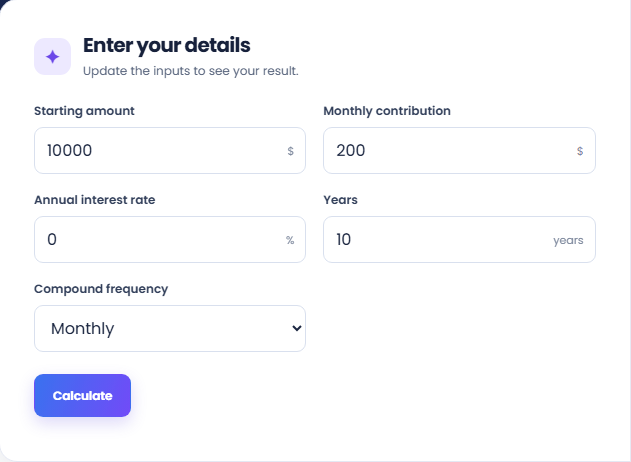
Select Calculate to read the estimated future value. The tool applies the equivalent monthly growth rate and adds each contribution at month end. Compare a second scenario by changing one input and retaining the others as a clear baseline.
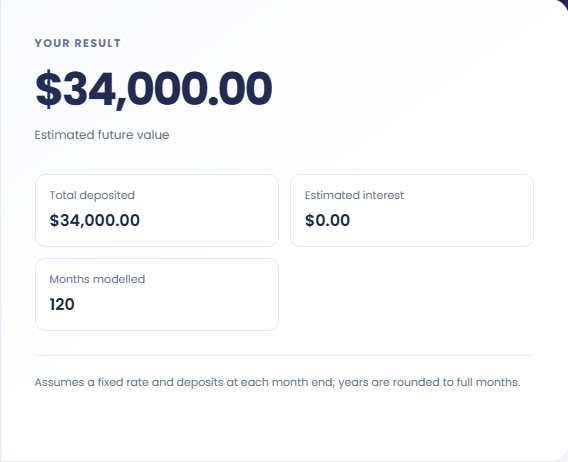
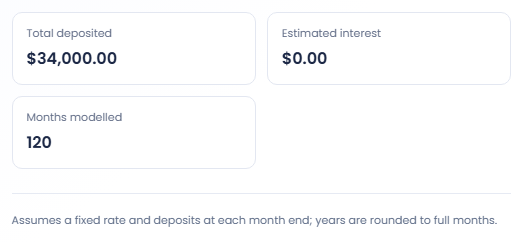
Review Total deposited, Estimated interest, and Months modelled. Future value includes the money contributed, so it is not all interest. Years are rounded to full months, and the fixed-rate model excludes taxes and fees rather than predicting actual returns.
Change one assumption at a time to see what caused the estimated balance to move.
Hold the starting balance, rate, time and frequency fixed while changing the monthly contribution. Compare both total deposited and estimated interest. A higher final balance can come from adding more money as well as from growth on that money.

Use the output as a model of deposits made at month end. If a separate spreadsheet adds deposits at month start, its balance may differ even with the same contribution amount. Align the timing before comparing those calculations.

Set the annual rate to zero to isolate deposits. A hypothetical $1,000 starting balance with $100 deposited monthly for one year gives $2,200. This arithmetic check makes the number of contributions visible without relying on a growth assumption.

Separate contributions from estimated interest when comparing future balances.
The duration in years is converted to a whole number of months for the calculation. Read the months modelled line when entering a fractional year, especially when comparing it with another model using exact days.
Estimated interest is the final balance minus the starting amount and later deposits. It assumes the entered rate stays fixed. Taxes, fees and changing returns are absent, so the output cannot promise an investment outcome.

Review rate, timing, and month-count assumptions before using the model.
Different tools may use different rate conventions or contribution timing. Check the nominal rate, selected frequency and monthly deposit basis before attributing a difference to rounding. Keep those assumptions with a saved result.
Enter a monthly contribution in the monthly field; an annual contribution entered there would be repeated each month. This calculator does not handle irregular deposits, withdrawals or a changing rate schedule, so those cash flows need a separate model.

Calculate compound annual growth rate from a starting value, ending value, and time in years.
Open tool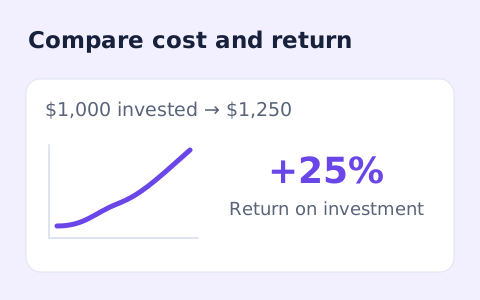
Calculate simple return on investment from the initial cost, final value, additional income, and costs.
Open tool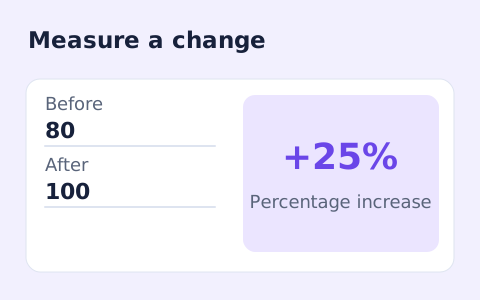
Calculate percentage change and absolute difference between a positive starting value and a new value.
Open toolChoose another tool for your next calculation, conversion, or text task.
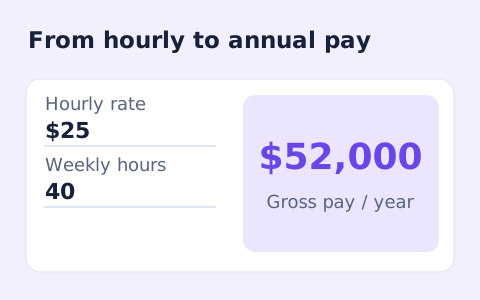
Convert hourly pay to gross annual, monthly, and weekly salary using your own working hours and weeks.
Open tool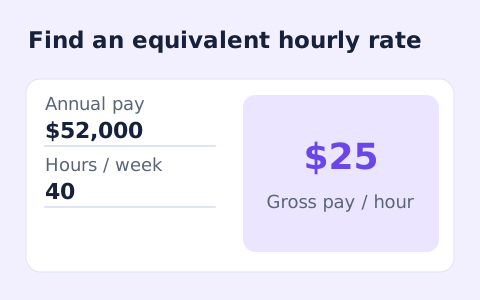
Convert annual gross salary into an hourly rate from your hours per week and paid weeks per year.
Open tool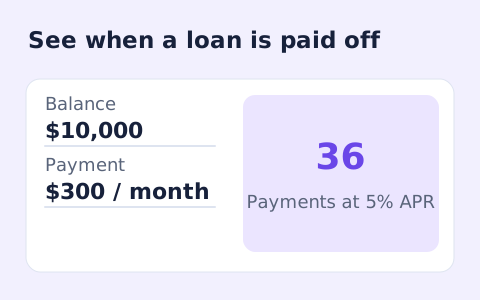
Estimate loan payoff time and interest savings from regular and extra monthly payments.
Open tool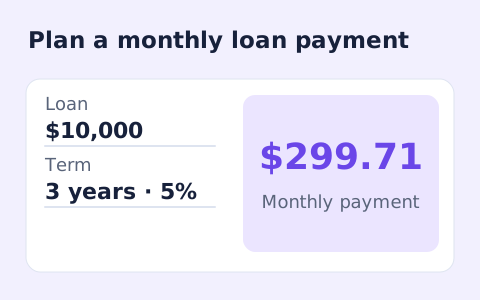
Calculate fixed monthly payments on an amortizing loan using amount, annual rate, and term.
Open toolModel compound growth using a starting balance, monthly contributions, and a fixed annual rate.
Answers about using Compound Interest Calculator and understanding its results.
The monthly contribution is added at the end of each month.
No. This calculator holds the rate constant only to illustrate compounding.
No. Contributions still enter at the end of each month. Frequency changes the equivalent monthly rate used for growth.
No. The result uses a fixed entered rate without taxes or fees. It is a modelled estimate rather than a promised investment return.