

Isotope Abundance Calculator
Find two-isotope abundance percentages from distinct isotope masses and a supplied mean.
Open toolSelect Mass + Density or Volume + Density mode and enter the quantities for Component 1 and Component 2 below to compute the mixture density, total mass, total volume, and mass/volume fractions.
Enter the inputs, then select Calculate mixture density.
Result will appear here
The Density Of Mixture Calculator solves for each component's mass and volume, sums them under the ideal additive-volume rule, and divides total mass by total volume.
Mass mode: ρ_mix = (m1 + m2) ÷ (m1/ρ1 + m2/ρ2); Volume mode: ρ_mix = (V1·ρ1 + V2·ρ2) ÷ (V1 + V2).
Both g/mL (g/cm³) and kg/m³ (1 g/mL = 1,000 kg/m³) are reported alongside weight-percent and volume-percent shares.
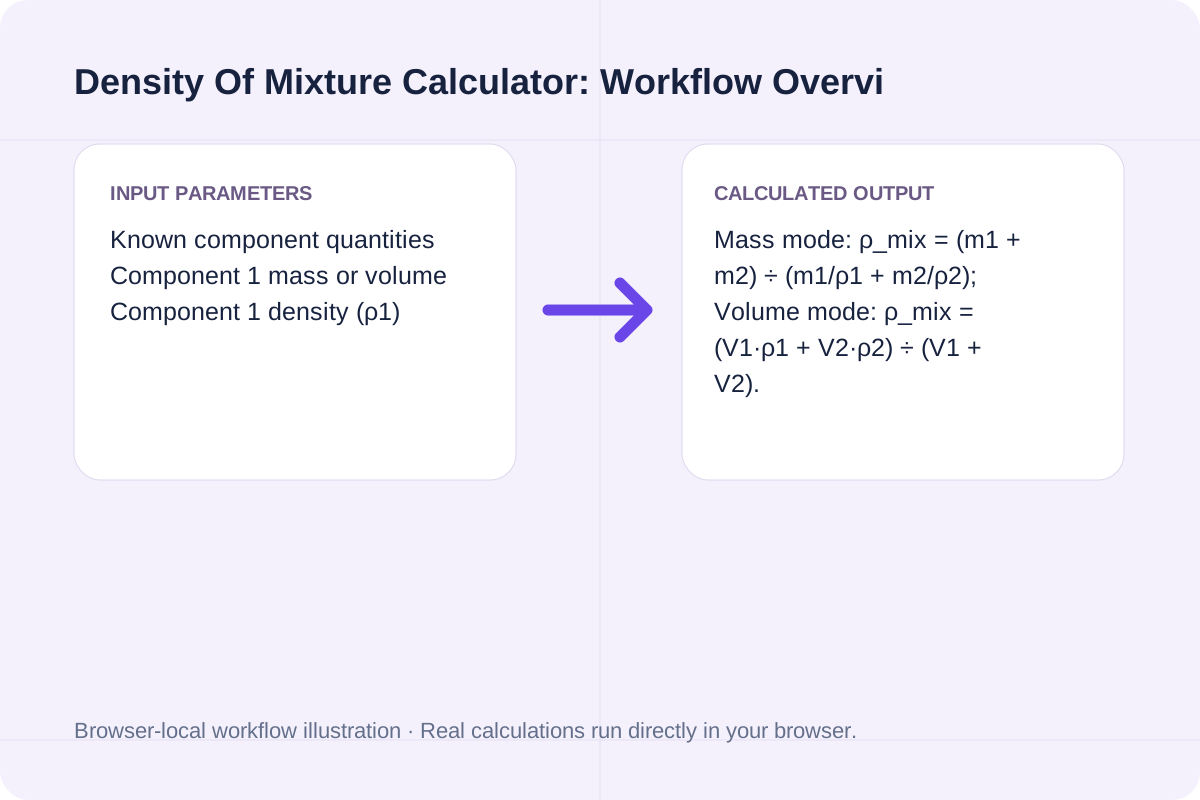
Review the input parameters, allowed value ranges, and worked reference cases for the Density Of Mixture Calculator below before running your calculation.
| Parameter / Scenario | Default / Sample Value | Rule or Allowed Range | Output / Usage Note |
|---|---|---|---|
| Input: Known component quantities | mass_density | Options: Mass + Density of each component (m1, ρ1, m2, ρ2), Volume + Density of each component (V1, ρ1, V2, ρ2) | Required workspace parameter |
| Input: Component 1 mass or volume | 600 | Range: 0.0001 to 1000000000 | Required workspace parameter |
| Input: Component 1 density (ρ1) | 0.998 | Range: 0.0001 to 100000 | Required workspace parameter |
| Input: Component 2 mass or volume | 400 | Range: 0.0001 to 1000000000 | Required workspace parameter |
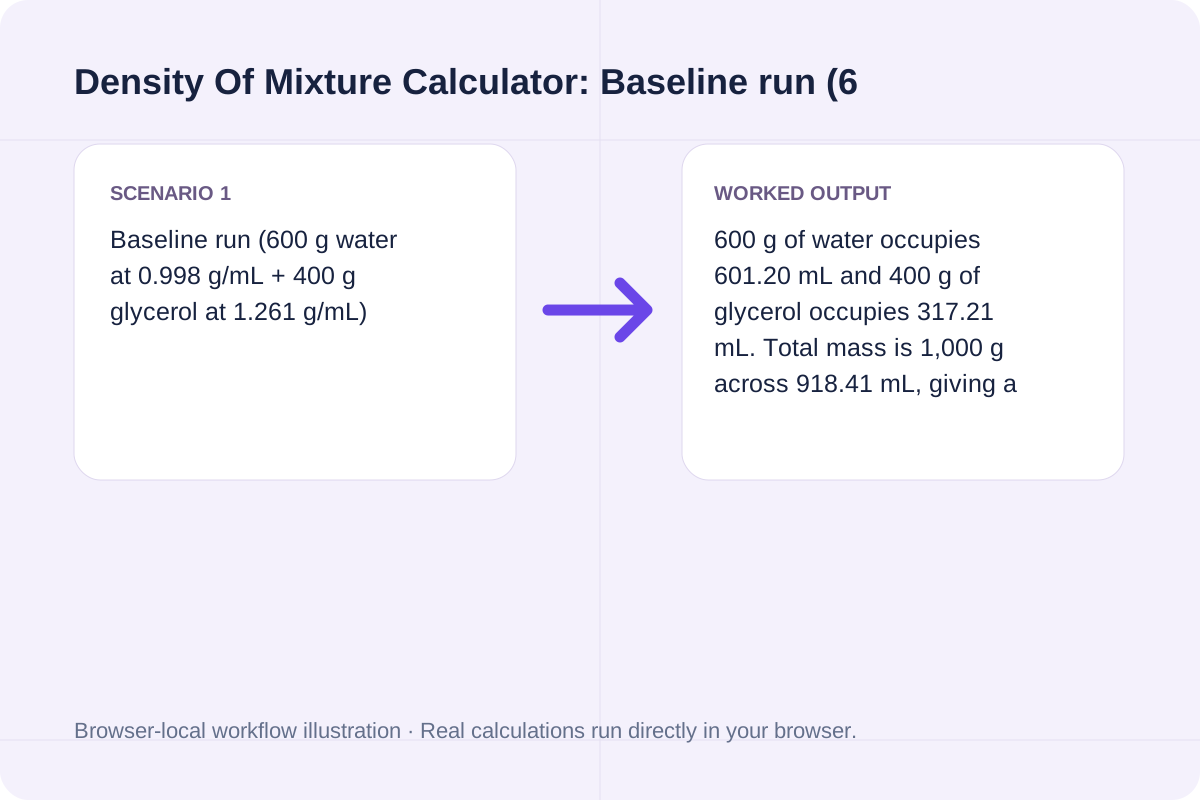
| Worked Case 1: Baseline run (600 g water at 0.998 g/mL + 400 g glycerol at 1.261 g/mL) | Preloaded / test values | Ideal additive volume: V_total = V1 + V2 = (m1 / ρ1) + (m2 / ρ2); Mixture Density ρ_mix = (m1 + m2) ÷ (V1 + V2) | 600 g of water occupies 601.20 mL and 400 g of glycerol occupies 317.21 mL. Total mass is 1,000 g across 918.41 mL, giving a mixture density of 1.0888 g/mL (1,088.84 kg/m³) with 60% mass / 65.46% volume of Component 1. |
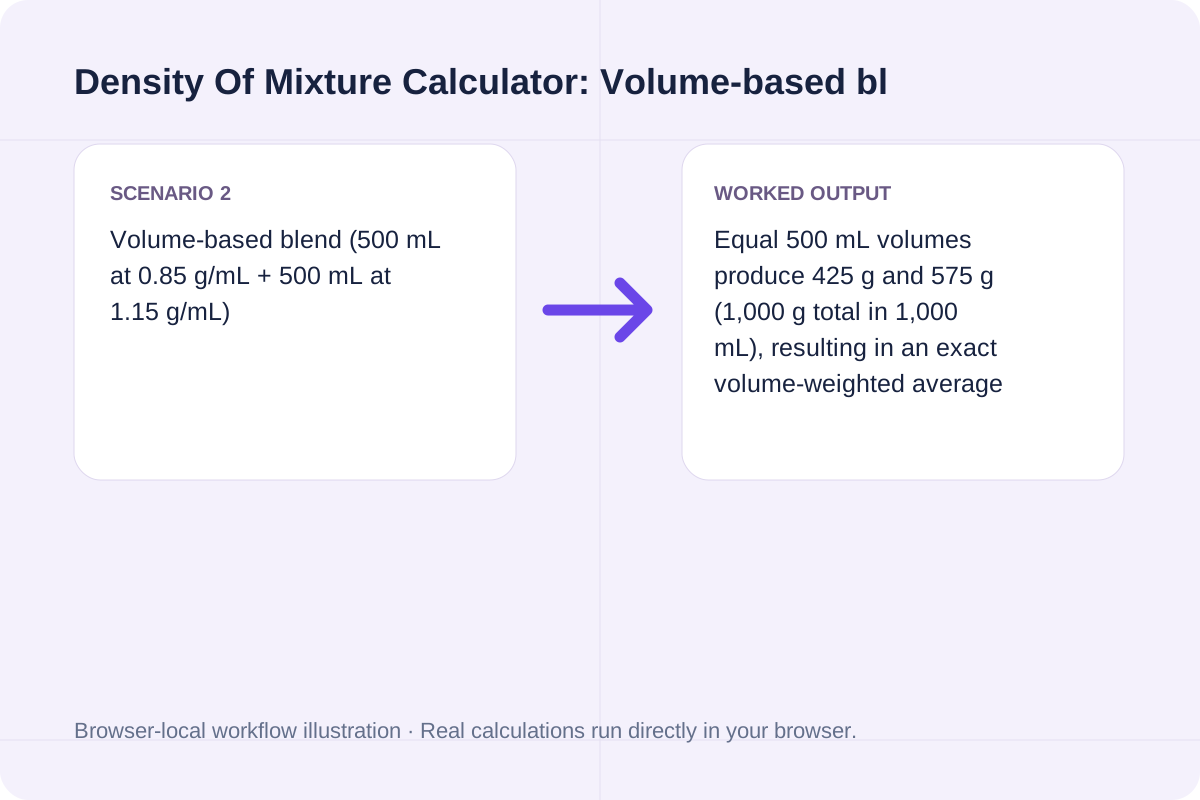
| Worked Case 2: Volume-based blend (500 mL at 0.85 g/mL + 500 mL at 1.15 g/mL) | Preloaded / test values | Ideal additive volume: V_total = V1 + V2 = (m1 / ρ1) + (m2 / ρ2); Mixture Density ρ_mix = (m1 + m2) ÷ (V1 + V2) | Equal 500 mL volumes produce 425 g and 575 g (1,000 g total in 1,000 mL), resulting in an exact volume-weighted average density of 1.000 g/mL and a 42.5% / 57.5% mass split. |
Pick the input mode that matches your lab notes or batch sheet, enter the two component values, and calculate.
Select Mass + Density if your formula specifies grams or kilograms of each ingredient, or Volume + Density if you measure milliliters or liters.
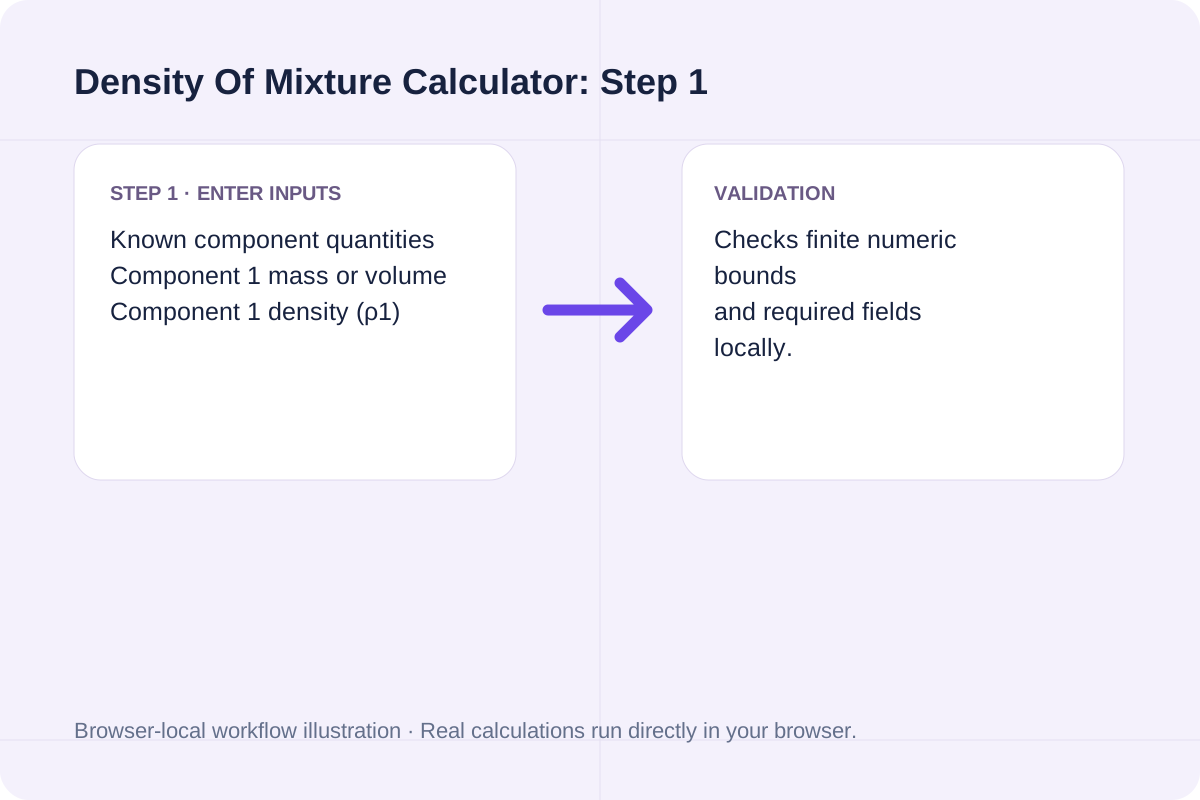
Enter the quantity and density of Component 1 and Component 2 using consistent units (such as g and g/mL).
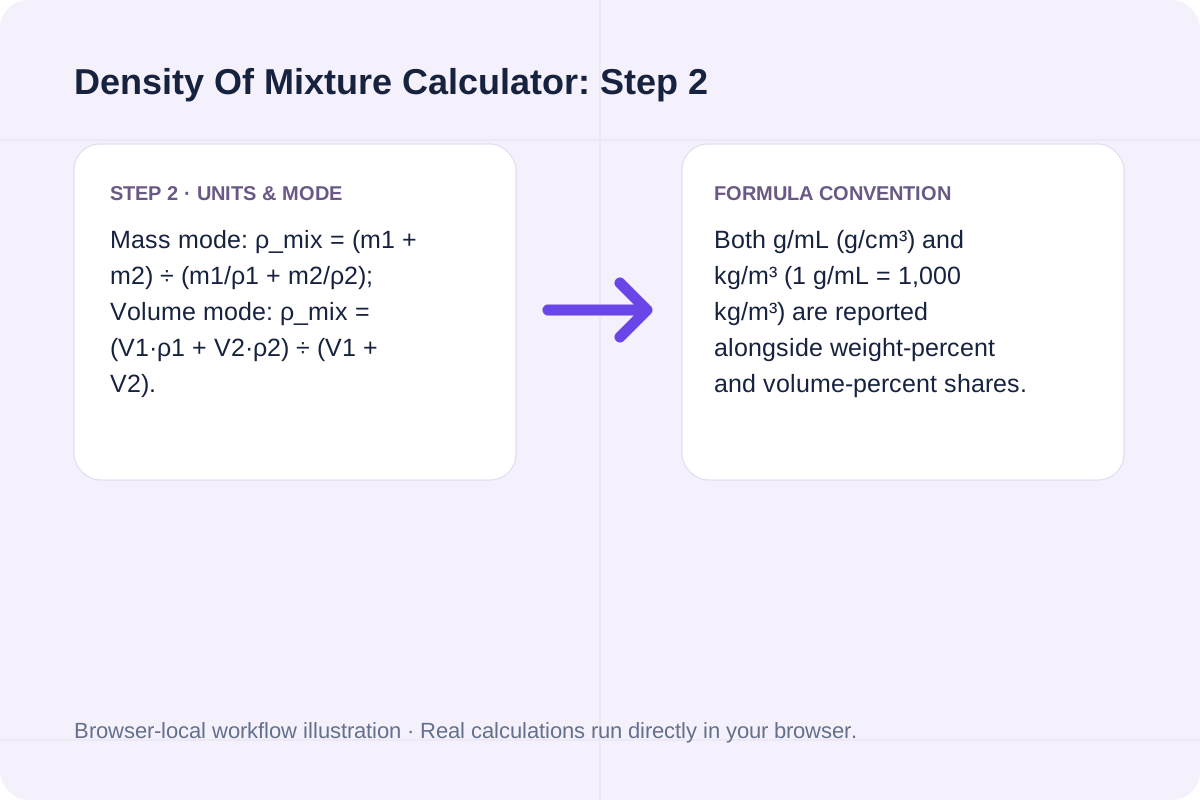
Select Calculate mixture density to view the combined density in g/mL and kg/m³, total mass, total volume, and mass/volume percentages.
Compare a mass-based water-glycerol blend against a volume-based mineral oil blend.
600 g of water occupies 601.20 mL and 400 g of glycerol occupies 317.21 mL. Total mass is 1,000 g across 918.41 mL, giving a mixture density of 1.0888 g/mL (1,088.84 kg/m³) with 60% mass / 65.46% volume of Component 1.
Equal 500 mL volumes produce 425 g and 575 g (1,000 g total in 1,000 mL), resulting in an exact volume-weighted average density of 1.000 g/mL and a 42.5% / 57.5% mass split.
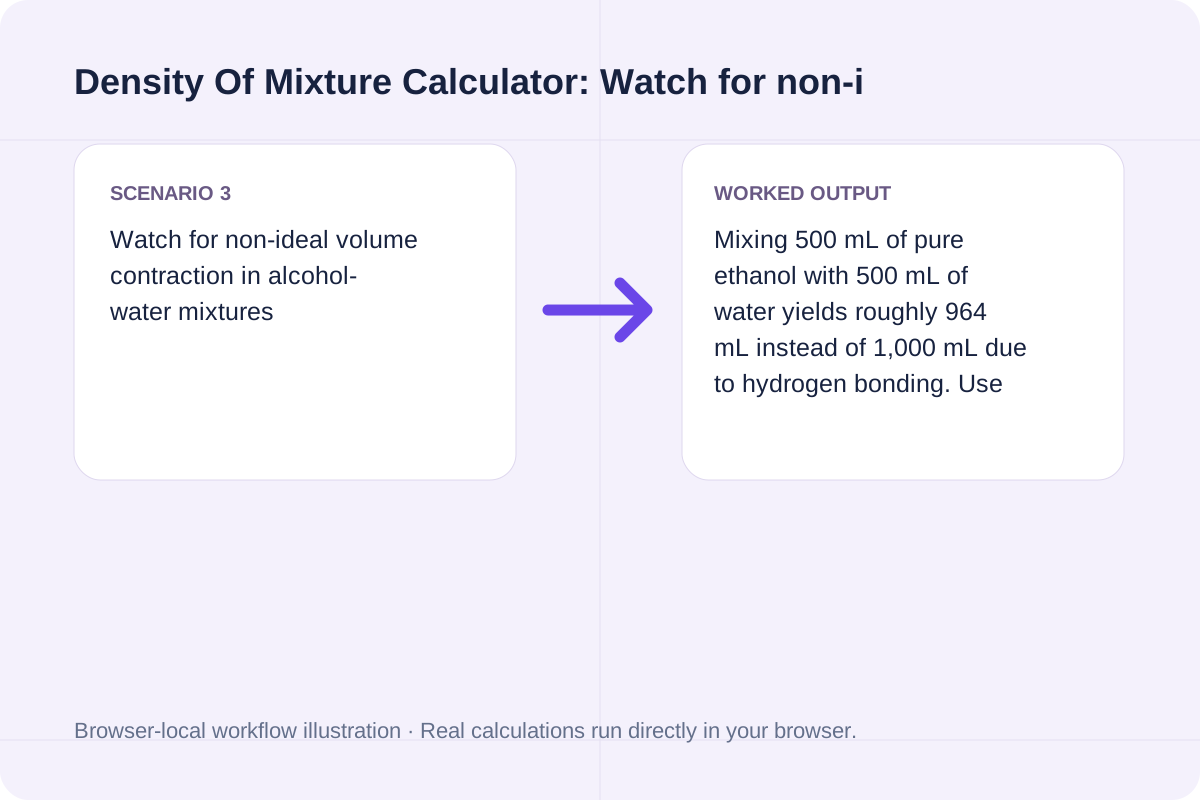
Mixing 500 mL of pure ethanol with 500 mL of water yields roughly 964 mL instead of 1,000 mL due to hydrogen bonding. Use experimental density tables when precise alcohol hydrometry is required.
Check why mass-fraction harmonic averaging differs from a naive arithmetic average of densities.
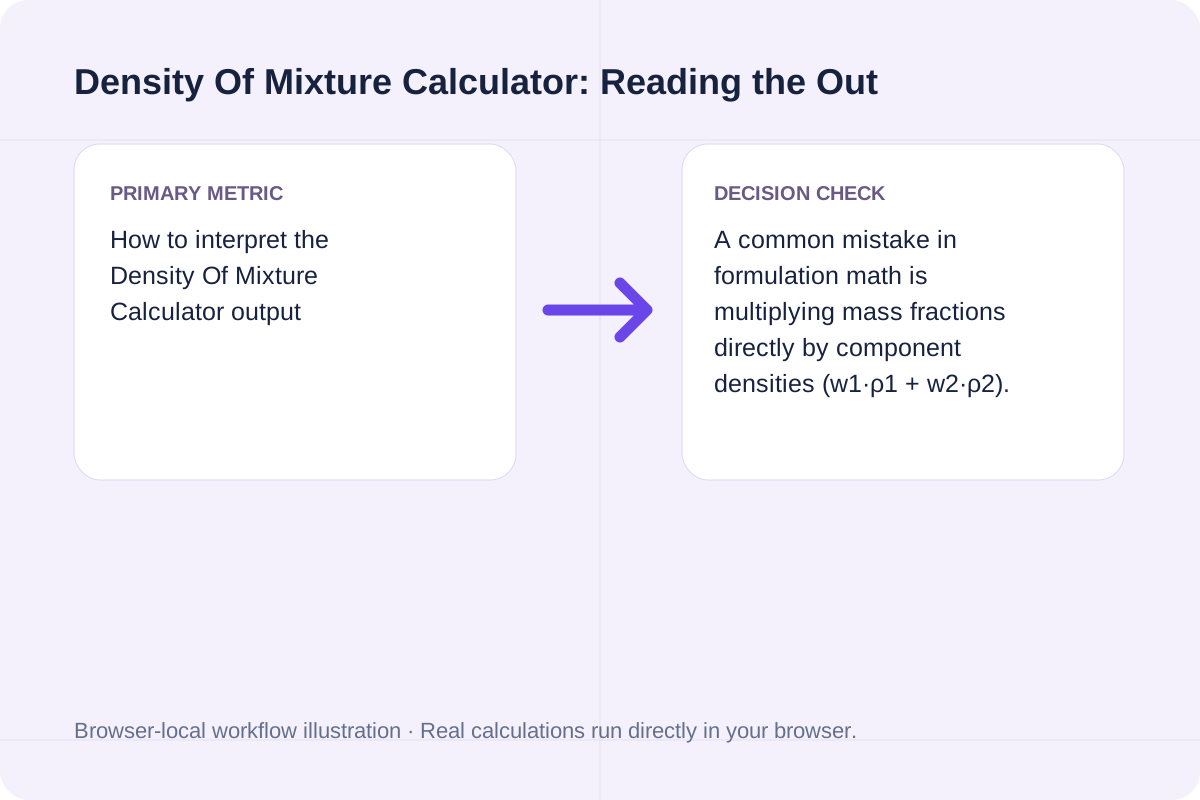
A common mistake in formulation math is multiplying mass fractions directly by component densities (w1·ρ1 + w2·ρ2). Because denser components occupy less volume per gram, the true additive-volume mixture density is always governed by total mass divided by total volume.
Confirm temperature and ideal-mixing assumptions before scaling batch vessels.
Liquid densities vary with temperature, so both ρ1 and ρ2 should be measured at the same reference temperature (typically 20 °C or 25 °C). Slurries with entrained air or chemical reactions that evolve gas will have a lower bulk density than the air-free theoretical mixture.
Find two-isotope abundance percentages from distinct isotope masses and a supplied mean.
Open tool
Calculate an ideal Keplerian period from semimajor axis and total two-body mass.
Open tool
Compute shipment volume in cubic feet and cubic meters, freight density in PCF (lb/ft³), and reference NMFC density freight class from pallet dimensions and weight.
Open toolChoose another tool for your next calculation, conversion, or text task.

Convert a quantity using the listed fixed unit factors.
Open tool
Calculate photographic depth of field (DoF), near and far acceptable sharpness limits, and hyperfocal distance from lens, f-stop, distance, and CoC.
Open tool
Compute driving time, total trip duration including rest breaks, effective average speed, and fuel cost in miles or kilometers.
Open tool
Calculate how much water to add and total final volume when diluting spirits or alcohol from initial ABV to target ABV.
Open toolAnswers about using Density Of Mixture Calculator and understanding its results.
First find each component's volume by dividing its mass by its density (V1 = m1/ρ1 and V2 = m2/ρ2). Then divide total mass (m1 + m2) by total volume (V1 + V2). Do not average the two densities directly unless the two volumes are equal.
Mixture density is weighted by volume fractions (ρ_mix = φ1·ρ1 + φ2·ρ2), whereas when working from mass fractions w1 and w2 you must use the harmonic form: 1/ρ_mix = (w1/ρ1) + (w2/ρ2).
Yes, as long as both components use the exact same mass, volume, and density unit system (for example, kg and m³ with kg/m³, or g and mL with g/mL).
Yes. All calculations run locally in your browser. Click Copy result or Download result.txt to save the mixture density, total mass, total volume, and component fractions.
Choose another tool for your next calculation, conversion, or text task.