

Density Of Mixture Calculator
Compute the effective density, total mass, total volume, and mass/volume percentages of a two-part mixture from masses and densities or volumes and densities.
Open toolEnter your route distance, average moving speed, planned rest stops, and vehicle fuel efficiency in the Travel Time Calculator below to find pure drive time, total door-to-door duration, effective speed, and fuel cost.
Enter the inputs, then select Calculate travel time.
Result will appear here
The Travel Time Calculator divides route distance by average moving speed to determine pure driving time, adds total stop duration, and computes fuel volume and cost in either Imperial or Metric units.
Total Duration = (Distance ÷ Moving Speed) + (Stops × Stop_min ÷ 60); Effective Speed = Distance ÷ Total Duration.
Both pure driving time and total trip time are formatted in hours and minutes (plus decimal hours for logbooks and mileage sheets).
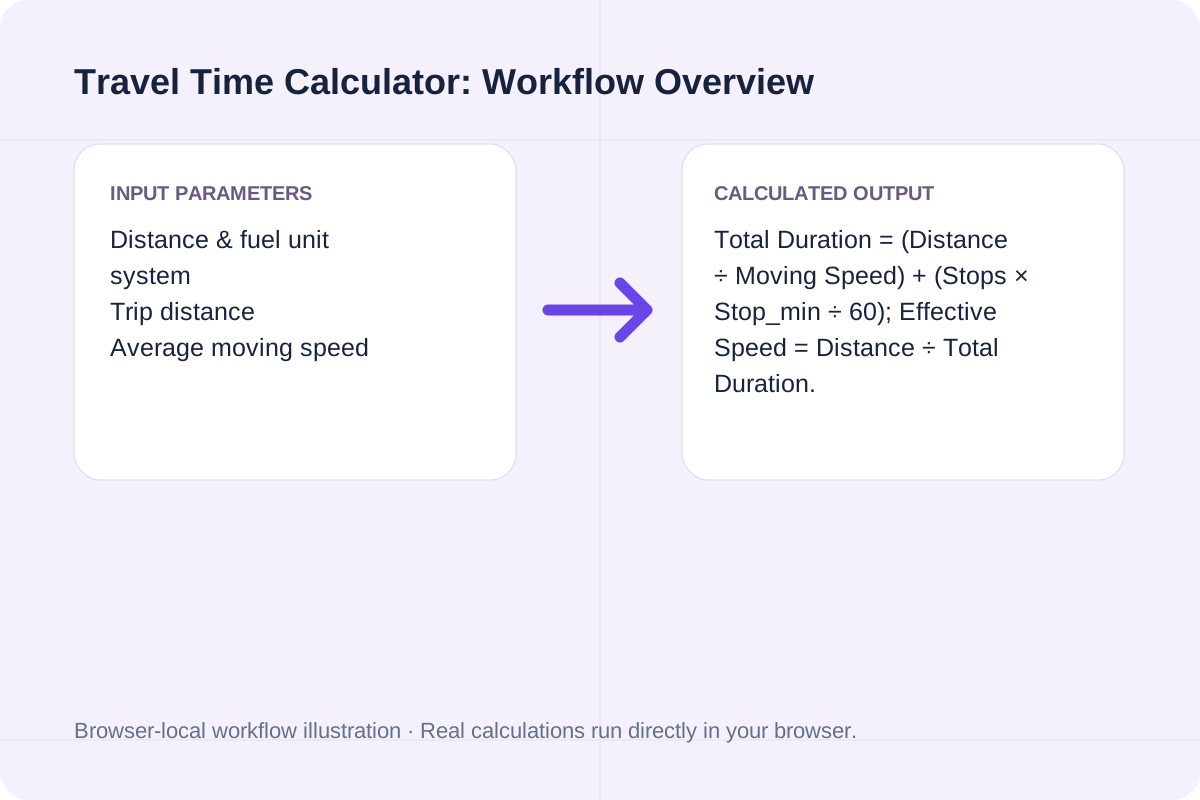
Review the input parameters, allowed value ranges, and worked reference cases for the Travel Time Calculator below before running your calculation.
| Parameter / Scenario | Default / Sample Value | Rule or Allowed Range | Output / Usage Note |
|---|---|---|---|
| Input: Distance & fuel unit system | imperial | Options: Imperial (miles, mph, MPG), Metric (kilometers, km/h, km/L) | Required workspace parameter |
| Input: Trip distance | 285 | Range: 0.1 to 100000 | Required workspace parameter |
| Input: Average moving speed | 62 | Range: 0.5 to 1000 | Required workspace parameter |
| Input: Number of rest or fuel stops | 2 | Range: 0 to 200 | Required workspace parameter |
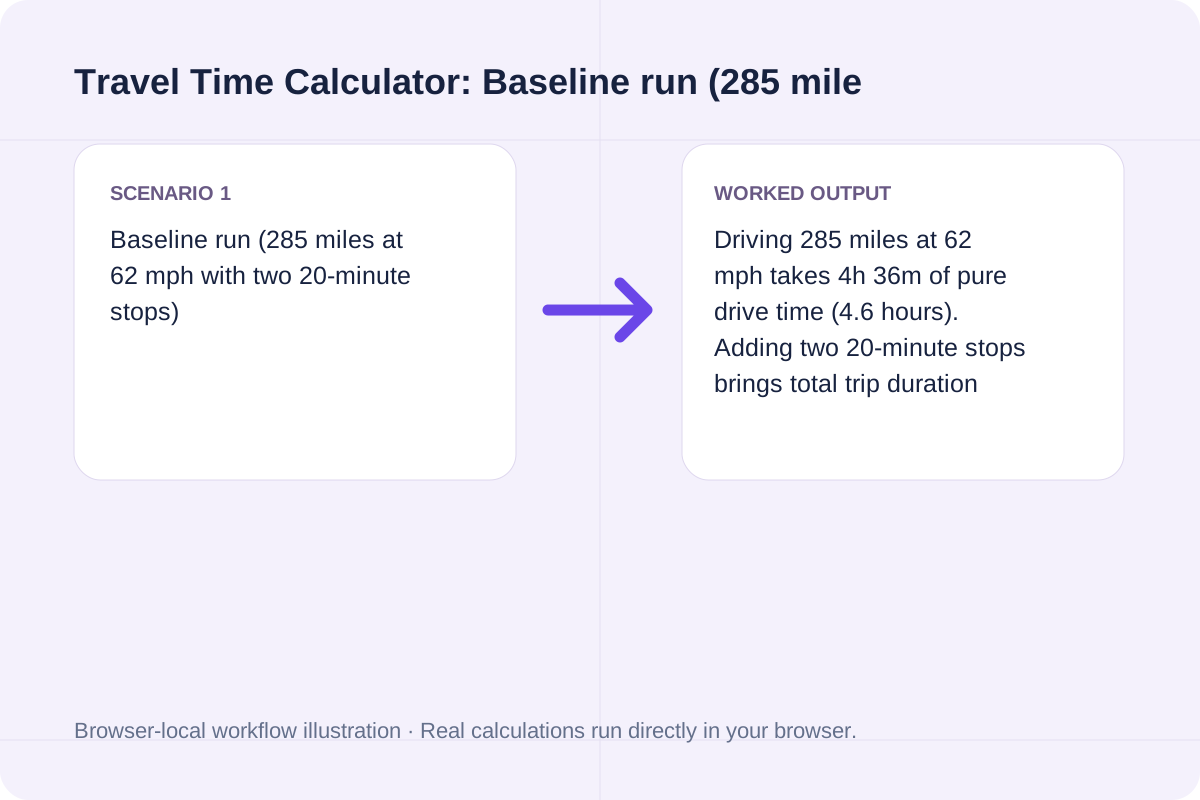
| Worked Case 1: Baseline run (285 miles at 62 mph with two 20-minute stops) | Preloaded / test values | Drive Hours = Distance ÷ Speed; Total Trip Hours = Drive Hours + (Stops × Stop Minutes ÷ 60); Fuel Cost = (Distance ÷ Fuel Efficiency) × Fuel Price | Driving 285 miles at 62 mph takes 4h 36m of pure drive time (4.6 hours). Adding two 20-minute stops brings total trip duration to 5h 16m (5.26 hours), lowers effective speed to 54.15 mph, and uses 9.19 gallons ($31.72 at $3.45/gal). |
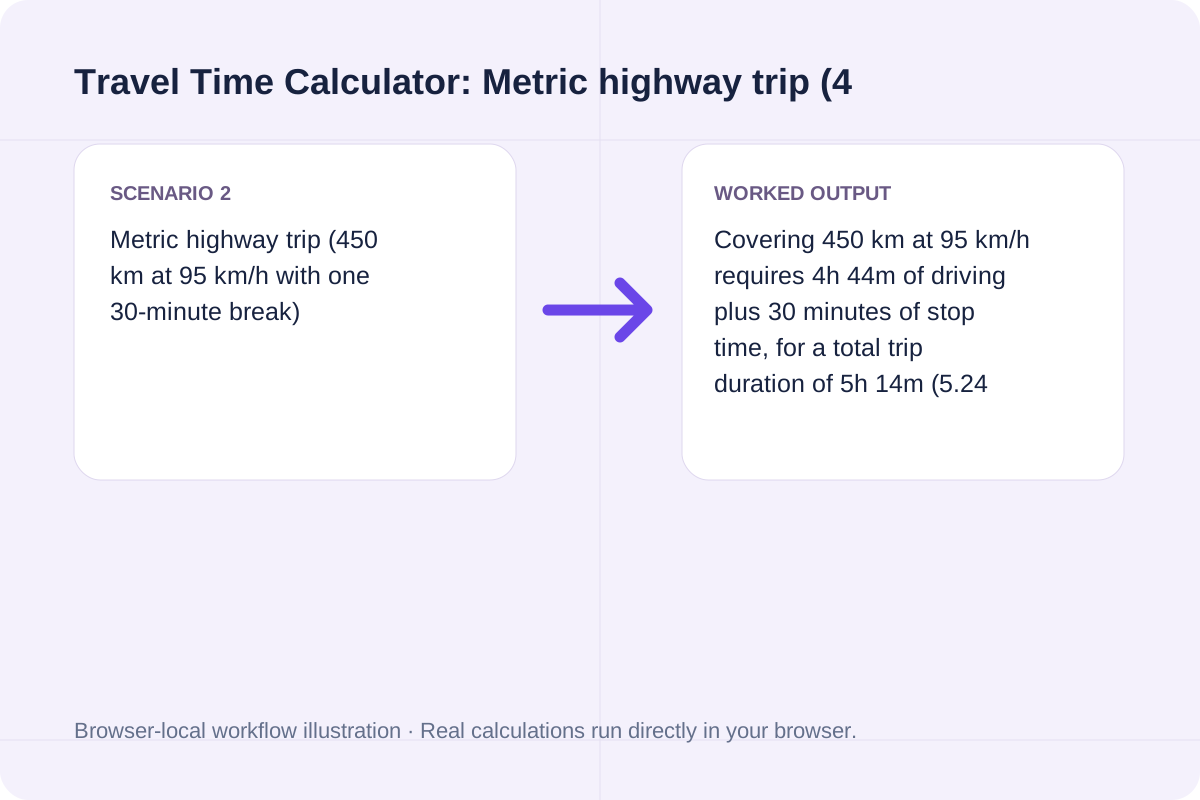
| Worked Case 2: Metric highway trip (450 km at 95 km/h with one 30-minute break) | Preloaded / test values | Drive Hours = Distance ÷ Speed; Total Trip Hours = Drive Hours + (Stops × Stop Minutes ÷ 60); Fuel Cost = (Distance ÷ Fuel Efficiency) × Fuel Price | Covering 450 km at 95 km/h requires 4h 44m of driving plus 30 minutes of stop time, for a total trip duration of 5h 14m (5.24 hours) and an effective door-to-door speed of 85.93 km/h. |
Choose Imperial or Metric units, enter your route distance and realistic highway speed, and add any planned rest breaks.
Choose Imperial (miles, mph, MPG) or Metric (km, km/h, km/L) and enter your total route distance and realistic average moving speed.
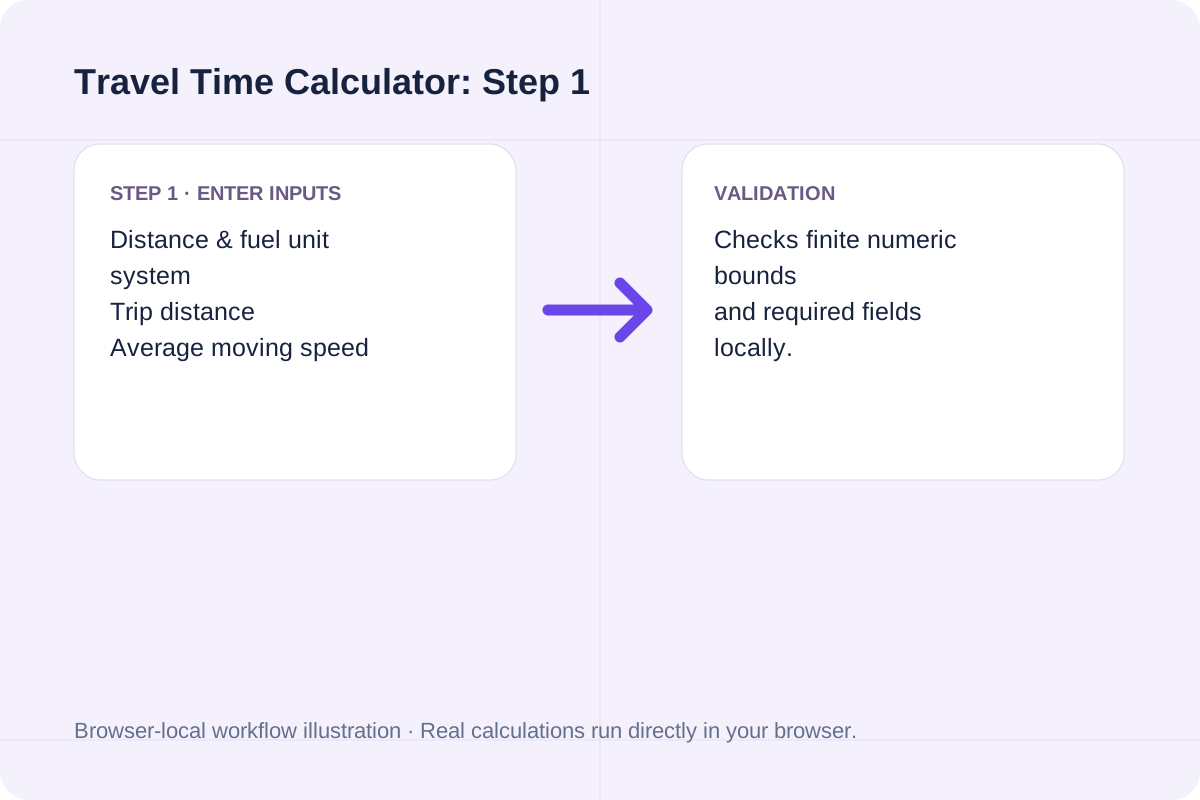
Specify the number of stops and average minutes per stop for refueling, meals, or driver rest breaks.
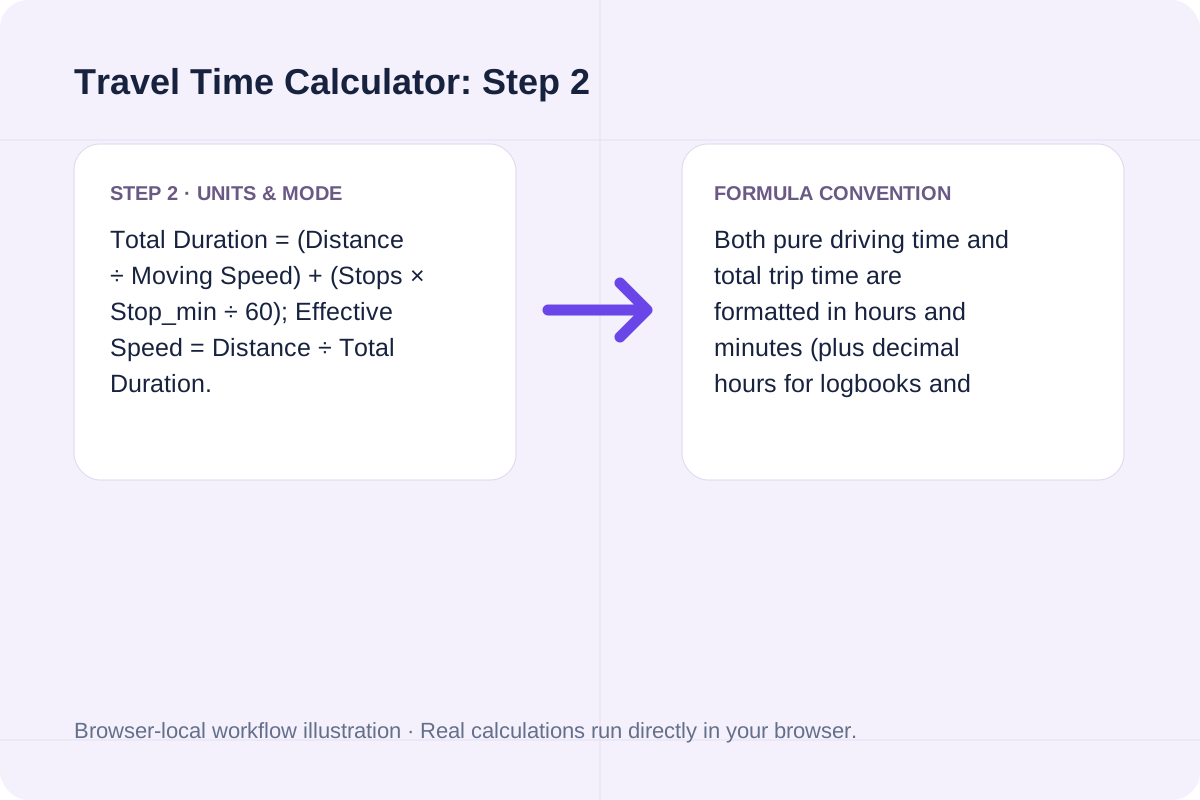
Enter your vehicle's fuel efficiency and local fuel price, then click Calculate travel time to see the complete itinerary summary.
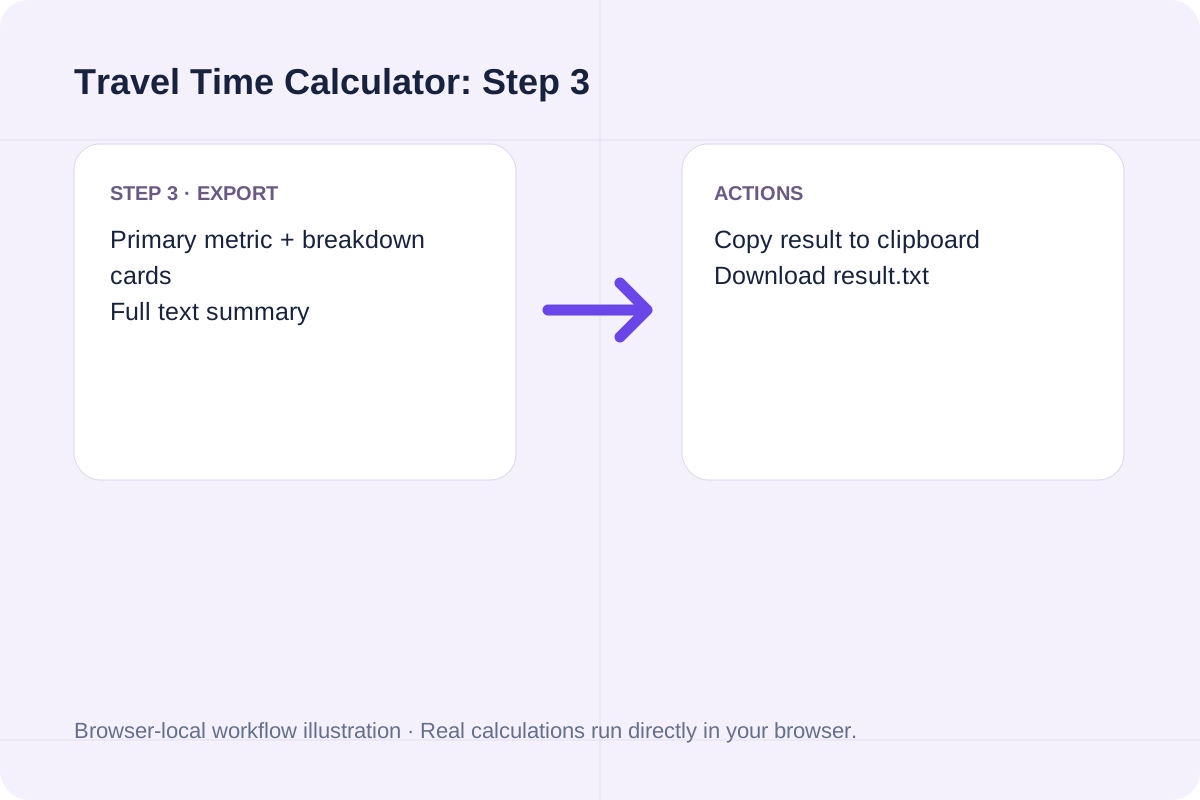
Compare a regional highway drive with two short stops against a long-distance metric road trip.
Driving 285 miles at 62 mph takes 4h 36m of pure drive time (4.6 hours). Adding two 20-minute stops brings total trip duration to 5h 16m (5.26 hours), lowers effective speed to 54.15 mph, and uses 9.19 gallons ($31.72 at $3.45/gal).
Covering 450 km at 95 km/h requires 4h 44m of driving plus 30 minutes of stop time, for a total trip duration of 5h 14m (5.24 hours) and an effective door-to-door speed of 85.93 km/h.
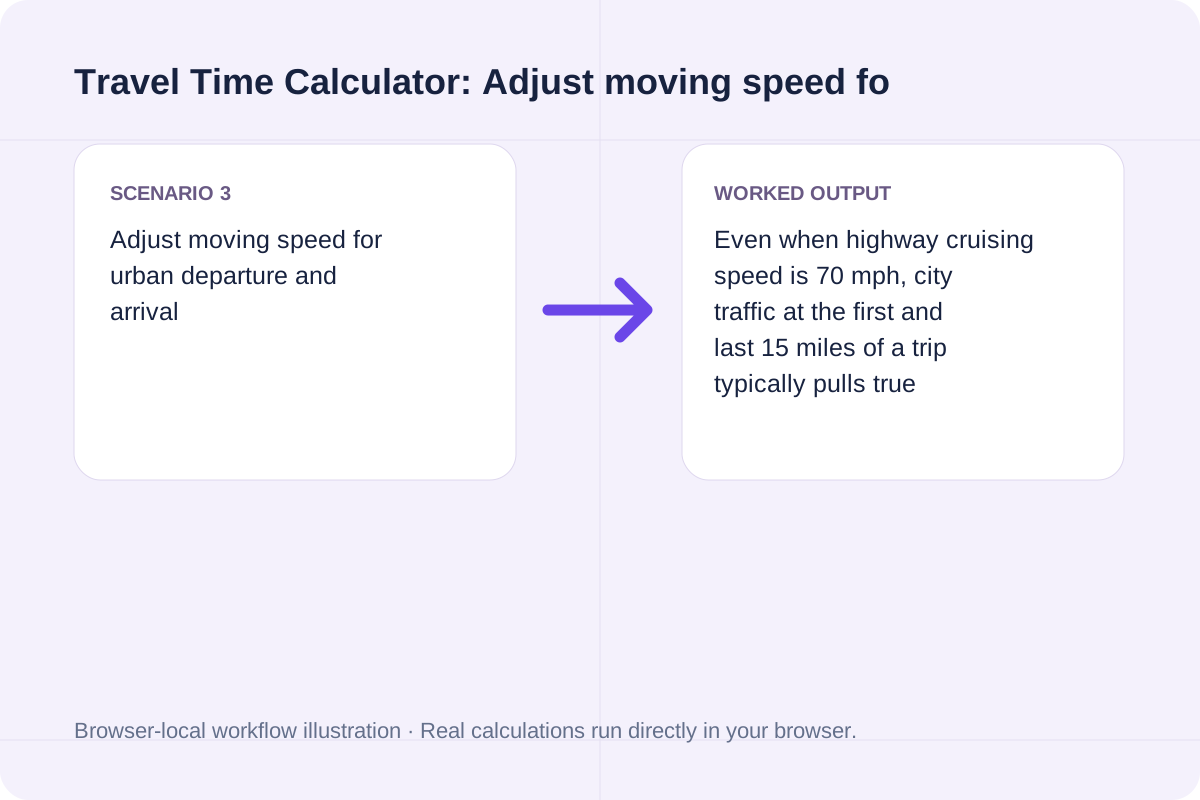
Even when highway cruising speed is 70 mph, city traffic at the first and last 15 miles of a trip typically pulls true moving speed down to 58–63 mph.
Use total trip duration for arrival scheduling and pure drive time for driver fatigue planning.
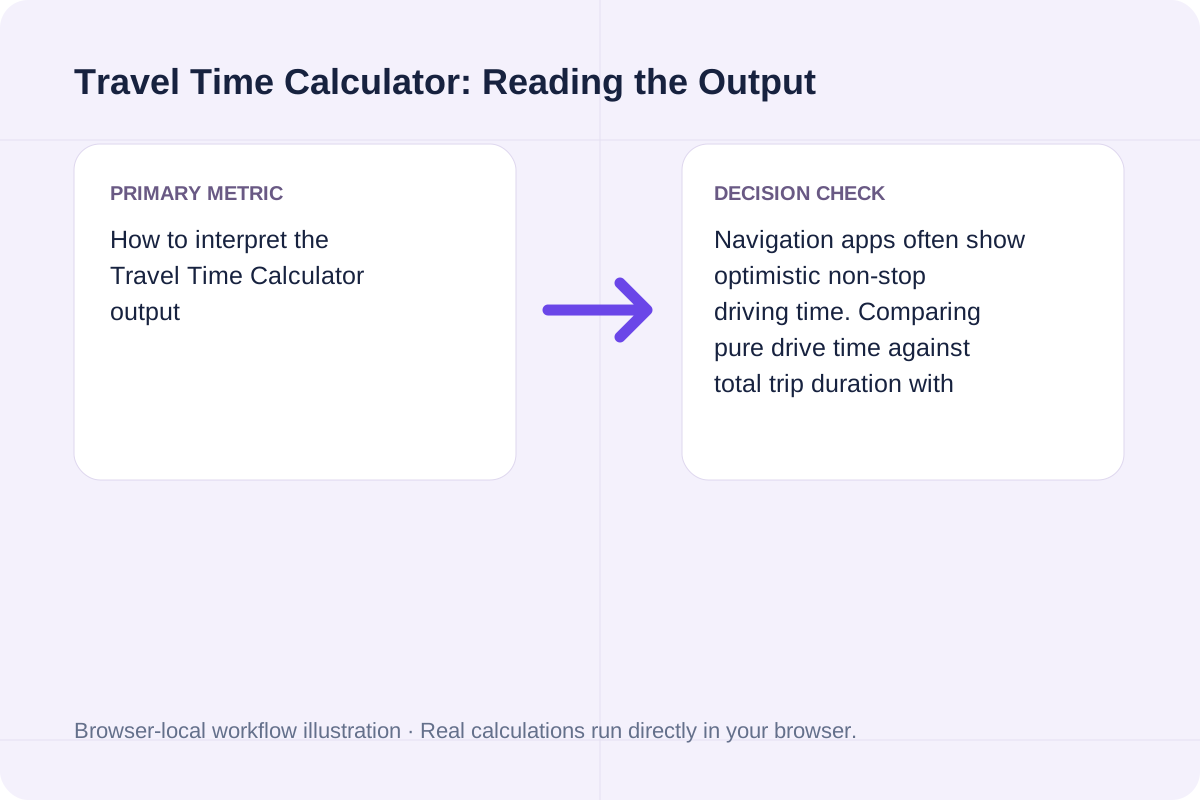
Navigation apps often show optimistic non-stop driving time. Comparing pure drive time against total trip duration with rest stops gives a realistic arrival window and shows your true door-to-door effective speed.
Check unit consistency and fuel efficiency conventions before budgeting a multi-stop trip.
In Metric mode, fuel efficiency is entered in kilometers per liter (km/L). If your vehicle displays liters per 100 km (L/100km), divide 100 by your L/100km rating to convert it to km/L (for example, 8 L/100km equals 12.5 km/L).
Compute the effective density, total mass, total volume, and mass/volume percentages of a two-part mixture from masses and densities or volumes and densities.
Open tool
Estimate meeting person-hours and total cost at a supplied average hourly rate.
Open tool
Find sound travel time as path length divided by supplied sound speed.
Open toolChoose another tool for your next calculation, conversion, or text task.

Estimate itemized group and per-person travel budget from supplied prices.
Open tool
Find treadmill pace and constant-speed target duration.
Open tool
Find average step length from distance and steps or speed and total cadence.
Open tool
Average angular acceleration = change in angular velocity / time.
Open toolAnswers about using Travel Time Calculator and understanding its results.
Divide total route distance by average moving speed to get pure driving hours, multiply the decimal remainder by 60 for minutes, and add your total planned stop time.
Moving speed is your average speed while driving on the road. Effective average speed divides the total trip distance by the total elapsed trip time including rest, meal, and fuel stops.
It divides your route distance by your vehicle fuel efficiency (MPG or km/L) to find gallons or liters needed, then multiplies that fuel volume by your entered price per gallon or liter.
Yes. Every calculation runs locally in your browser. Click Copy result or Download result.txt to save the driving time, stop time, effective speed, and fuel estimate.
Choose another tool for your next calculation, conversion, or text task.