

ABV Calculator
Estimate alcohol by volume from original and final measured specific gravities.
Open toolEnter your starting batch volume, initial ABV, and target ABV in the Alcohol Dilution Calculator below to compute exact water addition, final diluted volume, pure alcohol content, and US proof.
Enter the inputs, then select Calculate Dilution.
Result will appear here
The Alcohol Dilution Calculator applies the conservation of solute volume equation (C1 * V1 = C2 * V2) to find the total diluted volume that brings a spirit or alcohol solution down to your target ABV.
V2 = V1 * (C1 / C2); Water to Add = V1 * ((C1 / C2) - 1); US Proof = ABV * 2.
Target ABV (C2) must be strictly lower than starting ABV (C1). The calculator outputs results in your chosen volume unit alongside milliliters and liters for easy scale or graduated cylinder measurement.
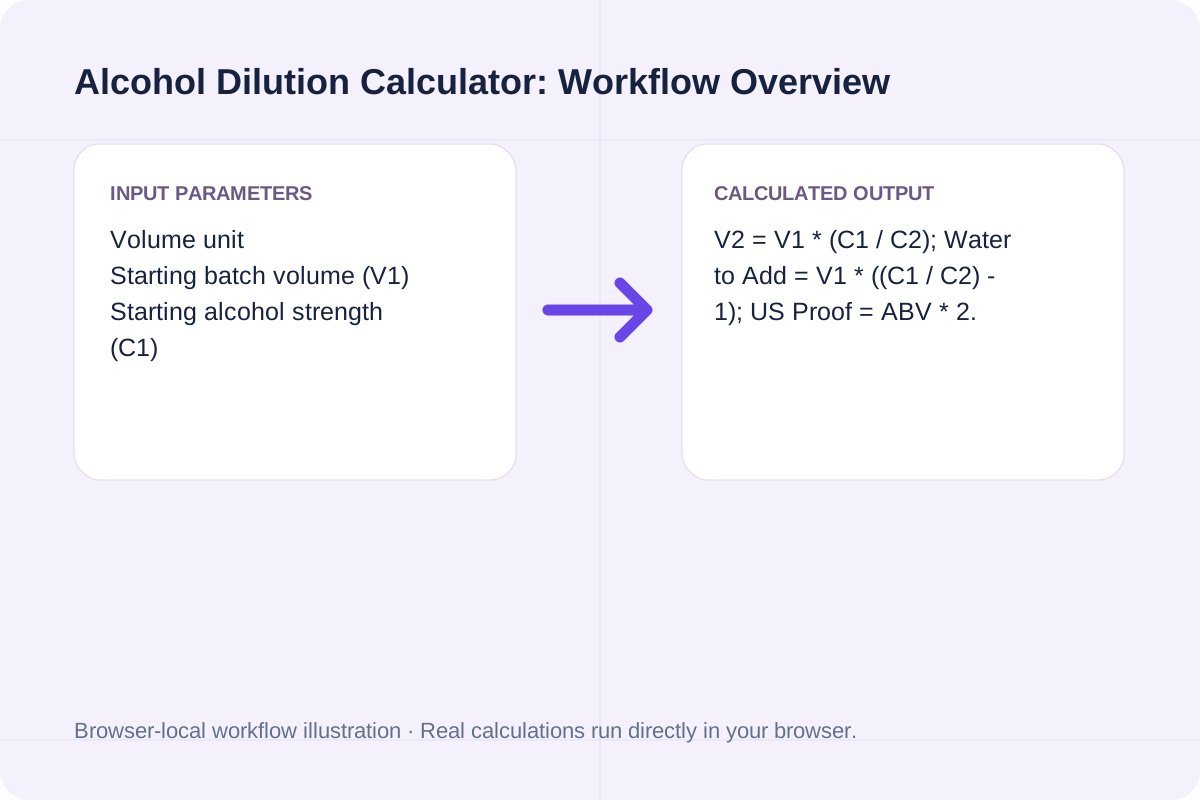
Review the input parameters, allowed value ranges, and worked reference cases for the Alcohol Dilution Calculator below before running your calculation.
| Parameter / Scenario | Default / Sample Value | Rule or Allowed Range | Output / Usage Note |
|---|---|---|---|
| Input: Volume unit | mL | Options: Milliliters (mL), Liters (L), US Fluid Ounces (fl oz), US Gallons (gal) | Required workspace parameter |
| Input: Starting batch volume (V1) | 1000 | Range: 0.1 to 1000000 | Required workspace parameter |
| Input: Starting alcohol strength (C1) | 65 | Range: 0.1 to 100 | Required workspace parameter |
| Input: Target alcohol strength (C2) | 40 | Range: 0.05 to 99.9 | Required workspace parameter |
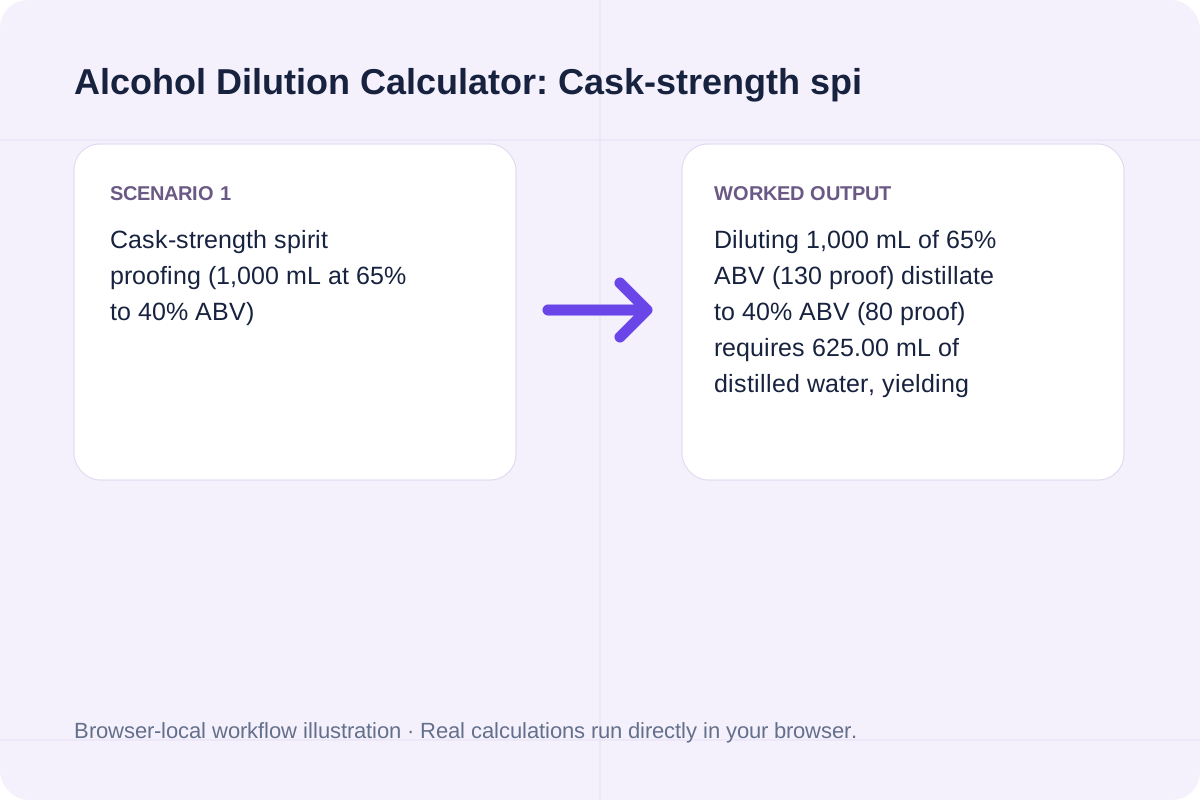
| Worked Case 1: Cask-strength spirit proofing (1,000 mL at 65% to 40% ABV) | Preloaded / test values | Final Volume (V2) = V1 * (C1 / C2); Water to Add = V2 - V1; Pure Ethanol Volume = V1 * (C1 / 100) | Diluting 1,000 mL of 65% ABV (130 proof) distillate to 40% ABV (80 proof) requires 625.00 mL of distilled water, yielding 1,625.00 mL total volume with 650.00 mL of pure ethanol. |
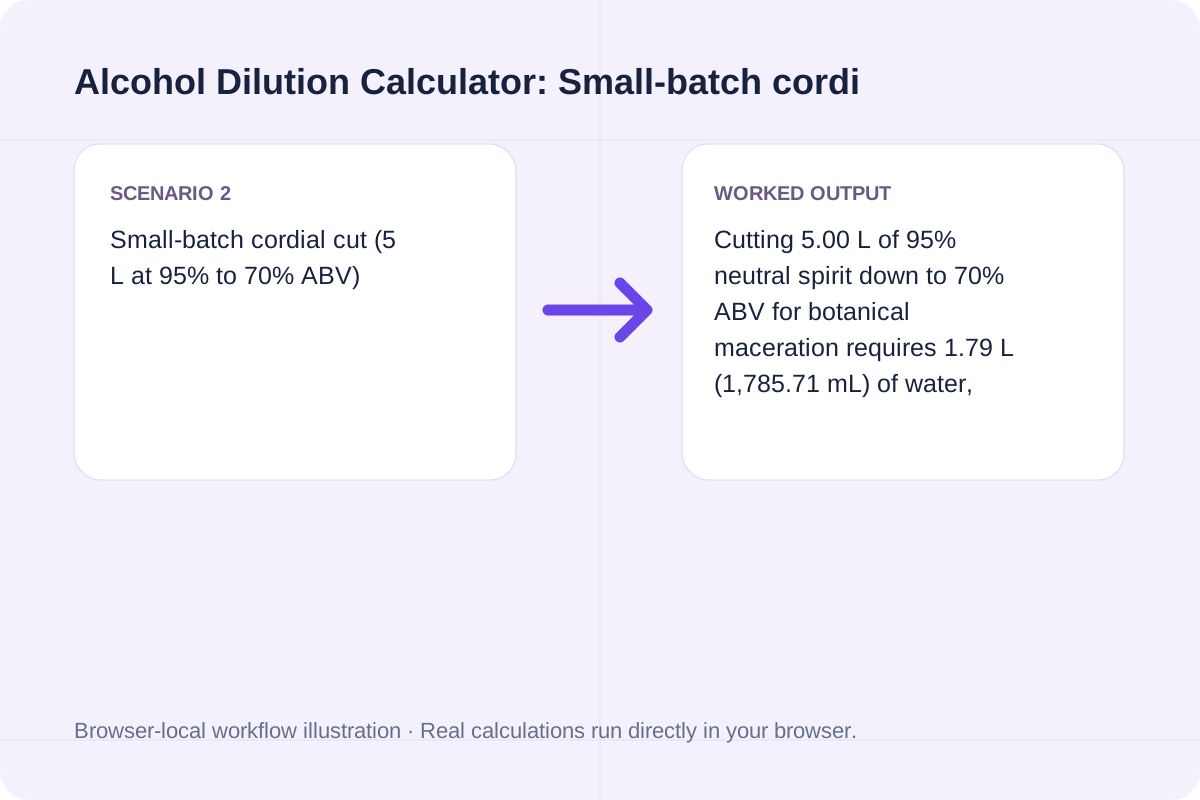
| Worked Case 2: Small-batch cordial cut (5 L at 95% to 70% ABV) | Preloaded / test values | Final Volume (V2) = V1 * (C1 / C2); Water to Add = V2 - V1; Pure Ethanol Volume = V1 * (C1 / 100) | Cutting 5.00 L of 95% neutral spirit down to 70% ABV for botanical maceration requires 1.79 L (1,785.71 mL) of water, producing 6.79 L of 140-proof base. |
Measure the temperature-corrected ABV and volume of your starting batch before calculating water addition.
Select mL, L, US fl oz, or US gallons to match your vessel or mixing tank scale.
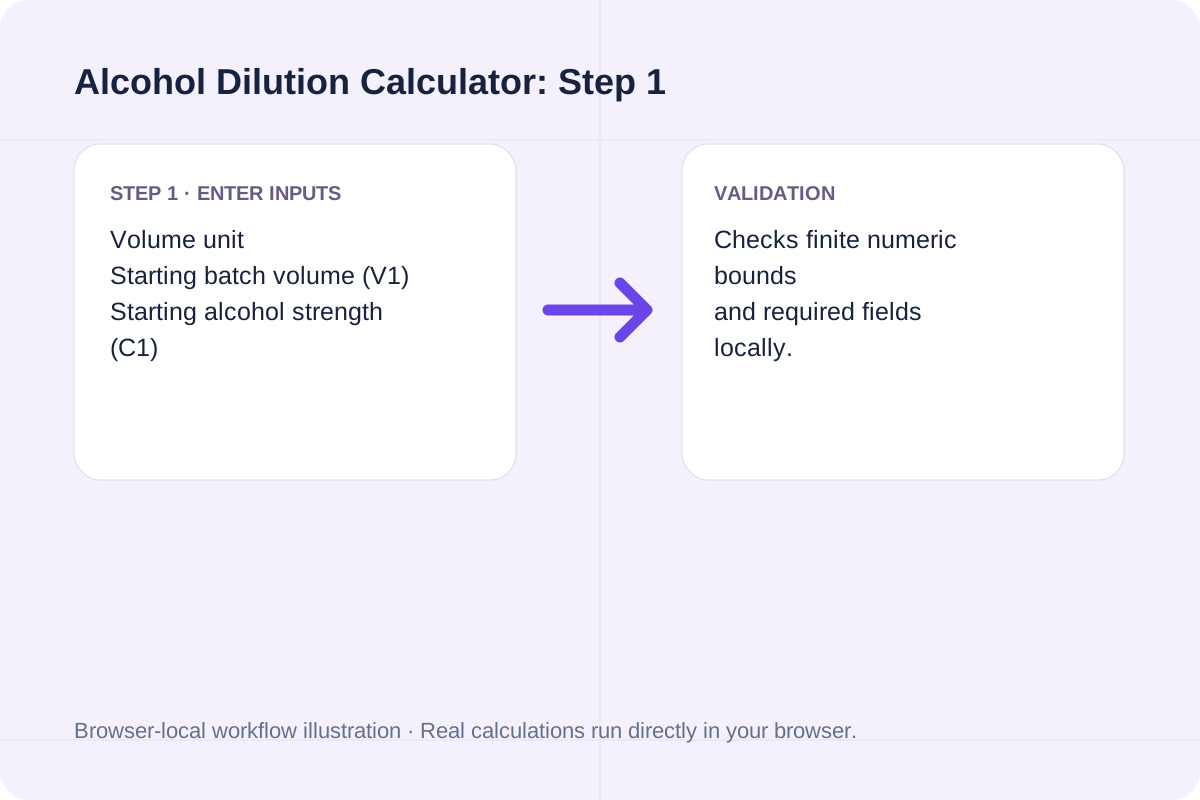
Input the current liquid volume (V1) and measured starting strength (C1) in percent ABV.
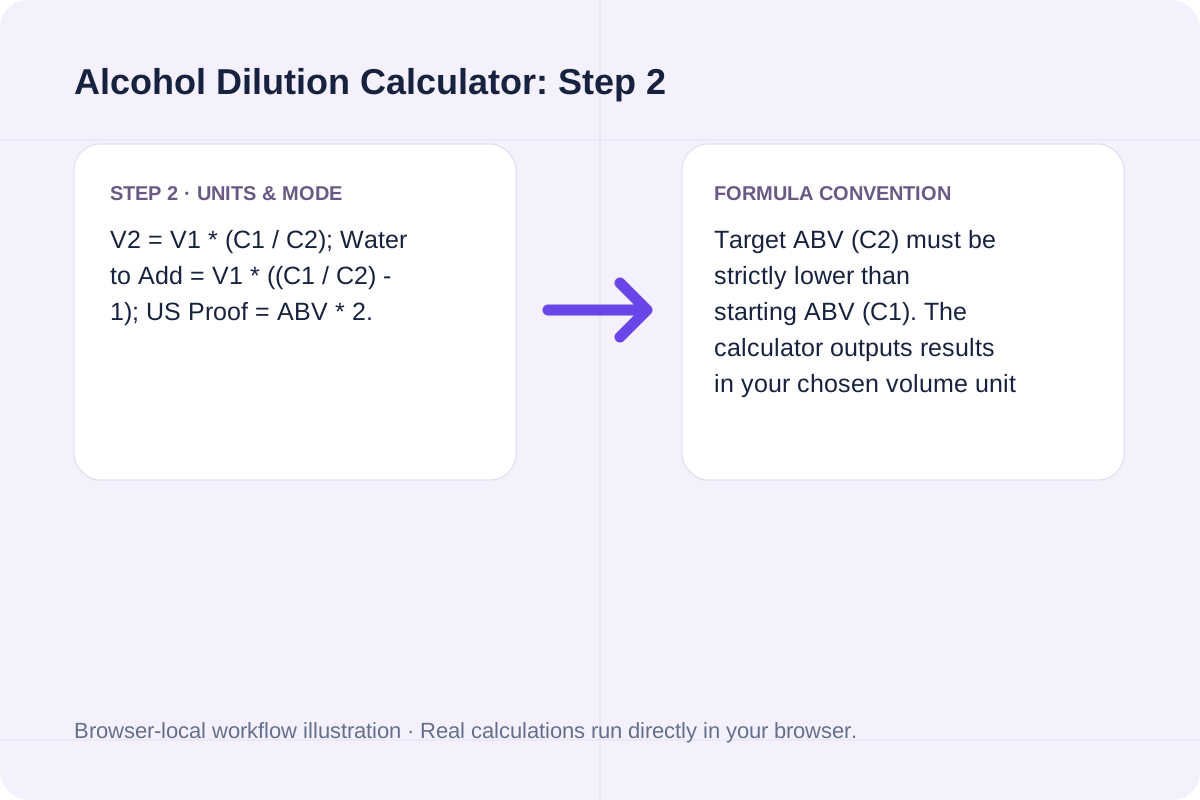
Enter your target strength (C2) and run the calculation to view water to add, total final volume (V2), and starting vs. target US proof.
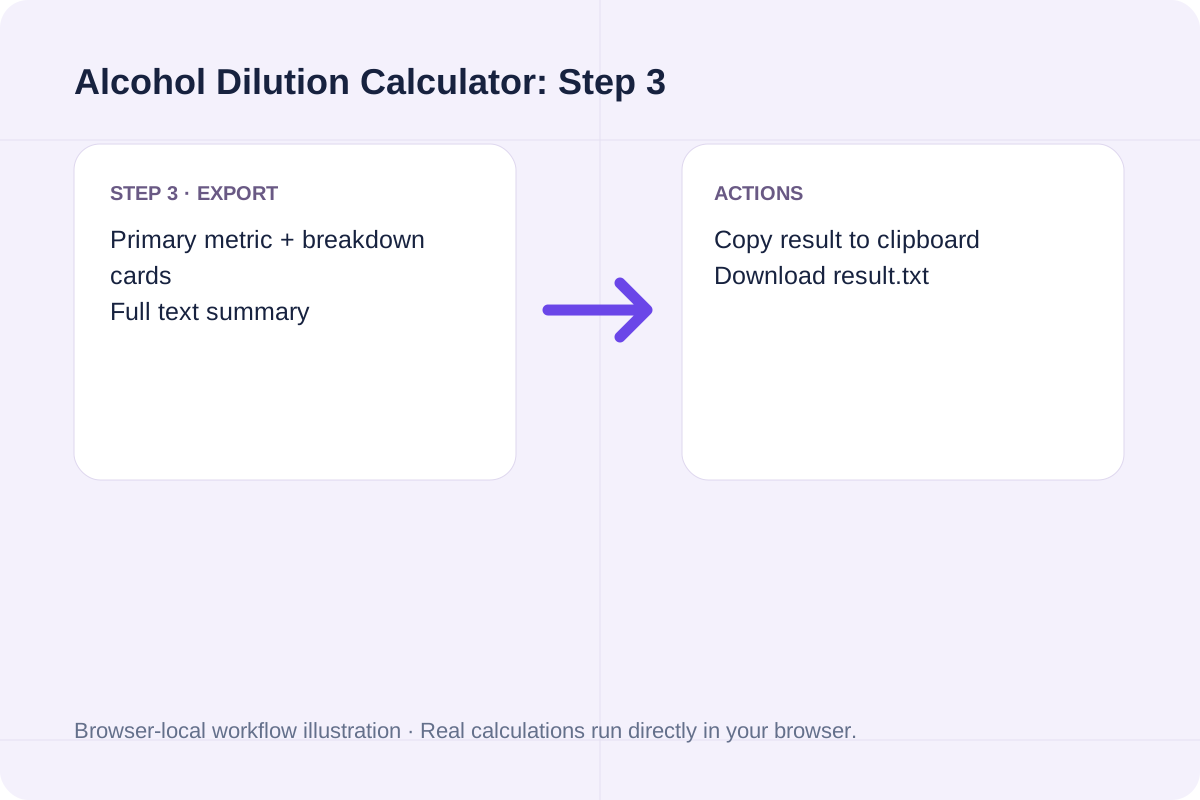
Check these practical proofing and lab dilution scenarios to verify how starting ABV and volume determine water addition.
Diluting 1,000 mL of 65% ABV (130 proof) distillate to 40% ABV (80 proof) requires 625.00 mL of distilled water, yielding 1,625.00 mL total volume with 650.00 mL of pure ethanol.
Cutting 5.00 L of 95% neutral spirit down to 70% ABV for botanical maceration requires 1.79 L (1,785.71 mL) of water, producing 6.79 L of 140-proof base.
Hydrometers are calibrated at 20 C (68 F) or 15.56 C (60 F). Always cool the diluted mixture to calibration temperature before taking a final proof reading.
Use the water-to-add and final volume numbers to check whether your receiving carboy or tank has enough headspace.
The primary output shows the ideal volume of water to add. The breakdown cards list the final total batch volume (V2), pure alcohol volume (which stays constant before and after dilution), dilution factor (C1 / C2), and US proof equivalents.
Keep physical mixing behavior and water quality in mind when proofing spirits or lab solutions.
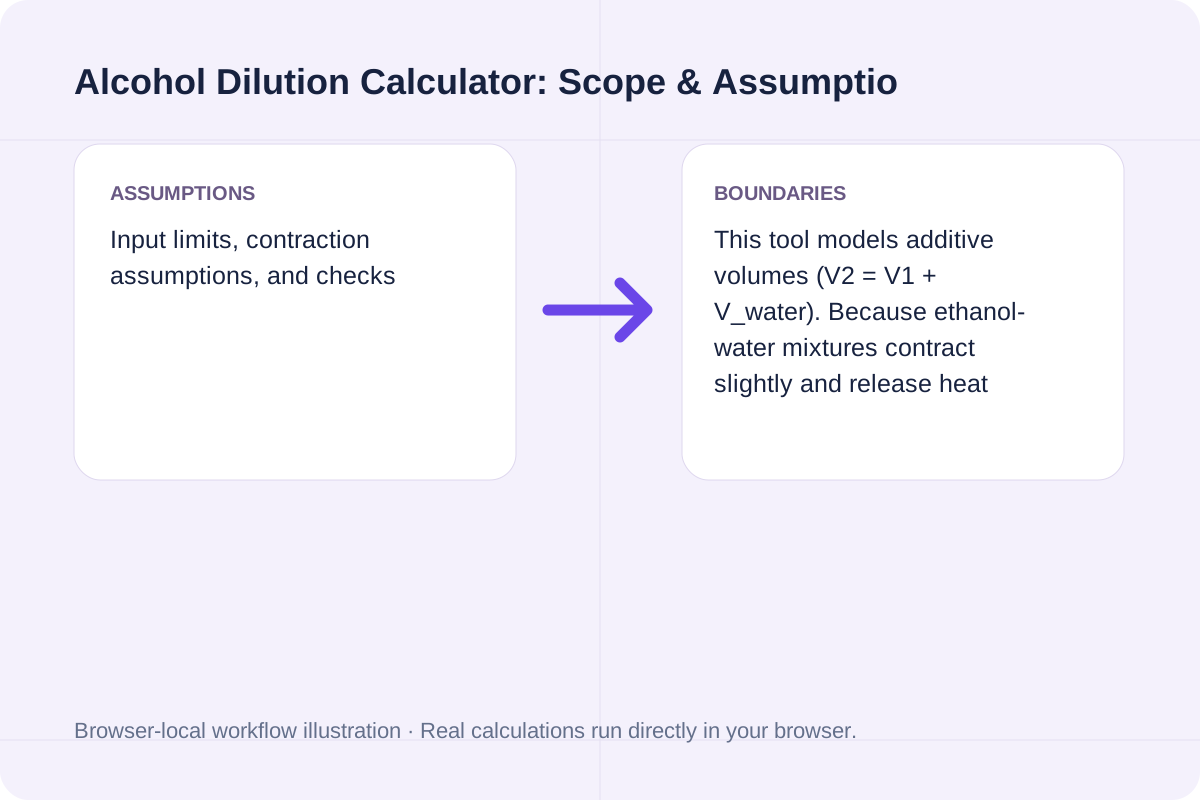
This tool models additive volumes (V2 = V1 + V_water). Because ethanol-water mixtures contract slightly and release heat (exothermic mixing) when combined, commercial distillers use gravimetric mass tables or step-addition with hydrometer checks for excise-tax accuracy. Use distilled or demineralized water to prevent calcium louching (cloudiness).
Estimate alcohol by volume from original and final measured specific gravities.
Open tool
Calculate aquarium water volume in US gallons and liters, substrate displacement, and filled water weight from interior tank dimensions.
Open tool
Find total dough hydration including starter and additional water needed for a supplied target.
Open toolChoose another tool for your next calculation, conversion, or text task.
Fold a supplied signal frequency into the first Nyquist band and show the folding curve.
Open tool
Convert an amplitude ratio into decibels as 20 × log10(value / reference).
Open tool
Calculate baker percentages and rescale all ingredients to a target flour mass.
Open tool
Calculate salt mass from a supplied water, food and concentration convention.
Open toolAnswers about using Alcohol Dilution Calculator and understanding its results.
It uses the standard dilution equation C1 * V1 = C2 * V2, where V1 is starting volume, C1 is starting ABV, and C2 is target ABV. Final volume V2 equals V1 * (C1 / C2), and water to add equals V2 - V1.
When ethanol and water mix, hydrogen bonding pulls the molecules closer together, causing 1% to 3% volume contraction. For exact commercial bottling proof, add 90% of the calculated water, let the mixture equilibrate to 20 C, and top up using an alcoholmeter.
In the United States, proof is exactly twice the alcohol by volume percentage at 60 F (15.56 C). For example, 40% ABV equals 80 proof, and 65% ABV equals 130 proof.
Yes. As long as both concentrations are expressed in the same percentage basis (v/v) and target concentration is lower than starting concentration, the dilution ratio applies to lab reagents and sanitizing solutions.
Choose another tool for your next calculation, conversion, or text task.