

Shipping Density Calculator
Compute shipment volume in cubic feet and cubic meters, freight density in PCF (lb/ft³), and reference NMFC density freight class from pallet dimensions and weight.
Open toolEnter carton length, width, height, package count, and unit weight in the CBM Calculator below to compute total cubic meters, cubic feet, air and sea volumetric weight, and standard container capacity.
Enter the inputs, then select Calculate CBM.
Result will appear here
The CBM Calculator converts your package dimensions into meters, multiplies length by width by height for a single carton, and scales the volume across your total consignment quantity.
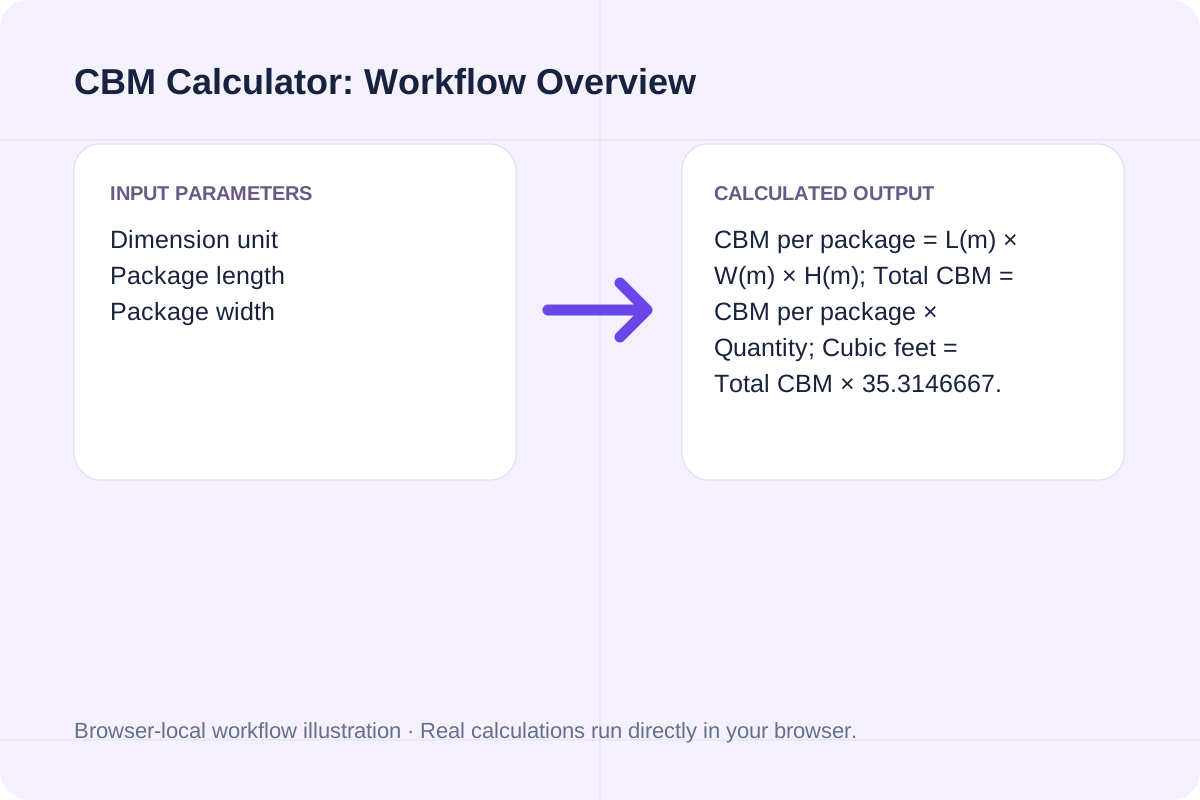
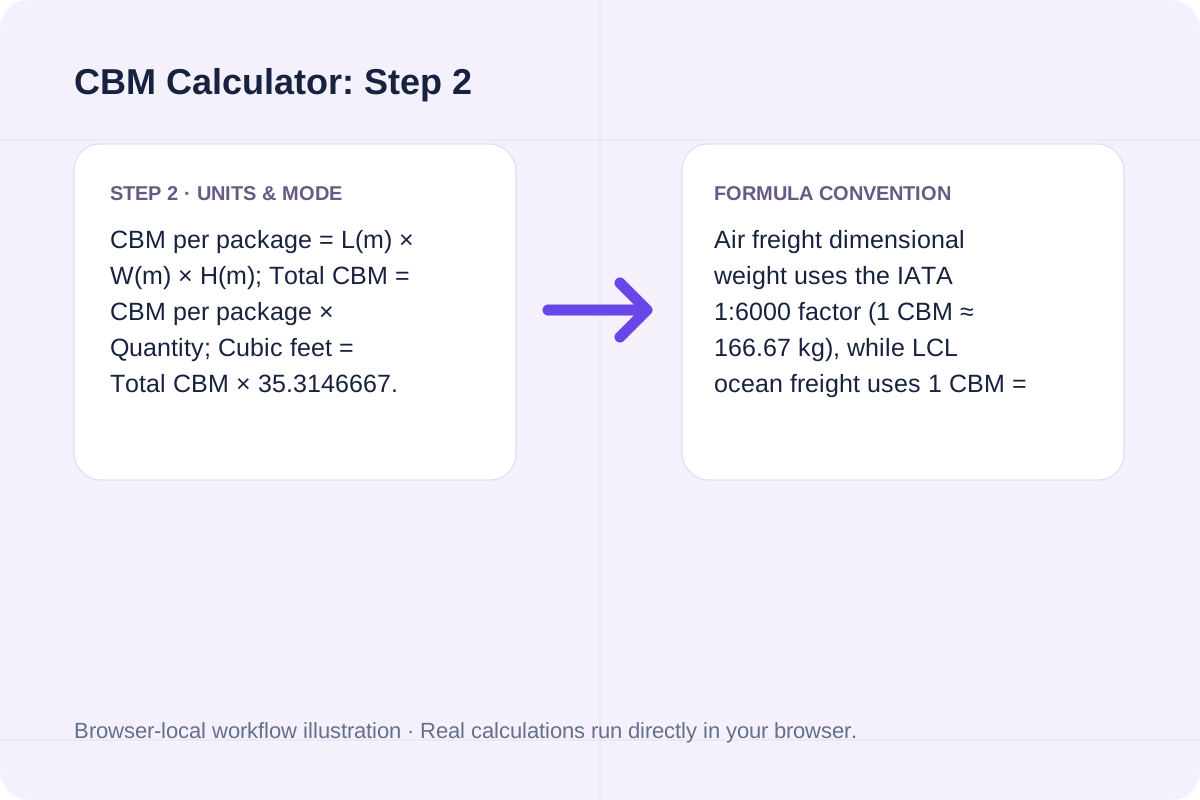
CBM per package = L(m) × W(m) × H(m); Total CBM = CBM per package × Quantity; Cubic feet = Total CBM × 35.3146667.
Air freight dimensional weight uses the IATA 1:6000 factor (1 CBM ≈ 166.67 kg), while LCL ocean freight uses 1 CBM = 1,000 kg. Container count estimates divide working container volume (28, 58, or 68 CBM) by single-carton volume.
Review the input parameters, allowed value ranges, and worked reference cases for the CBM Calculator below before running your calculation.
| Parameter / Scenario | Default / Sample Value | Rule or Allowed Range | Output / Usage Note |
|---|---|---|---|
| Input: Dimension unit | cm | Options: Centimeters (cm), Millimeters (mm), Meters (m), Inches (in) | Required workspace parameter |
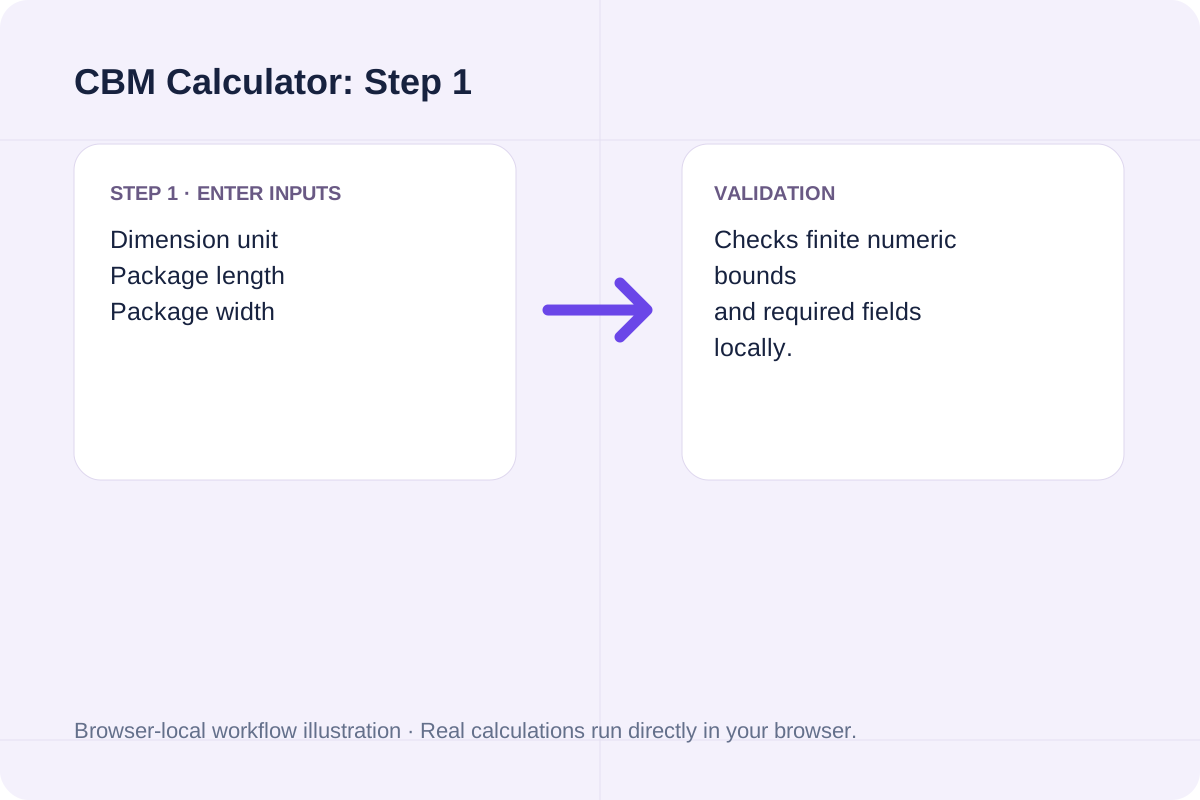
| Input: Package length | 60 | Range: 0.01 to 100000 | Required workspace parameter |
| Input: Package width | 40 | Range: 0.01 to 100000 | Required workspace parameter |
| Input: Package height | 35 | Range: 0.01 to 100000 | Required workspace parameter |
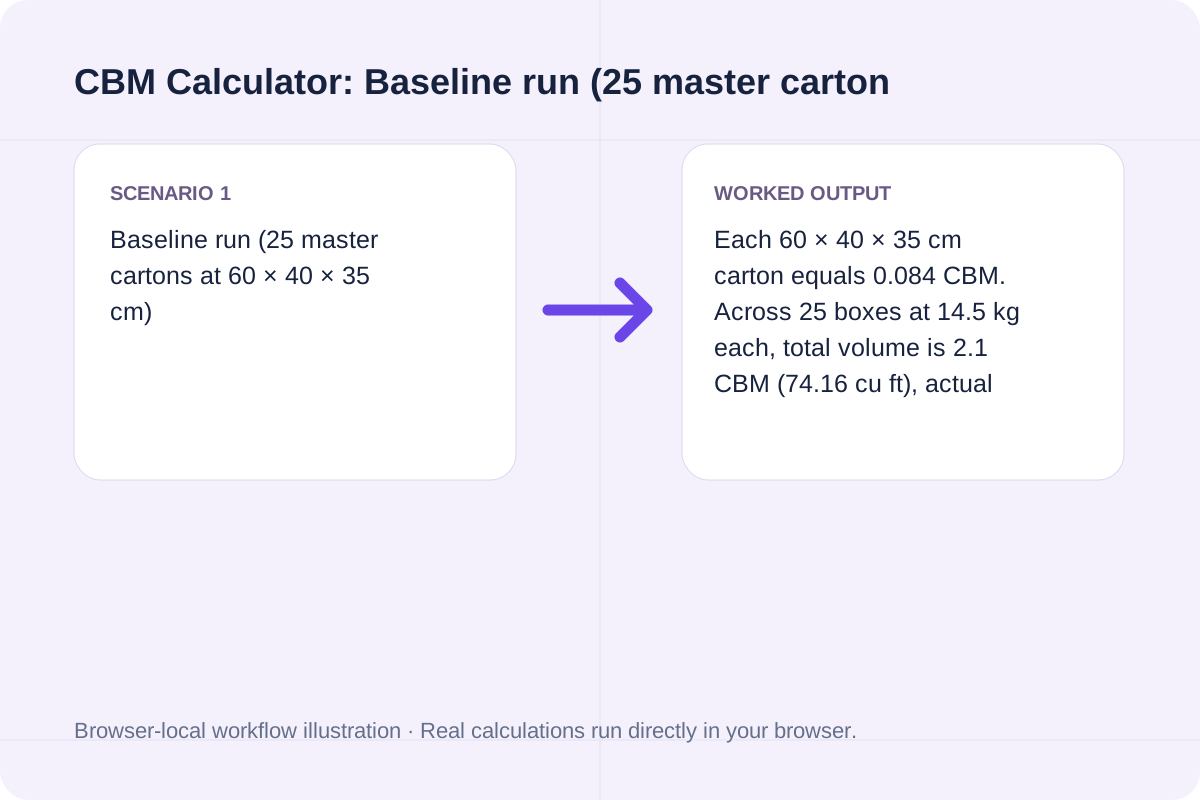
| Worked Case 1: Baseline run (25 master cartons at 60 × 40 × 35 cm) | Preloaded / test values | CBM per carton = Length(m) × Width(m) × Height(m); Total CBM = CBM per carton × Quantity; Air volumetric weight (kg) = Total CBM × 166.67 | Each 60 × 40 × 35 cm carton equals 0.084 CBM. Across 25 boxes at 14.5 kg each, total volume is 2.1 CBM (74.16 cu ft), actual gross weight is 362.5 kg, and air volumetric weight is 350.01 kg. |
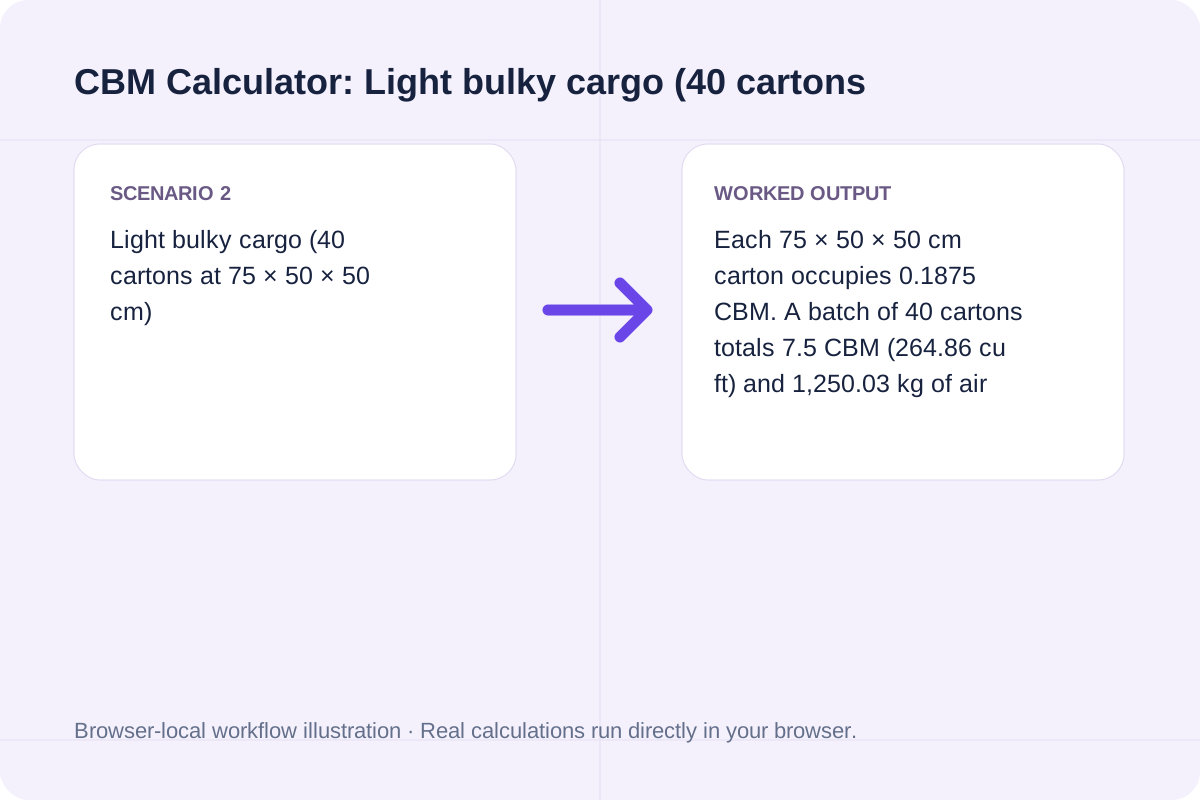
| Worked Case 2: Light bulky cargo (40 cartons at 75 × 50 × 50 cm) | Preloaded / test values | CBM per carton = Length(m) × Width(m) × Height(m); Total CBM = CBM per carton × Quantity; Air volumetric weight (kg) = Total CBM × 166.67 | Each 75 × 50 × 50 cm carton occupies 0.1875 CBM. A batch of 40 cartons totals 7.5 CBM (264.86 cu ft) and 1,250.03 kg of air volumetric weight, with roughly 149 cartons fitting in a 20ft container. |
Measure the outer dimensions of a packed master carton, select your measurement unit, and run the calculation.
Choose cm, mm, m, in, or ft and enter the exterior length, width, and height of one shipping carton, including any bulges or strapping.
Enter the whole number of cartons in the shipment and the gross weight per box in kilograms to compare actual weight against volumetric weight.
Select Calculate CBM to view total cubic meters, cubic feet, air/ocean chargeable weight, and estimated cartons per 20ft, 40ft, and 40ft HC container.
Review two practical freight scenarios to see how carton dimensions translate into CBM and chargeable weight.
Each 60 × 40 × 35 cm carton equals 0.084 CBM. Across 25 boxes at 14.5 kg each, total volume is 2.1 CBM (74.16 cu ft), actual gross weight is 362.5 kg, and air volumetric weight is 350.01 kg.
Each 75 × 50 × 50 cm carton occupies 0.1875 CBM. A batch of 40 cartons totals 7.5 CBM (264.86 cu ft) and 1,250.03 kg of air volumetric weight, with roughly 149 cartons fitting in a 20ft container.
If cartons are stacked on standard 120 × 100 cm pallets, measure the full palletized footprint and height including the wood deck so your LCL or air freight quote matches the warehouse tally.
Compare total CBM, actual gross weight, and carrier volumetric weight before requesting a freight quote.
Freight forwarders bill based on whichever is higher: actual gross weight or volumetric weight. For LCL sea freight, 1 CBM is typically billed against 1,000 kg (1 metric ton), so most boxed goods are billed by CBM. For air freight, any cargo lighter than 166.67 kg per CBM is billed by volumetric weight.
Check the container loading assumptions and unit conversions before finalizing a commercial packing list.
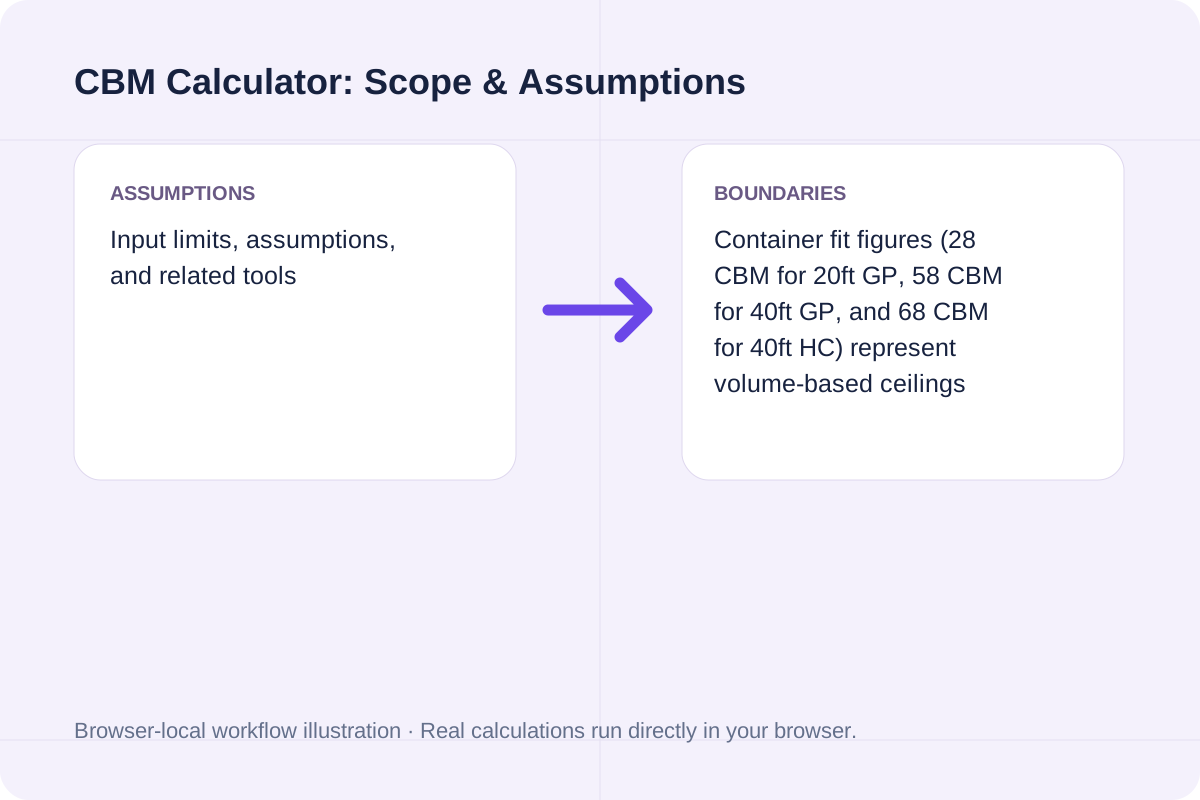
Container fit figures (28 CBM for 20ft GP, 58 CBM for 40ft GP, and 68 CBM for 40ft HC) represent volume-based ceilings using floor-Division of working capacity. Real container loading can be lower if cartons cannot be rotated, if floor weight limits are reached first, or if pallets leave vertical gap space.
Compute shipment volume in cubic feet and cubic meters, freight density in PCF (lb/ft³), and reference NMFC density freight class from pallet dimensions and weight.
Open tool
Calculate aquarium water volume in US gallons and liters, substrate displacement, and filled water weight from interior tank dimensions.
Open tool
Calculate carpet needed in square feet, square yards, and square meters, linear roll length, and cost from room dimensions and waste %.
Open toolChoose another tool for your next calculation, conversion, or text task.

Find a central angle from arc length or sector area and radius.
Open tool
Centripetal acceleration magnitude = speed² / radius.
Open tool
Calculate how much water to add and total final volume when diluting spirits or alcohol from initial ABV to target ABV.
Open tool
Calculate saddle-stitch or signature booklet page counts, blank padding pages, duplex sheets, paper weight, and imposition spread order.
Open toolAnswers about using CBM Calculator and understanding its results.
To find cubic meters from centimeters, multiply length × width × height in cm and divide by 1,000,000. From inches, convert each side to meters by multiplying by 0.0254 before multiplying the three dimensions together.
Actual gross weight is the physical scale weight of your cargo. Volumetric (dimensional) weight converts cargo volume into an equivalent weight using a carrier density factor, such as 1 CBM = 166.67 kg for international air freight or 1 CBM = 1,000 kg for LCL ocean freight.
While theoretical internal volumes are 33.2 CBM (20ft), 67.7 CBM (40ft), and 76.4 CBM (40ft HC), usable loading capacity for boxed cargo typically averages 28 CBM, 58 CBM, and 68 CBM respectively due to carton geometry and door clearance.
Yes. All calculations run locally in your browser with no server uploads. Use Copy result or Download result.txt to save the volume, weight, and container fit figures.
Choose another tool for your next calculation, conversion, or text task.