

Curtain Fabric Calculator
Calculate curtain fabric yardage or meters, number of fabric widths, and cut drop length from rod width, drop, fullness, and pattern repeat.
Open toolEnter your finished binding width, required tape length, and usable fabric width in the Bias Tape Calculator below to compute unfinished cut strip width, continuous-bias square dimensions, and bolt length.
Enter the inputs, then select Calculate Bias Tape.
Result will appear here
The Bias Tape Calculator multiplies your finished binding width by the fold factor (2x for single-fold or 4x for double-fold), calculates the total surface area of bias strips required including your seam waste allowance, and derives both the continuous-method square size and full-width bolt cut.
Cut Width = Finished * FoldFactor; Gross Area = Cut Width * Length * (1 + Waste%); Square Side = sqrt(Gross Area).
Also converts your required tape length and bolt cut into yards (for inches) or meters (for centimeters).
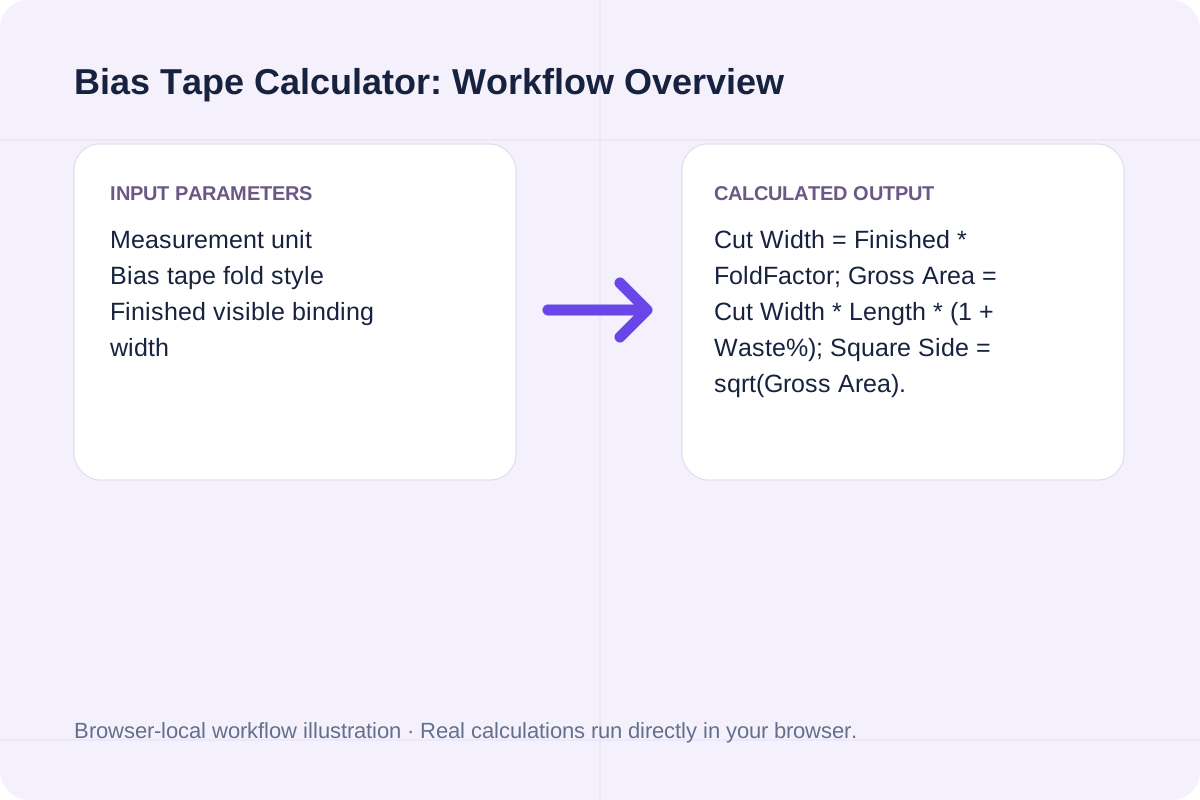
Review the input parameters, allowed value ranges, and worked reference cases for the Bias Tape Calculator below before running your calculation.
| Parameter / Scenario | Default / Sample Value | Rule or Allowed Range | Output / Usage Note |
|---|---|---|---|
| Input: Measurement unit | in | Options: Inches (in), Centimeters (cm) | Required workspace parameter |
| Input: Bias tape fold style | double_fold | Options: Double-fold / Quilt binding (Cut width = 4x finished), Single-fold bias tape (Cut width = 2x finished) | Required workspace parameter |
| Input: Finished visible binding width | 0.5 | Range: 0.1 to 20 | Required workspace parameter |
| Input: Total bias tape length needed | 120 | Range: 1 to 100000 | Required workspace parameter |
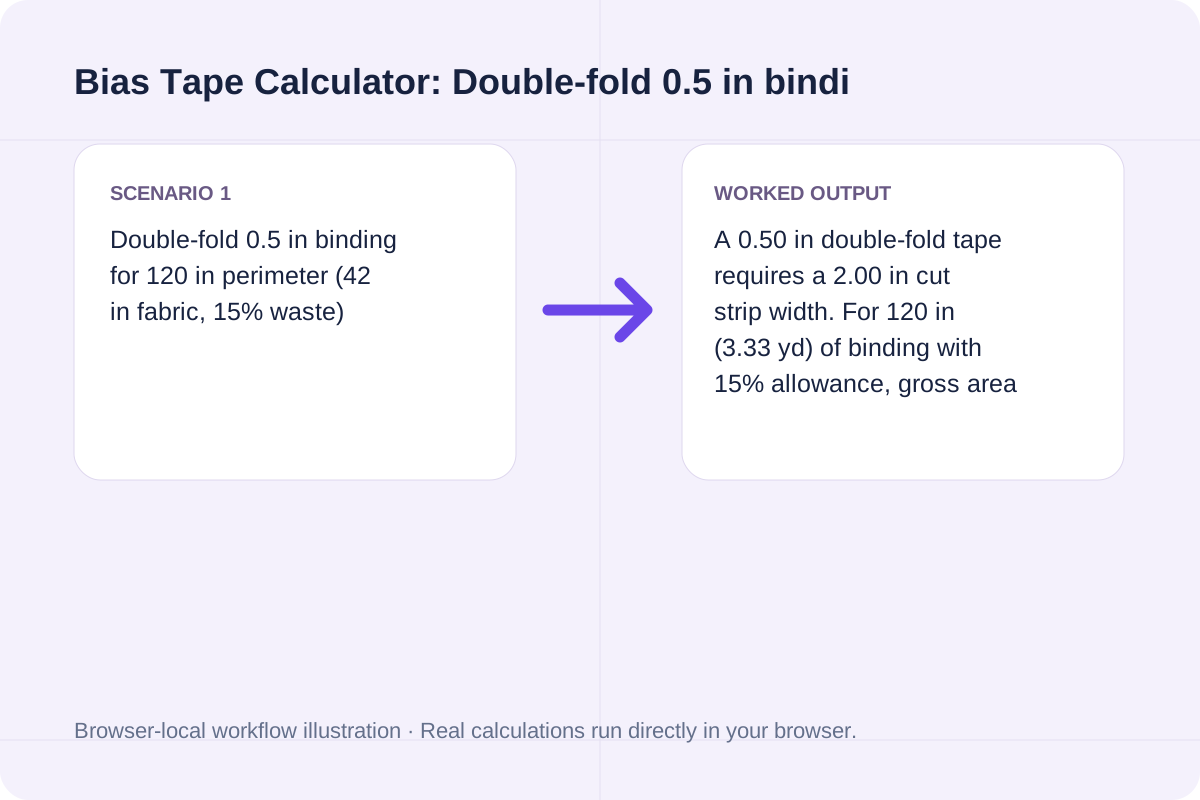
| Worked Case 1: Double-fold 0.5 in binding for 120 in perimeter (42 in fabric, 15% waste) | Preloaded / test values | Cut Strip Width = Finished Width * (4 for double-fold, 2 for single-fold); Gross Area = Cut Width * Needed Length * (1 + Waste%); Continuous Square Side = sqrt(Gross Area) | A 0.50 in double-fold tape requires a 2.00 in cut strip width. For 120 in (3.33 yd) of binding with 15% allowance, gross area is 276.00 in², requiring a 16.61 x 16.61 in continuous bias square (or a 6.57 in cut across a 42 in bolt). |
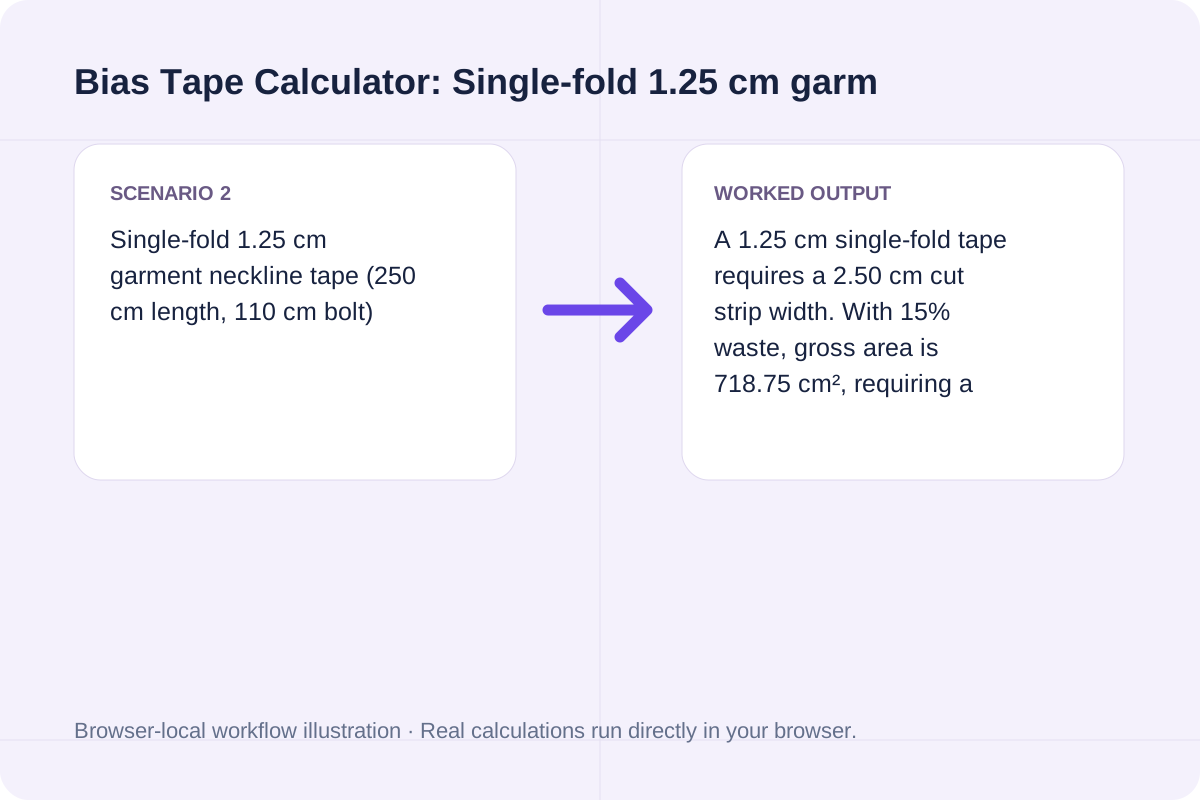
| Worked Case 2: Single-fold 1.25 cm garment neckline tape (250 cm length, 110 cm bolt) | Preloaded / test values | Cut Strip Width = Finished Width * (4 for double-fold, 2 for single-fold); Gross Area = Cut Width * Needed Length * (1 + Waste%); Continuous Square Side = sqrt(Gross Area) | A 1.25 cm single-fold tape requires a 2.50 cm cut strip width. With 15% waste, gross area is 718.75 cm², requiring a 26.81 x 26.81 cm fabric square. |
Measure the total neckline, armhole, or quilt perimeter you plan to bind before cutting into your fabric.
Select Inches or Centimeters and pick Double-fold (4x) or Single-fold (2x).
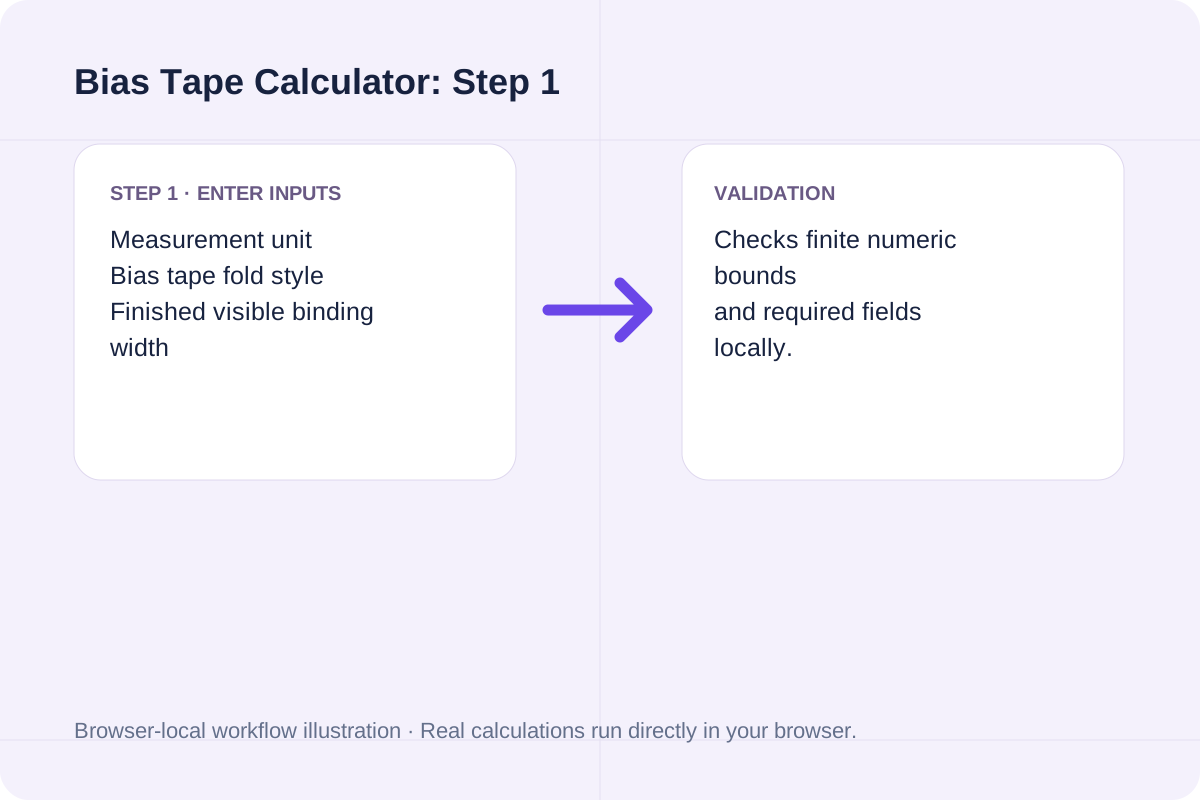
Enter the visible finished binding width (e.g., 0.5 in) and total length of bias tape needed (e.g., 120 in).
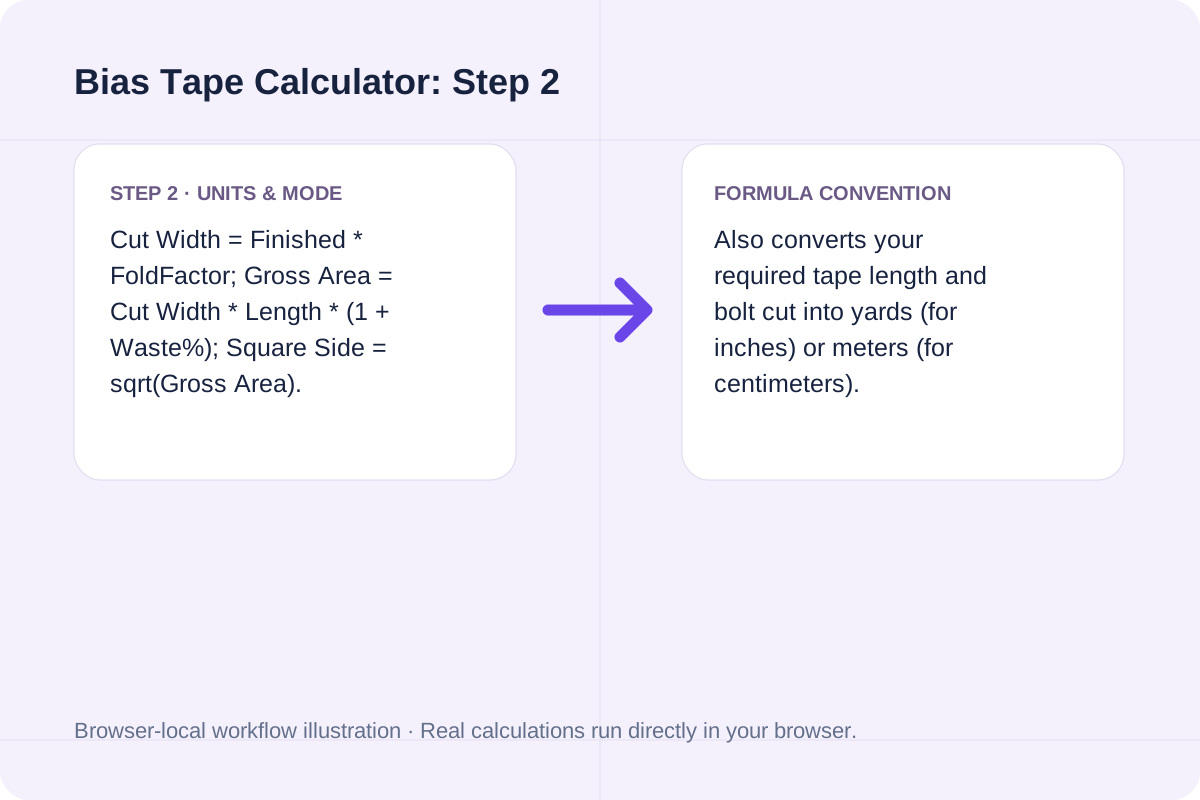
Input your fabric's usable width after trimming selvedges (e.g., 42 in) and click Calculate Bias Tape.
Review these quilting and garment sewing examples to see how strip width and square size relate.
A 0.50 in double-fold tape requires a 2.00 in cut strip width. For 120 in (3.33 yd) of binding with 15% allowance, gross area is 276.00 in², requiring a 16.61 x 16.61 in continuous bias square (or a 6.57 in cut across a 42 in bolt).
A 1.25 cm single-fold tape requires a 2.50 cm cut strip width. With 15% waste, gross area is 718.75 cm², requiring a 26.81 x 26.81 cm fabric square.
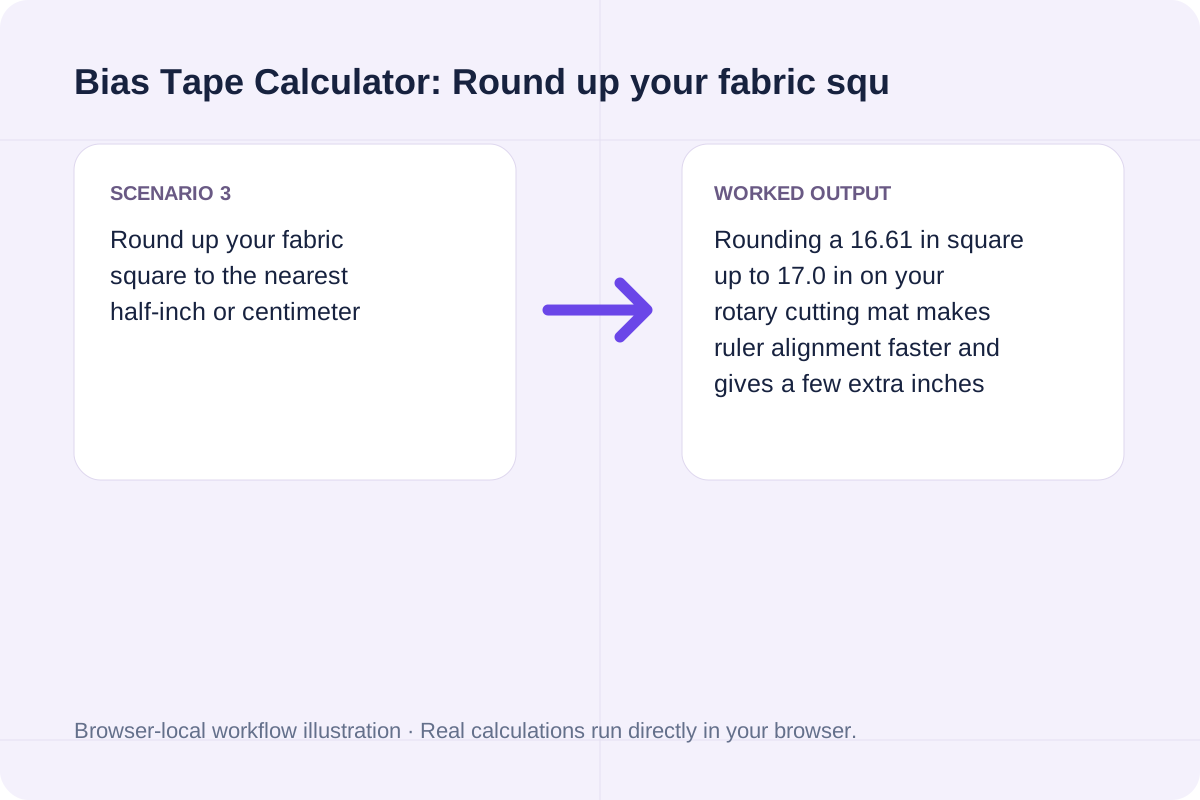
Rounding a 16.61 in square up to 17.0 in on your rotary cutting mat makes ruler alignment faster and gives a few extra inches of binding tail.
Use the Cut Strip Width for your bias tape maker and the Continuous Square Side for rotary cutting.
Note that commercial bias tape makers are labeled by their single-fold output width (for example, a '1/2 inch' metal tape maker takes a 1-inch strip and produces a 1/2-inch single-fold tape, which folds in half again to a 1/4-inch double-fold binding). Always check the Cut Strip Width card against your tool slot.
Check bolt width and directional prints before cutting a continuous bias tube.
The continuous bias tube method places diagonal seams at regular intervals and angles striped or directional prints at 45 degrees. If your required square side exceeds your usable bolt width, cut the reported full-width Bolt Cut Length instead.
Calculate curtain fabric yardage or meters, number of fabric widths, and cut drop length from rod width, drop, fullness, and pattern repeat.
Open tool
Calculate drywall sheets (4x8, 4x10, 4x12), wall and ceiling square footage, joint mud, tape, and screws from room dimensions and openings.
Open tool
Calculate carpet needed in square feet, square yards, and square meters, linear roll length, and cost from room dimensions and waste %.
Open toolChoose another tool for your next calculation, conversion, or text task.
Calculate mechanical bicycle trail from wheel radius, head angle and fork offset.
Open tool
Find ideal bicycle pedal cadence or speed using wheel circumference and gear ratio.
Open tool
Calculate waist radius, outer hem radius, hem sweep, and fabric yardage for full, 3/4, half, or quarter circle skirts with seam allowance.
Open tool
Find stitched design and fabric-cut dimensions from stitch counts and fabric count.
Open toolAnswers about using Bias Tape Calculator and understanding its results.
For single-fold bias tape (where both raw edges meet in the center on the back), cut strips at 2x the finished width. For double-fold bias tape or standard quilt binding (folded to the center and then folded in half again), cut strips at 4x the finished width.
A square of fabric is cut in half diagonally, sewn into a parallelogram, and marked in parallel lines at your Cut Strip Width. The ends are offset by one strip width and sewn into a tube, allowing you to cut one continuous spiral strip.
Every diagonal join consumes a 45-degree seam allowance, and the triangular ends ('dog-ears') at the start and end of a continuous tube cannot be used. Adding 15% ensures your usable finished length meets your target perimeter.
When the required square side exceeds your usable bolt width, cut a rectangle of full bolt width by the calculated Bolt Cut Length (or make two smaller continuous squares).
Choose another tool for your next calculation, conversion, or text task.