

Bias Tape Calculator
Calculate bias strip cut width, continuous bias fabric square dimensions, and bolt yardage for single-fold or double-fold bias tape.
Open toolSelect your unit and skirt fullness (Full, 3/4, Half, or Quarter circle) and enter your waist, length, and seam allowances in the Circle Skirt Calculator below to get your exact waist cutting radius, outer hem cutting radius, and hem sweep.
Enter the inputs, then select Calculate Skirt Pattern.
Result will appear here
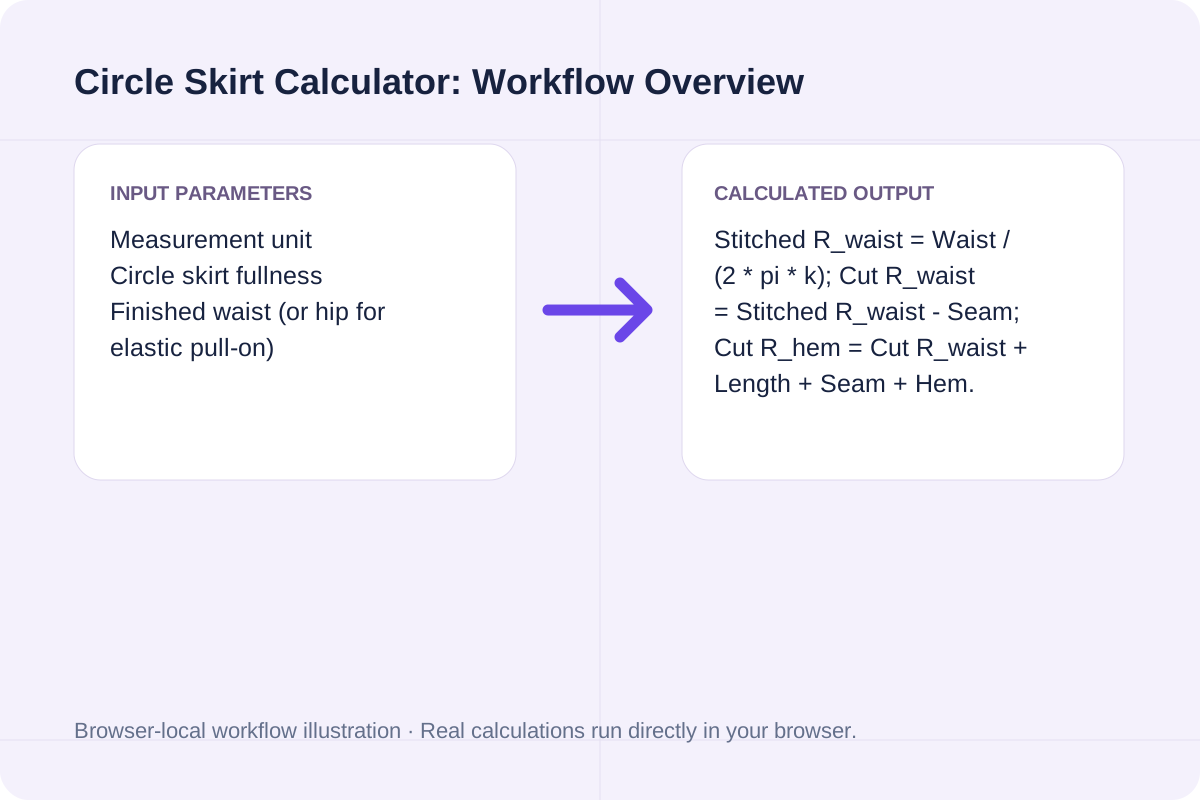
The Circle Skirt Calculator divides your waist measurement by the arc fraction (2*pi*k) to find the stitched waist radius, subtracts your waist seam allowance to find the raw cutting radius from the corner fold, and adds your skirt length plus seam and hem allowances for the outer arc.
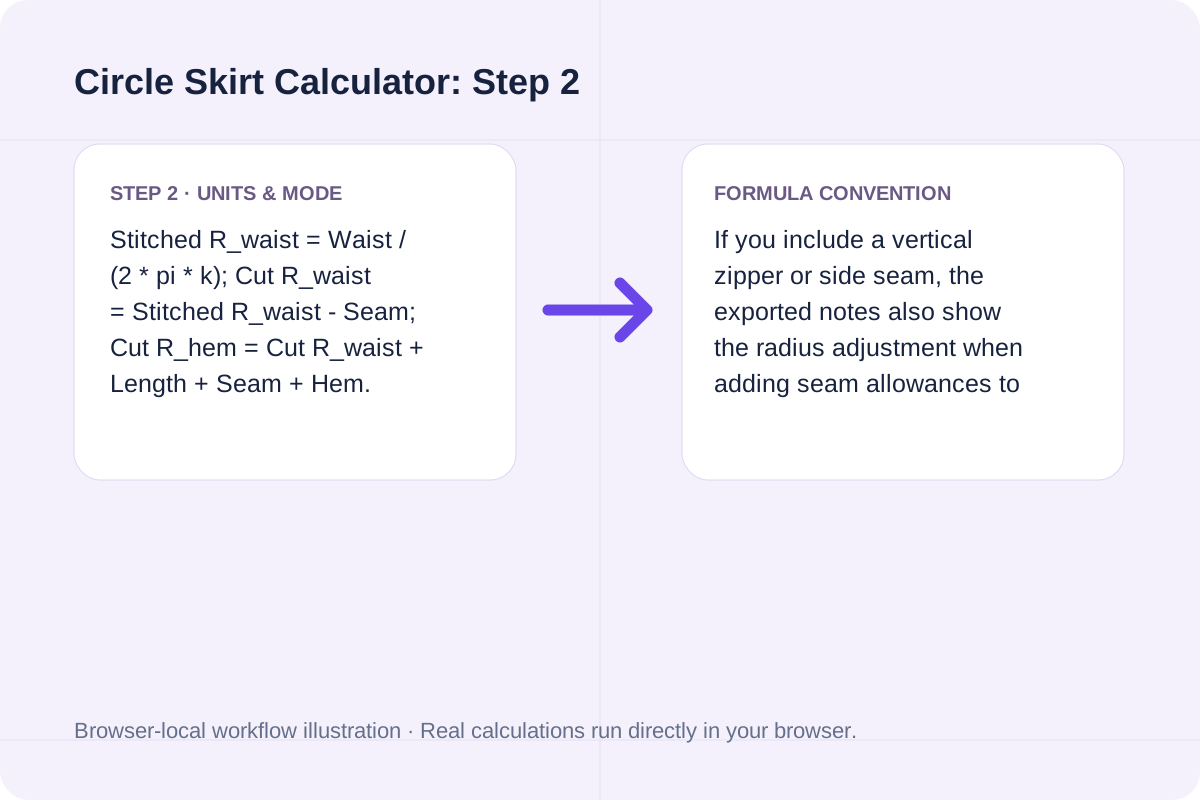
Stitched R_waist = Waist / (2 * pi * k); Cut R_waist = Stitched R_waist - Seam; Cut R_hem = Cut R_waist + Length + Seam + Hem.
If you include a vertical zipper or side seam, the exported notes also show the radius adjustment when adding seam allowances to the straight edges.
Review the input parameters, allowed value ranges, and worked reference cases for the Circle Skirt Calculator below before running your calculation.
| Parameter / Scenario | Default / Sample Value | Rule or Allowed Range | Output / Usage Note |
|---|---|---|---|
| Input: Measurement unit | in | Options: Inches (in), Centimeters (cm) | Required workspace parameter |
| Input: Circle skirt fullness | full | Options: Full Circle Skirt (360 deg), Three-Quarter Circle Skirt (270 deg), Half Circle Skirt (180 deg), Quarter Circle / A-Line Skirt (90 deg) | Required workspace parameter |
| Input: Finished waist (or hip for elastic pull-on) | 28 | Range: 10 to 250 | Required workspace parameter |
| Input: Finished skirt length (waist to hem) | 22 | Range: 4 to 150 | Required workspace parameter |
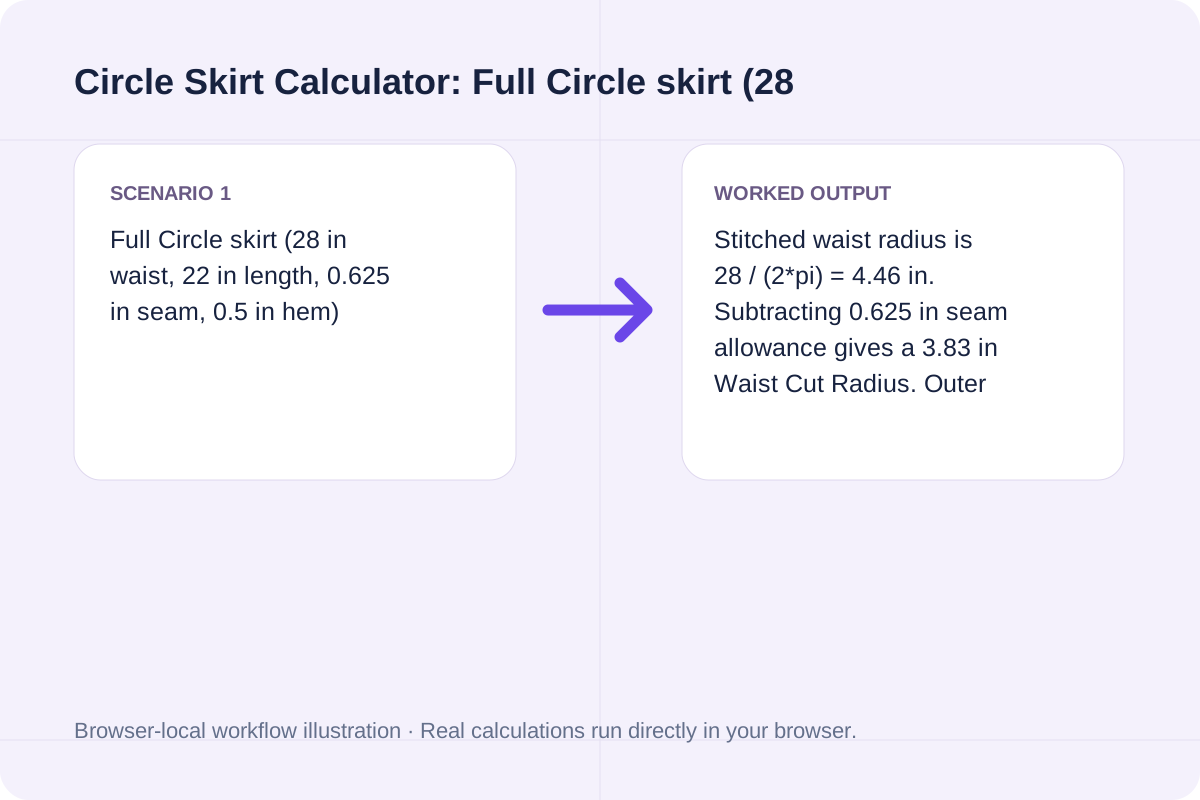
| Worked Case 1: Full Circle skirt (28 in waist, 22 in length, 0.625 in seam, 0.5 in hem) | Preloaded / test values | Waist Cut Radius (R_w) = (Waist / (2 * pi * Fraction)) - SeamAllowance; Outer Cut Radius (R_h) = R_w + SkirtLength + SeamAllowance + HemAllowance | Stitched waist radius is 28 / (2*pi) = 4.46 in. Subtracting 0.625 in seam allowance gives a 3.83 in Waist Cut Radius. Outer Hem Cut Radius is 3.83 + 22 + 0.625 + 0.5 = 26.96 in (requiring a 53.91 in fabric diameter and 166.25 in hem sweep). |
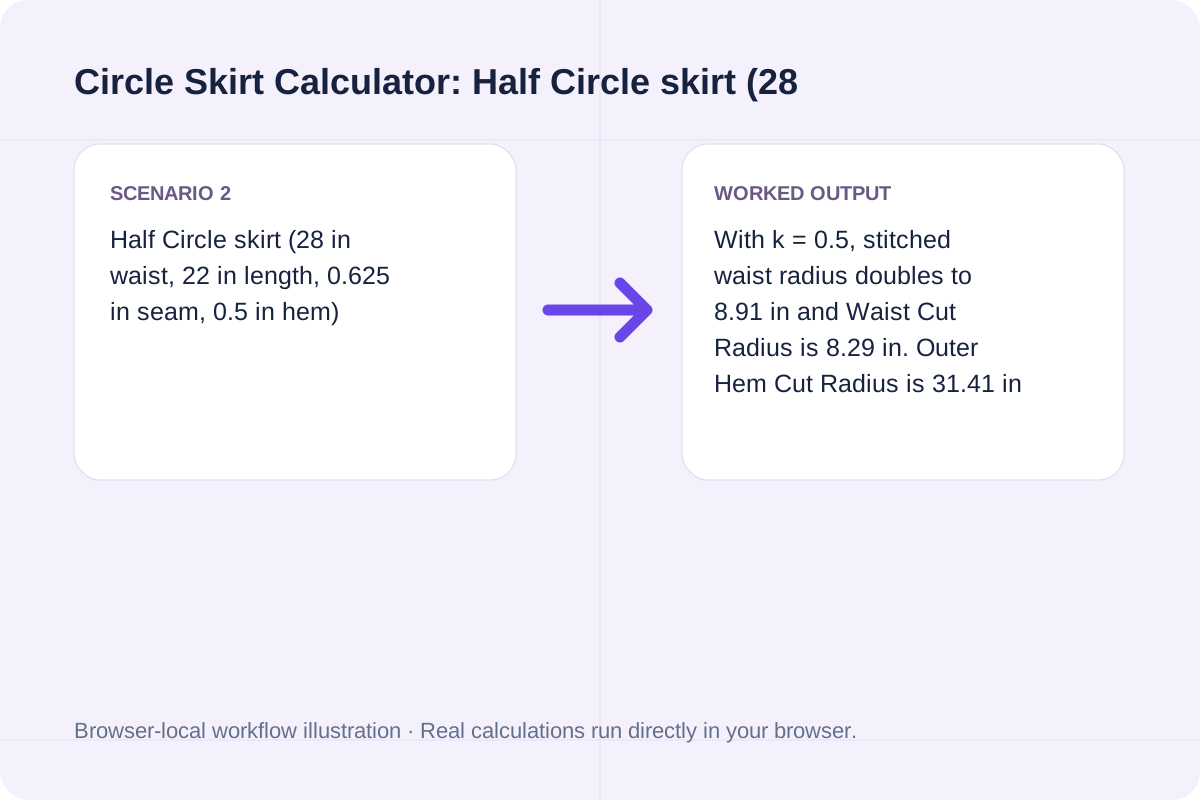
| Worked Case 2: Half Circle skirt (28 in waist, 22 in length, 0.625 in seam, 0.5 in hem) | Preloaded / test values | Waist Cut Radius (R_w) = (Waist / (2 * pi * Fraction)) - SeamAllowance; Outer Cut Radius (R_h) = R_w + SkirtLength + SeamAllowance + HemAllowance | With k = 0.5, stitched waist radius doubles to 8.91 in and Waist Cut Radius is 8.29 in. Outer Hem Cut Radius is 31.41 in with a 97.12 in finished hem sweep. |
Measure your waist (or full hips for a pull-on elastic waist) and desired skirt length from waist to knee or midi.
Select Inches or Centimeters and choose Full (360 deg), Three-Quarter (270 deg), Half (180 deg), or Quarter (90 deg) circle.
Input your waist circumference and desired finished length.
Enter your waist seam allowance (e.g., 0.625 in = 5/8 in) and hem allowance (e.g., 0.5 in), then click Calculate Skirt Pattern.
Compare a 28-inch waist Full Circle skirt against a Half Circle skirt of the same length.
Stitched waist radius is 28 / (2*pi) = 4.46 in. Subtracting 0.625 in seam allowance gives a 3.83 in Waist Cut Radius. Outer Hem Cut Radius is 3.83 + 22 + 0.625 + 0.5 = 26.96 in (requiring a 53.91 in fabric diameter and 166.25 in hem sweep).
With k = 0.5, stitched waist radius doubles to 8.91 in and Waist Cut Radius is 8.29 in. Outer Hem Cut Radius is 31.41 in with a 97.12 in finished hem sweep.
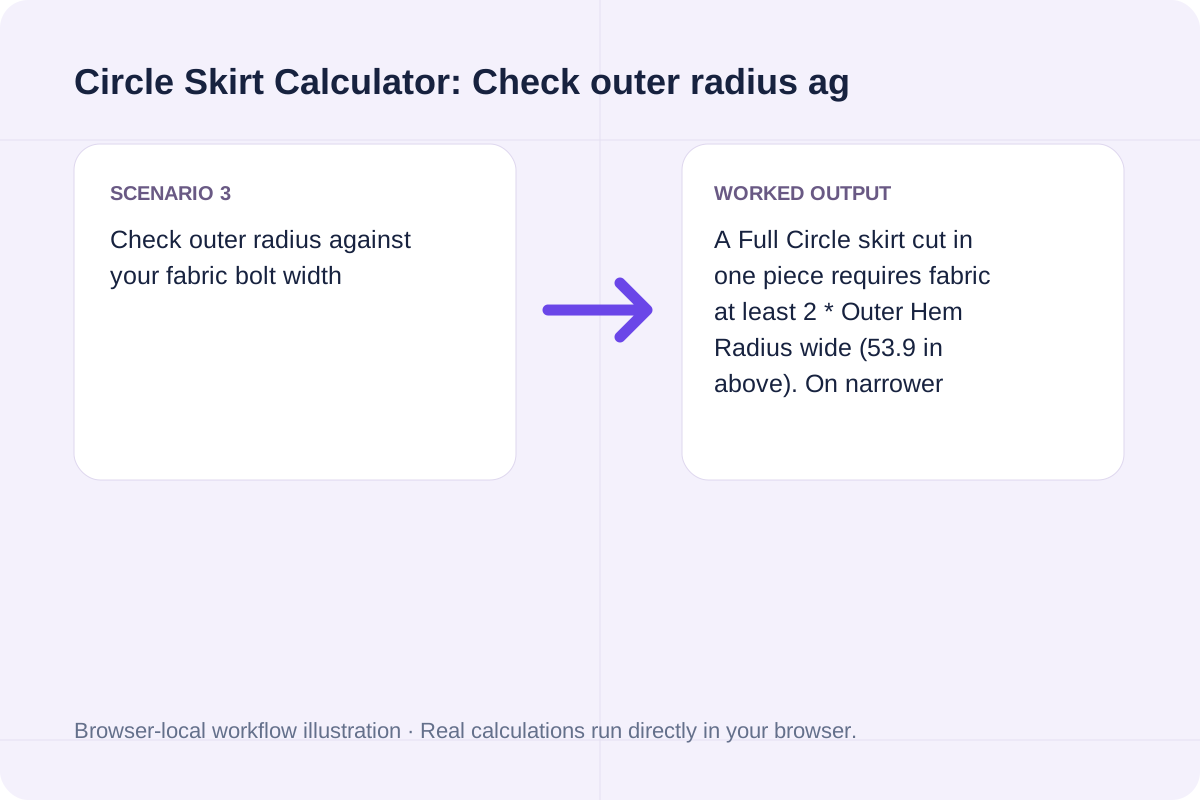
A Full Circle skirt cut in one piece requires fabric at least 2 * Outer Hem Radius wide (53.9 in above). On narrower 44-inch fabric, cut two Half-Circle panels and join them with two side seams.
Mark both the Waist Cut Radius and Outer Hem Cut Radius from the same corner pivot point on your folded fabric.
The headline result shows your Waist Cut Radius and Outer Hem Cut Radius. Breakdown cards list Stitched waist radius, Finished hem circumference (sweep, useful for buying bias tape or horsehair braid), Minimum single-piece fabric width, and Two-panel yardage estimate.
Ensure the waist cut radius stays positive when using thick seam allowances on small waists.
Your waist seam allowance must be smaller than the stitched waist radius so the inner cut radius stays greater than zero. To calculate bias binding for your finished hem sweep, copy the Finished Hem Sweep value into the Bias Tape Calculator.
Calculate bias strip cut width, continuous bias fabric square dimensions, and bolt yardage for single-fold or double-fold bias tape.
Open tool
Calculate curtain fabric yardage or meters, number of fabric widths, and cut drop length from rod width, drop, fullness, and pattern repeat.
Open tool
Find ring area as π × (outer radius² − inner radius²).
Open toolChoose another tool for your next calculation, conversion, or text task.

Calculate the intersection area of two disks.
Open tool
Find minor circular segment area as r²(θ − sin θ)/2.
Open tool
Calculate mechanical bicycle trail from wheel radius, head angle and fork offset.
Open tool
Calculate bracelet size, inner circumference, bead-diameter allowance, and bead count from wrist circumference, fit ease, and bead size.
Open toolAnswers about using Circle Skirt Calculator and understanding its results.
The waist opening is an inside curve. Cutting a smaller radius puts extra fabric inside the ring; when you stitch 5/8 inch (1.5 cm) further out from that cut edge, the stitched circle has a larger radius and longer circumference that matches your finished waist.
Let Fraction k be 1.0 (Full), 0.75 (Three-Quarter), 0.50 (Half), or 0.25 (Quarter). Stitched Waist Radius = Waist / (2 * pi * k). Subtract your waist seam allowance to get the raw Waist Cut Radius.
For a pull-on elastic skirt with no zipper opening, enter your widest full-hip measurement (plus 1 inch / 2.5 cm ease) into the 'Finished waist' box so the skirt can slide up over your hips before the elastic gathers it.
A circle skirt rotates through true grain, cross-grain, and 45-degree bias. The bias sections stretch downward under gravity; letting the skirt hang on a dress form or hanger overnight lets you trim the uneven bias drop level before hemming.
Choose another tool for your next calculation, conversion, or text task.