

Bias Tape Calculator
Calculate bias strip cut width, continuous bias fabric square dimensions, and bolt yardage for single-fold or double-fold bias tape.
Open toolEnter your curtain rod width, finished drop length, pleat fullness ratio, bolt width, hem allowance, and optional pattern repeat in the Curtain Fabric Calculator below to compute required fabric widths, cut length per drop, and total yards or meters.
Enter the inputs, then select Calculate Curtain Fabric.
Result will appear here
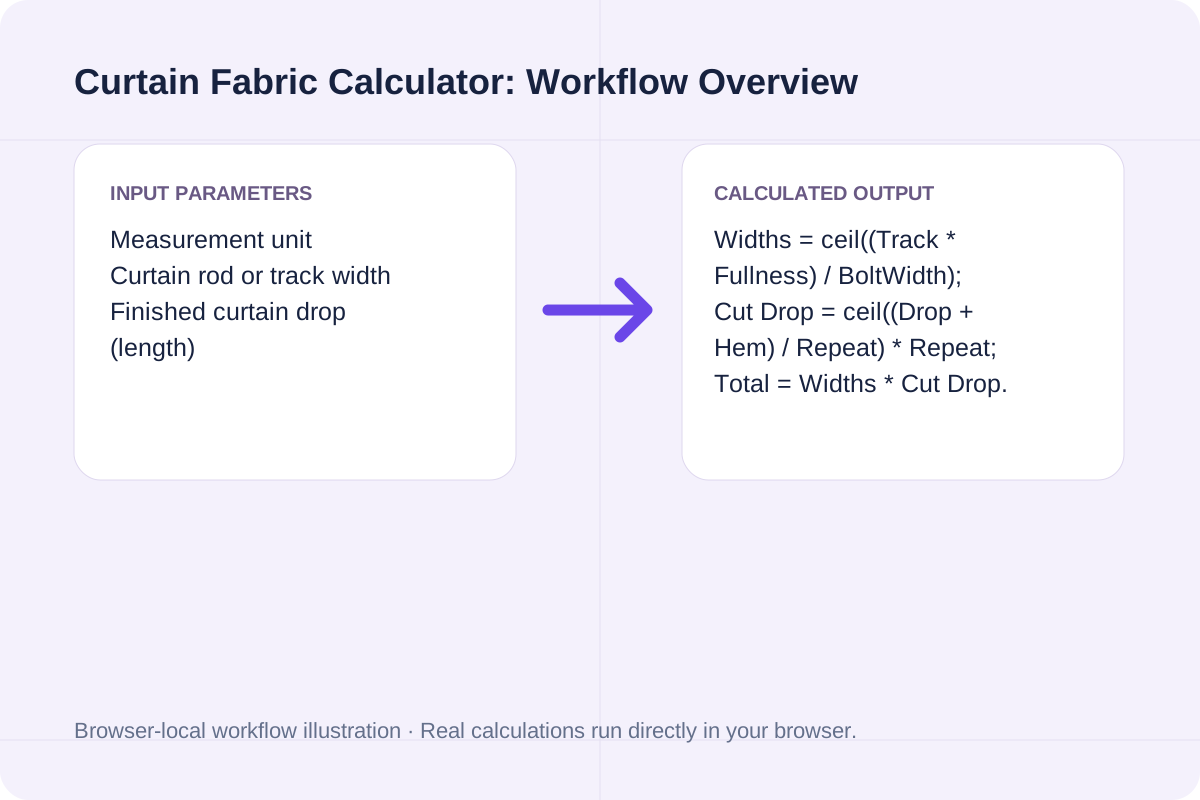
The Curtain Fabric Calculator multiplies your track width by the fullness ratio, divides by usable bolt width to determine how many vertical fabric widths (drops) are required, rounds each drop's cut length up to match any vertical pattern repeat, and converts total length into yards and meters.
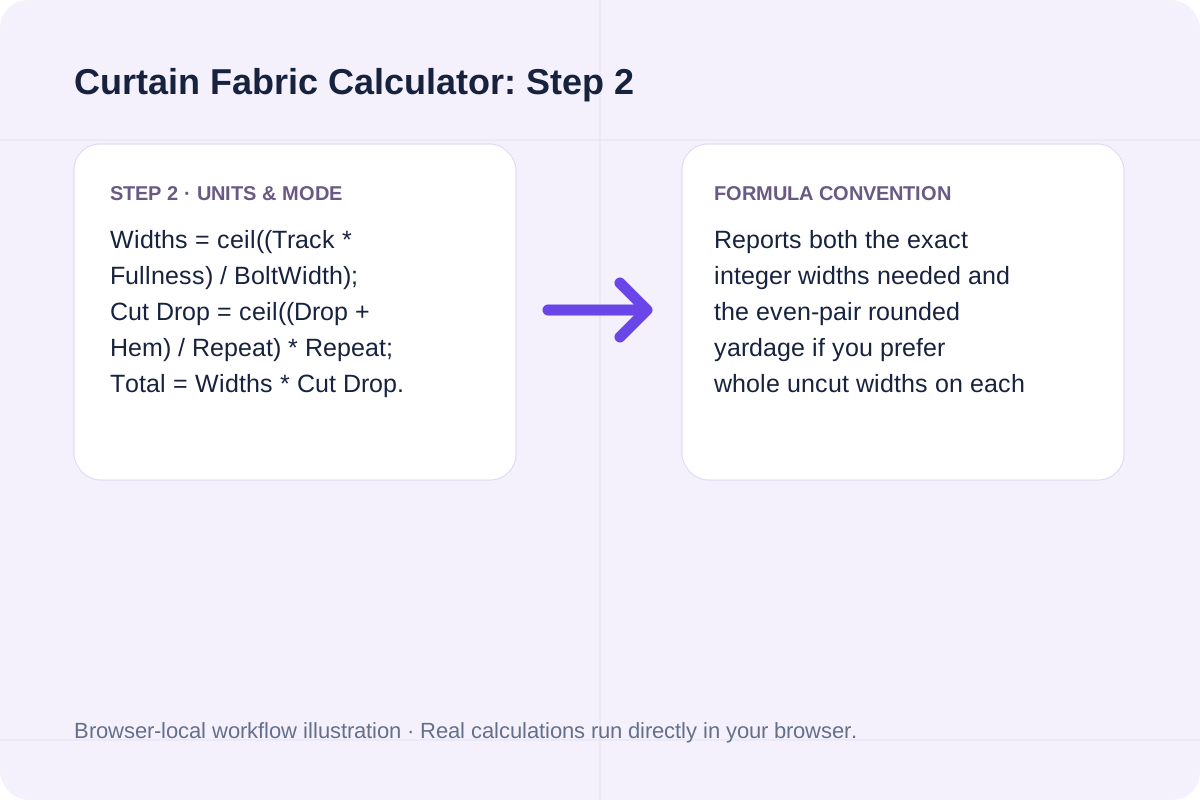
Widths = ceil((Track * Fullness) / BoltWidth); Cut Drop = ceil((Drop + Hem) / Repeat) * Repeat; Total = Widths * Cut Drop.
Reports both the exact integer widths needed and the even-pair rounded yardage if you prefer whole uncut widths on each side of a pair.
Review the input parameters, allowed value ranges, and worked reference cases for the Curtain Fabric Calculator below before running your calculation.
| Parameter / Scenario | Default / Sample Value | Rule or Allowed Range | Output / Usage Note |
|---|---|---|---|
| Input: Measurement unit | in | Options: Inches (in) -> Yards output, Centimeters (cm) -> Meters output | Required workspace parameter |
| Input: Curtain rod or track width | 72 | Range: 10 to 1000 | Required workspace parameter |
| Input: Finished curtain drop (length) | 84 | Range: 10 to 500 | Required workspace parameter |
| Input: Pleat fullness multiplier | 2.0 | Range: 1.2 to 3.5 | Required workspace parameter |
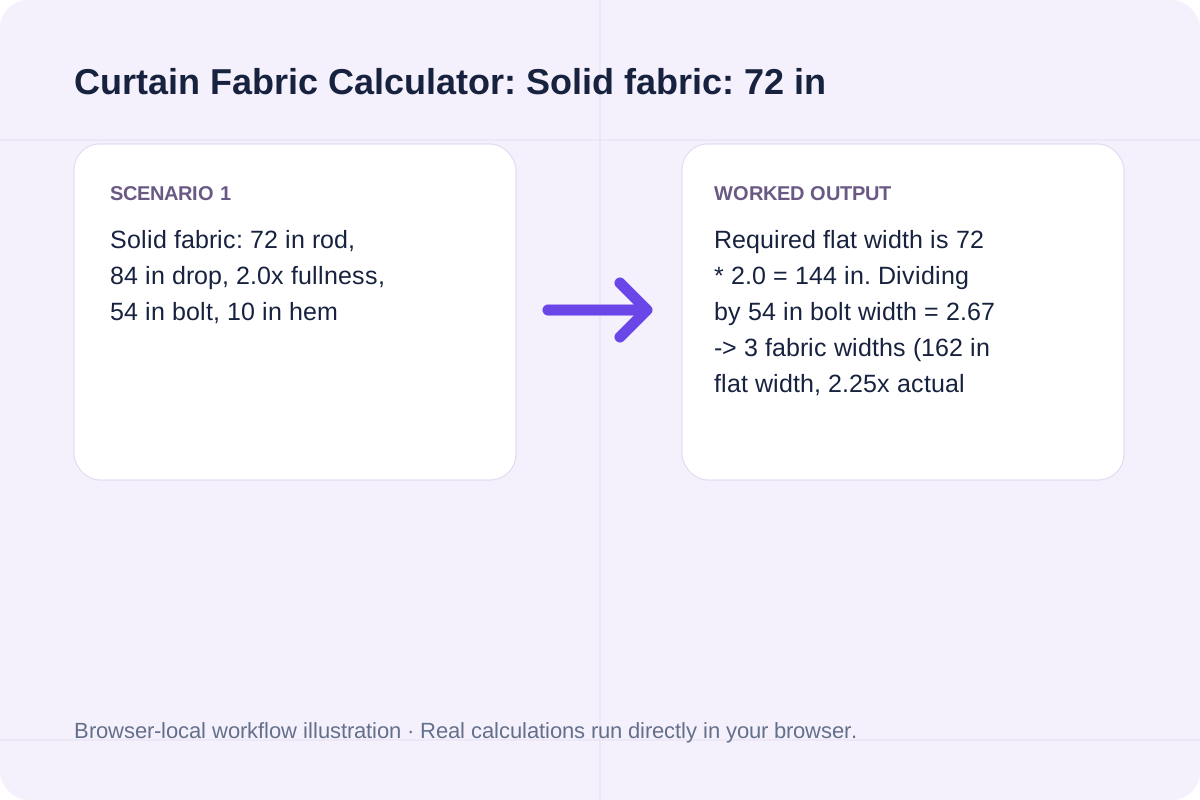
| Worked Case 1: Solid fabric: 72 in rod, 84 in drop, 2.0x fullness, 54 in bolt, 10 in hem | Preloaded / test values | Widths Needed = ceil((TrackWidth * Fullness) / FabricWidth); Raw Cut Drop = FinishedDrop + Allowances; Adjusted Cut Drop = ceil(RawCut / Repeat) * Repeat; Total Fabric = Widths * Adjusted Cut Drop | Required flat width is 72 * 2.0 = 144 in. Dividing by 54 in bolt width = 2.67 -> 3 fabric widths (162 in flat width, 2.25x actual fullness). Each drop cuts at 84 + 10 = 94 in. Total for 3 widths = 282 in (7.83 yd / 7.16 m); for 4 even widths = 376 in (10.44 yd). |
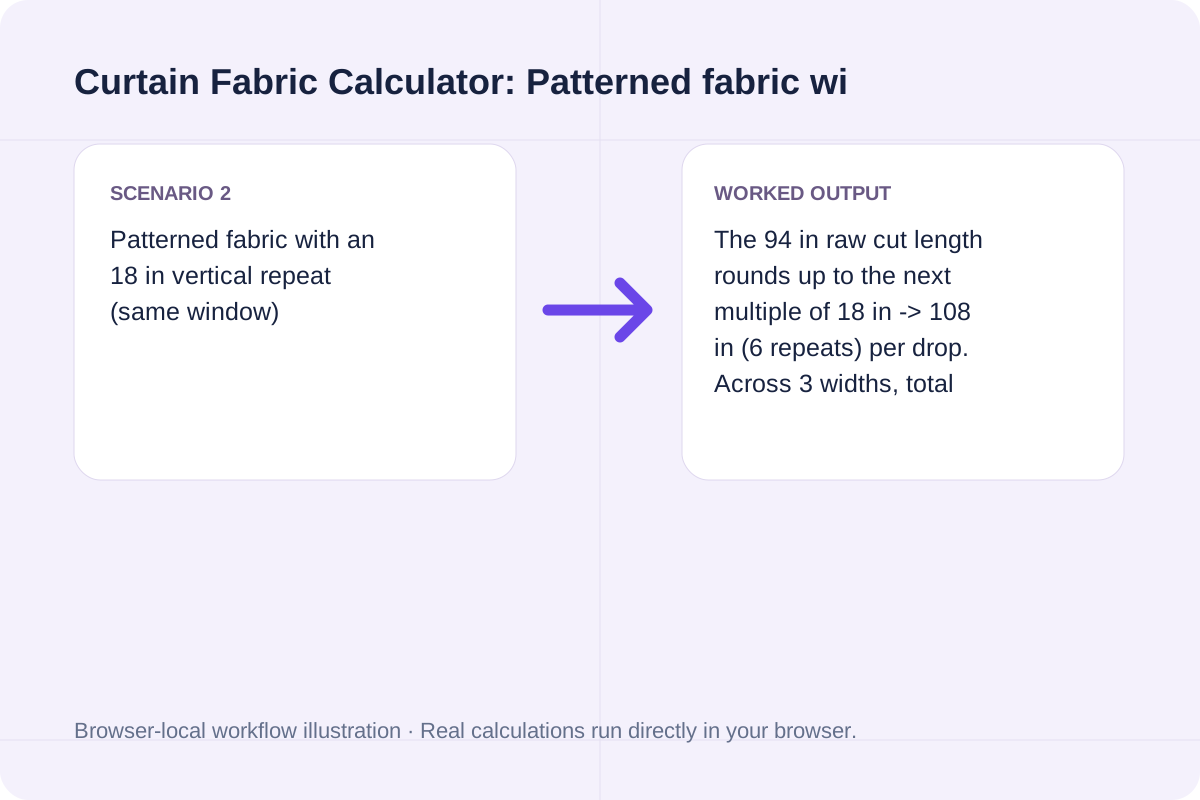
| Worked Case 2: Patterned fabric with an 18 in vertical repeat (same window) | Preloaded / test values | Widths Needed = ceil((TrackWidth * Fullness) / FabricWidth); Raw Cut Drop = FinishedDrop + Allowances; Adjusted Cut Drop = ceil(RawCut / Repeat) * Repeat; Total Fabric = Widths * Adjusted Cut Drop | The 94 in raw cut length rounds up to the next multiple of 18 in -> 108 in (6 repeats) per drop. Across 3 widths, total fabric increases to 324 in (9.00 yd). |
Install or plan your curtain rod height and width before measuring finished drop and ordering fabric.
Choose Inches (in) or Centimeters (cm) and enter your curtain rod width and finished drop length.
Enter your fullness ratio (2.0 for standard gather, 2.5 for pinch pleat) and usable fabric bolt width (e.g., 54 in or 140 cm).
Input combined top/bottom hem allowance (default 10 in / 25 cm) and vertical pattern repeat (0 for solid fabric), then click Calculate Curtain Fabric.
Compare a solid 84-inch curtain pair against a patterned drapery fabric with an 18-inch repeat.
Required flat width is 72 * 2.0 = 144 in. Dividing by 54 in bolt width = 2.67 -> 3 fabric widths (162 in flat width, 2.25x actual fullness). Each drop cuts at 84 + 10 = 94 in. Total for 3 widths = 282 in (7.83 yd / 7.16 m); for 4 even widths = 376 in (10.44 yd).
The 94 in raw cut length rounds up to the next multiple of 18 in -> 108 in (6 repeats) per drop. Across 3 widths, total fabric increases to 324 in (9.00 yd).
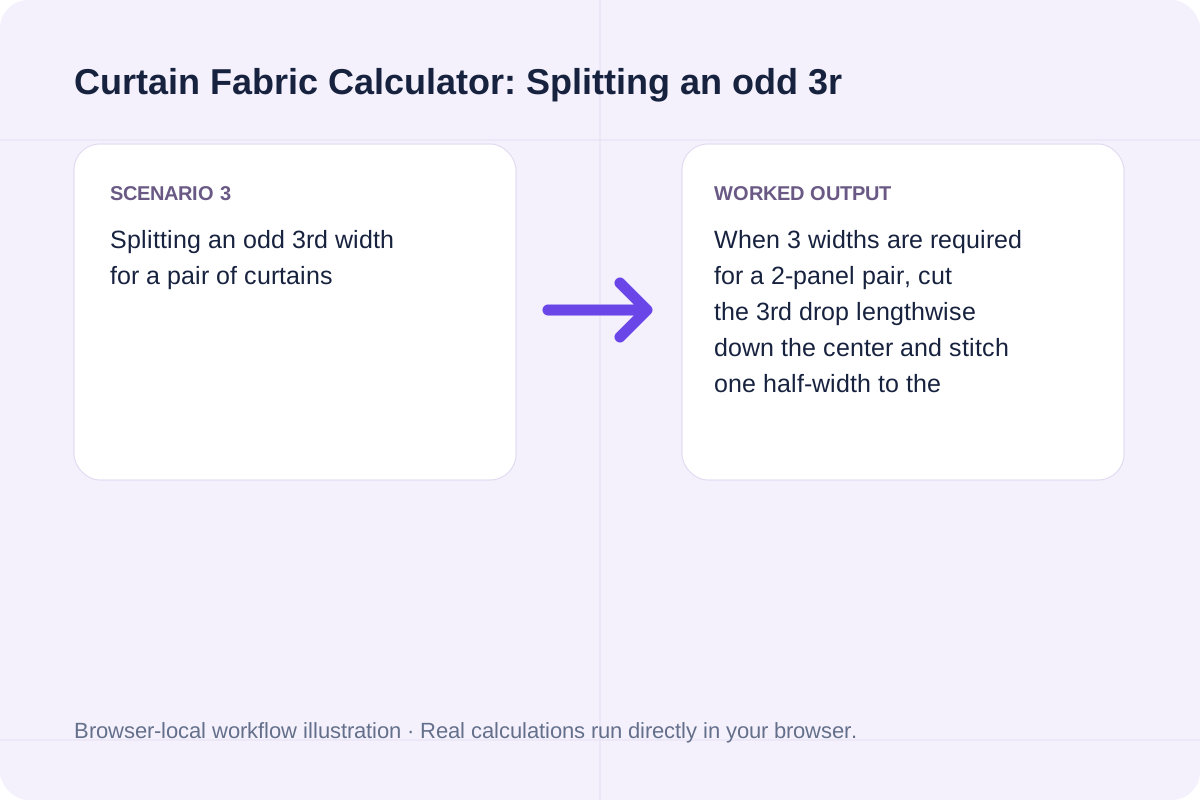
When 3 widths are required for a 2-panel pair, cut the 3rd drop lengthwise down the center and stitch one half-width to the outer edge of each panel (1.5 widths per curtain).
Order at least the rounded yardage and check whether you need lining fabric of the same length.
The headline result displays Total Fabric Required in yards (or meters) and total inches/cm. Breakdown cards show Number of fabric widths (drops), Cut length per drop (including repeat waste), Actual fullness achieved, and Even-pair (next even width) yardage.
Account for side-hem turnings and fabric shrinkage before cutting.
Each curtain panel typically loses 3 to 4 inches (7.5 to 10 cm) of width to doubled side hems and join seams. Pre-wash or steam natural linen and cotton drapery fabrics before cutting so they do not shrink after hanging.
Calculate bias strip cut width, continuous bias fabric square dimensions, and bolt yardage for single-fold or double-fold bias tape.
Open tool
Calculate carpet needed in square feet, square yards, and square meters, linear roll length, and cost from room dimensions and waste %.
Open tool
Calculate waist radius, outer hem radius, hem sweep, and fabric yardage for full, 3/4, half, or quarter circle skirts with seam allowance.
Open toolChoose another tool for your next calculation, conversion, or text task.

Find blended acquisition cost from supplied marketing and sales costs and new customers.
Open tool
Find retention rate as ending customers minus new customers divided by starting customers.
Open tool
Calculate how many deck boards, linear feet of decking, and deck screws you need from deck length, width, board width, gap, and waste %.
Open tool
Calculate horizontal, vertical, and diagonal camera field of view (FOV) in degrees and scene dimensions from sensor size, focal length, and distance.
Open toolAnswers about using Curtain Fabric Calculator and understanding its results.
Pencil pleat, rod pocket, and grommet/eyelet curtains typically use 2.0x fullness (total flat fabric width = twice the rod width). Triple French pinch pleats and goblet pleats look best at 2.2x to 2.5x fullness, while flat ripple-fold or sheer wave tracks often use 1.5x to 1.8x.
Workrooms typically allow 10 inches (25 cm) total per drop: a 4-inch (10 cm) double-turned top heading plus a 6-inch (15 cm) double-folded weighted bottom hem (3 inches doubled).
When sewing multiple widths of patterned fabric side by side, every drop must start at the exact same point in the motif so horizontal patterns line up across the window. Rounding each panel's cut length up to the next whole multiple of the vertical pattern repeat ensures every panel matches.
Curtain rods usually extend 6 to 12 inches (15 to 30 cm) past each side of the window frame for 'stackback' so open curtains clear the glass. Always enter the full pole width between finials (plus center overlap if using a traverse track).
Choose another tool for your next calculation, conversion, or text task.