

Carpet Calculator
Calculate carpet needed in square feet, square yards, and square meters, linear roll length, and cost from room dimensions and waste %.
Open toolEnter your deck length and width, actual board width, spacing gap, stock plank length, and waste allowance in the Deck Board Calculator below to find total stock boards, linear feet of decking, row count, and fastener estimates.
Enter the inputs, then select Calculate Deck Boards.
Result will appear here
The Deck Board Calculator adds your board width and gap width to find the effective center-to-center row pitch, calculates how many rows (courses) span the deck width, multiplies by deck length to get net linear feet, adds your waste percentage, and divides by your chosen stock board length.
Row Pitch = BoardWidth_in + Gap_in; Net Linear Ft = ((DeckWidth_ft * 12) / Row Pitch) * DeckLength_ft; Boards = ceil(Gross Linear Ft / StockLength).
Also estimates face screws / hidden clips based on standard 16-inch on-center joist spacing (2 fasteners per joist intersection).
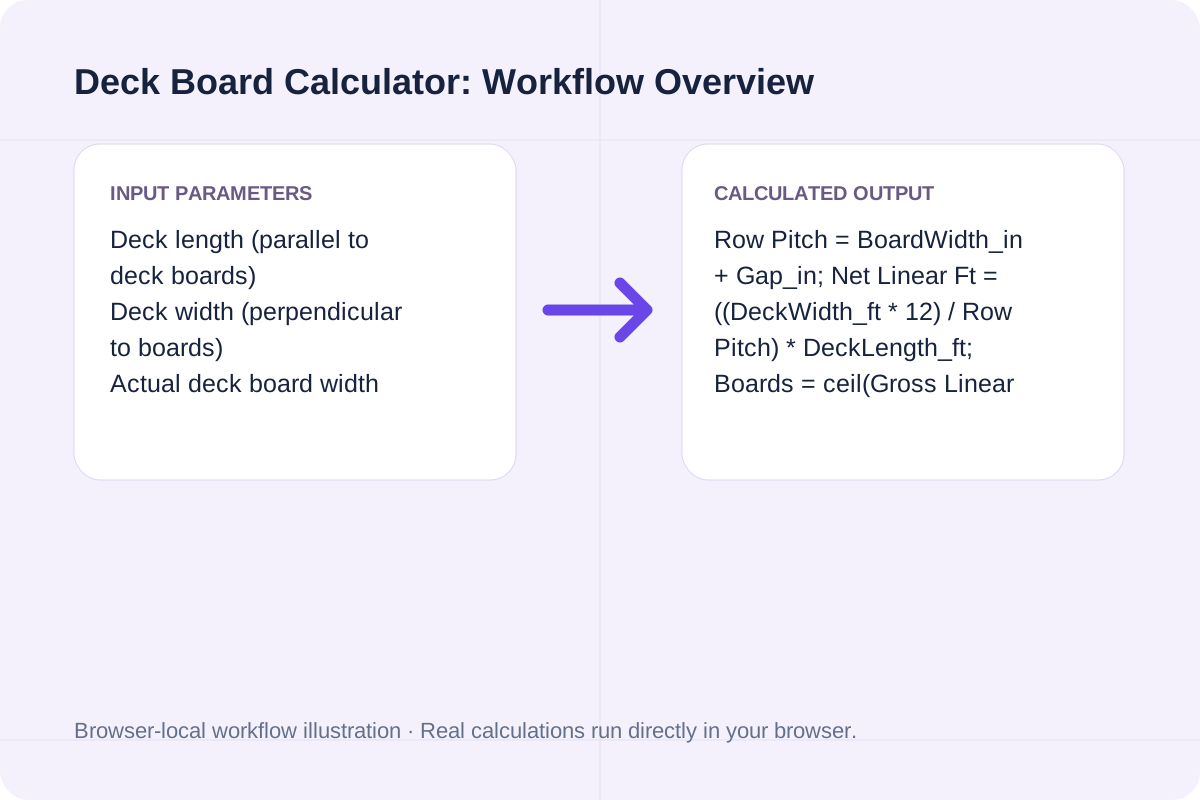
Review the input parameters, allowed value ranges, and worked reference cases for the Deck Board Calculator below before running your calculation.
| Parameter / Scenario | Default / Sample Value | Rule or Allowed Range | Output / Usage Note |
|---|---|---|---|
| Input: Deck length (parallel to deck boards) | 16 | Range: 2 to 500 | Required workspace parameter |
| Input: Deck width (perpendicular to boards) | 12 | Range: 2 to 500 | Required workspace parameter |
| Input: Actual deck board width | 5.5 | Range: 2 to 12 | Required workspace parameter |
| Input: Spacing gap between boards | 0.125 | Range: 0 to 1 | Required workspace parameter |
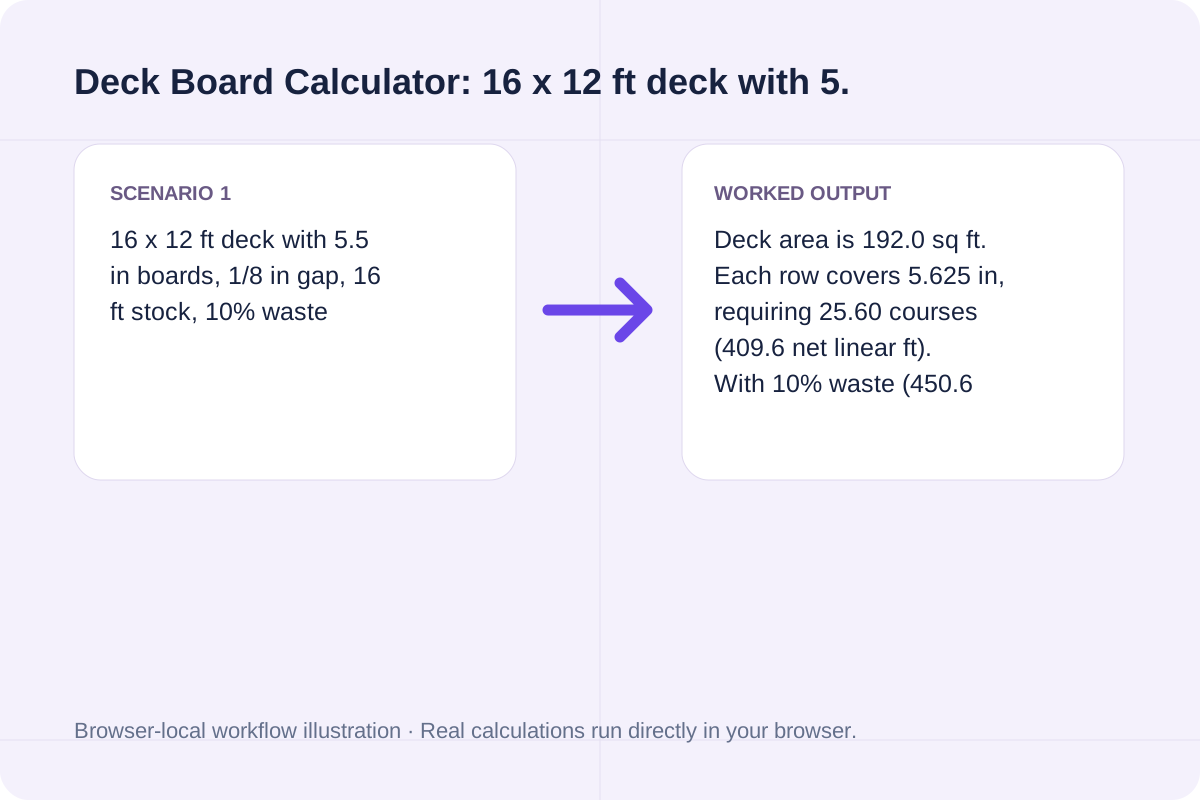
| Worked Case 1: 16 x 12 ft deck with 5.5 in boards, 1/8 in gap, 16 ft stock, 10% waste | Preloaded / test values | Effective Pitch (in) = BoardWidth + GapWidth; Courses = (DeckWidth_ft * 12) / Effective Pitch; Net Linear Feet = Courses * DeckLength_ft; Total Boards = ceil((Net Linear Feet * (1 + Waste%)) / StockLength_ft) | Deck area is 192.0 sq ft. Each row covers 5.625 in, requiring 25.60 courses (409.6 net linear ft). With 10% waste (450.6 gross linear ft), you need 29 stock 16-foot boards and ~735 deck screws (at 16 in OC joists). |
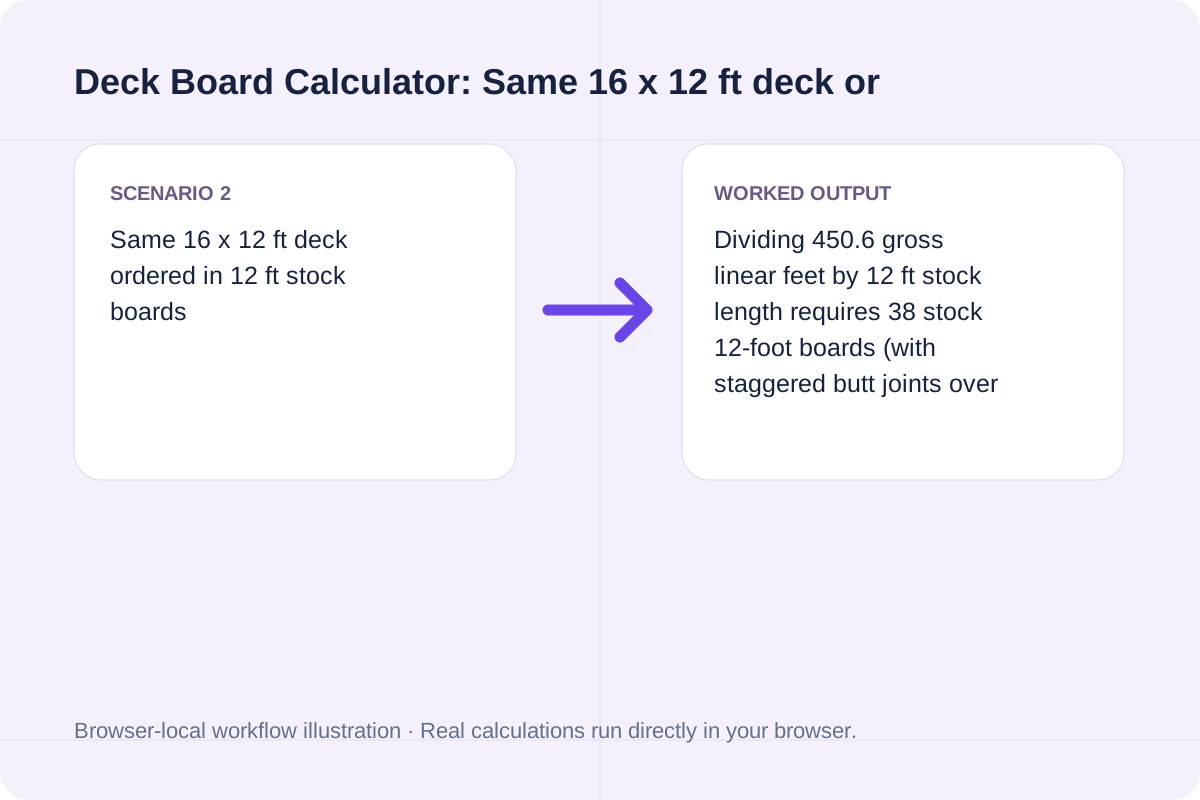
| Worked Case 2: Same 16 x 12 ft deck ordered in 12 ft stock boards | Preloaded / test values | Effective Pitch (in) = BoardWidth + GapWidth; Courses = (DeckWidth_ft * 12) / Effective Pitch; Net Linear Feet = Courses * DeckLength_ft; Total Boards = ceil((Net Linear Feet * (1 + Waste%)) / StockLength_ft) | Dividing 450.6 gross linear feet by 12 ft stock length requires 38 stock 12-foot boards (with staggered butt joints over joists). |
Confirm which way your joists run so you know which dimension is parallel to the deck boards.
Input your deck length (parallel to the planks) and deck width (perpendicular to the planks) in feet.
Enter actual board width in inches (5.5 in for standard 6-inch decking, 3.5 in for 4-inch decking) and gap width (0.125 in = 1/8 in).
Select 8, 10, 12, 16, or 20 ft stock boards and set waste (10% straight, 15% diagonal), then click Calculate Deck Boards.
See how a 16 x 12 ft deck breaks down into 16-foot planks, linear footage, and screws.
Deck area is 192.0 sq ft. Each row covers 5.625 in, requiring 25.60 courses (409.6 net linear ft). With 10% waste (450.6 gross linear ft), you need 29 stock 16-foot boards and ~735 deck screws (at 16 in OC joists).
Dividing 450.6 gross linear feet by 12 ft stock length requires 38 stock 12-foot boards (with staggered butt joints over joists).
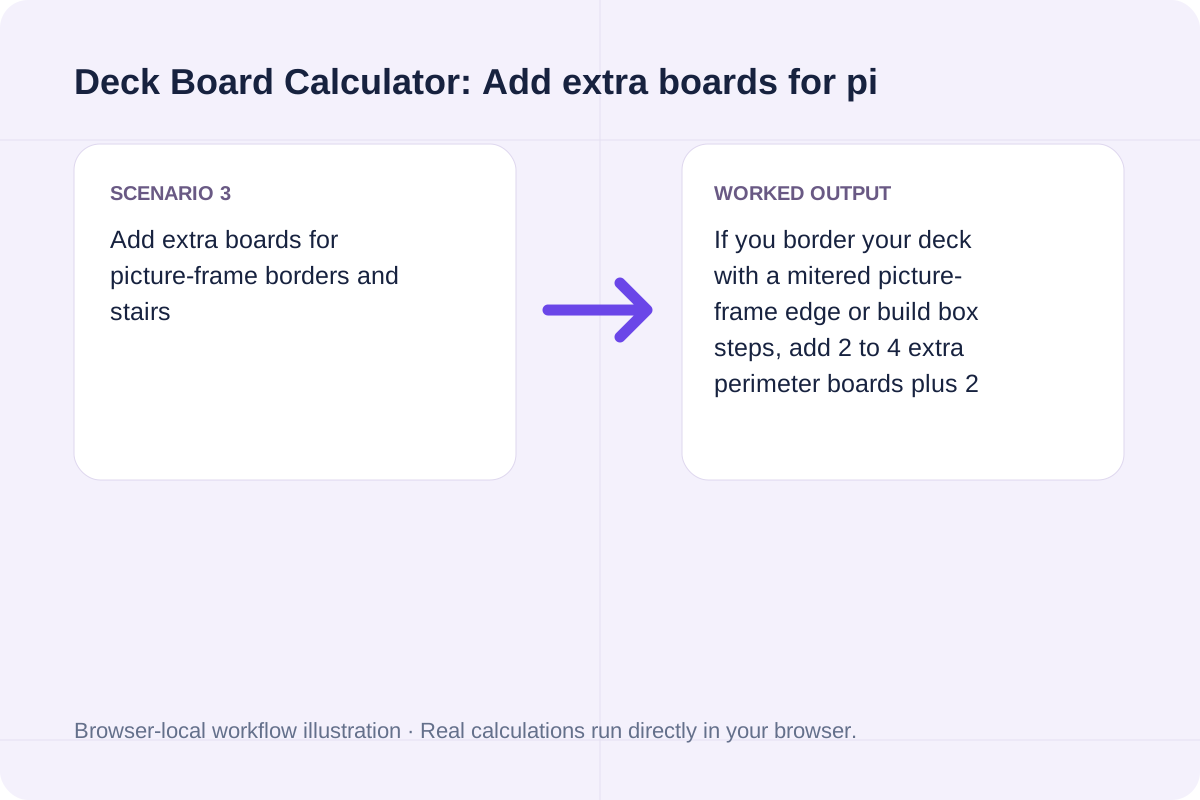
If you border your deck with a mitered picture-frame edge or build box steps, add 2 to 4 extra perimeter boards plus 2 treads per step.
Use Stock Boards to Purchase for your lumberyard order and Linear Feet for per-foot pricing.
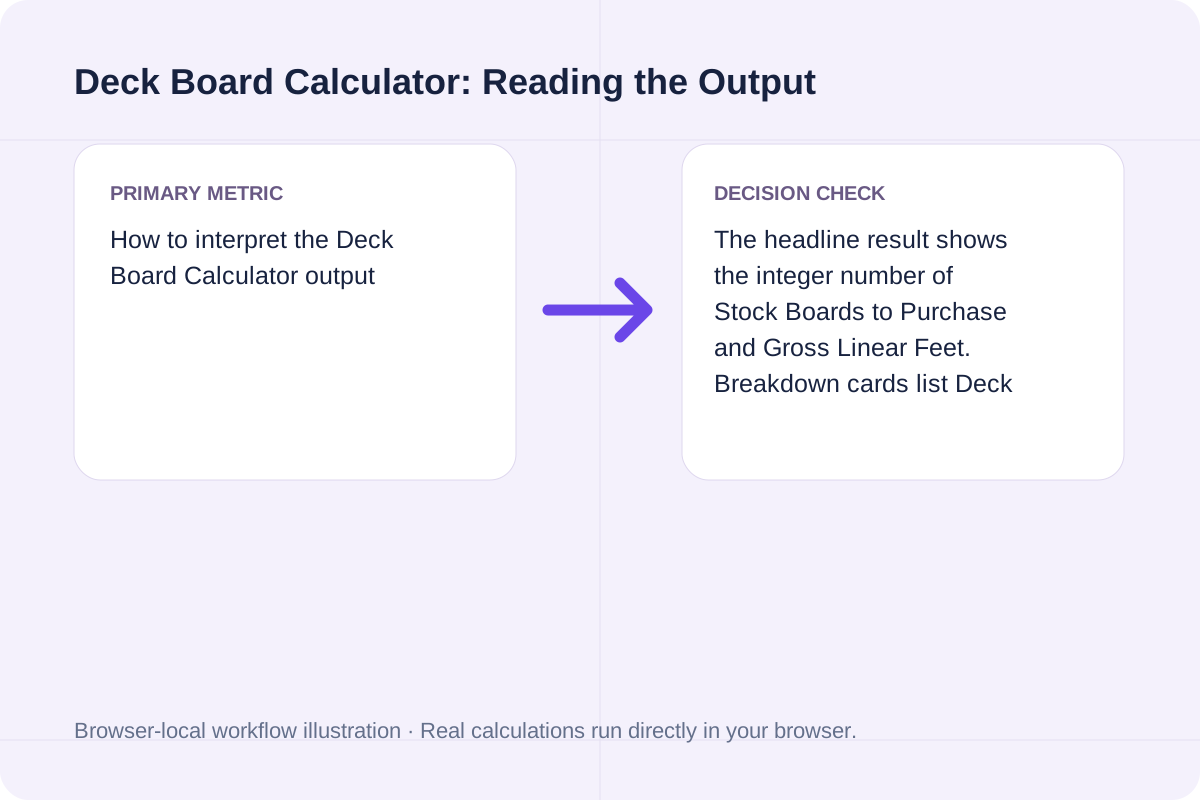
The headline result shows the integer number of Stock Boards to Purchase and Gross Linear Feet. Breakdown cards list Deck surface area (sq ft), Parallel board rows (courses), Net vs. Gross linear feet, and Estimated screws/fasteners (16 in OC joists).
Check joist spacing requirements for composite vs. wood decking before ordering.
This calculator covers surface decking planks and top fasteners; substructure framing (2x8 or 2x10 joists, beams, ledger board, and concrete footings) must be sized separately according to local building codes.
Calculate carpet needed in square feet, square yards, and square meters, linear roll length, and cost from room dimensions and waste %.
Open tool
Calculate curtain fabric yardage or meters, number of fabric widths, and cut drop length from rod width, drop, fullness, and pattern repeat.
Open tool
Calculate theoretical string tension from vibrating length, fundamental frequency and supplied linear density.
Open toolChoose another tool for your next calculation, conversion, or text task.

Compute the effective density, total mass, total volume, and mass/volume percentages of a two-part mixture from masses and densities or volumes and densities.
Open tool
Convert a quantity using the listed fixed unit factors.
Open tool
Calculate bias strip cut width, continuous bias fabric square dimensions, and bolt yardage for single-fold or double-fold bias tape.
Open tool
Calculate how many people a round, square, or rectangular sheet cake serves using standard party (2x2 in) or wedding (1x2 in) slice sizes.
Open toolAnswers about using Deck Board Calculator and understanding its results.
Dimensional lumber (5/4x6 or 2x6) and most composite deck boards have an actual milled width of 5.5 inches (or 5.4 inches for some grooved composite profiles). Using 6 inches instead of 5.5 inches underestimates your board count by nearly 9%.
A 12-foot wide deck is 144 inches across. With a 5.5-inch board and a 0.125-inch (1/8 in) gap, each row covers 5.625 inches, requiring 144 / 5.625 = 25.60 courses (26 rows before waste).
Assuming standard joists spaced 16 inches on center (OC), the number of joist crossings per row is floor(DeckLength_in / 16) + 1. Multiplying by 2 screws per crossing per course (plus 10% waste) gives the required screw count.
Straight perpendicular decking typically uses a 10% waste factor for end trimming and culling warped boards. Diagonal 45-degree decking creates triangular offcuts at every perimeter edge and requires a 15% waste factor.
Choose another tool for your next calculation, conversion, or text task.