

Circle Of Confusion Calculator
Calculate optical Circle of Confusion (CoC) in mm and microns from camera sensor dimensions, print size, viewing distance, and visual acuity.
Open toolEnter your camera sensor width and height, lens focal length, and subject distance in the Camera Field Of View Calculator below to compute horizontal, vertical, and diagonal angles of view plus exact scene coverage in meters and feet.
Enter the inputs, then select Calculate Field of View.
Result will appear here
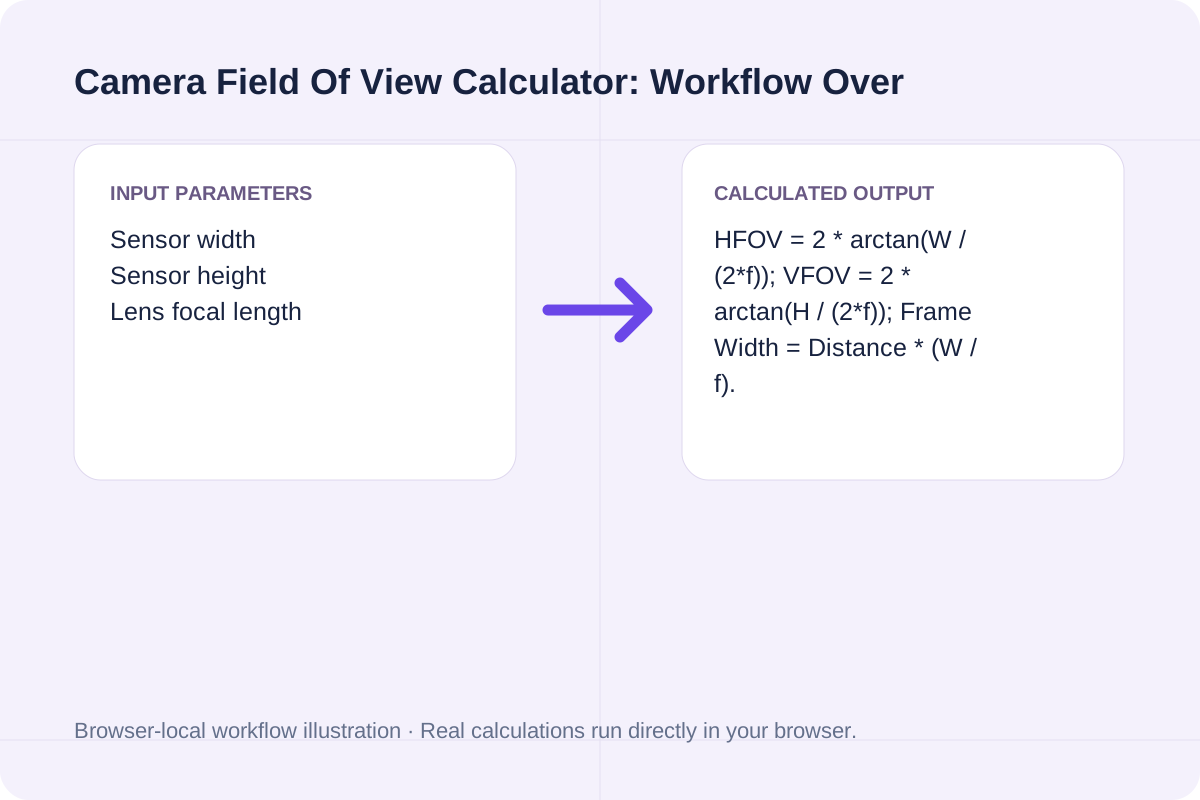
The Camera Field Of View Calculator applies rectilinear trigonometry to your sensor dimensions and focal length to compute angular FOV in degrees and projects that triangle out to your subject distance to find linear frame width, height, and diagonal.
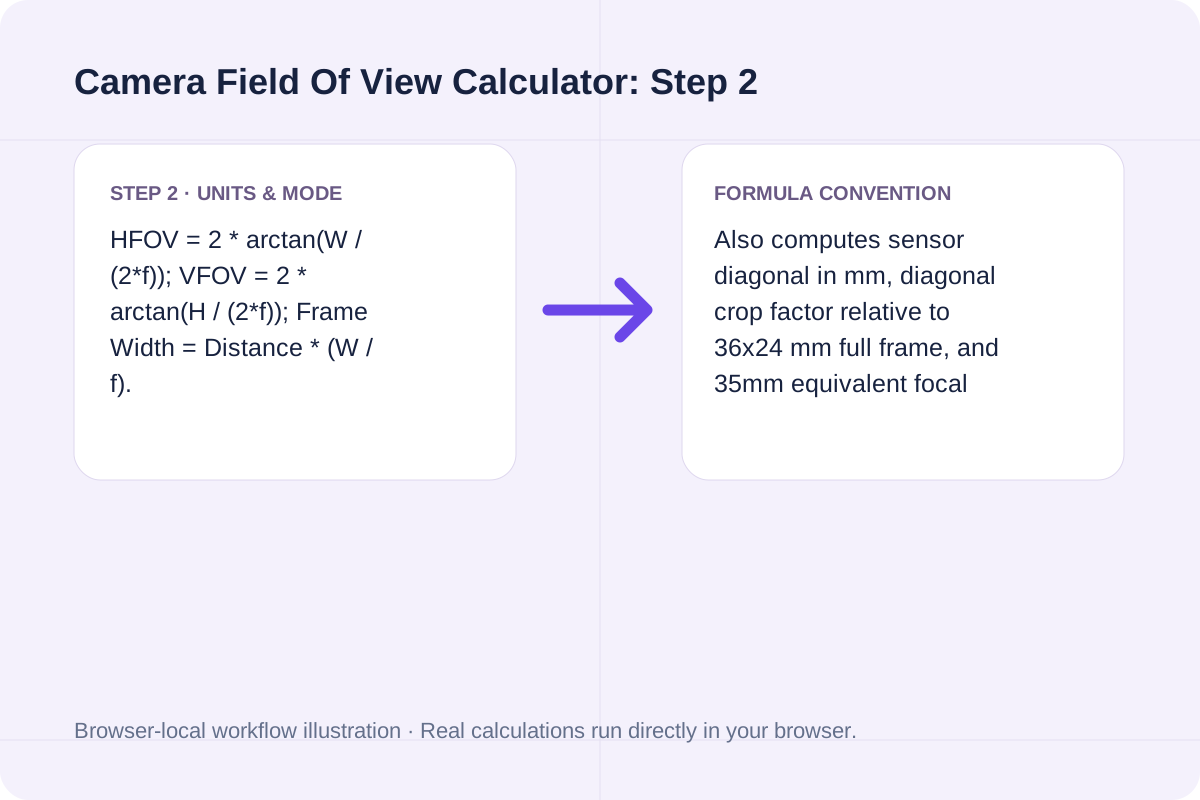
HFOV = 2 * arctan(W / (2*f)); VFOV = 2 * arctan(H / (2*f)); Frame Width = Distance * (W / f).
Also computes sensor diagonal in mm, diagonal crop factor relative to 36x24 mm full frame, and 35mm equivalent focal length.
Review the input parameters, allowed value ranges, and worked reference cases for the Camera Field Of View Calculator below before running your calculation.
| Parameter / Scenario | Default / Sample Value | Rule or Allowed Range | Output / Usage Note |
|---|---|---|---|
| Input: Sensor width | 36 | Range: 1 to 200 | Required workspace parameter |
| Input: Sensor height | 24 | Range: 1 to 200 | Required workspace parameter |
| Input: Lens focal length | 50 | Range: 1 to 5000 | Required workspace parameter |
| Input: Subject distance | 10 | Range: 0.1 to 100000 | Required workspace parameter |
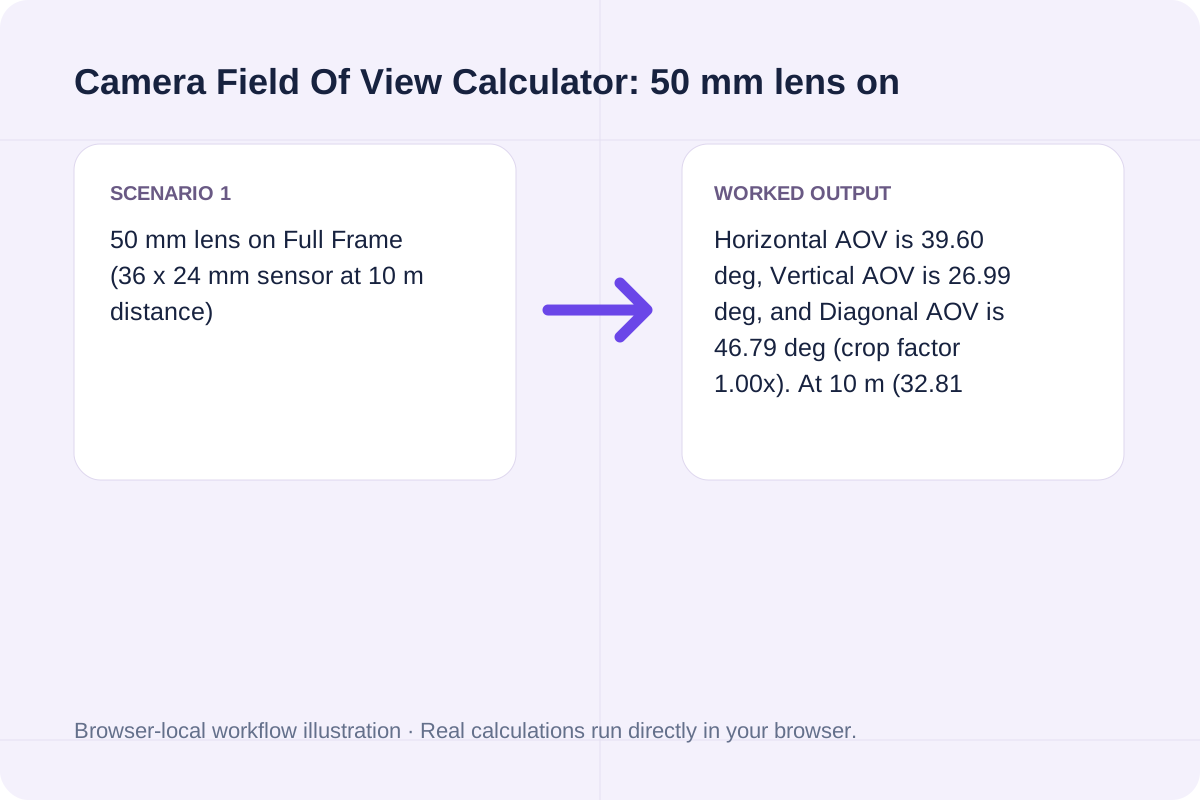
| Worked Case 1: 50 mm lens on Full Frame (36 x 24 mm sensor at 10 m distance) | Preloaded / test values | Angle of View = 2 * arctan(SensorDimension / (2 * FocalLength)); Scene Dimension = Distance * (SensorDimension / FocalLength) | Horizontal AOV is 39.60 deg, Vertical AOV is 26.99 deg, and Diagonal AOV is 46.79 deg (crop factor 1.00x). At 10 m (32.81 ft), the frame captures a scene 7.20 m wide by 4.80 m tall (23.62 x 15.75 ft). |
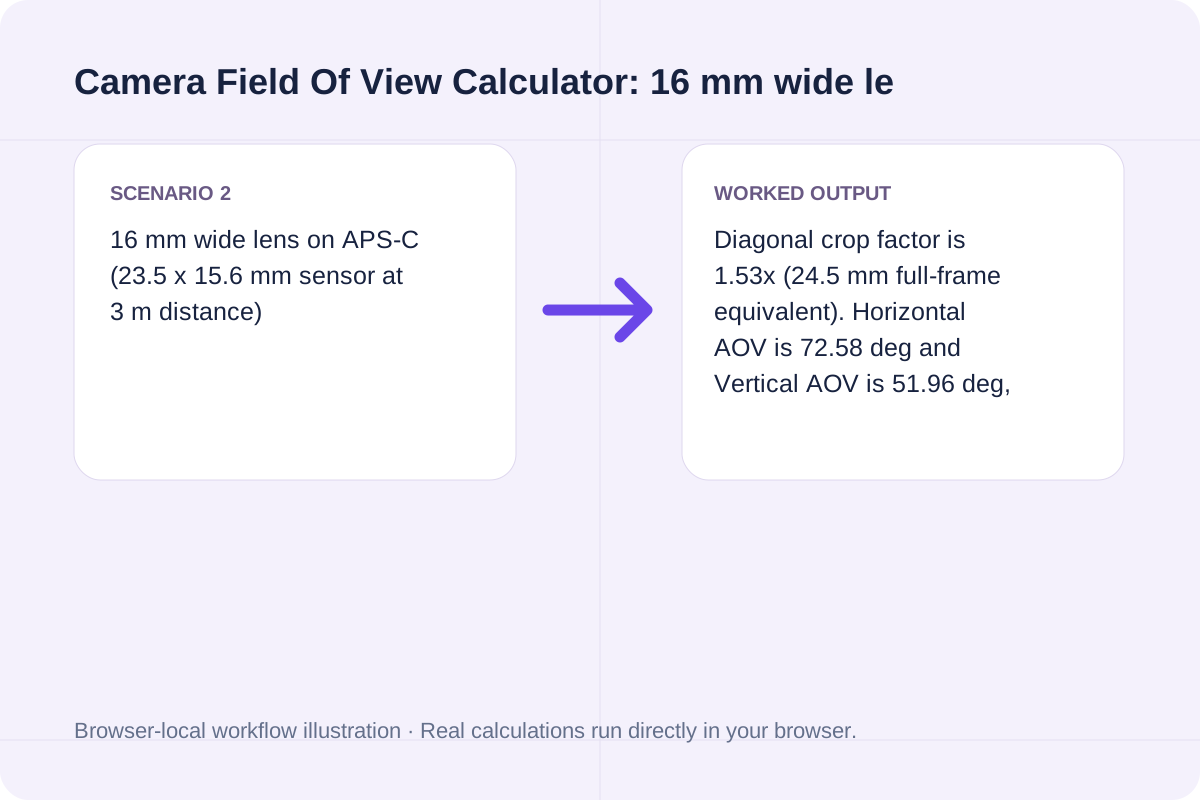
| Worked Case 2: 16 mm wide lens on APS-C (23.5 x 15.6 mm sensor at 3 m distance) | Preloaded / test values | Angle of View = 2 * arctan(SensorDimension / (2 * FocalLength)); Scene Dimension = Distance * (SensorDimension / FocalLength) | Diagonal crop factor is 1.53x (24.5 mm full-frame equivalent). Horizontal AOV is 72.58 deg and Vertical AOV is 51.96 deg, capturing a 4.41 m x 2.93 m frame at 3 m distance. |
Look up your camera's active sensor size in millimeters and enter your lens focal length and shooting distance.
Input your sensor's width and height in millimeters (for example, 36 and 24 for Full Frame, or 23.5 and 15.6 for APS-C).
Enter the physical focal length printed on the lens barrel (e.g., 50 mm), not the crop-equivalent number.
Set the distance to your subject in meters and click Calculate Field of View to see angular FOV and scene coverage in meters and feet.
Compare a 50mm lens on a Full Frame body against a 16mm lens on an APS-C camera.
Horizontal AOV is 39.60 deg, Vertical AOV is 26.99 deg, and Diagonal AOV is 46.79 deg (crop factor 1.00x). At 10 m (32.81 ft), the frame captures a scene 7.20 m wide by 4.80 m tall (23.62 x 15.75 ft).
Diagonal crop factor is 1.53x (24.5 mm full-frame equivalent). Horizontal AOV is 72.58 deg and Vertical AOV is 51.96 deg, capturing a 4.41 m x 2.93 m frame at 3 m distance.
An APS-C lens marked '16mm' has a true 16 mm optical focal length; entering your 23.5 x 15.6 mm sensor size already accounts for the 1.53x crop.
Use Angular FOV for lens comparison and Scene Coverage for studio, stage, or security camera placement.
The headline result displays Horizontal x Vertical Angle of View in degrees (plus Diagonal AOV). Breakdown cards list Scene Width and Height at your distance (in meters and feet), Sensor diagonal & crop factor, and 35mm equivalent focal length.
Keep rectilinear distortion vs. fisheye projection in mind for ultra-wide lenses.
These formulas model rectilinear lenses (where straight lines in the scene render straight). Stereographic or equisolid fisheye lenses have a wider angular field of view for the same focal length. For focus zone depth, pair this tool with the Circle Of Confusion Calculator and Depth Of Field Calculator.
Calculate optical Circle of Confusion (CoC) in mm and microns from camera sensor dimensions, print size, viewing distance, and visual acuity.
Open tool
Calculate carpet needed in square feet, square yards, and square meters, linear roll length, and cost from room dimensions and waste %.
Open tool
Calculate photographic depth of field (DoF), near and far acceptable sharpness limits, and hyperfocal distance from lens, f-stop, distance, and CoC.
Open toolChoose another tool for your next calculation, conversion, or text task.

Calculate dry candle wax weight and fragrance oil weight in ounces and grams from jar water weight, wax specific gravity, and fragrance load %.
Open tool
Convert a quantity using the listed fixed unit factors.
Open tool
Find diagonal crop factor and equivalent focal length for a supplied reference frame.
Open tool
Calculate starting drawing size from target dimensions and measured linear shrinkage.
Open toolAnswers about using Camera Field Of View Calculator and understanding its results.
For a rectilinear lens focused near infinity, Angle of View (in degrees) = 2 * arctan(d / (2 * f)) * (180 / pi), where d is sensor width, height, or diagonal in mm and f is focal length in mm. Linear Field of View at distance D equals D * (d / f).
Standard Full Frame (35mm) is 36 x 24 mm (diagonal 43.27 mm). Sony/Nikon/Fuji APS-C is 23.5 x 15.6 mm (Canon APS-C is 22.3 x 14.9 mm). Micro Four Thirds is 17.3 x 13.0 mm, and 1-inch type sensors are 13.2 x 8.8 mm.
The diagonal crop factor compares the 35mm full-frame diagonal (43.2666 mm) to your sensor's diagonal sqrt(W^2 + H^2). Multiplying your actual lens focal length by that crop factor gives the 35mm equivalent focal length.
Yes. At close focus distances where magnification m is significant, the effective focal length increases to f * (1 + m), which narrows the angle of view compared to infinity focus.
Choose another tool for your next calculation, conversion, or text task.