

Bracelet Size Calculator
Calculate bracelet size, inner circumference, bead-diameter allowance, and bead count from wrist circumference, fit ease, and bead size.
Open toolEnter your ring's **inner diameter (`mm`)** or **finger circumference (`mm`)** and band width to calculate your exact **US / Canada**, **UK / Australia (`A–Z+`)**, **EU / ISO 8653**, and **Japan / China** ring size, plus wide-band comfort sizing.
Enter the inputs, then select Calculate Ring Size.
Result will appear here
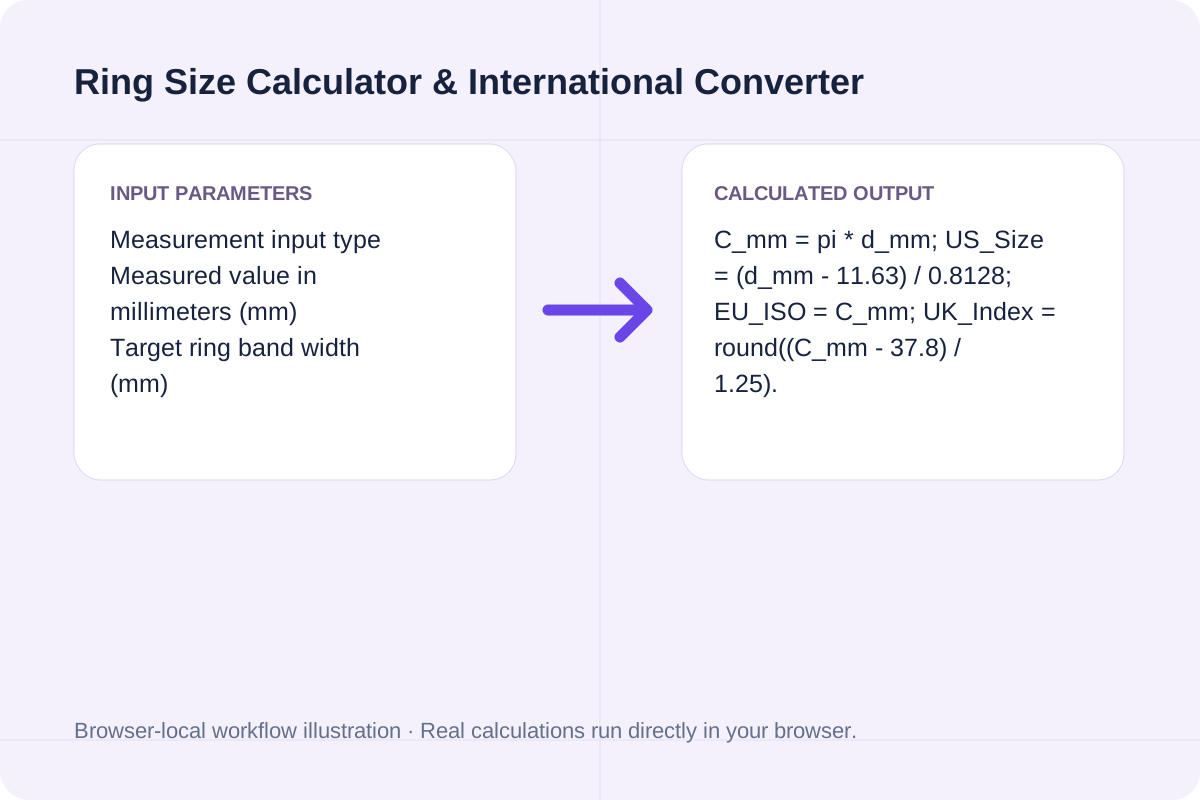
All international ring standards derive from the circular geometry `C = pi * d`, where `d` is the internal bore diameter of the ring band and `C` is the internal perimeter.
C_mm = pi * d_mm; US_Size = (d_mm - 11.63) / 0.8128; EU_ISO = C_mm; UK_Index = round((C_mm - 37.8) / 1.25).
A half-size step in the US scale equals `0.406 mm` of diameter or `1.28 mm` of circumference (one full UK letter step).
Exact inside diameters (`mm`), inner circumferences (`mm`), and international equivalents across the most common ring sizes.
| US / Canada Size | Inner Diameter (mm / in) | Inner Circumference (EU / ISO) | UK / Australia & Japan (JP) |
|---|---|---|---|
| `US Size 5` | `15.70 mm` (`0.618 in`) | `49.3 mm` (`EU 49`) | `UK J½` • `JP 9` |
| `US Size 6` | `16.51 mm` (`0.650 in`) | `51.9 mm` (`EU 52`) | `UK L½` • `JP 11` |
| **`US Size 7` (Default)** | **`17.35 mm` (`0.683 in`)** | **`54.5 mm` (`EU 54.5 / 55`)** | **`UK N½` • `JP 14`** |
| `US Size 8` | `18.19 mm` (`0.716 in`) | `57.1 mm` (`EU 57`) | `UK P½` • `JP 16` |
| `US Size 9` | `18.89 mm` (`0.744 in`) | `59.5 mm` (`EU 59.5`) | `UK R½` • `JP 18` |
| `US Size 10` | `19.84 mm` (`0.781 in`) | `62.3 mm` (`EU 62`) | `UK T½` • `JP 20` |
Measure at room temperature in the evening when fingers are at their normal daily volume.
If measuring an existing ring, place it flat on a millimeter ruler or digital caliper and read the inside diameter excluding the metal rim.
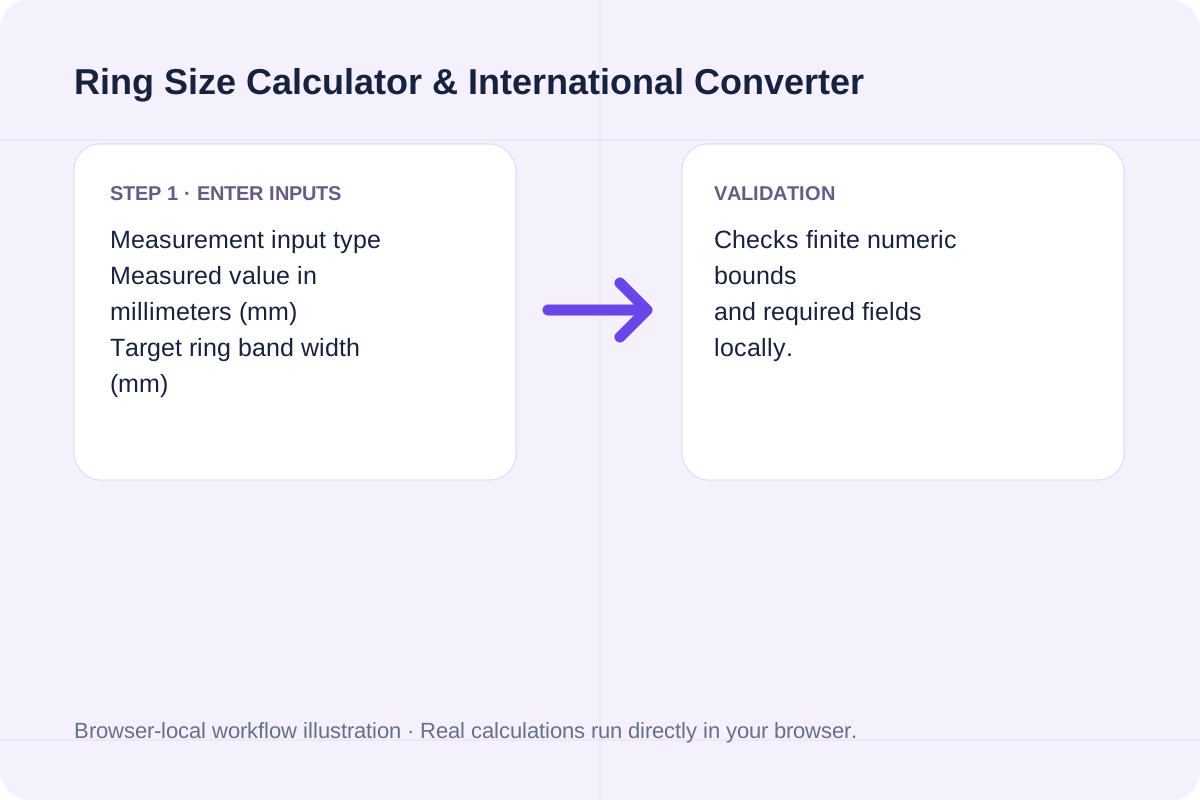
If measuring your finger with a non-stretch sizing tape, enter the circumference in millimeters (`37.7` to `77.0 mm`) and ensure the loop slides over your knuckle.
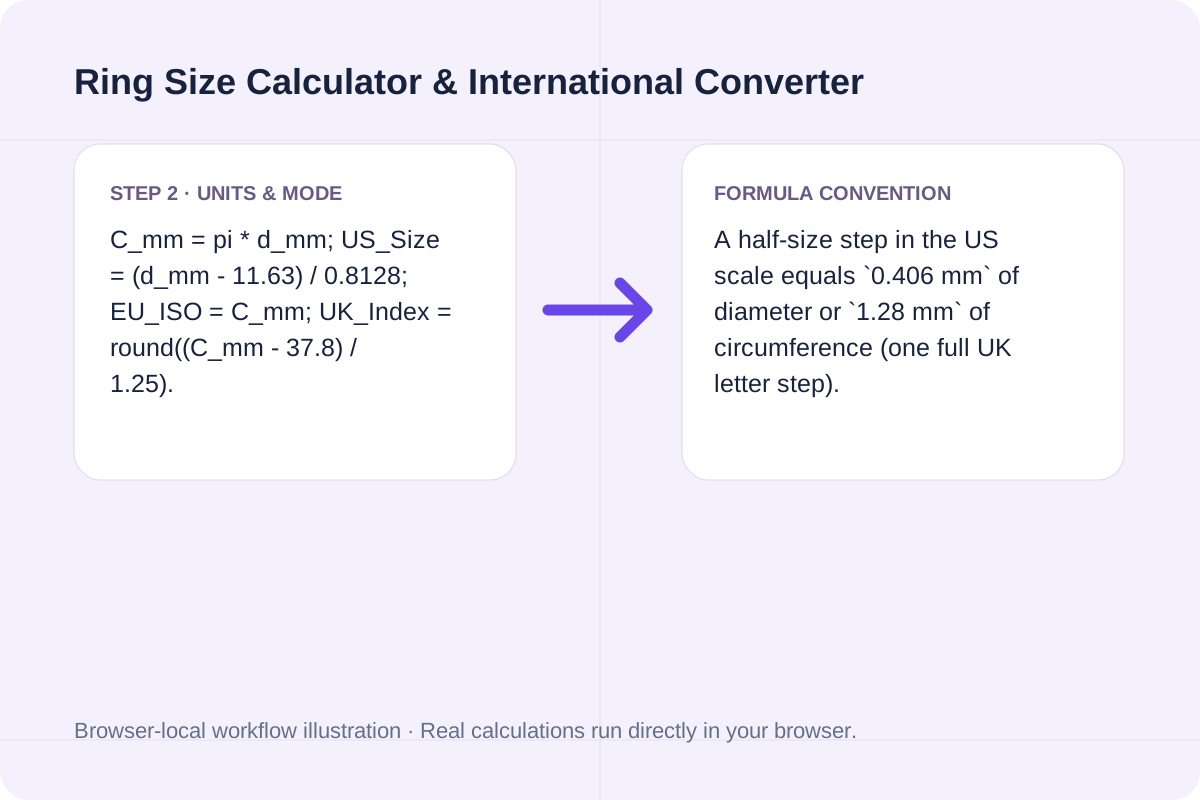
Enter your target band width so the calculator can compute whether a `+0.25` or `+0.50` wide-band comfort adjustment applies.
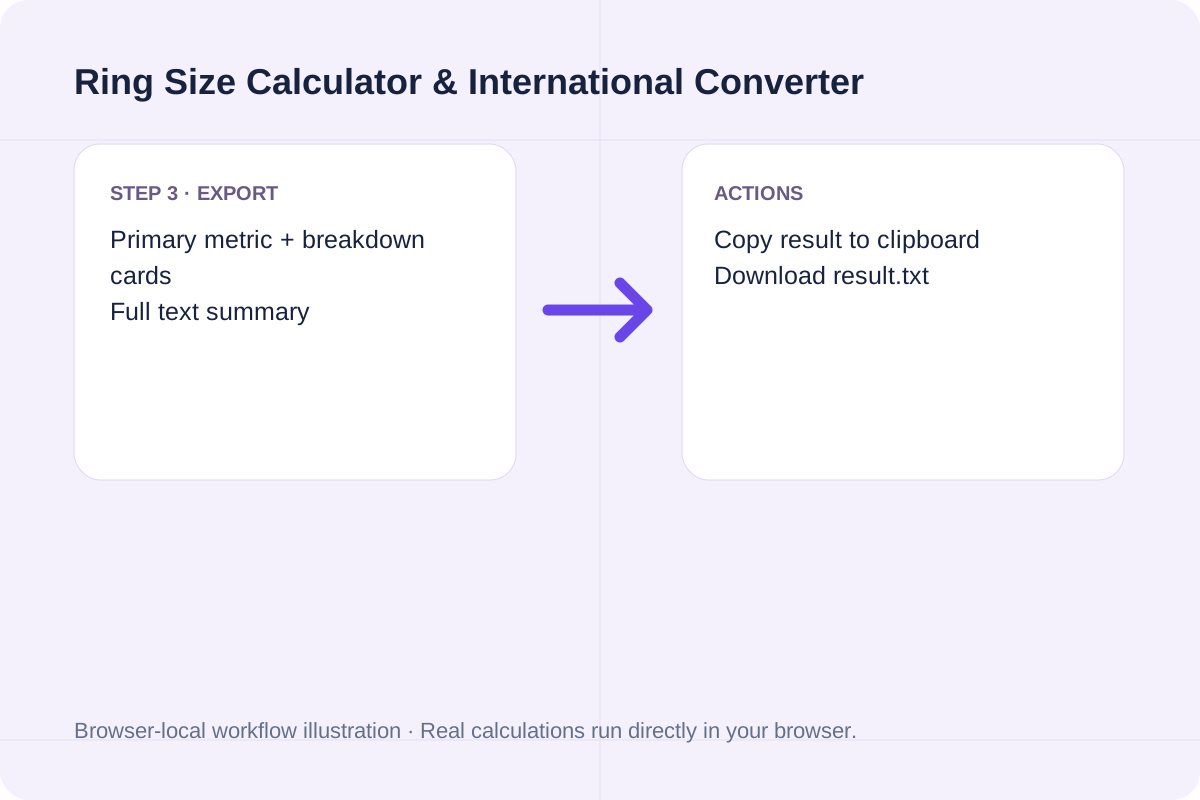
See how inner diameter, circumference, and wide cigar bands translate across countries.
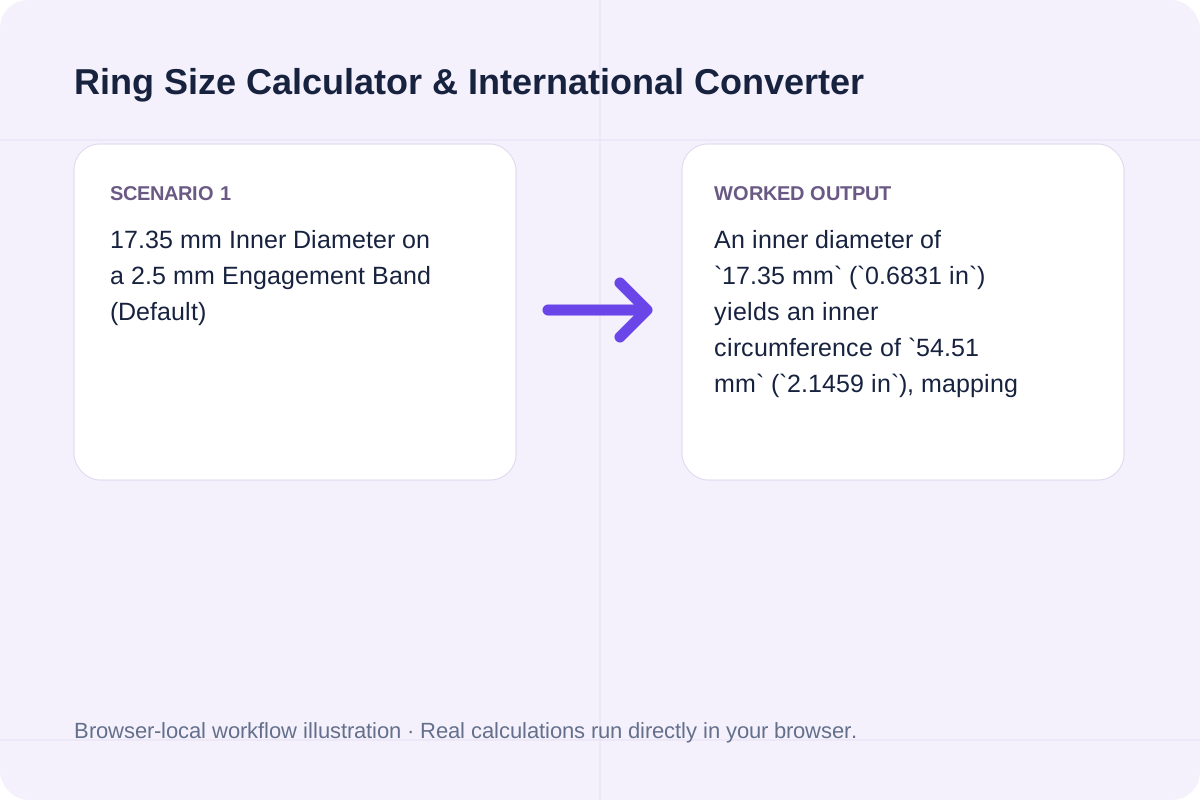
An inner diameter of `17.35 mm` (`0.6831 in`) yields an inner circumference of `54.51 mm` (`2.1459 in`), mapping to **US Size 7**, **UK N½**, **EU 54.5**, and **Japan Size 14** with no wide-band offset required.
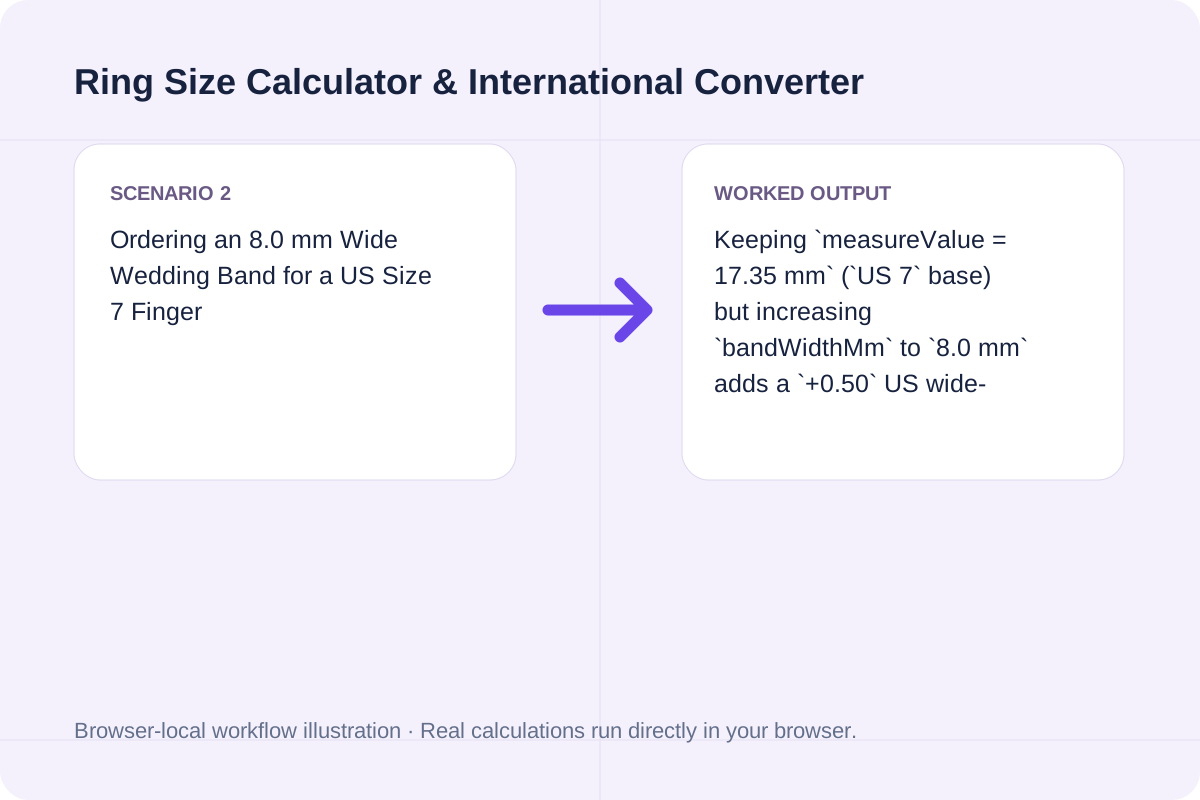
Keeping `measureValue = 17.35 mm` (`US 7` base) but increasing `bandWidthMm` to `8.0 mm` adds a `+0.50` US wide-band comfort allowance, recommending **US Size 7.5** (`17.75 mm` diameter / `UK O½` / `EU 55.8`).
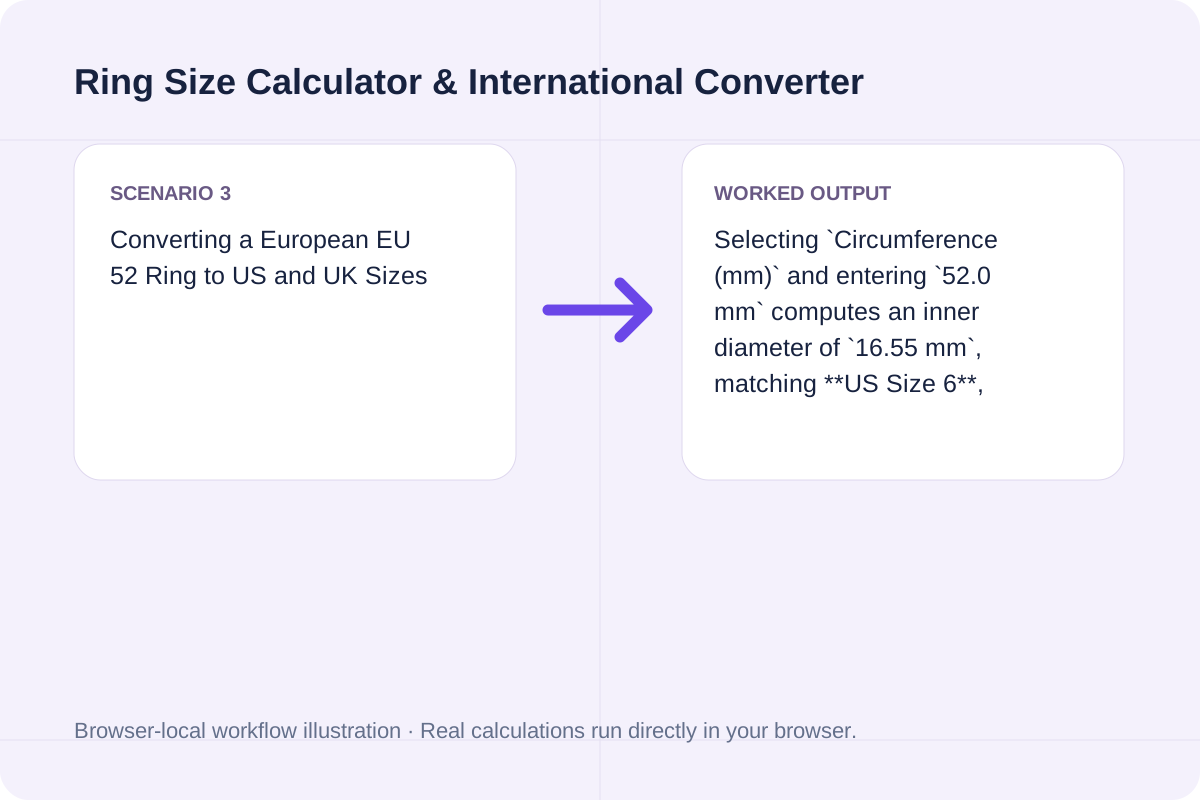
Selecting `Circumference (mm)` and entering `52.0 mm` computes an inner diameter of `16.55 mm`, matching **US Size 6**, **UK L½**, and **Japan Size 11**.
Fingers fluctuate by up to half a ring size between cold mornings and warm evenings.
Always measure the exact finger on the exact hand where the ring will be worn: the dominant hand is typically `0.25` to `0.50` US sizes larger than the non-dominant hand. If your knuckle is noticeably wider than the base of your finger, size midway between the base and knuckle measurements so the ring can pass the joint without spinning loosely.
If you are also sizing wrist jewelry or custom cuffs, use our Bracelet Size Calculator (/tools/bracelet-size-calculator) for snug, comfort, and loose wrist allowances.
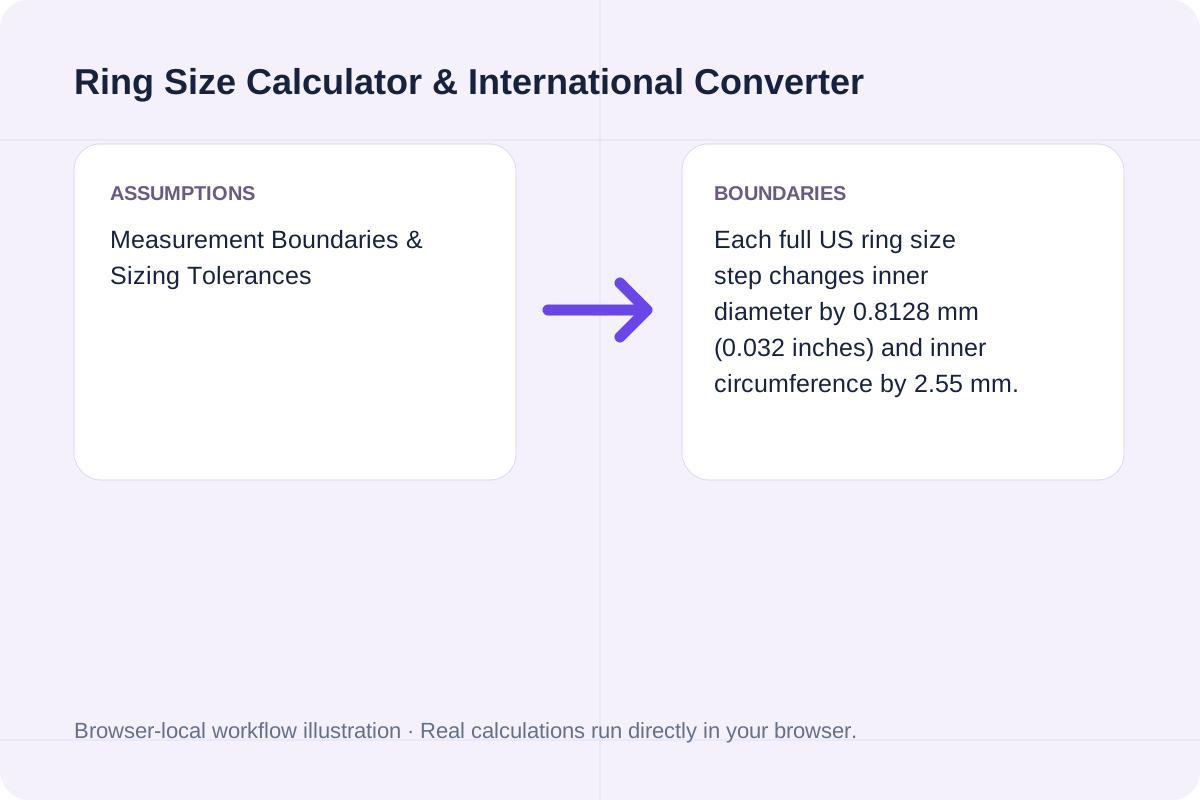
The calculator enforces realistic adult ring geometry boundaries to prevent unit confusion.
C_mm = pi * d_mm; US_Size = (d_mm - 11.63) / 0.8128; EU_ISO = C_mm; UK_Index = round((C_mm - 37.8) / 1.25). A half-size step in the US scale equals `0.406 mm` of diameter or `1.28 mm` of circumference (one full UK letter step).
Calculate bracelet size, inner circumference, bead-diameter allowance, and bead count from wrist circumference, fit ease, and bead size.
Open tool
Calculate waist radius, outer hem radius, hem sweep, and fabric yardage for full, 3/4, half, or quarter circle skirts with seam allowance.
Open tool
Calculate how many smaller sheets or cards fit on a parent paper sheet (ISO A0-A4, SRA3, US Tabloid, or custom mm/in). Compare portrait, landscape, and mixed cut yields and waste %.
Open toolChoose another tool for your next calculation, conversion, or text task.

Compute signed tetrahedral volume, surface area, bounding box dimensions, watertight edge warnings, and estimated 3D printing part weight from ASCII STL mesh geometry.
Open tool
Calculate tap drill size for Metric ISO (mm pitch) and Unified Inch (TPI) threads at any thread engagement percentage (50% to 90%) for cutting and forming taps.
Open tool
Calculate how long it takes to mow any lawn size by deck width, mowing speed, pass overlap, and turn/obstacle field efficiency.
Open tool
Calculate bottleneck cycle time, Takt time margin, hourly and shift throughput, line balance efficiency, flow efficiency, and Little's Law WIP from workstation times.
Open toolAnswers about using Ring Size Calculator & International Converter (mm, US, UK, EU, JP) and understanding its results.
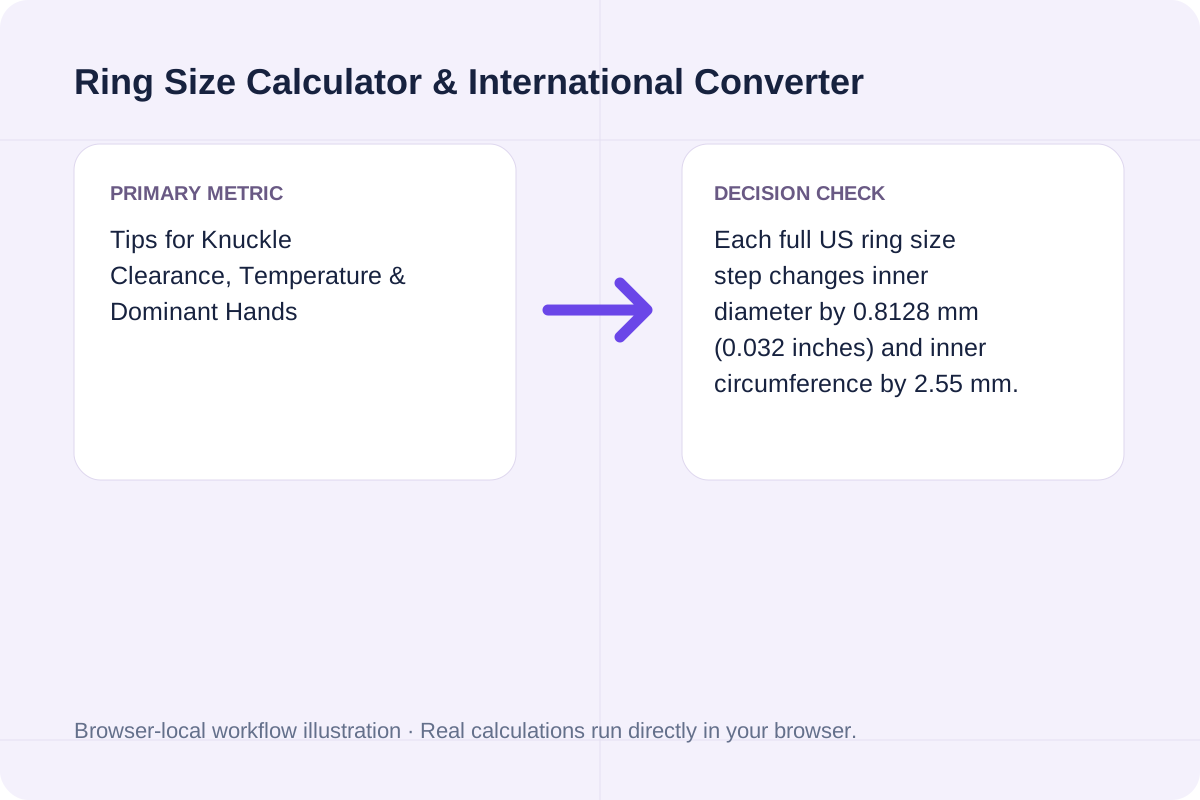
Under the standard North American mandrel scale, each full US ring size increments the inside diameter by exactly 0.032 inches (0.8128 mm) starting from US Size 0 at 11.63 mm: US Size = (d_mm - 11.63) / 0.8128. For example, an inside diameter of 17.35 mm gives (17.35 - 11.63) / 0.8128 = 7.037, which rounds to US Size 7 (inner circumference = pi * 17.35 = 54.51 mm).
European ISO 8653 ring sizes equal the inner circumference in millimeters directly (so a 54.5 mm circumference is EU Size 54.5 / 55). UK and Australian sizes use alphabetical letters (A to Z+) spaced every ~1.25 mm of circumference (half a US size), where US 7 equals UK N½. Japanese (JIS) sizes use integer numbers where US 7 corresponds to JP Size 14.
A wide flat or comfort-fit band covers more of the proximal phalanx, trapping skin tissue that would normally bulge around a thin 2 mm wire band. Jewelers recommend sizing up by +0.25 US size for 5.0–7.9 mm bands and +0.50 US size for bands 8.0 mm or wider.
String and paper strips stretch or twist around the knuckle, easily adding 1.5 to 2.5 mm of false circumference (an entire full US size too large). Measuring the inside opening of a ring you already wear on that exact finger with a ruler or caliper is repeatable within 0.2 mm.
Choose another tool for your next calculation, conversion, or text task.