

Metal Removal Rate Calculator
Calculate CNC milling and turning Metal Removal Rate (MRR in cm³/min and in³/min), estimated spindle power (kW / HP), and chip load.
Open toolCompute exact pre-tapping hole diameters (`mm` and `inches`) for **ISO Metric (`M`)** and **Unified Inch (`UNC`/`UNF`)** 60° threads: compare 75% thread height vs. the `D − P` machinist rule and **Cutting Tap** vs. **Cold-Forming Roll Tap** bore sizes.
Enter the inputs, then select Calculate Tap Drill Size.
Result will appear here
The tap drill diameter sets the minor diameter of the internal thread, determining how much material the tap flutes must shear (or displace) and how much flank area engages the mating bolt.
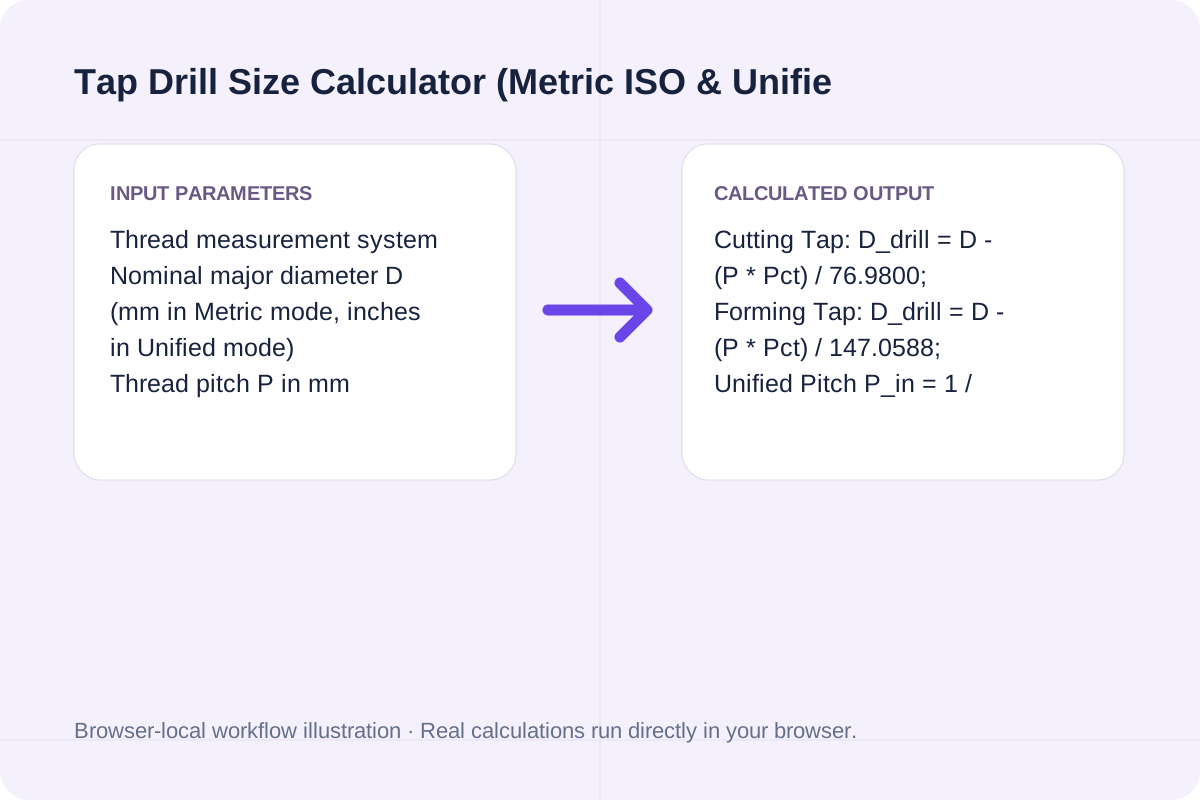
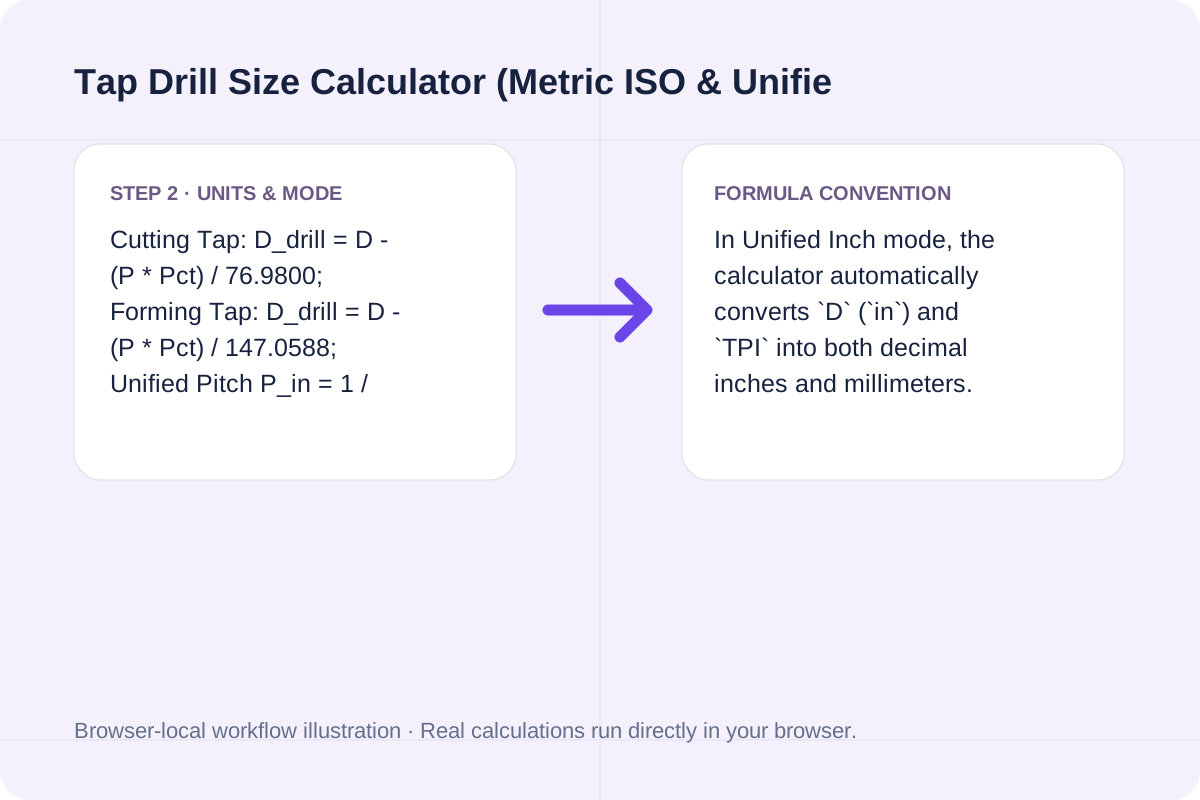
Cutting Tap: D_drill = D - (P * Pct) / 76.9800; Forming Tap: D_drill = D - (P * Pct) / 147.0588; Unified Pitch P_in = 1 / TPI (P_mm = 25.4 / TPI).
In Unified Inch mode, the calculator automatically converts `D` (`in`) and `TPI` into both decimal inches and millimeters.
Exact 75% theoretical drill sizes, standard shop `D − P` drill bits, and cold-forming tap drill sizes for common coarse threads.
| Thread Size & Pitch | Cutting Tap (75% Exact) | Standard Shop Drill (D − P) | Forming / Roll Tap (75%) |
|---|---|---|---|
| `M6 × 1.0` (Coarse) | `5.03 mm` (`0.1979 in`) | `5.00 mm` (`76.98%` thread) | `5.49 mm` (`5.50 mm` drill) |
| `M8 × 1.25` (Coarse) | `6.78 mm` (`0.2670 in`) | `6.80 mm` (`75.89%` thread) | `7.36 mm` (`7.40 mm` drill) |
| **`M10 × 1.5` (Default)** | **`8.54 mm` (`0.3362 in`)** | **`8.50 mm` (`76.98%` thread)** | **`9.24 mm` (`9.25 mm` drill)** |
| `1/4"-20 UNC` (`0.25 in`, `20 TPI`) | `0.2013 in` (`5.11 mm`) | `#7 Drill` (`0.2010 in`) | `0.2245 in` (`#1` or `7/32"`) |
Select your thread system, enter diameter and pitch/TPI, and pick your tap geometry.
Pick `Metric ISO` when working with millimeter pitch threads (`M3` through `M68`) or `Unified Inch` when working with threads per inch (`#4-40`, `1/4-20`, `3/8-16`).
Enter major diameter `D` (`10` for `M10`, `0.25` for `1/4"`) and pitch (`1.5` mm or `20` TPI). Note that pitch must be strictly smaller than half the major diameter.
Choose `75%` for general aluminum, brass, and mild steel, or lower to `60%–65%` for work-hardening stainless steels and titanium.
See how thread percentage and tap type change hole diameter across Metric and Unified threads.
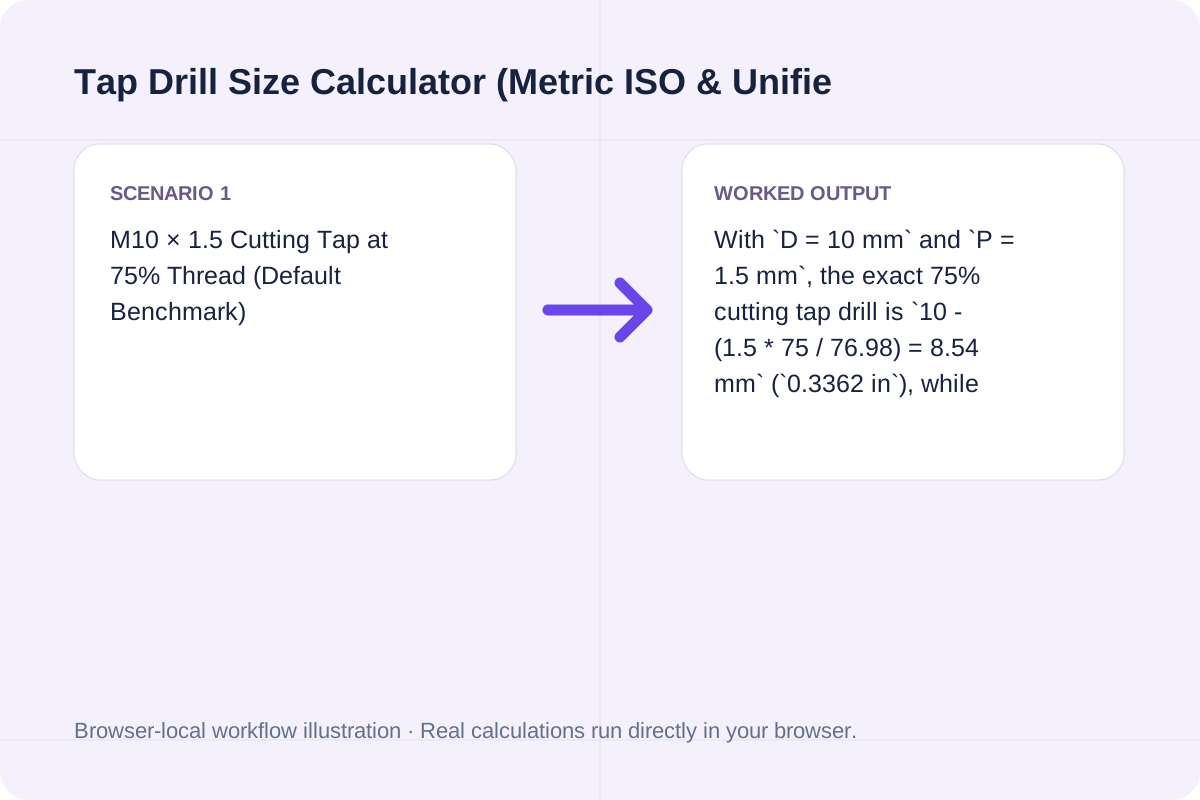
With `D = 10 mm` and `P = 1.5 mm`, the exact 75% cutting tap drill is `10 - (1.5 * 75 / 76.98) = 8.54 mm` (`0.3362 in`), while the standard `D - P` metric drill bit is `8.50 mm` (`76.98%` thread engagement).
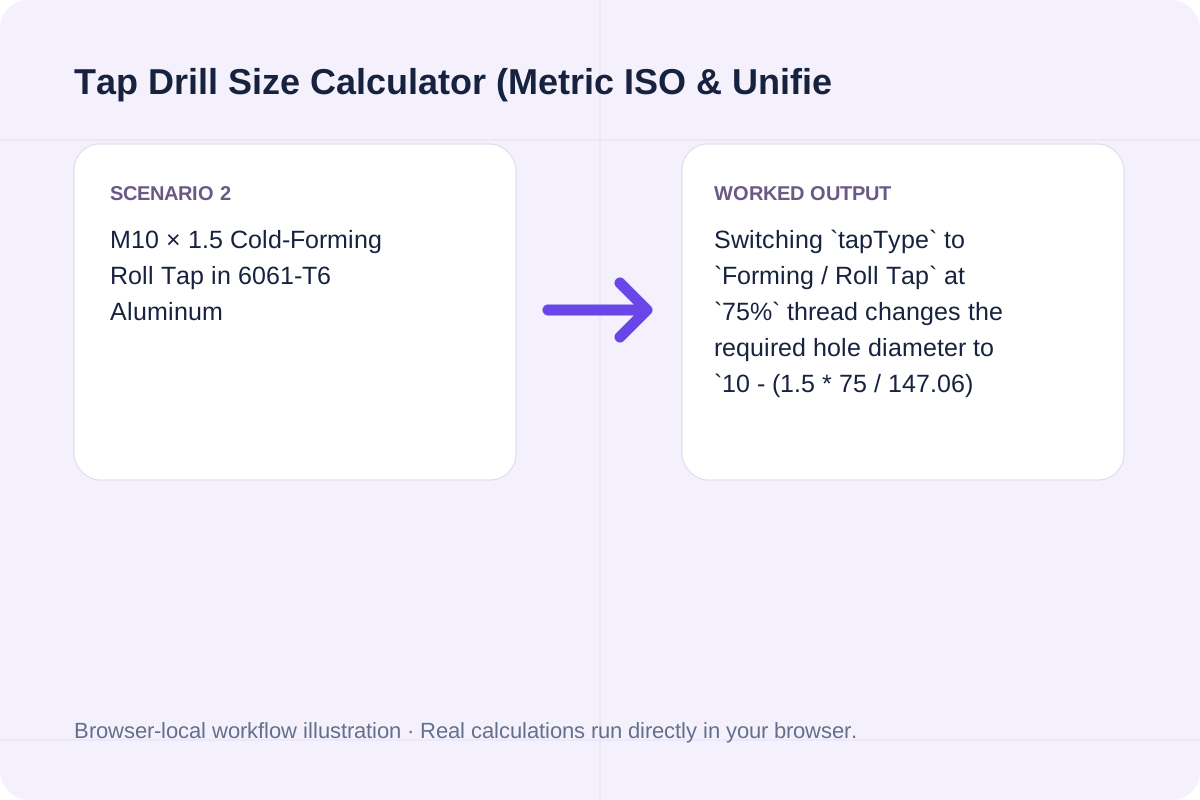
Switching `tapType` to `Forming / Roll Tap` at `75%` thread changes the required hole diameter to `10 - (1.5 * 75 / 147.06) = 9.24 mm` (`0.3636 in`), matching a standard `9.25 mm` carbide drill.
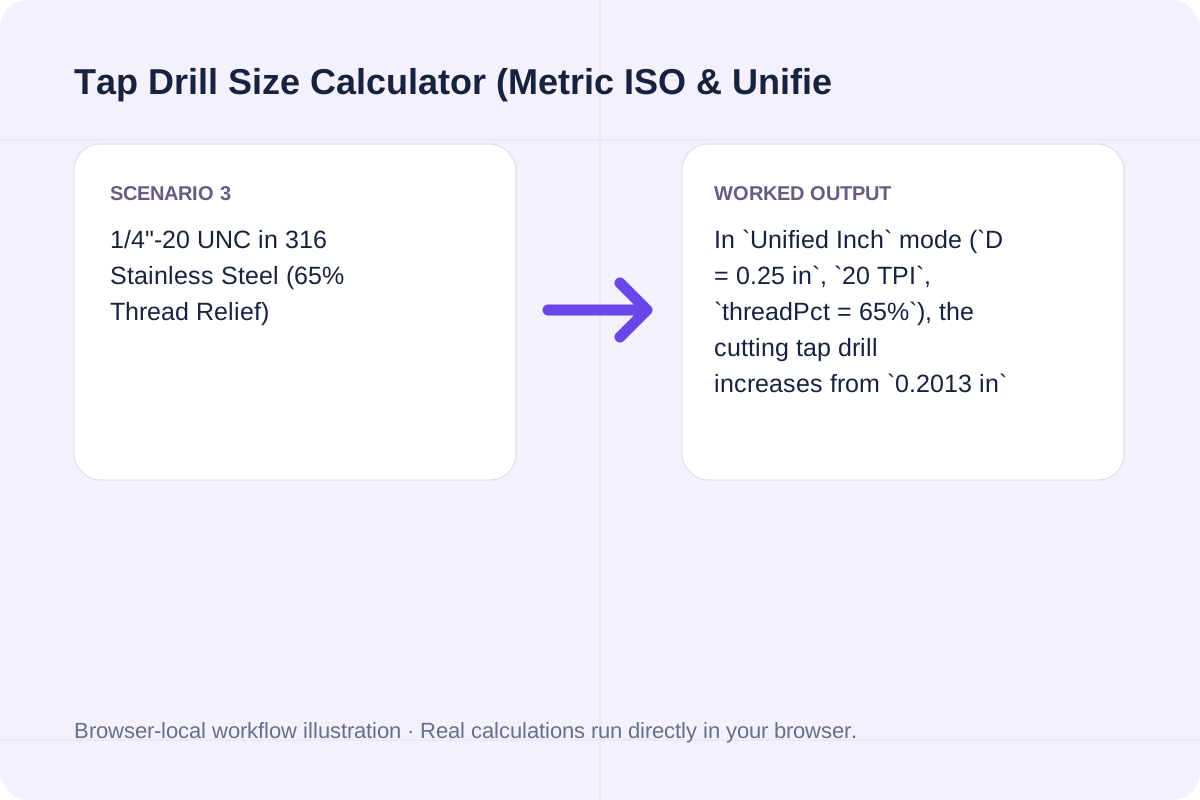
In `Unified Inch` mode (`D = 0.25 in`, `20 TPI`, `threadPct = 65%`), the cutting tap drill increases from `0.2013 in` (`#7` drill at 75%) to `0.2078 in` (`#5` or `#4` drill), reducing tap torque in 316 stainless.
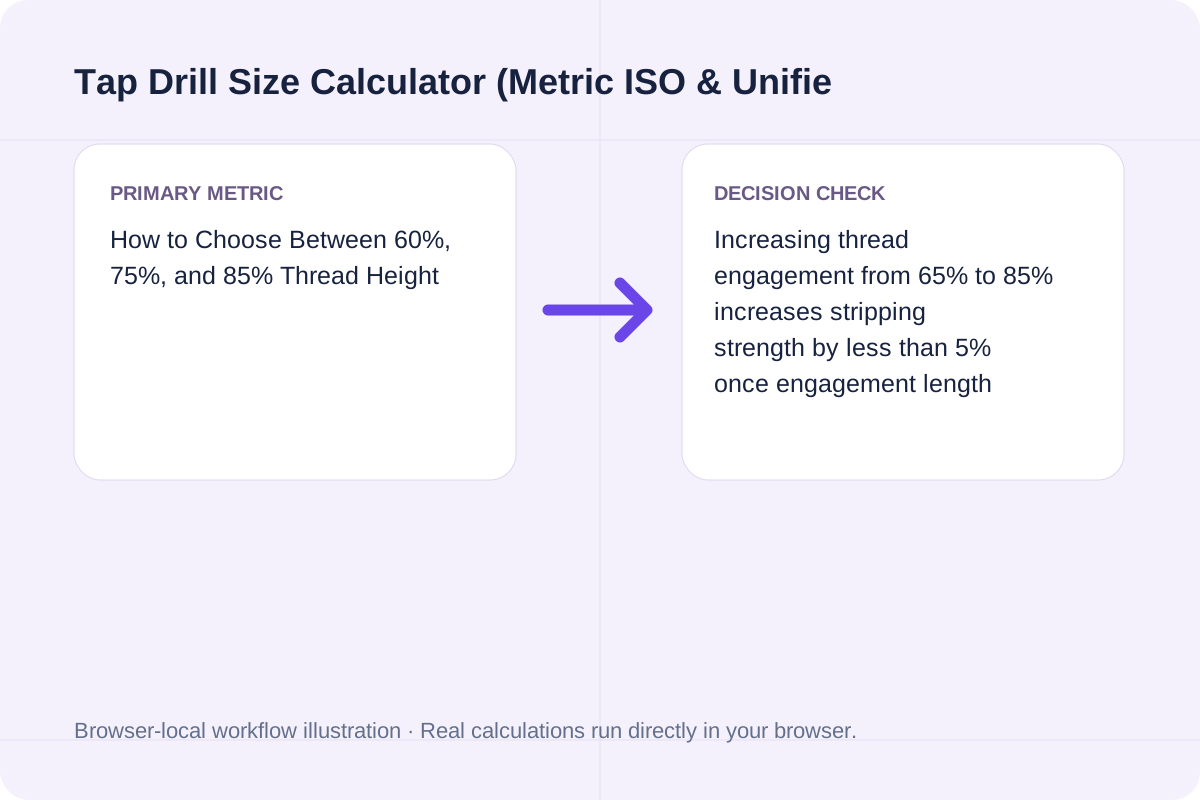
More thread height does not mean a proportionally stronger bolted joint.
Fastener pull-out tests show that when a steel screw engages at least `1.5x` its major diameter in depth, a `60%` thread height already develops enough shear area to break the bolt shank in tension before stripping the internal threads. Raising thread percentage above `75%` sharply increases tap tooth chipping.
If you are also programming roughing passes before drilling and tapping, pair this tool with our Metal Removal Rate Calculator (/tools/metal-removal-rate-calculator) to balance spindle load.
Verify these geometric limits before running a rigid tapping cycle.
Cutting Tap: D_drill = D - (P * Pct) / 76.9800; Forming Tap: D_drill = D - (P * Pct) / 147.0588; Unified Pitch P_in = 1 / TPI (P_mm = 25.4 / TPI). In Unified Inch mode, the calculator automatically converts `D` (`in`) and `TPI` into both decimal inches and millimeters.
Calculate CNC milling and turning Metal Removal Rate (MRR in cm³/min and in³/min), estimated spindle power (kW / HP), and chip load.
Open tool
Compute signed tetrahedral volume, surface area, bounding box dimensions, watertight edge warnings, and estimated 3D printing part weight from ASCII STL mesh geometry.
Open tool
Calculate how many smaller sheets or cards fit on a parent paper sheet (ISO A0-A4, SRA3, US Tabloid, or custom mm/in). Compare portrait, landscape, and mixed cut yields and waste %.
Open toolChoose another tool for your next calculation, conversion, or text task.

Generate printable SVG and text number lines with custom start/end values, step increments, tick labels, and plotted coordinate markers.
Open tool
Calculate 3D mesh total surface area, enclosed volume, bounding box dimensions, and facet count from ASCII STL meshes in mm², cm², and in².
Open tool
Calculate how long it takes to mow any lawn size by deck width, mowing speed, pass overlap, and turn/obstacle field efficiency.
Open tool
Convert ring inner diameter (mm) or finger circumference (mm) to US/Canada, UK/Australia letter, EU/ISO, and Japanese ring sizes with wide-band sizing guidance.
Open toolAnswers about using Tap Drill Size Calculator (Metric ISO & Unified Inch Cutting vs. Forming) and understanding its results.
For standard 60-degree ISO Metric and Unified National threads, the fundamental triangle height is H = (sqrt(3) / 2) * P = 0.866025 * P, and the standard internal thread height is (5/8) * H = 0.541266 * P. Because thread depth applies to both sides of the hole diameter, 100% full thread engagement reduces the hole diameter by 2 * 0.541266 * P = 1.082532 * P = P / 0.92376, or P * (100 / 76.9800) when using the traditional machinist 76.98 divisor.
When you drill at D - P (for example, 10.0 mm - 1.5 mm = 8.50 mm for an M10 × 1.5 thread), the resulting percentage of thread is 1.0 / 1.2990 = 76.98% of full theoretical thread height. That sits right at the 75% workshop standard.
A cold-forming tap has no cutting edges and produces zero chips; instead, its lobes plastically displace metal from the hole wall inward to form the thread crests. Using a cutting-tap drill size with a roll tap will seize and snap the tap immediately. For M10 × 1.5 at 75% thread, a cutting tap uses an 8.54 mm (8.50 mm standard) drill, whereas a forming tap requires a 9.24 mm (9.25 mm standard) drill.
Use 60% to 65% thread height for work-hardening alloys (304/316 stainless steel, Inconel, titanium) and blind holes deeper than 2 diameters. Machinery's Handbook tests show that 60% thread height provides over 95% of the pull-out strength of a 75% thread when thread engagement length is at least 1.5x major diameter, while cutting tapping torque by ~40%.
Choose another tool for your next calculation, conversion, or text task.