

Reaction Rate Calculator
Calculate average chemical reaction rate, reactant consumption rate, apparent rate constant k, and half-life from initial and final molarity and Δt.
Open toolCalculate volumetric Metal Removal Rate (`Q` / `MRR`) in both `cm³/min` and `in³/min`, plus required spindle cutting power (`kW` / `HP`) and chip mass per hour from depth of cut, width of cut, and table feed.
Enter the inputs, then select Calculate Metal Removal Rate.
Result will appear here
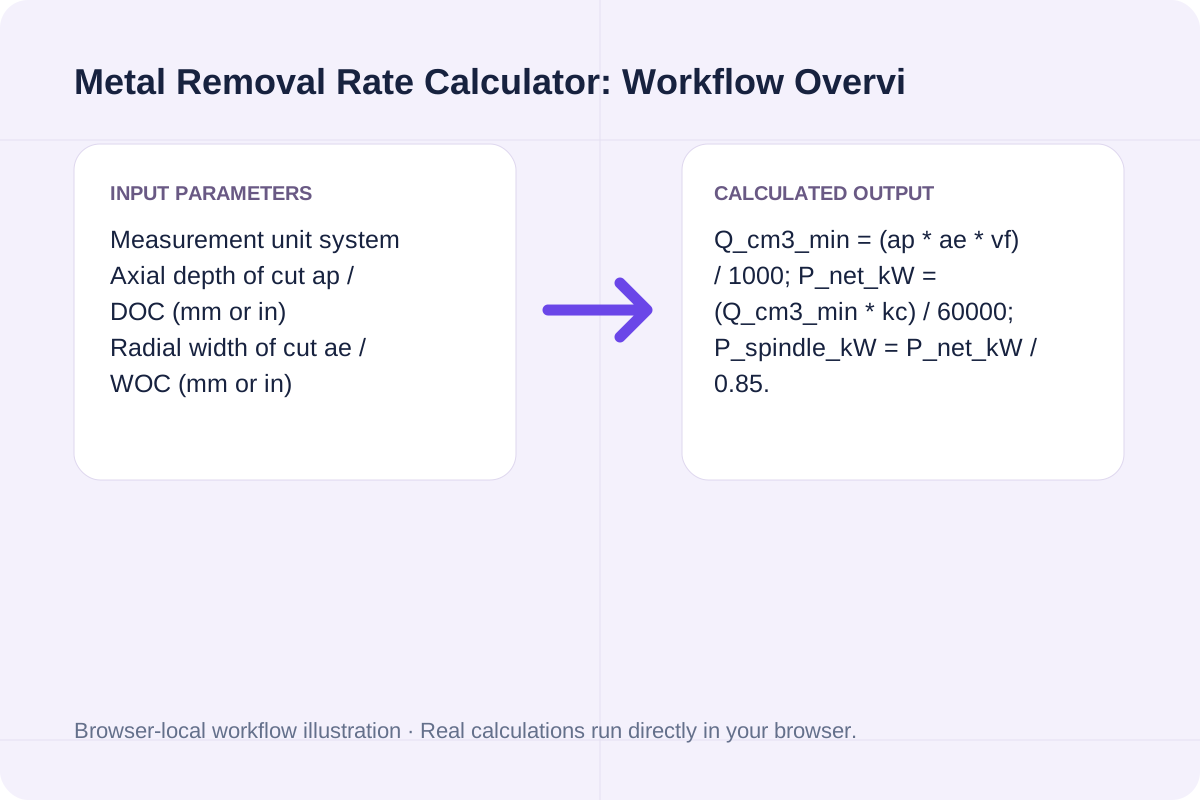
The calculator multiplies axial engagement (`ap` / `DOC`), radial stepover (`ae` / `WOC`), and linear feed rate (`vf` / `IPM`) to find the volume of metal sheared per minute, then scales by specific cutting energy (`kc`) to determine net cutting power and motor load.
Q_cm3_min = (ap * ae * vf) / 1000; P_net_kW = (Q_cm3_min * kc) / 60000; P_spindle_kW = P_net_kW / 0.85.
Includes automatic cross-conversion between metric (`cm³/min`, `kW`) and imperial (`in³/min`, `HP`) outputs.
Benchmark specific cutting force (kc in N/mm²), imperial unit power (HP per in³/min), and material density for common CNC alloys.
| Workpiece Alloy | ISO Group | Specific Force kc (N/mm²) | Unit Power (HP / in³/min) | Density (g/cm³) |
|---|---|---|---|---|
| Aluminum 6061-T6 / 7075 | ISO N | 750 N/mm² | 0.28 HP/in³/min | 2.70 g/cm³ |
| Gray Cast Iron (GG25) | ISO K | 1,350 N/mm² | 0.50 HP/in³/min | 7.20 g/cm³ |
| Mild Steel 1018 / A36 | ISO P | 1,800 N/mm² | 0.66 HP/in³/min | 7.87 g/cm³ |
| Alloy Steel 4140 (28 HRC) | ISO P | 2,200 N/mm² | 0.80 HP/in³/min | 7.85 g/cm³ |
| Stainless Steel 304 / 316 | ISO M | 2,450 N/mm² | 0.90 HP/in³/min | 8.00 g/cm³ |
| Titanium Ti-6Al-4V (Gr 5) | ISO S | 2,800 N/mm² | 1.02 HP/in³/min | 4.43 g/cm³ |
Check volumetric removal rate and spindle load in three steps.
Pick Metric if your CAM program outputs `mm` and `mm/min`, or Imperial for `in` and `IPM`.
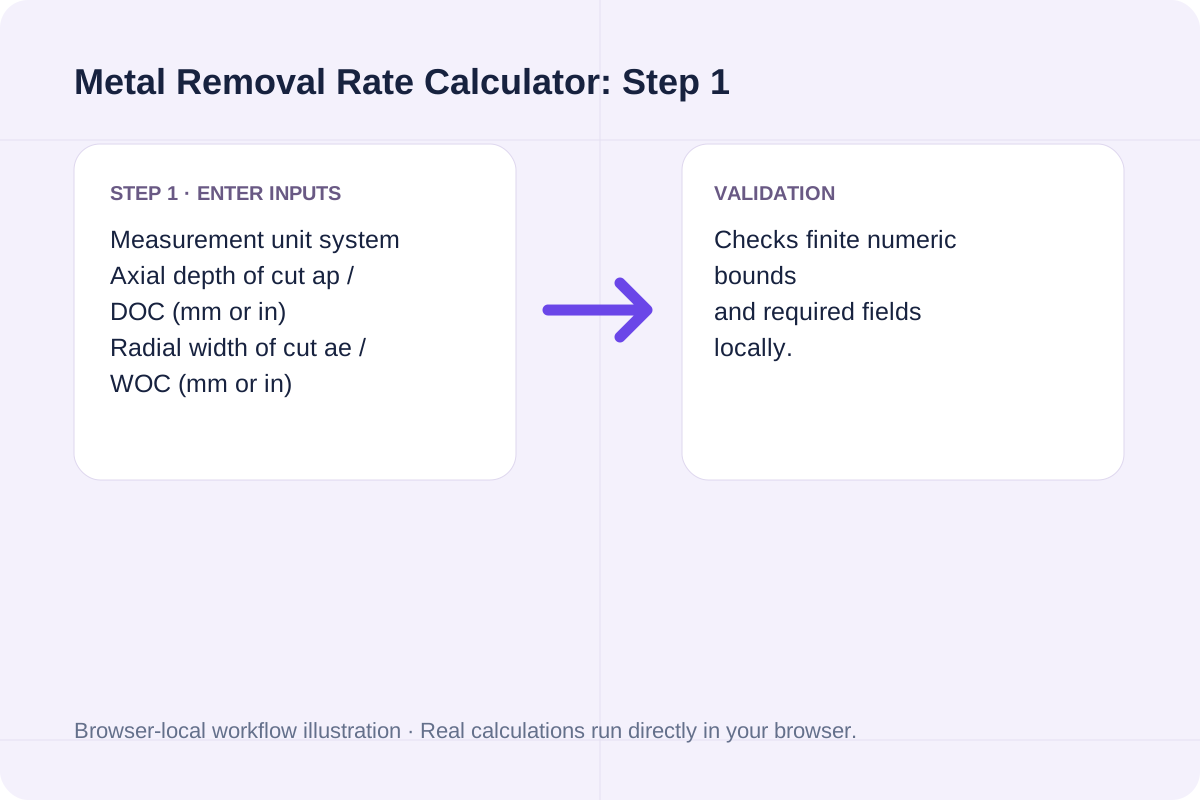
Input your axial depth of cut (`ap`), radial stepover (`ae`), and table feed velocity (`vf`).
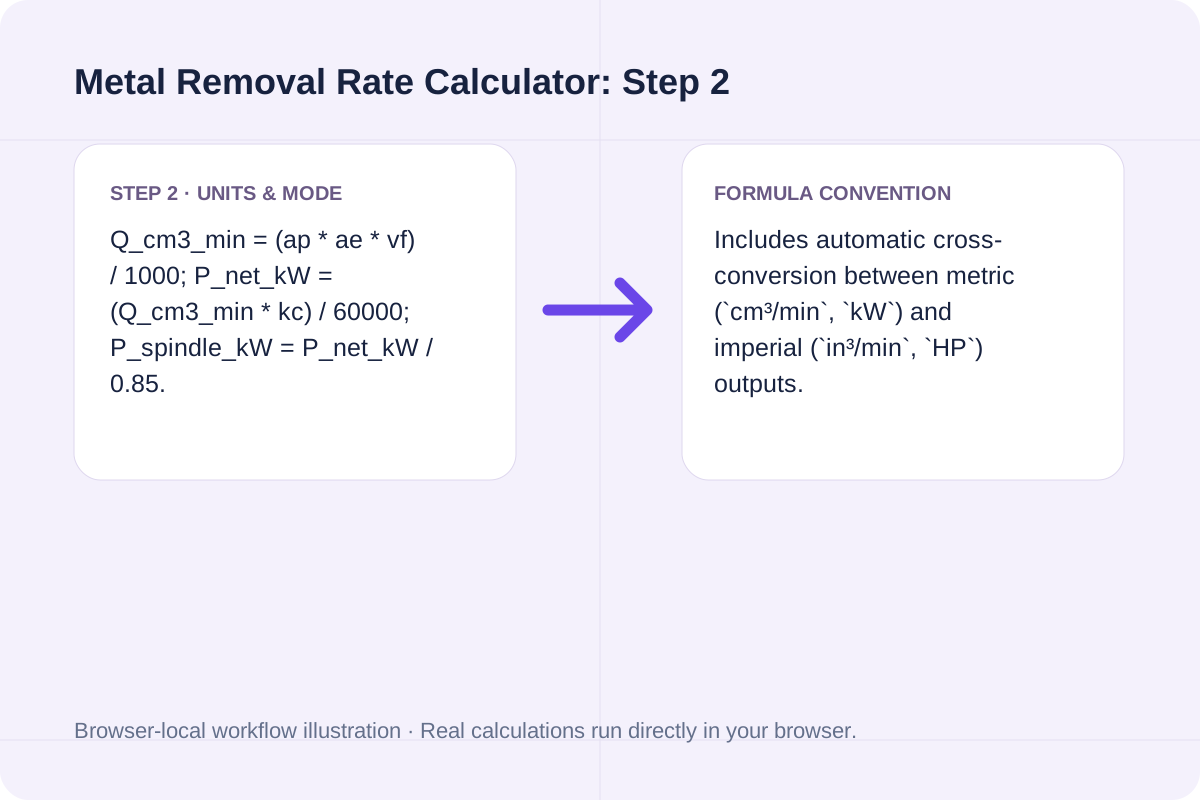
Click Calculate Metal Removal Rate to compare `cm³/min`, `in³/min`, net cutting power (`kW` / `HP`), required spindle power at 85% efficiency, and chip mass removed per hour.
Compare baseline and alternative runs for Metal Removal Rate Calculator before exporting the result.
Calculate CNC milling and turning Metal Removal Rate (MRR in cm³/min and in³/min), estimated spindle power (kW / HP), and chip load.
Q_cm3_min = (ap * ae * vf) / 1000; P_net_kW = (Q_cm3_min * kc) / 60000; P_spindle_kW = P_net_kW / 0.85.
Includes automatic cross-conversion between metric (`cm³/min`, `kW`) and imperial (`in³/min`, `HP`) outputs.
Review the calculated output alongside your entered parameters and unit conventions.
Includes automatic cross-conversion between metric (`cm³/min`, `kW`) and imperial (`in³/min`, `HP`) outputs.
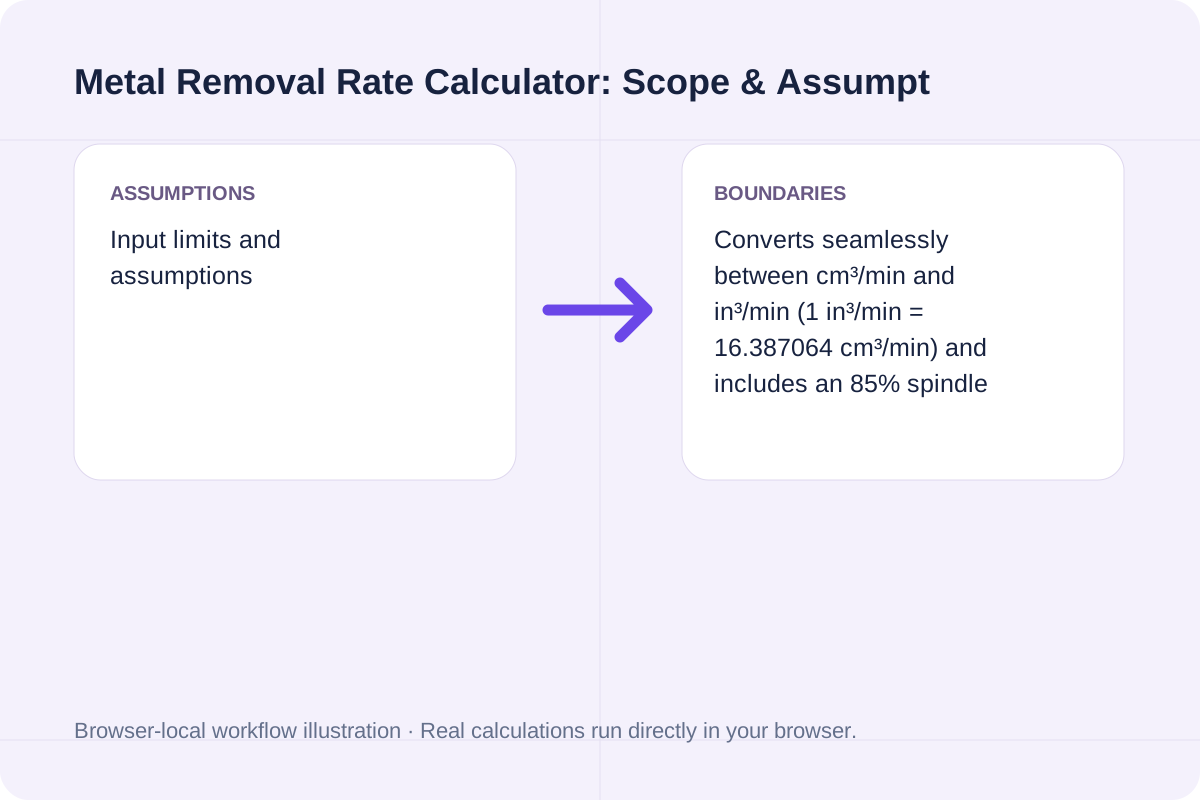
Check the model scope and boundary conditions before applying the numbers to a real project.
Q_cm3_min = (ap * ae * vf) / 1000; P_net_kW = (Q_cm3_min * kc) / 60000; P_spindle_kW = P_net_kW / 0.85. Includes automatic cross-conversion between metric (`cm³/min`, `kW`) and imperial (`in³/min`, `HP`) outputs.
Calculate average chemical reaction rate, reactant consumption rate, apparent rate constant k, and half-life from initial and final molarity and Δt.
Open tool
Calculate bottleneck cycle time, Takt time margin, hourly and shift throughput, line balance efficiency, flow efficiency, and Little's Law WIP from workstation times.
Open tool
Calculate oligonucleotide primer melting temperature (Tm) using SantaLucia 1998 Nearest-Neighbor thermodynamics, Salt-Adjusted Marmur-Doty, and Wallace rules.
Open toolChoose another tool for your next calculation, conversion, or text task.

Analyze warehouse fulfillment performance from order line data: compute unit fill rate, line fill rate, order fill rate, and backorder recovery with explicit gross vs. net denominators.
Open tool
Calculate hiking time from trail distance, elevation gain, elevation loss, base flat pace, and terrain difficulty using Naismith's Rule, Langmuir descent adjustments, and Tobler's function.
Open tool
Determine reaction order (0th, 1st, or 2nd) from time-concentration data by linearizing [A], ln[A], and 1/[A] vs. time t, comparing R² and RMSE, and calculating rate constant k and half-life.
Open tool
Calculate how long it takes to mow any lawn size by deck width, mowing speed, pass overlap, and turn/obstacle field efficiency.
Open toolAnswers about using Metal Removal Rate Calculator and understanding its results.
In metric units, MRR (cm³/min) = (ap * ae * vf) / 1000, where ap is axial depth of cut (mm), ae is radial width of cut (mm), and vf is table feed rate (mm/min). In imperial units, MRR (in³/min) = DOC * WOC * IPM, where DOC and WOC are in inches and IPM is feed rate in inches per minute.
Multiply MRR by the material's specific cutting energy (kc or unit power factor Kp) and divide by the machine's drivetrain efficiency (typically η = 0.80 to 0.90). In metric units, Net Power (kW) = (ap * ae * vf * kc) / (60 * 10^6), where kc is specific cutting force in N/mm² (MPa).
1 cubic inch equals 16.387064 cubic centimeters (2.54³). Divide MRR in cm³/min by 16.387064 to get in³/min, or multiply in³/min by 16.387064 to get cm³/min.
HEM uses a large axial depth of cut (ap = 1.5x to 2x cutter diameter) combined with a small radial stepover (ae = 8% to 15% of diameter) and higher feed rates to account for radial chip thinning, distributing wear evenly along the flute while keeping radial deflection and peak torque controlled.
Choose another tool for your next calculation, conversion, or text task.