

Reaction Rate Calculator
Calculate average chemical reaction rate, reactant consumption rate, apparent rate constant k, and half-life from initial and final molarity and Δt.
Open toolCompute PCR primer melting temperature (`Tm`) side-by-side using **SantaLucia (1998) Nearest-Neighbor thermodynamics** (`ΔH°`, `ΔS°`), **Salt-Adjusted Marmur-Doty**, and the **Wallace Rule**, complete with `GC%`, `3' GC clamp` check, and recommended annealing temperature (`Ta`).
Enter the inputs, then select Calculate Primer Tm.
Result will appear here
Two primers with identical length and identical GC% can have melting temperatures that differ by 4 °C to 6 °C because base-pair stability depends on adjacent base stacking (`5'-GC-3'` vs. `5'-CG-3'`), not just individual hydrogen bonds.
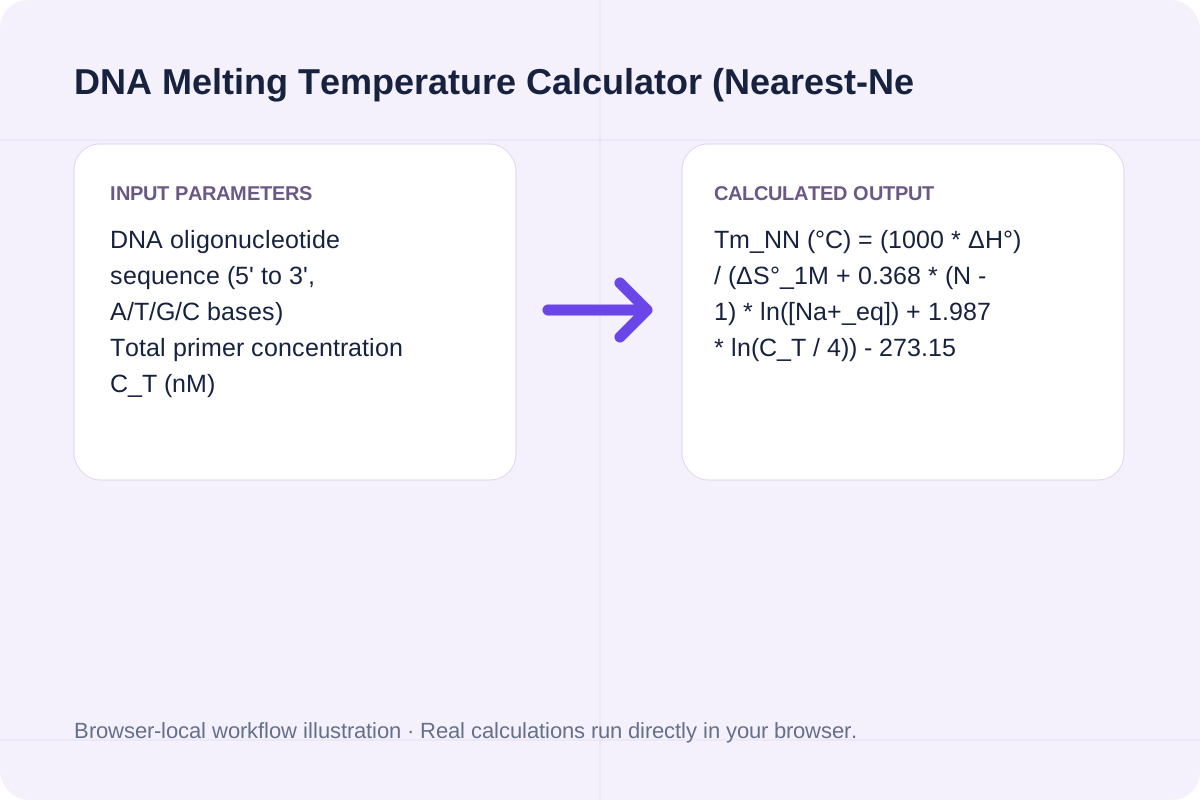
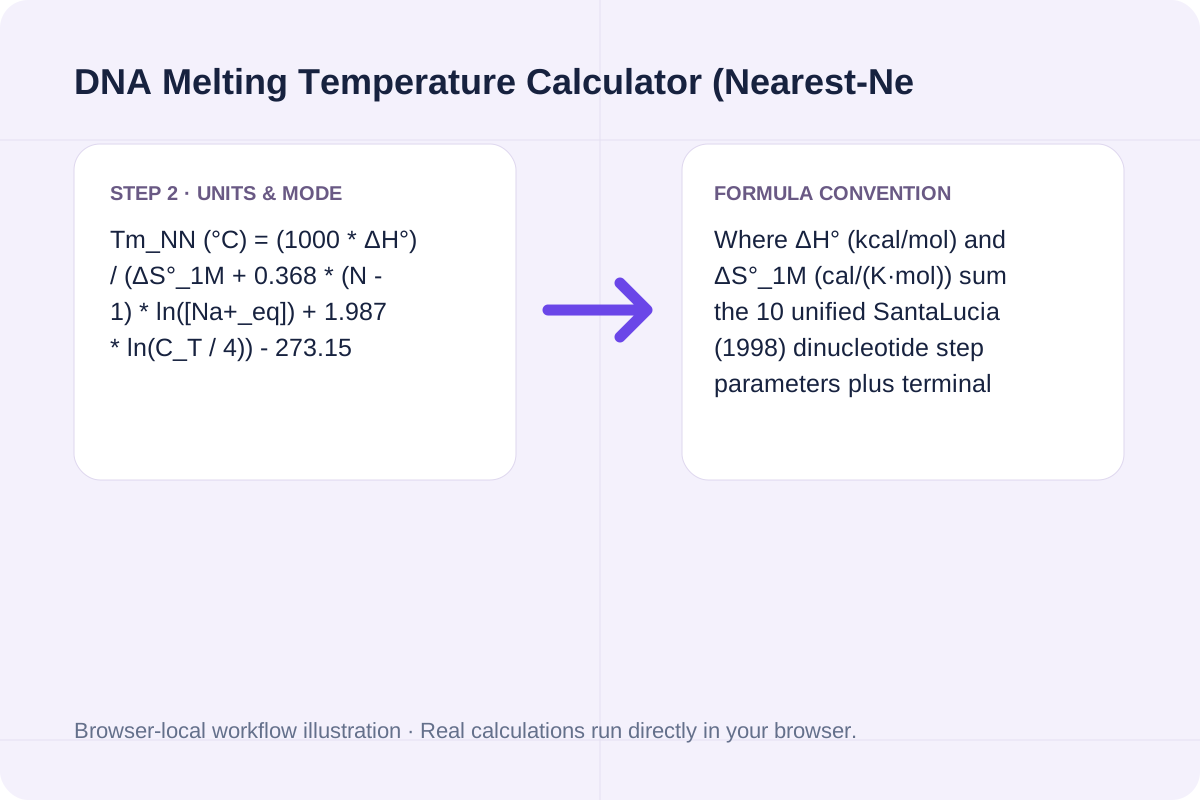
Tm_NN (°C) = (1000 * ΔH°) / (ΔS°_1M + 0.368 * (N - 1) * ln([Na+_eq]) + 1.987 * ln(C_T / 4)) - 273.15
Where ΔH° (kcal/mol) and ΔS°_1M (cal/(K·mol)) sum the 10 unified SantaLucia (1998) dinucleotide step parameters plus terminal initiation penalties, R = 1.987 cal/(K·mol), and [Na+_eq] (in mol/L) includes divalent Mg2+ stabilization.
Comparison of the three standard oligonucleotide $T_m$ equations evaluated on the default `20-nt` EGFP forward primer (`5'-ATGGTGAGCAAGGGCGAGGA-3'`, `60.0% GC`, `500 nM` oligo, `50 mM Na+`, `1.5 mM Mg2+`).
| Tm Method | Thermodynamic / Empirical Equation | Default 20-nt EGFP Primer Result | Recommended Sequence Length Scope |
|---|---|---|---|
| **SantaLucia (1998) Nearest-Neighbor (`Tm_NN`)** | `1000·ΔH° / (ΔS°_salt + R·ln(C_T/4)) - 273.15` | **`68.1 °C`** (`ΔH° = -154.6 kcal/mol`, `ΔS° = -410.1 cal/K·mol`) | **Gold standard (`8 to 60 nt`)** — captures sequence-specific dinucleotide stacking |
| **Salt-Adjusted Marmur-Doty (`Tm_Salt`)** | `81.5 + 16.6·log10([Na+_eq]) + 0.41·(%GC) - 675/N` | **`60.6 °C`** (`[Na+_eq] = 197.0 mM` w/ `1.5 mM Mg2+`) | Longer oligonucleotides & probes (`20 to 80 nt`) where base composition averages out |
| **Wallace Rule (`Tm_Wallace`)** | `2 · (A + T) + 4 · (G + C)` | **`64.0 °C`** (`8 A/T` bases + `12 G/C` bases) | Short oligonucleotides only (`14 to 18 nt` at high salt); ignores `[Na+]` and `[Mg2+]` |
| **Recommended PCR Annealing (`Ta`)** | `Ta = Tm_NN - 4.0 °C` (Standard Taq rule) | **`64.1 °C`** (`3' end = GAGGA`, `3/5` GC clamp) | Starting thermal cycler annealing step (`55 °C – 65 °C` typical) |
Follow three steps to evaluate any forward or reverse primer sequence.
Enter your DNA sequence using A, T, G, and C bases (5' to 3'). Non-DNA formatting characters like spaces, dashes, or '5'-' prefixes are automatically cleaned.
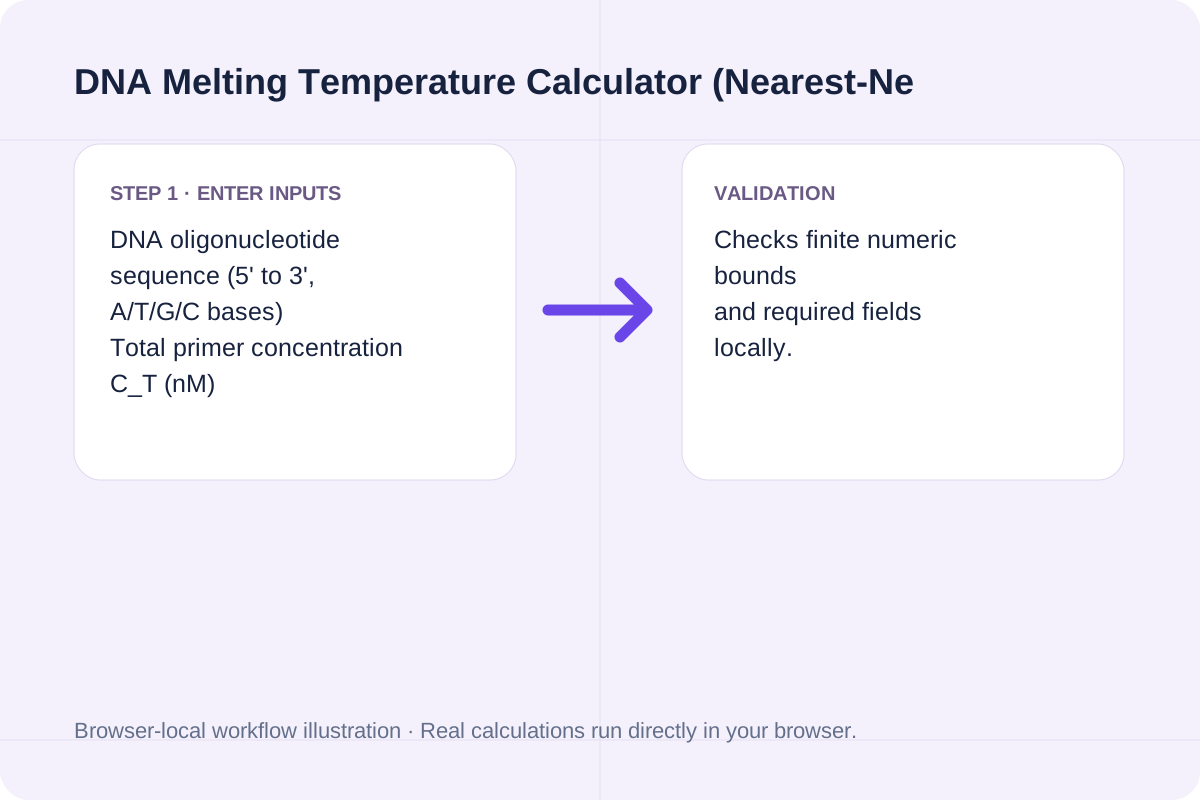
Enter your PCR primer concentration (500 nM default) and reaction buffer cation levels (50 mM Na+/K+ and 1.5 mM Mg2+ for standard Taq buffer; set Mg2+ to 0 mM for monovalent-only comparison).
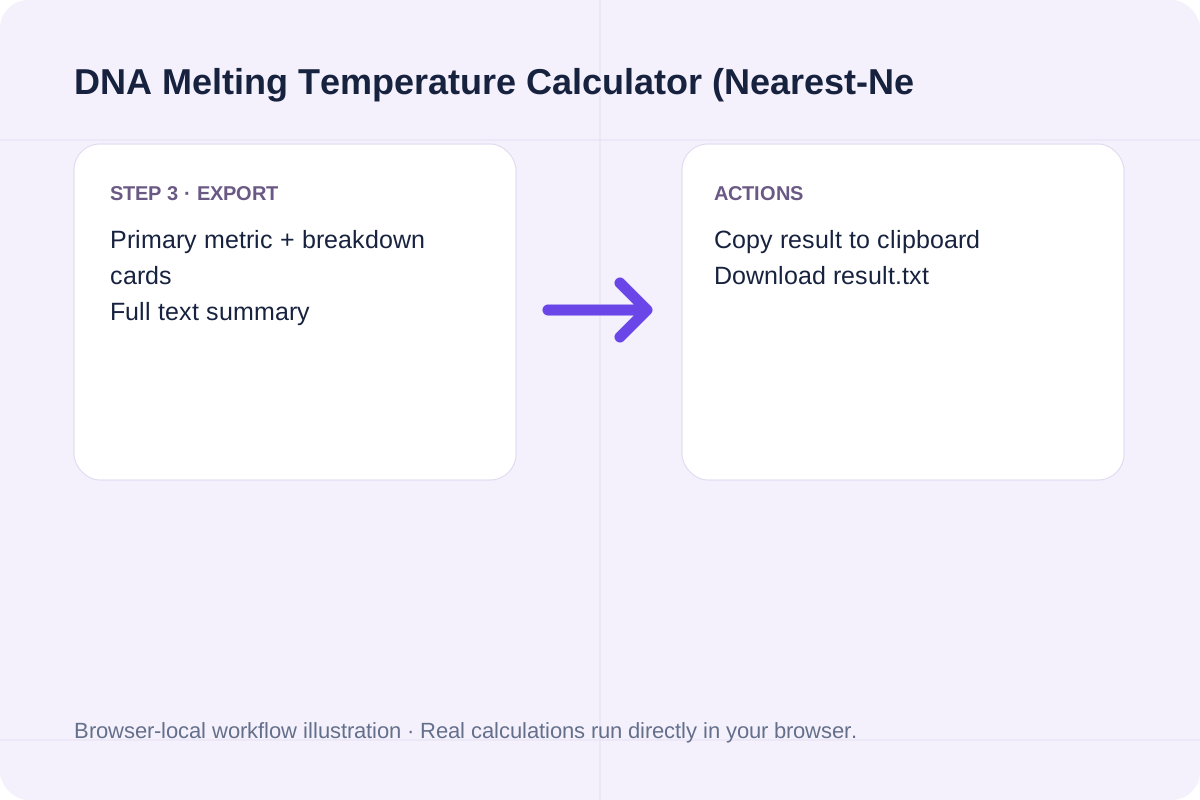
Click Calculate Primer Tm to view Nearest-Neighbor Tm, Salt-Adjusted Tm, Wallace Tm, total ΔH°/ΔS°, anhydrous molecular weight (Da), and the 5'<-3' reverse complement.
Compare how primer sequence and divalent magnesium shift melting temperature.
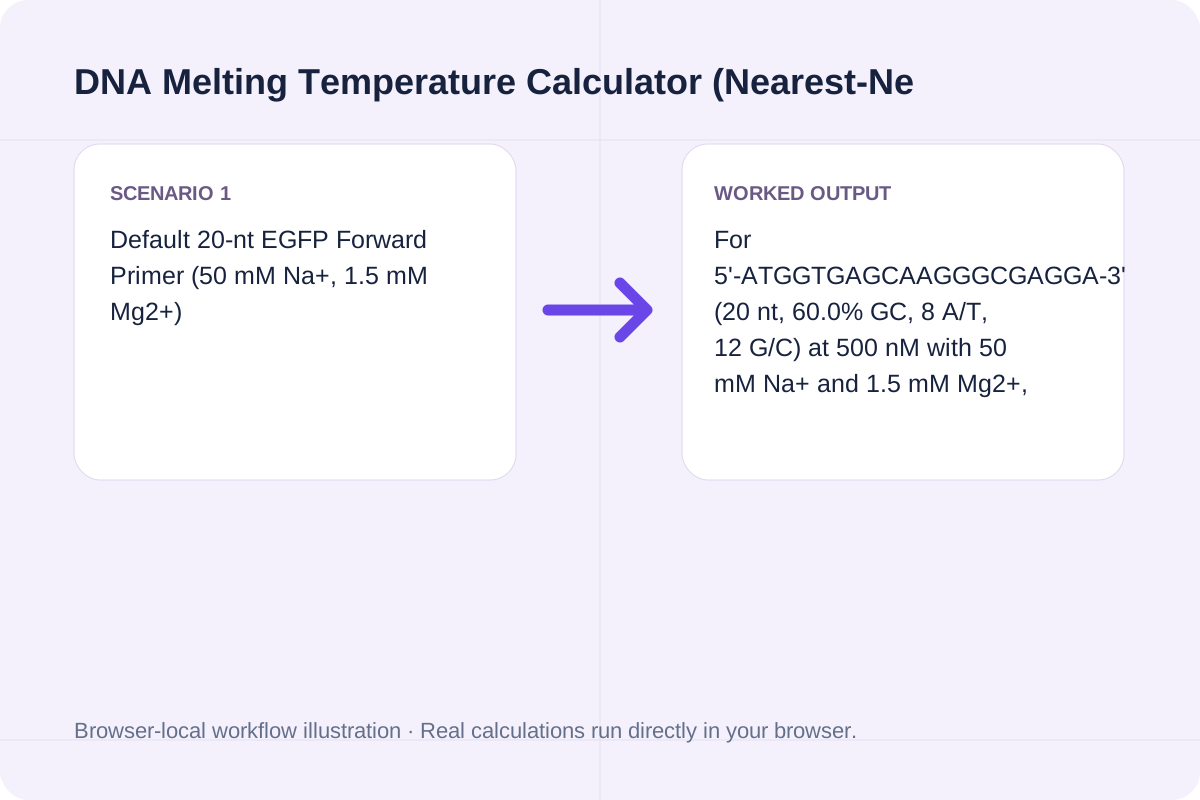
For 5'-ATGGTGAGCAAGGGCGAGGA-3' (20 nt, 60.0% GC, 8 A/T, 12 G/C) at 500 nM with 50 mM Na+ and 1.5 mM Mg2+, SantaLucia Nearest-Neighbor Tm is 64.8 °C, Salt-Adjusted Tm is 60.5 °C, and Wallace Tm is 64.0 °C (recommended Ta = 60.8 °C).
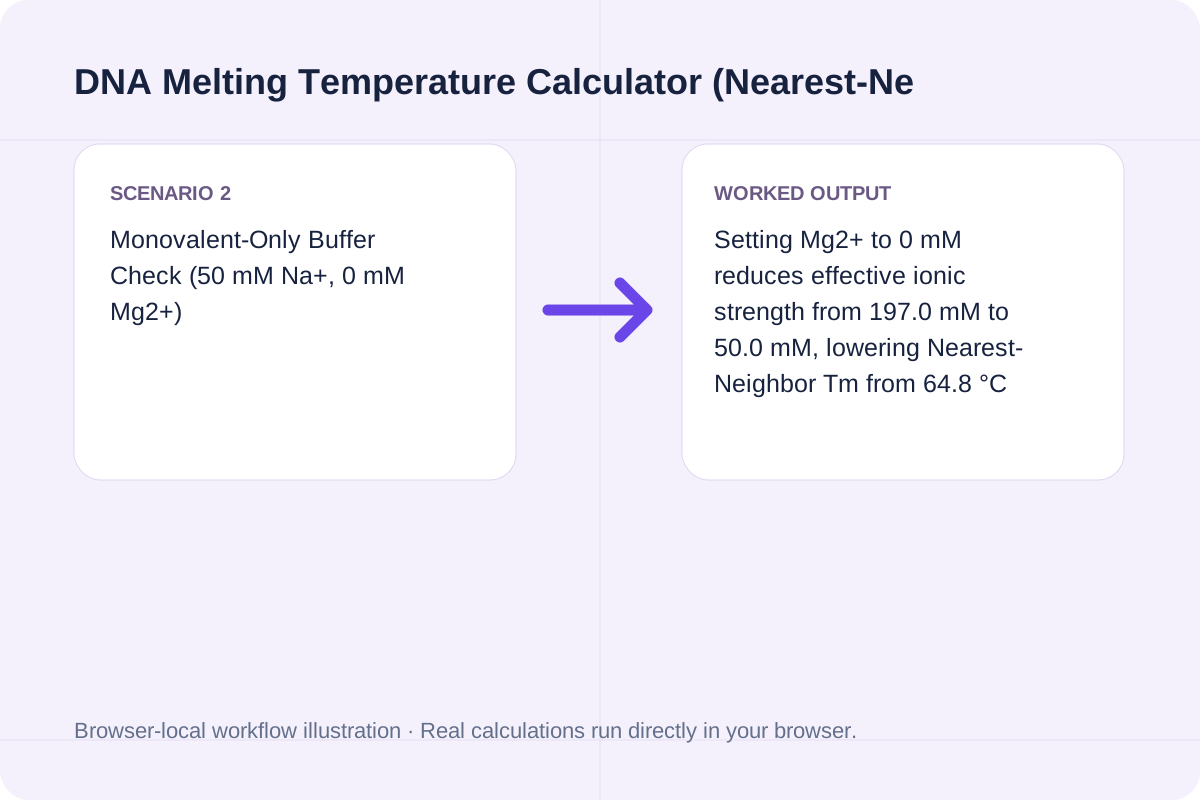
Setting Mg2+ to 0 mM reduces effective ionic strength from 197.0 mM to 50.0 mM, lowering Nearest-Neighbor Tm from 64.8 °C to 58.6 °C and Salt-Adjusted Tm from 60.5 °C to 50.6 °C.
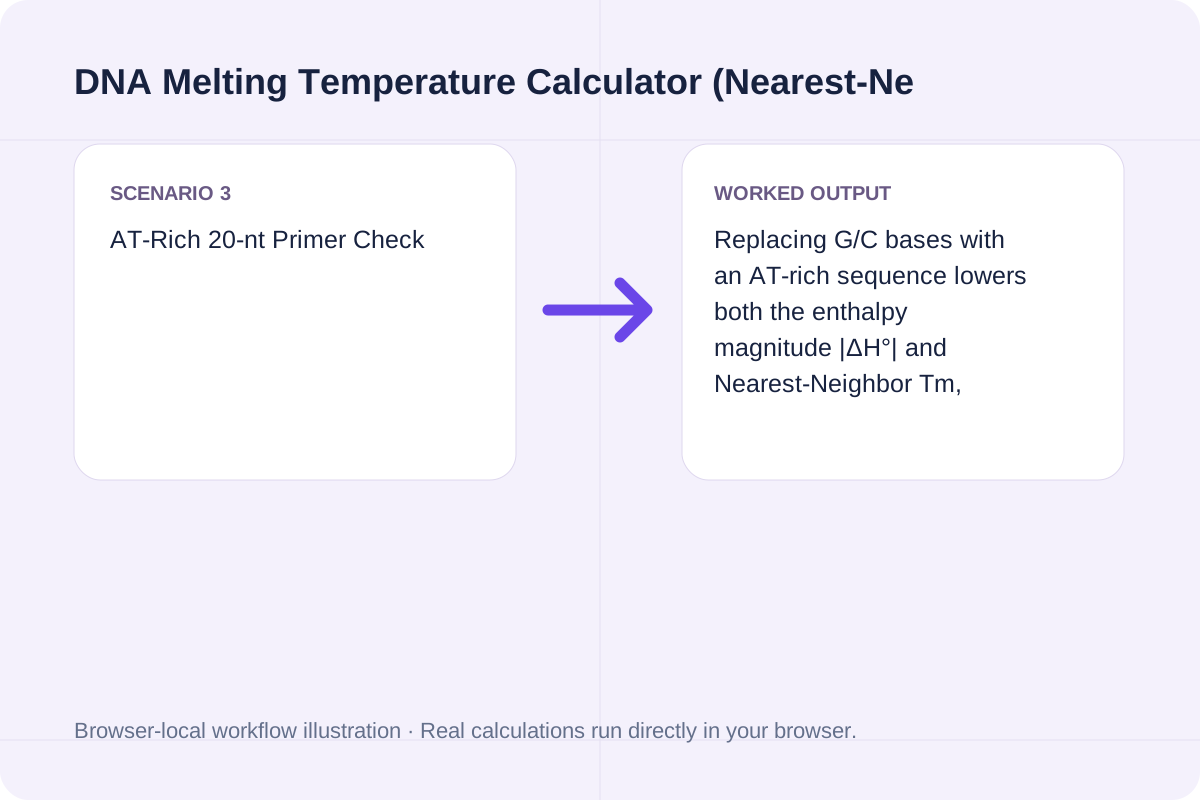
Replacing G/C bases with an AT-rich sequence lowers both the enthalpy magnitude |ΔH°| and Nearest-Neighbor Tm, triggering a low-Tm warning if Tm drops below 52 °C.
Use the Nearest-Neighbor $T_m$ as your primary benchmark for PCR design.
The primary result line reports SantaLucia Nearest-Neighbor Tm (°C), Salt-Adjusted Tm (°C), Wallace Tm (°C), and GC percentage.
The detailed audit lists exact base counts (A, T, G, C), total enthalpy ΔH° (kcal/mol), entropy ΔS° (cal/(K·mol)), single-stranded molecular weight (g/mol), 3'-terminal GC clamp count (number of G/C bases in the last 5 nucleotides), and the exact 5'->3' reverse complement sequence.
Note how specialized polymerase buffers differ from standard 50 mM KCl Taq buffers.
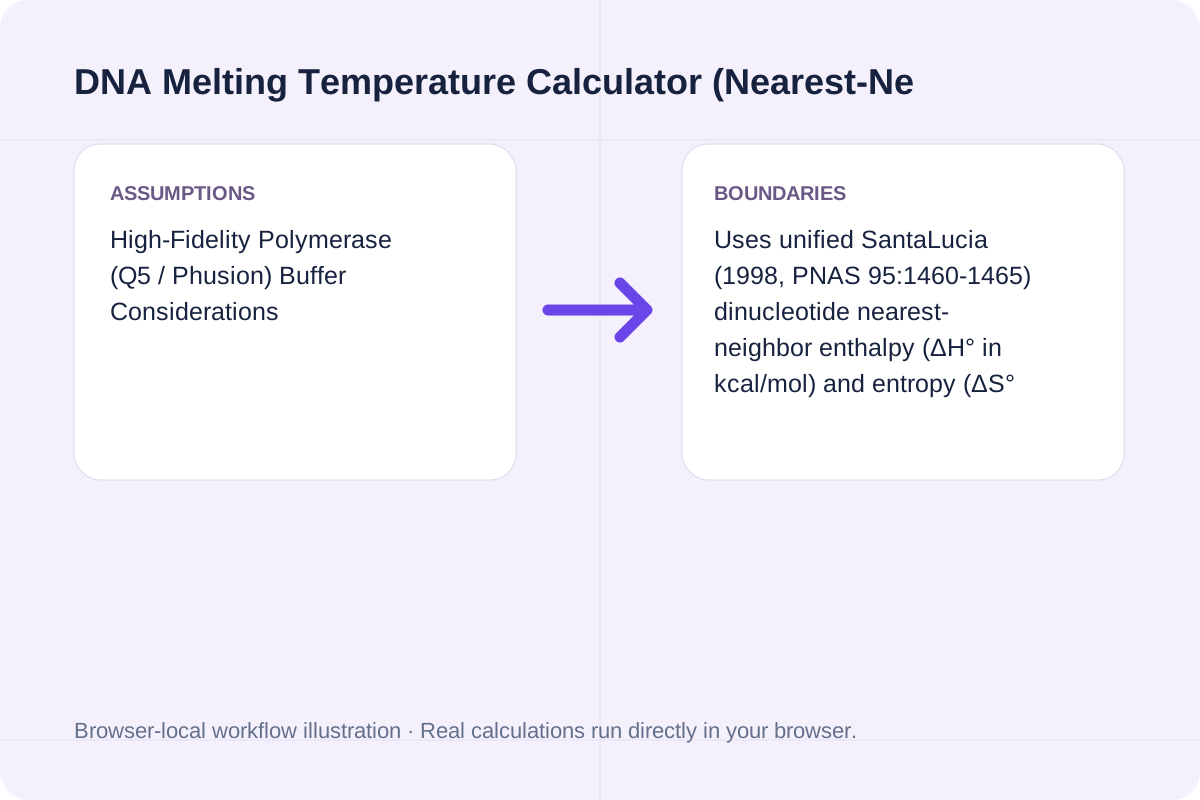
Standard Taq, Platinum Taq, and GoTaq buffers are modeled accurately by 50 mM monovalent salt + 1.5 mM Mg2+. High-processivity fusion polymerases (such as NEB Q5 or Phusion) use proprietary high-ionic-strength buffers that stabilize duplexes by an additional +3 °C to +6 °C.
When ordering lyophilized primers, divide nmol yield by 10 to find the microliters of TE buffer needed for a 100 µM master stock.
Calculate average chemical reaction rate, reactant consumption rate, apparent rate constant k, and half-life from initial and final molarity and Δt.
Open tool
Determine reaction order (0th, 1st, or 2nd) from time-concentration data by linearizing [A], ln[A], and 1/[A] vs. time t, comparing R² and RMSE, and calculating rate constant k and half-life.
Open tool
Compute the effective density, total mass, total volume, and mass/volume percentages of a two-part mixture from masses and densities or volumes and densities.
Open toolChoose another tool for your next calculation, conversion, or text task.

Calculate hiking time from trail distance, elevation gain, elevation loss, base flat pace, and terrain difficulty using Naismith's Rule, Langmuir descent adjustments, and Tobler's function.
Open tool
Calculate bottleneck cycle time, Takt time margin, hourly and shift throughput, line balance efficiency, flow efficiency, and Little's Law WIP from workstation times.
Open tool
Calculate how long it takes to mow any lawn size by deck width, mowing speed, pass overlap, and turn/obstacle field efficiency.
Open tool
Calculate CNC milling and turning Metal Removal Rate (MRR in cm³/min and in³/min), estimated spindle power (kW / HP), and chip load.
Open toolAnswers about using DNA Melting Temperature Calculator (Nearest-Neighbor, Salt-Adjusted & Wallace Tm) and understanding its results.
The Wallace Rule (Tm = 2(A+T) + 4(G+C)) is a quick bench approximation valid only for short 14–18 nt oligos at ~0.9 M salt and wildly overestimates Tm for 20+ nt primers in 50 mM PCR buffer. The Salt-Adjusted formula accounts for length N, %GC, and salt concentration, while the SantaLucia (1998) Nearest-Neighbor model sums the exact base-stacking thermodynamics (ΔH° and ΔS°) of every adjacent dinucleotide step along your 5'->3' sequence.
Positively charged cations shield the negatively charged phosphate backbones of the two DNA strands, stabilizing the duplex and raising Tm. Divalent Mg2+ ions stabilize DNA duplexes roughly 100-fold more strongly per millimole than monovalent Na+ or K+ ions; increasing Mg2+ from 0 mM to 1.5 mM raises a typical 20-mer primer's Tm by ~5.5 °C to 6.5 °C.
Optimal PCR primers are 18 to 24 nucleotides long with 40% to 60% GC content, a Nearest-Neighbor Tm between 58 °C and 65 °C (with forward and reverse primers matched within 2 °C), and 1 to 2 G or C bases within the final 5 bases at the 3' end (3' GC clamp) to promote specific polymerase extension.
For standard Taq polymerase, set the initial PCR annealing temperature (Ta) to 3 °C to 5 °C below the lower Nearest-Neighbor Tm of your forward/reverse primer pair (Ta = Tm_NN - 4 °C).
Choose another tool for your next calculation, conversion, or text task.