

Travel Time Calculator
Compute driving time, total trip duration including rest breaks, effective average speed, and fuel cost in miles or kilometers.
Open toolEnter your horizontal trail distance, cumulative elevation gain, descent, flat walking pace, and terrain multiplier to calculate Naismith moving time, total duration with rest breaks, AMC Book Time, and Hydration/Water requirements.
Enter the inputs, then select Calculate Hiking Time.
Result will appear here
Flat walking pace alone underestimates mountain hikes by 30% to 60% because every 100 meters of vertical climb requires roughly the same metabolic work as 0.83 kilometers of flat walking.
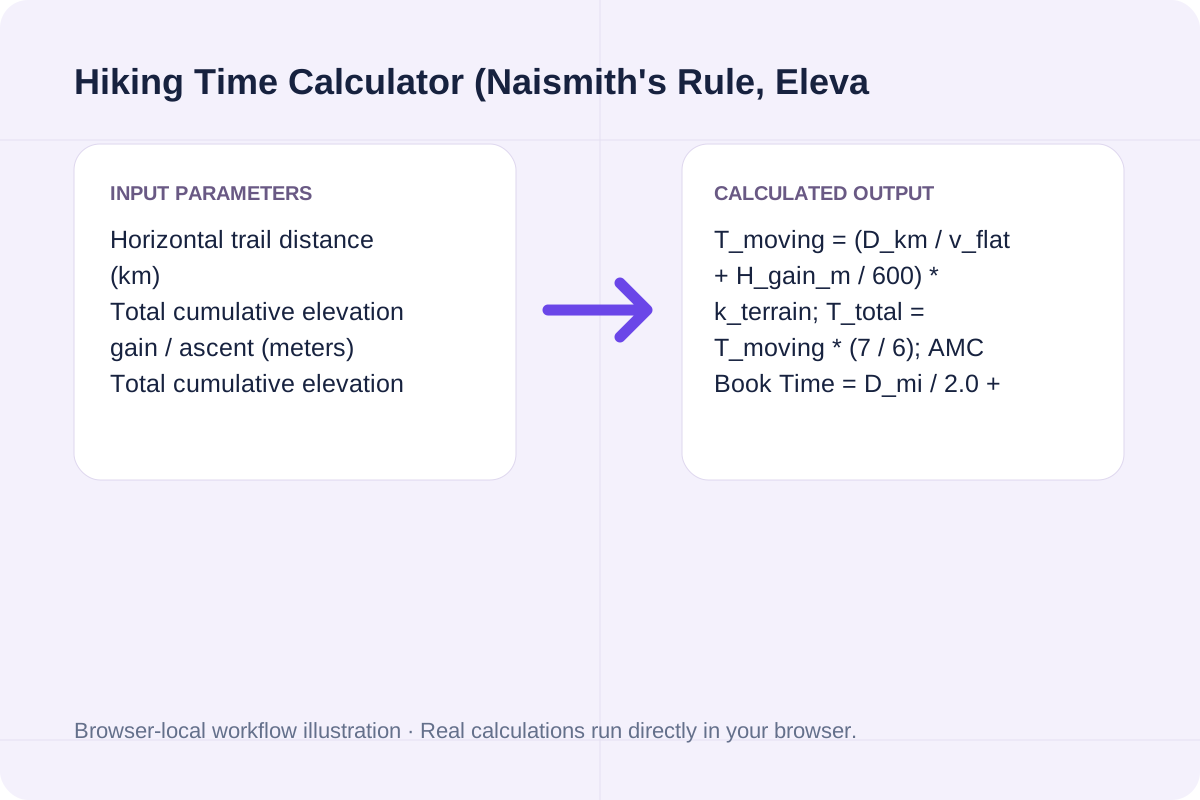
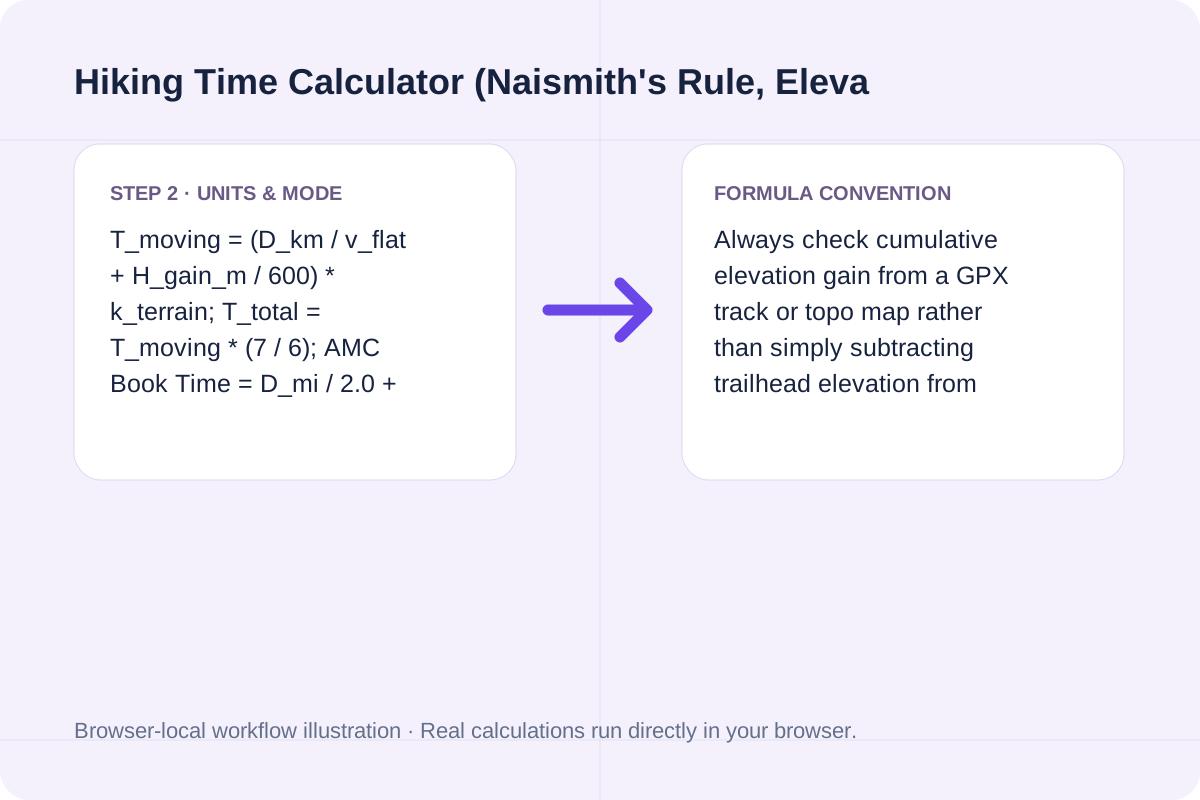
T_moving = (D_km / v_flat + H_gain_m / 600) * k_terrain; T_total = T_moving * (7 / 6); AMC Book Time = D_mi / 2.0 + H_gain_ft / 2000.
Always check cumulative elevation gain from a GPX track or topo map rather than simply subtracting trailhead elevation from summit elevation, as rolling ridges add hidden climbs.
Standard moving time and total trip duration (including 10 min rest per moving hour) across common day-hike distances and elevation gains.
| Trail Distance | Cumulative Ascent | Naismith Moving Time | Total Time w/ Breaks & Water Needed |
|---|---|---|---|
| `8.0 km` (`5.0 mi`) | `300 m` (`984 ft`) | `2h 06m` (`2.10 hr`) | `2h 27m` total • `~1.1 L` water (`0.5 L/hr`) |
| **`12.0 km` (`7.5 mi` — Default)** | **`600 m` (`1,969 ft`)** | **`3h 24m` (`3.40 hr`)** | **`3h 58m` (`3.97 hr`)** total • `~1.7 L` water |
| `16.0 km` (`9.9 mi`) | `900 m` (`2,953 ft`) | `4h 42m` (`4.70 hr`) | `5h 29m` total • `~2.4 L` water |
| `20.0 km` (`12.4 mi`) | `1,200 m` (`3,937 ft`) | `6h 00m` (`6.00 hr`) | `7h 00m` total • `~3.0 L` water |
Pull your route stats from your topographic map and run the numbers before setting your turnaround time.
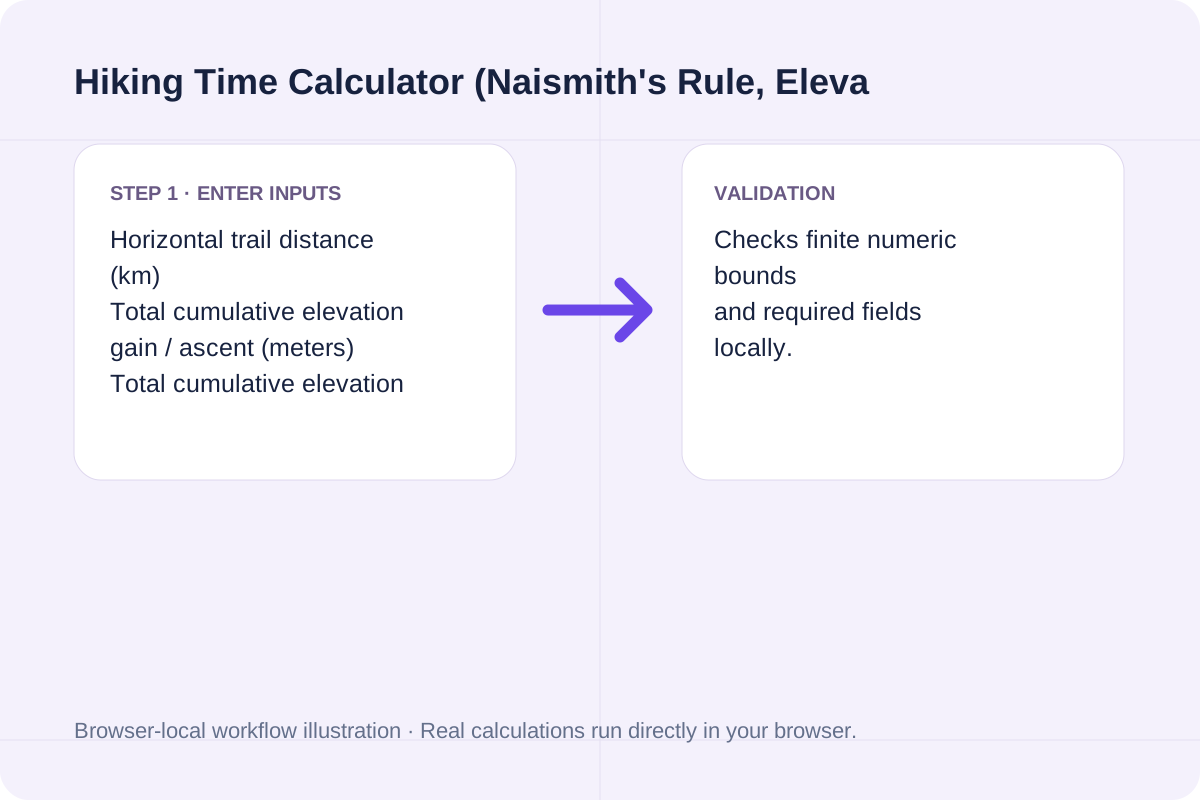
Input the total round-trip or point-to-point distance in kilometers and the total vertical meters climbed.
Keep `5.0 km/h` (`3.11 mph`) for a standard brisk hiker, or lower it to `4.0 km/h` for family groups.
Select `1.15x` for rocky/rooted forest trails or `1.30x` for alpine talus, snowfields, or a heavy multi-day backpack.
Compare a classic 12 km ridge loop, a steep alpine scramble, and a fast-packing training run.
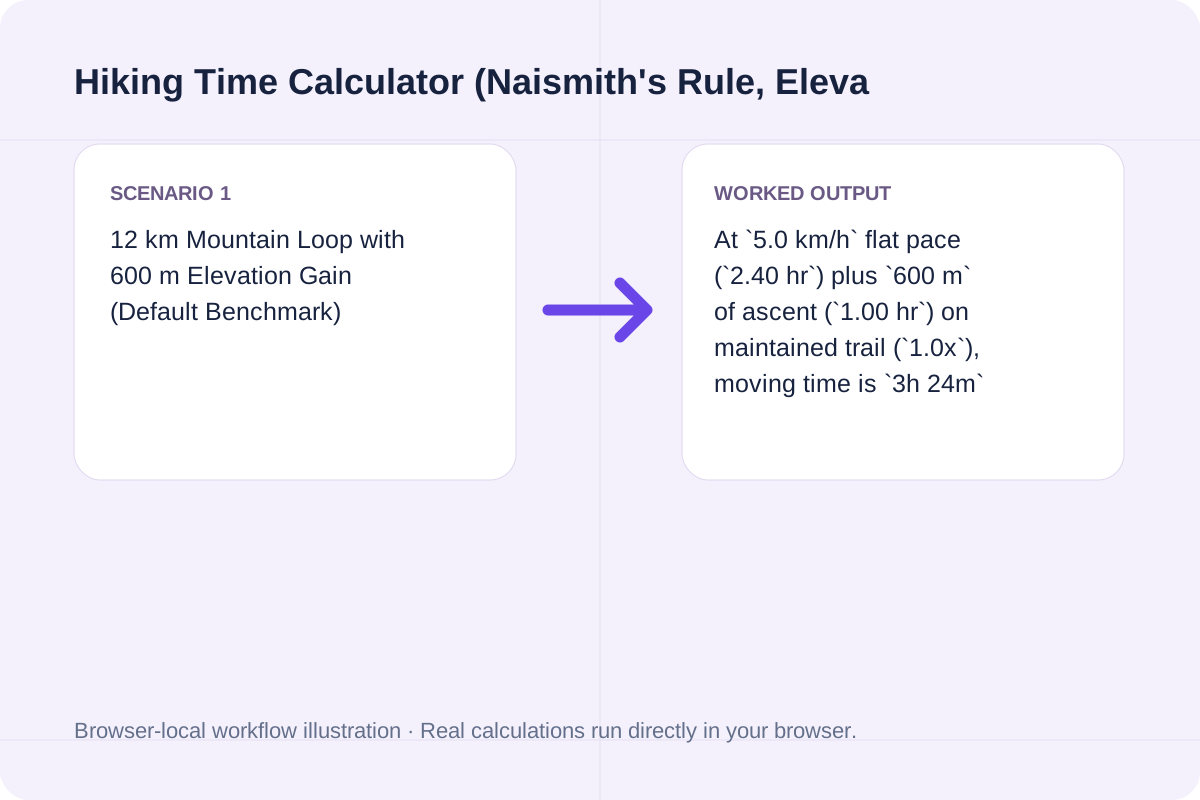
At `5.0 km/h` flat pace (`2.40 hr`) plus `600 m` of ascent (`1.00 hr`) on maintained trail (`1.0x`), moving time is `3h 24m` (`3.40 hr`) and total duration with 10 min/hr breaks is `3h 58m` (`3.97 hr`), with an average moving speed of `3.53 km/h`.
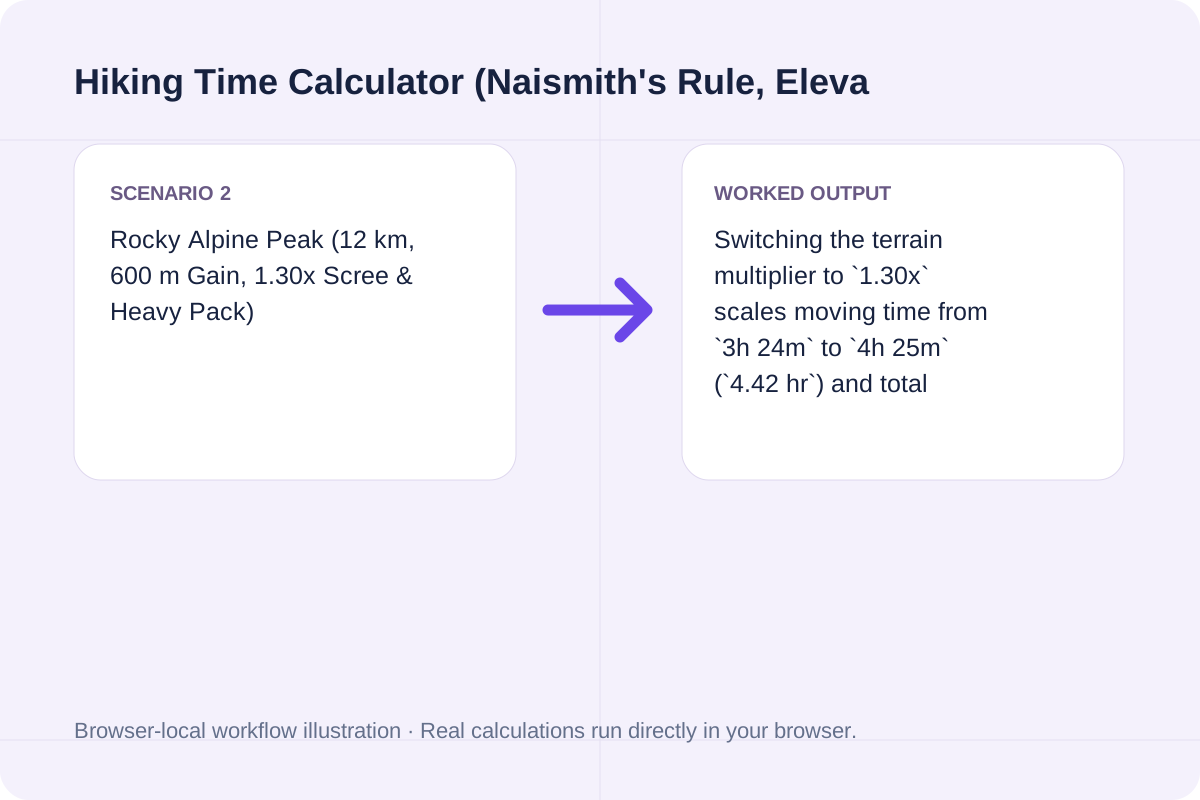
Switching the terrain multiplier to `1.30x` scales moving time from `3h 24m` to `4h 25m` (`4.42 hr`) and total duration with breaks to `5h 09m`.
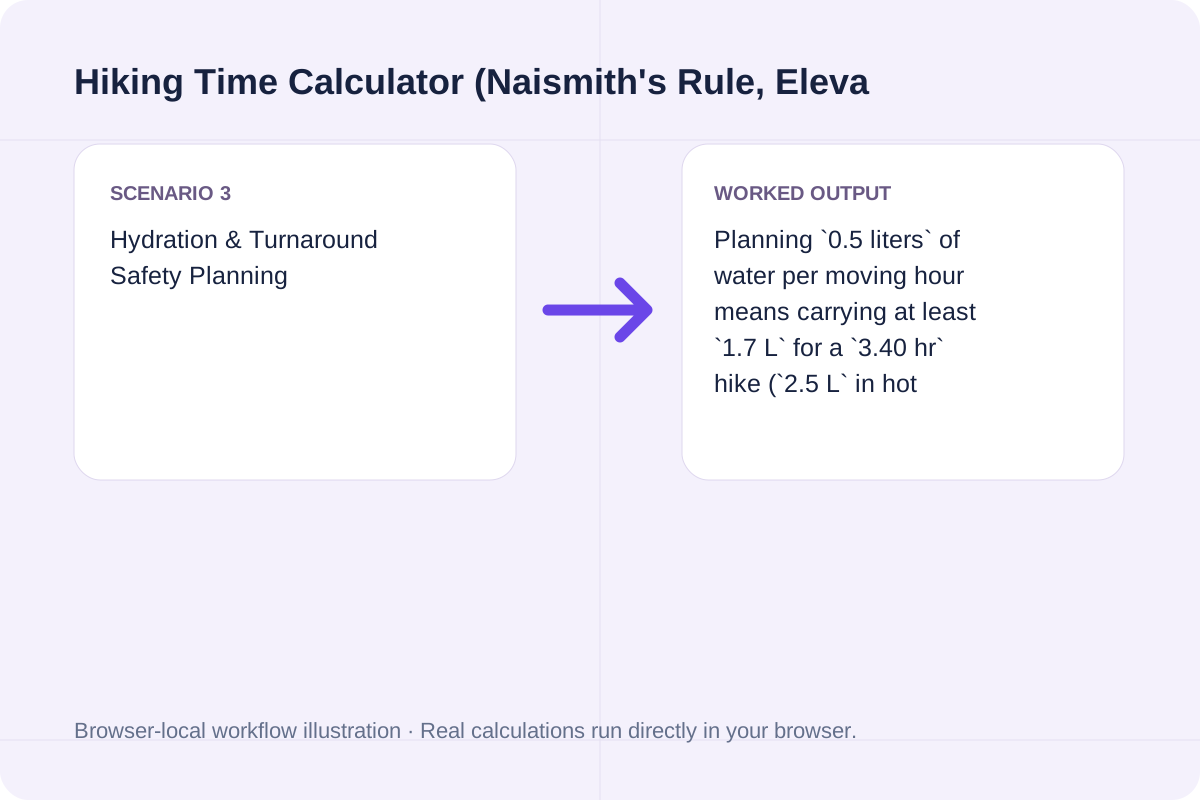
Planning `0.5 liters` of water per moving hour means carrying at least `1.7 L` for a `3.40 hr` hike (`2.5 L` in hot summer conditions) and setting a strict turnaround time 1 hour before sunset.
GPS watches pause during rest stops (`Moving Time`), whereas daylight safety depends on `Total Elapsed Time`.
Use `Moving Time` (`3h 24m` on the default route) to gauge physical exertion and compare against your Strava or Garmin moving pace, and use `Total Time w/ Breaks` (`3h 58m`) to schedule carpool return times in our Travel Time Calculator (/tools/travel-time-calculator).
If your average grade (`Ascent_m / (Distance_km * 1000)`) exceeds `15%`, expect downhill knees to slow your return leg nearly as much as the climb.
Account for altitude and weather before heading onto exposed ridges.
T_moving = (D_km / v_flat + H_gain_m / 600) * k_terrain; T_total = T_moving * (7 / 6); AMC Book Time = D_mi / 2.0 + H_gain_ft / 2000. Always check cumulative elevation gain from a GPX track or topo map rather than simply subtracting trailhead elevation from summit elevation, as rolling ridges add hidden climbs.
Compute driving time, total trip duration including rest breaks, effective average speed, and fuel cost in miles or kilometers.
Open tool
Budget your 168-hour week across sleep, work, commute, chores, and exercise to calculate remaining free hours and category percentages.
Open tool
Subtract UTC date-only timestamps and divide by 86,400,000 milliseconds.
Open toolChoose another tool for your next calculation, conversion, or text task.

Determine reaction order (0th, 1st, or 2nd) from time-concentration data by linearizing [A], ln[A], and 1/[A] vs. time t, comparing R² and RMSE, and calculating rate constant k and half-life.
Open tool
Calculate how long it takes to mow any lawn size by deck width, mowing speed, pass overlap, and turn/obstacle field efficiency.
Open tool
Calculate bottleneck cycle time, Takt time margin, hourly and shift throughput, line balance efficiency, flow efficiency, and Little's Law WIP from workstation times.
Open tool
Calculate room reverberation time (RT60) using Sabine (0.161 V / A) and Norris-Eyring formulas from room volume and surface absorption coefficients.
Open toolAnswers about using Hiking Time Calculator (Naismith's Rule, Elevation Gain & Pace) and understanding its results.
Formulated by Scottish mountaineer William W. Naismith in 1892, Naismith's Rule allows 1 hour for every 5 kilometers (3.1 miles) of horizontal distance plus 1 additional hour for every 600 meters (2,000 feet) of cumulative elevation gain. On a 12 km hike with 600 m of ascent, flat distance takes 12 / 5 = 2.40 hours and climbing adds 600 / 600 = 1.00 hour, totaling 3.40 hours (3 hours 24 minutes) of moving time.
Naismith's formula estimates continuous moving time on the trail. Adding 10 minutes of rest per hour of moving time accounts for water stops, layer adjustments, navigation checks, and summit photos, turning 3h 24m of moving time into 3h 58m of total trailhead-to-trailhead time.
In North America, the AMC White Mountain Guide estimates 'Book Time' at 2 miles per hour (3.22 km/h) on the flat plus 30 minutes for every 1,000 feet (304.8 m) of elevation gain. Both Naismith and AMC Book Time are displayed in the detailed report.
Gentle downhill grades (5° to 12°) allow slightly faster walking (subtracting ~10 minutes per 300 m of descent), whereas steep descents (> 12° grade on knees and loose rock) add +10 minutes per 300 m of descent.
Choose another tool for your next calculation, conversion, or text task.