
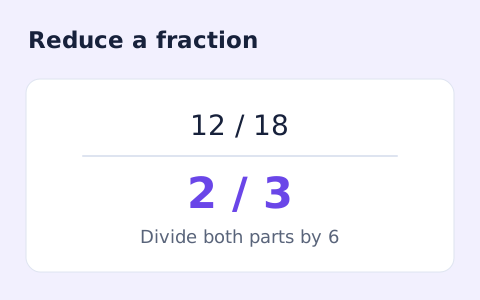
Fraction Simplifier
Simplify signed integer fractions exactly and see the greatest common divisor and mixed-number form.
Open toolSolve a quadratic equation from coefficients a, b, and c. Review the discriminant and the rounded real or complex roots.
Update the inputs to see your result.
Result will appear here
The discriminant determines which form of the quadratic root calculation applies.
The solver calculates b squared minus four times a times c. A nonnegative discriminant is used in the quadratic formula for real roots; a negative one is represented as a real part plus or minus an imaginary component.
Coefficient a must be nonzero. Results are rounded for display; exact algebraic forms are not generated.

Enter coefficients for a quadratic written with all terms on one side of the equation.
Enter a, b, and c from a quadratic written in the form ax squared plus bx plus c equals zero. Keep coefficient signs intact. The a coefficient must be nonzero, because this form does not switch to solving a linear equation.

Select Calculate and read the root result and its type. The discriminant decides whether the answer has two real roots, one repeated real root, or complex conjugates. Check the entered signs if the expected type differs from the result.
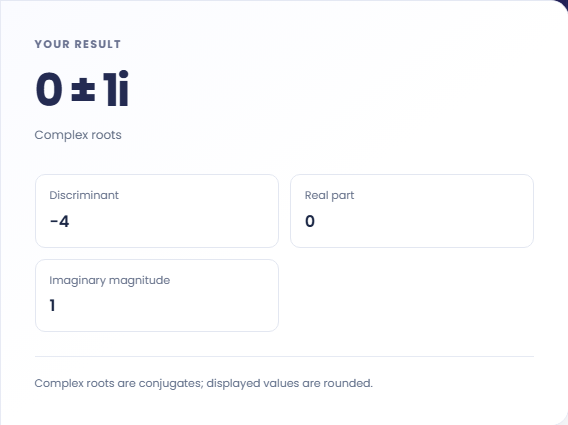
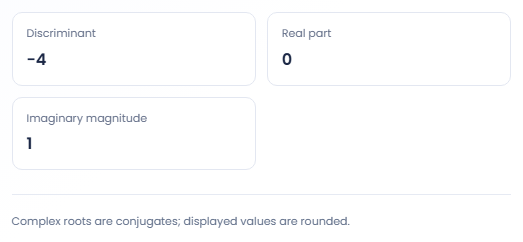
Read the discriminant and supporting roots or real and imaginary components. Values are rounded to four decimal places for display; exact radical forms are not generated. Keep the original coefficients when checking a rounded root in another calculation.
Use explicit coefficient examples so the equation being solved remains clear.
The hypothetical equation x squared minus five x plus six equals zero has roots two and three. Enter a as one, b as negative five and c as six. This is a direct check of coefficient signs and the two root result.

Use coefficients that produce a zero discriminant to see the repeated real root case. The result label distinguishes it from two distinct roots. A numerical display alone can make equal roots look like an omitted answer unless that label is retained.

For a negative discriminant, read the real part and imaginary magnitude together with the conjugate pair. The output uses rounded numerical values. It does not generate exact symbolic expressions or explain a full algebraic derivation for the entered equation.

Read the root type and rounding with the original coefficients.
Real roots are displayed to four decimal places. Substituting a rounded root into the original equation can leave a small residual, so the display should not be treated as an exact symbolic expression.
The discriminant determines the root type in the entered numerical model. Complex roots are given as a conjugate pair. Exact radicals, symbolic simplification and graph plotting are not part of this tool's output.

Check coefficient signs and the nonzero quadratic term before solving.
A zero a coefficient is rejected because the equation would no longer be quadratic. Use the equation's correct form rather than entering an arbitrary nonzero value to get a result. Preserve minus signs when moving terms.
If the answer differs from a worked example, compare every coefficient and its sign first. The calculator does not parse variables or an equation string. Keep numerical precision in mind when checking a displayed root by substitution.

Simplify signed integer fractions exactly and see the greatest common divisor and mixed-number form.
Open tool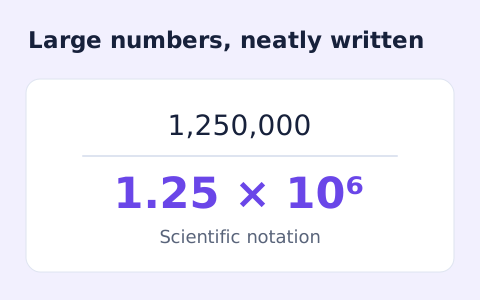
Convert decimal numbers to normalized scientific notation and back using digit-based arithmetic.
Open tool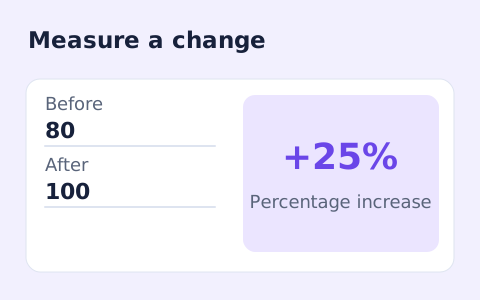
Calculate percentage change and absolute difference between a positive starting value and a new value.
Open toolChoose another tool for your next calculation, conversion, or text task.

Quickly split a bill with a percentage tip. See the tip amount, total, and per-person amount.
Open tool
Split a bill among friends using a subtotal, sales tax, tip, and number of people.
Open tool
Calculate a weighted grade from scores, points possible, and weights for multiple assignments.
Open tool
Add courses, letter grades, and credit hours to calculate a weighted 4.0-scale GPA.
Open toolSolve a quadratic equation from coefficients a, b, and c.
Answers about using Quadratic Equation Solver and understanding its results.
The equation has one repeated real root.
Yes. A negative discriminant is displayed as a real part plus or minus an imaginary part.
No. A zero a coefficient makes the equation non-quadratic. This form asks for a nonzero a rather than switching to a linear solver.
No. Roots are formatted to four decimal places. Check rounding before using the displayed values in further calculations.