

Order Fill Rate Analyzer
Analyze warehouse fulfillment performance from order line data: compute unit fill rate, line fill rate, order fill rate, and backorder recovery with explicit gross vs. net denominators.
Open toolAudit supply-chain delivery compliance from actual order rows: compute exact On-Time (`OT%`), In-Full (`IF%`), combined `OTIF%` (`DIFOT`), unit-level fill rate, SLA gap, and a root-cause breakdown (`Late Only`, `Short Only`, `Both Late & Short`).
Enter the inputs, then select Calculate OTIF & Failure Breakdown.
Result will appear here
Each order row is evaluated against two binary gates: the schedule gate (did it arrive within the allowed date window?) and the quantity gate (were 100% of ordered units delivered?).
OTIF% = (Count of orders where OnTime == true AND InFull == true) / Total_Orders * 100; SLA Gap = OTIF% - Target_SLA%.
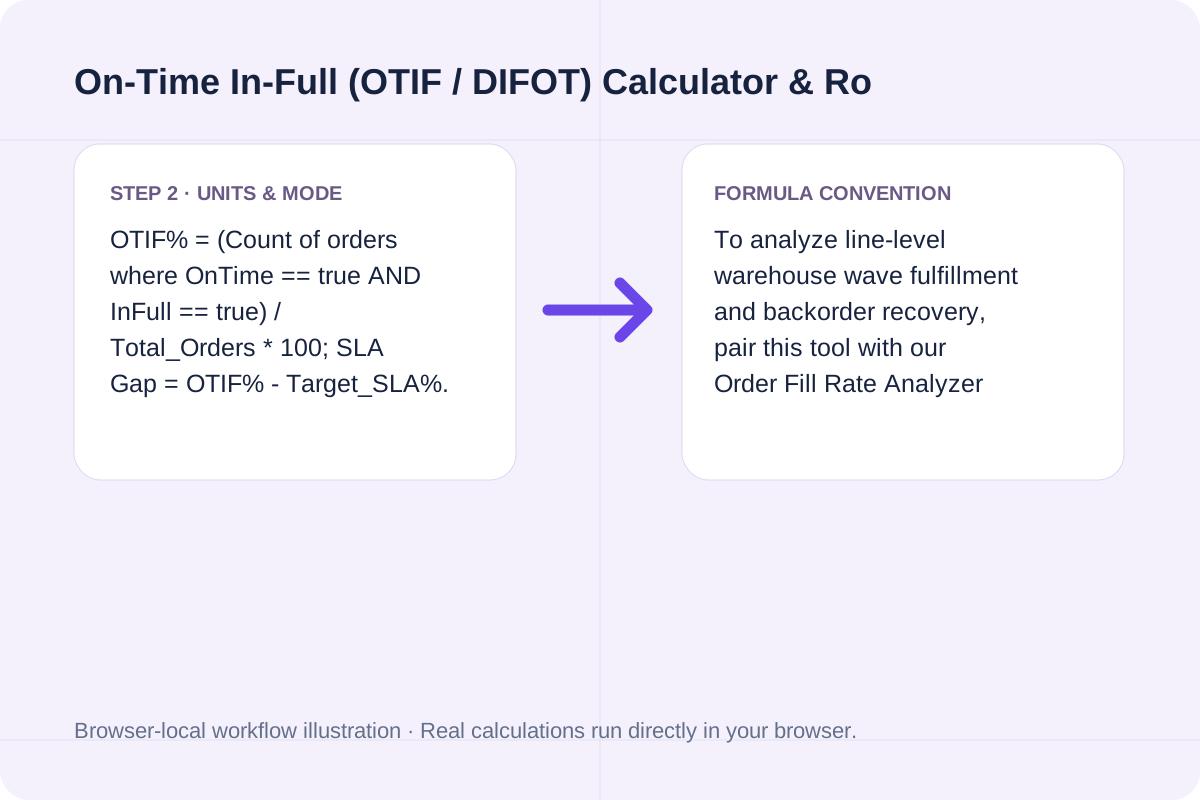
To analyze line-level warehouse wave fulfillment and backorder recovery, pair this tool with our Order Fill Rate Analyzer (/tools/order-fill-rate-analyzer).
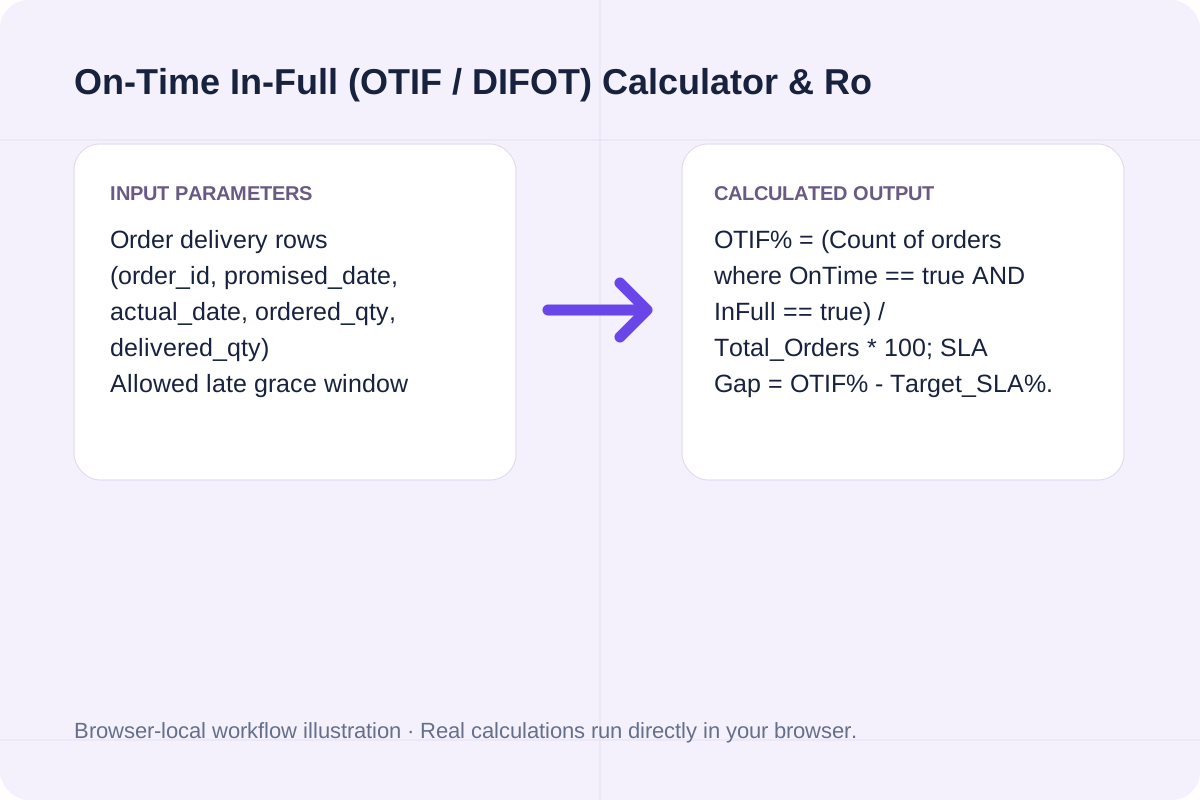
Standard supply-chain definitions and exact outputs for the default 5-order shipment log (`1,000` ordered units).
| Supply Chain KPI | Exact Formula | Default 5-Order Log Output | Operational Meaning |
|---|---|---|---|
| On-Time Delivery (`OT%`) | `(# Orders with Actual <= Promised + Grace) / N` | `80.00%` (`4 / 5` orders on time) | `ORD-103` arrived 2 days late (`Oct 10` vs `Oct 08`) |
| In-Full Delivery (`IF%`) | `(# Orders with Delivered >= Ordered) / N` | `80.00%` (`4 / 5` orders complete) | `ORD-104` shipped short (`180 / 200` units) |
| True Combined `OTIF%` (`DIFOT`) | `(# Orders BOTH On-Time AND In-Full) / N` | `60.00%` (`3 / 5` orders OTIF) | Only `ORD-101`, `ORD-102`, `ORD-105` met both gates |
| Unit-Level Fill Rate | `sum(min(Delivered, Ordered)) / sum(Ordered)` | `98.00%` (`980 / 1,000` units) | Total physical units fulfilled across all orders |
Paste your ERP or WMS shipment export to pinpoint why OTIF misses SLA targets.
Enter one order per line as 'order_id, promised_date, actual_date, ordered_qty, delivered_qty' using YYYY-MM-DD dates.
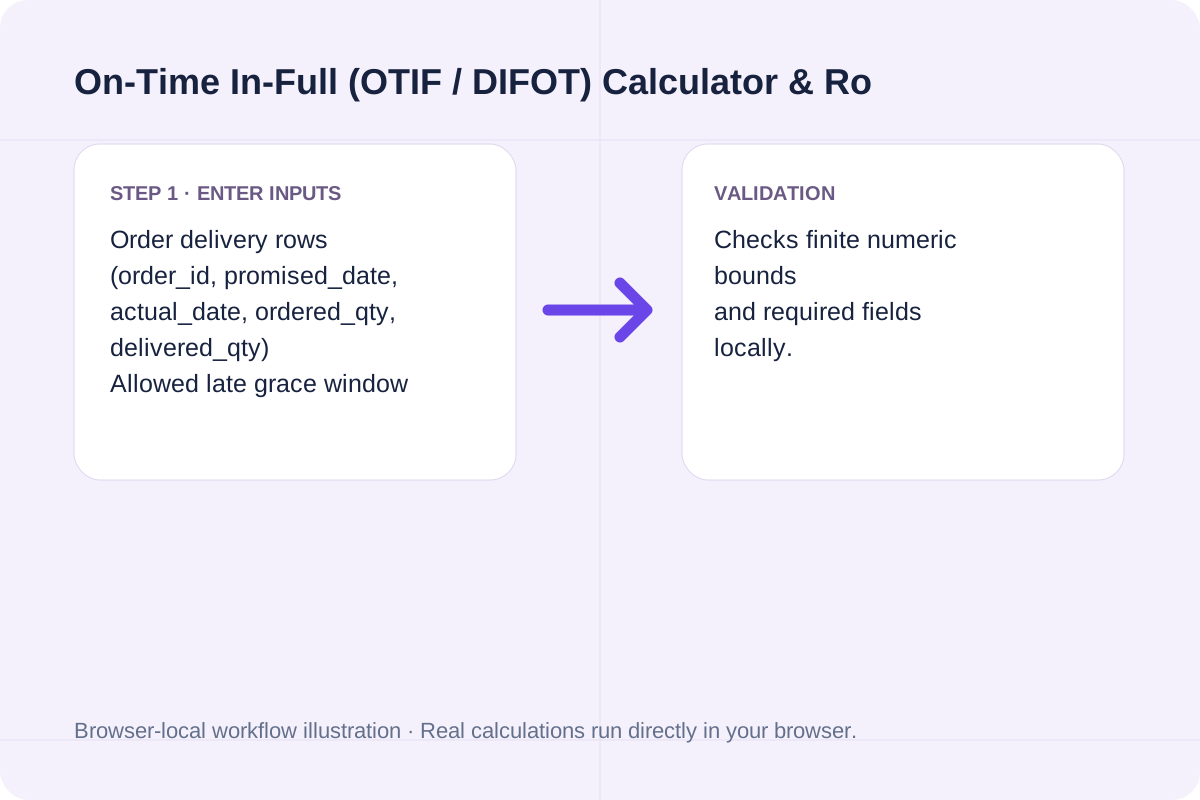
Choose whether early arrivals count as On-Time (standard B2B) or must land on the exact promised date (strict big-box MABD), and enter your SLA threshold.
Inspect the failure breakdown separating carrier/dispatch delays (Late Only) from inventory shortages (Short Only) and export the audit report.
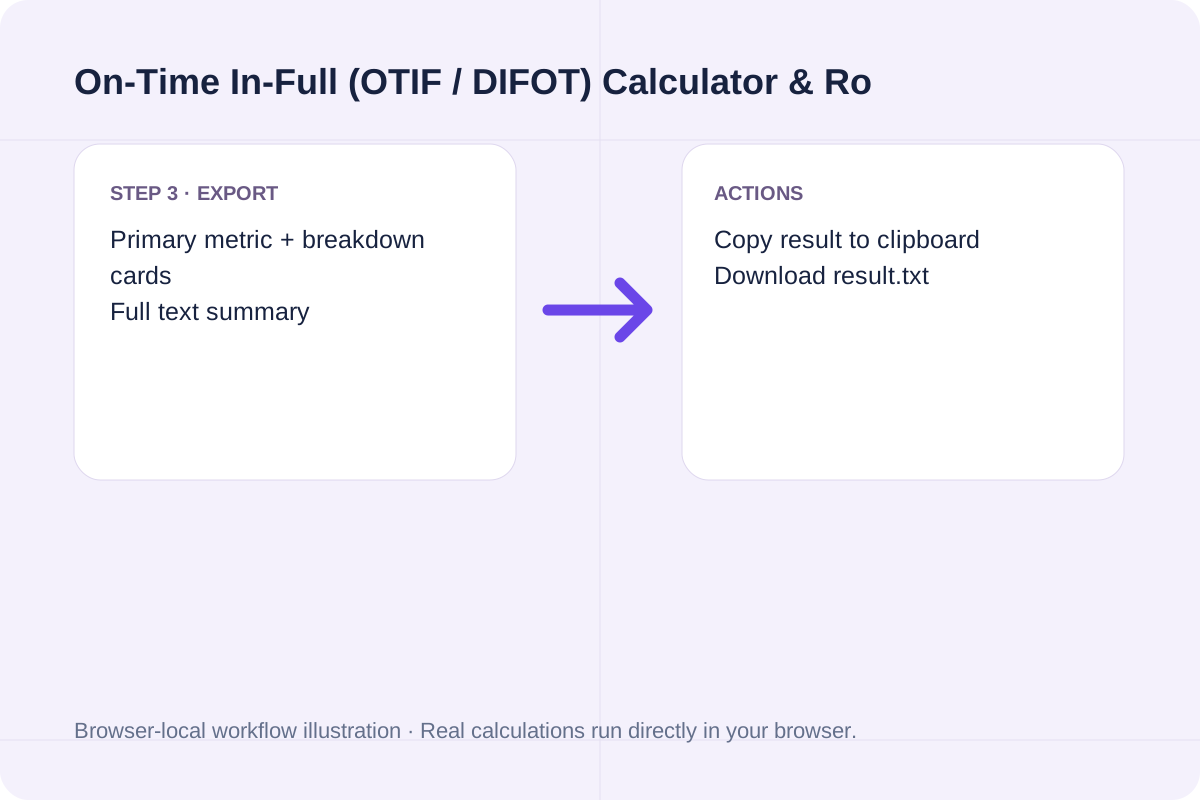
See how disjoint failures and early-arrival rules impact OTIF scores.
Free On-Time In-Full (OTIF / DIFOT) supply chain calculator. Audit order-level and unit-level OT%, IF%, OTIF%, SLA compliance, and failure root causes in your browser.
OTIF% = (Count of orders where OnTime == true AND InFull == true) / Total_Orders * 100; SLA Gap = OTIF% - Target_SLA%.
To analyze line-level warehouse wave fulfillment and backorder recovery, pair this tool with our Order Fill Rate Analyzer (/tools/order-fill-rate-analyzer).
Compare Order-Level OTIF% against Unit-Level Fill Rate to diagnose systemic vs. isolated misses.
When Unit-Level Fill Rate is high (e.g., 98.0%) but Order-Level In-Full % is low (e.g., 75.0%), small 1-to-2 unit stockouts on fast-moving SKUs are spoiling otherwise complete shipments.
When On-Time % lags In-Full %, warehouse inventory is healthy but order cutoff times, pick-pack cycle time (/tools/cycle-time-analyzer), or carrier transit lead times need adjustment.
Keep these measurement standards consistent across monthly scorecards.
1. Promised Date Anchor: Always benchmark OTIF against the original customer-confirmed delivery date rather than a rescheduled carrier ETA.
2. Over-Shipments: If delivered_qty exceeds ordered_qty, unit fill is capped at 100% of ordered demand so over-shipping one order cannot mask a shortage on another.
Analyze warehouse fulfillment performance from order line data: compute unit fill rate, line fill rate, order fill rate, and backorder recovery with explicit gross vs. net denominators.
Open tool
Calculate bottleneck cycle time, Takt time margin, hourly and shift throughput, line balance efficiency, flow efficiency, and Little's Law WIP from workstation times.
Open tool
Analyze manufacturing changeover and setup times using SMED (Single-Minute Exchange of Die). Break down internal vs. external steps, parallel savings, and downtime reduction %.
Open toolChoose another tool for your next calculation, conversion, or text task.

Calculate team productive capacity, utilization percentage, and FTE surplus or deficit from headcount, workdays, PTO, and focus factor.
Open tool
Calculate flat or 2-tier accelerated sales commission, effective commission rate, total base + variable payout, and net revenue.
Open tool
Calculate Dynamic Time Warping (DTW) distance and optimal alignment path between two time series in your browser. Supports absolute, squared, and root-squared costs plus Sakoe-Chiba window band.
Open tool
Determine reaction order (0th, 1st, or 2nd) from time-concentration data by linearizing [A], ln[A], and 1/[A] vs. time t, comparing R² and RMSE, and calculating rate constant k and half-life.
Open toolAnswers about using On-Time In-Full (OTIF / DIFOT) Calculator & Root-Cause Analyzer and understanding its results.
Multiplying aggregate On-Time % by In-Full % assumes timing failures and quantity shortages occur independently across orders. True OTIF counts the exact intersection: the percentage of orders where the same order arrived both on time AND with 100% of ordered units.
Order Fill Rate (/tools/order-fill-rate-analyzer) measures warehouse inventory availability (whether ordered units ship on the first wave without backorders). OTIF (Delivery In Full, On Time) adds carrier transit performance by checking whether the shipment actually arrived at the customer's dock by the promised date.
Retail distribution centers schedule dock doors and cross-dock labor around a Must-Arrive-By-Date (MABD). Arriving days early consumes staging floor space, so strict retail OTIF policies only count deliveries arriving on the exact MABD window.
Separate your missed orders into the three failure buckets reported by this calculator: Late-Only (carrier transit or dispatch delay), Short-Only (safety stock or picking stockout), and Both Late & Short.
Choose another tool for your next calculation, conversion, or text task.