

Cycle Time Analyzer (Bottleneck, Takt Time & Little's Law WIP)
Calculate bottleneck cycle time, Takt time margin, hourly and shift throughput, line balance efficiency, flow efficiency, and Little's Law WIP from workstation times.
Open toolBreak down machine changeover steps into **Internal** (machine stopped), **Convertible** (internal steps that can be externalized), and **External** (machine running) categories to calculate current line downtime, post-SMED target downtime, and bottleneck tasks.
Enter the inputs, then select Analyze Changeover Time.
Result will appear here
Paste your observed time-study steps to quantify SMED Stage 1, Stage 2, and Stage 3 downtime savings.
Current Machine Downtime = ∑(Internal_i + Convertible_i); Post-SMED Downtime = (∑Internal_i) × (1 − ParallelSpeedup%/100); Downtime Saved = Current Downtime − Post-SMED Downtime; Reduction % = (Downtime Saved / Current Downtime) × 100.
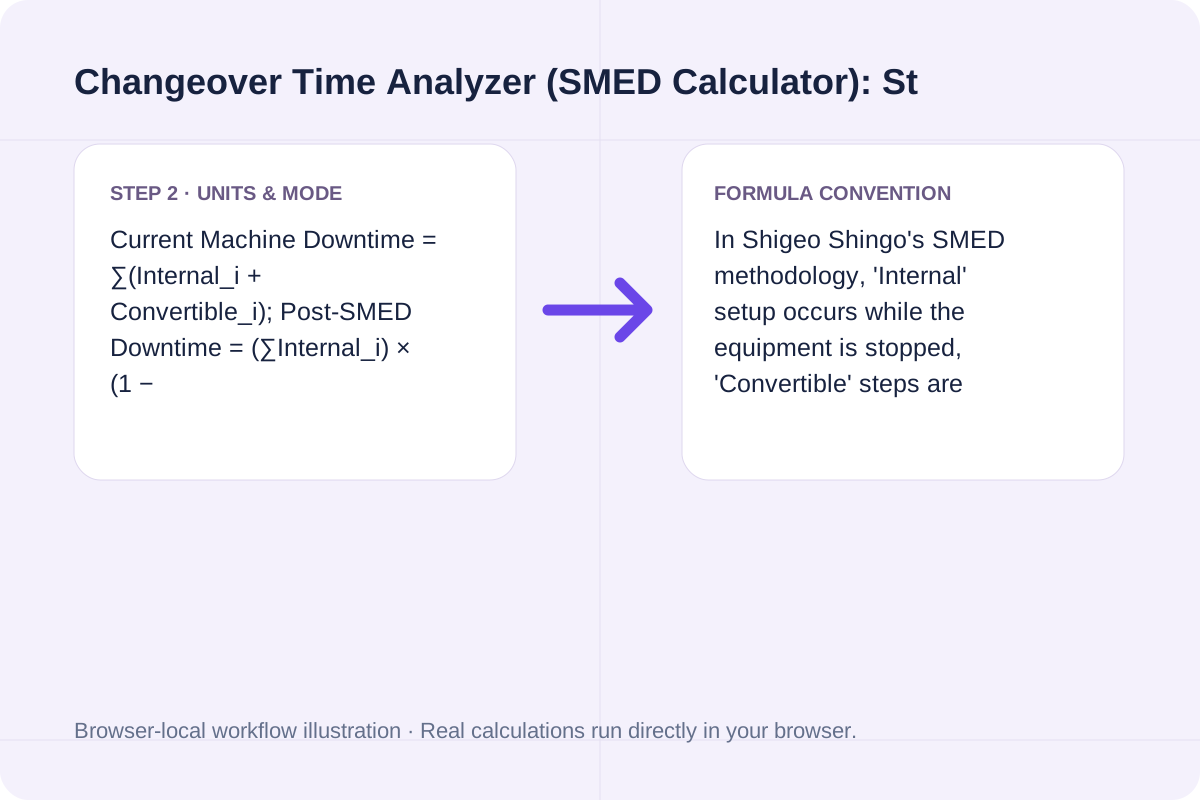
In Shigeo Shingo's SMED methodology, 'Internal' setup occurs while the equipment is stopped, 'Convertible' steps are currently performed while stopped but can be externalized before/after the stop, and 'External' steps occur while the line is producing.
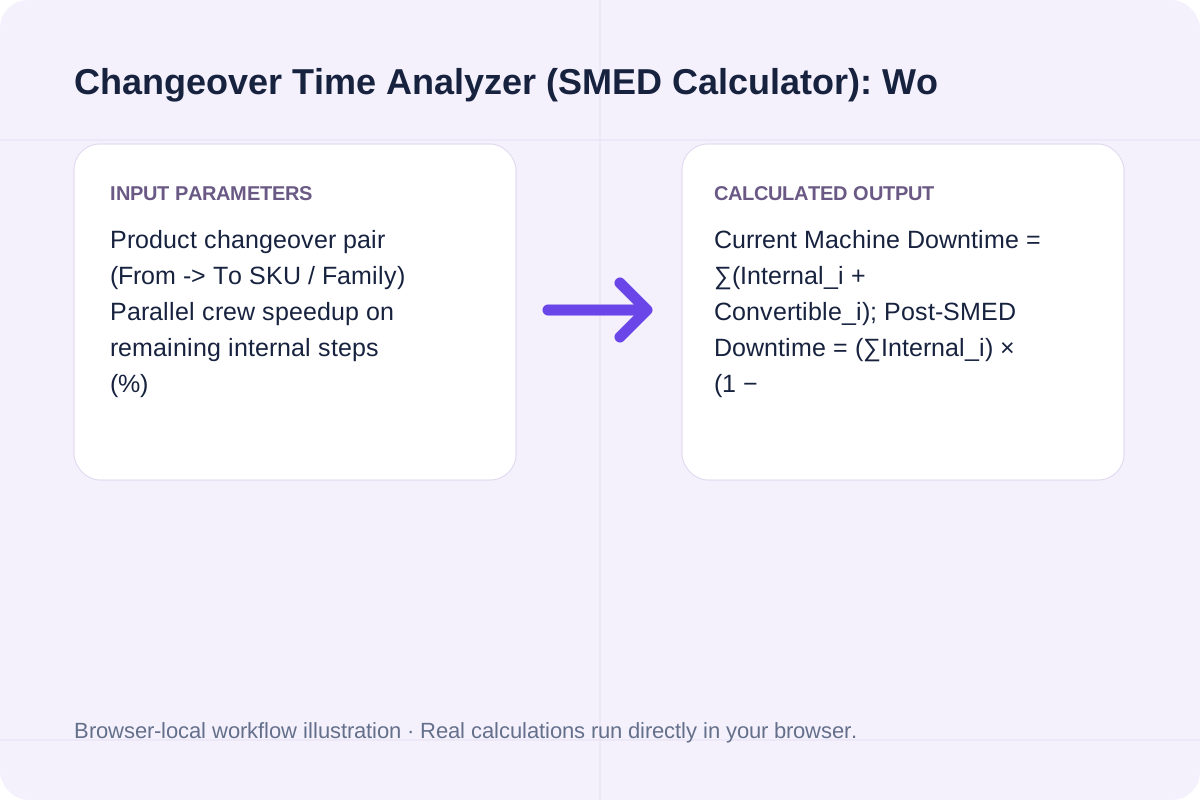
How each step category contributes to current line downtime versus post-SMED target downtime.
| Step Category Code | Machine State Today | Counts in Current Downtime? | Counts in Post-SMED Downtime? | Typical Industrial Examples |
|---|---|---|---|---|
| `internal` | Machine **Stopped** | **Yes** (`100%`) | **Yes** (`× (1 − Parallel%)`) | Lockout/tagout, unbolting dies, mounting new rails |
| `convertible` | Machine **Stopped** (today) | **Yes** (`100%`) | **No** (`0%` — moved external) | Fetching tools, pre-heating molds, trial-and-error adjustments |
| `external` | Machine **Running** | **No** (`0%`) | **No** (`0%`) | Returning old dies to rack, staging raw materials |
Enter the values for your scenario, verify the units, and run the calculation.
Start by entering the required fields in the Changeover Time Analyzer (SMED Calculator) form above.
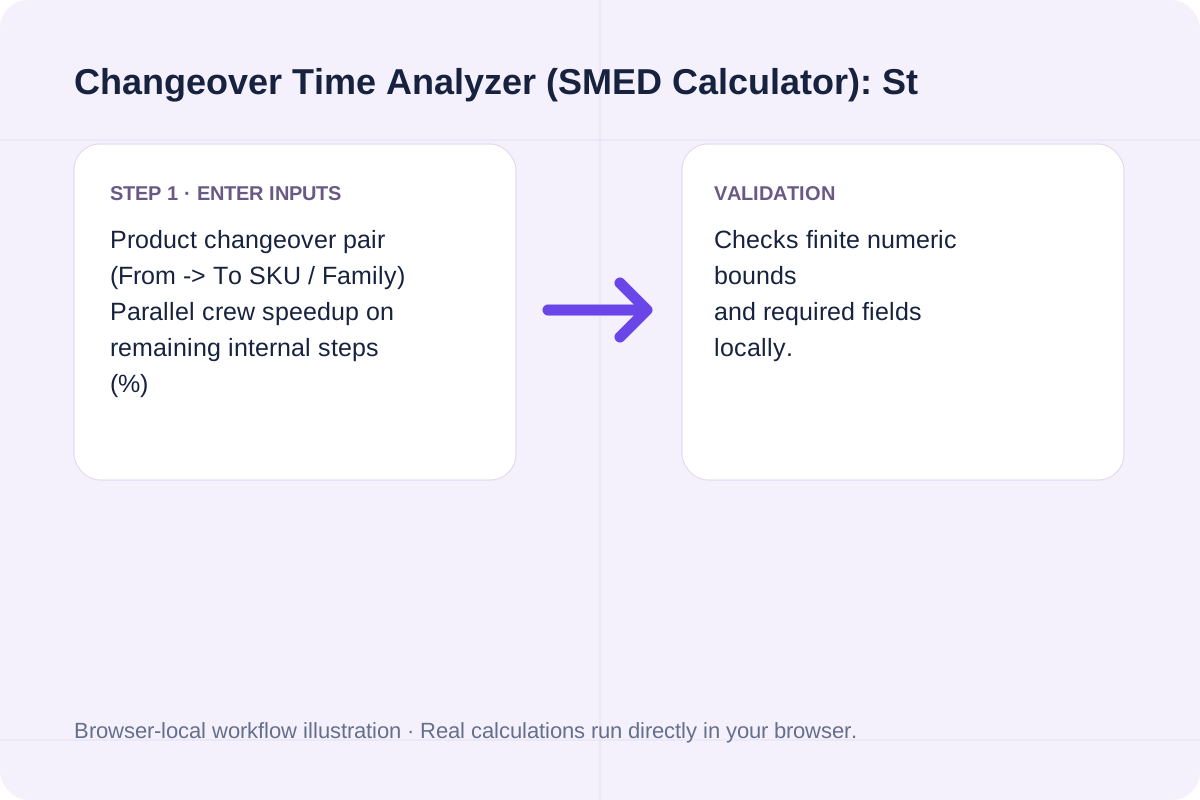
Match each value to the unit or format shown next to the input box before running the calculation.
Select Analyze Changeover Time, inspect the primary metric and breakdown cards, then use Copy result or Download result.txt.
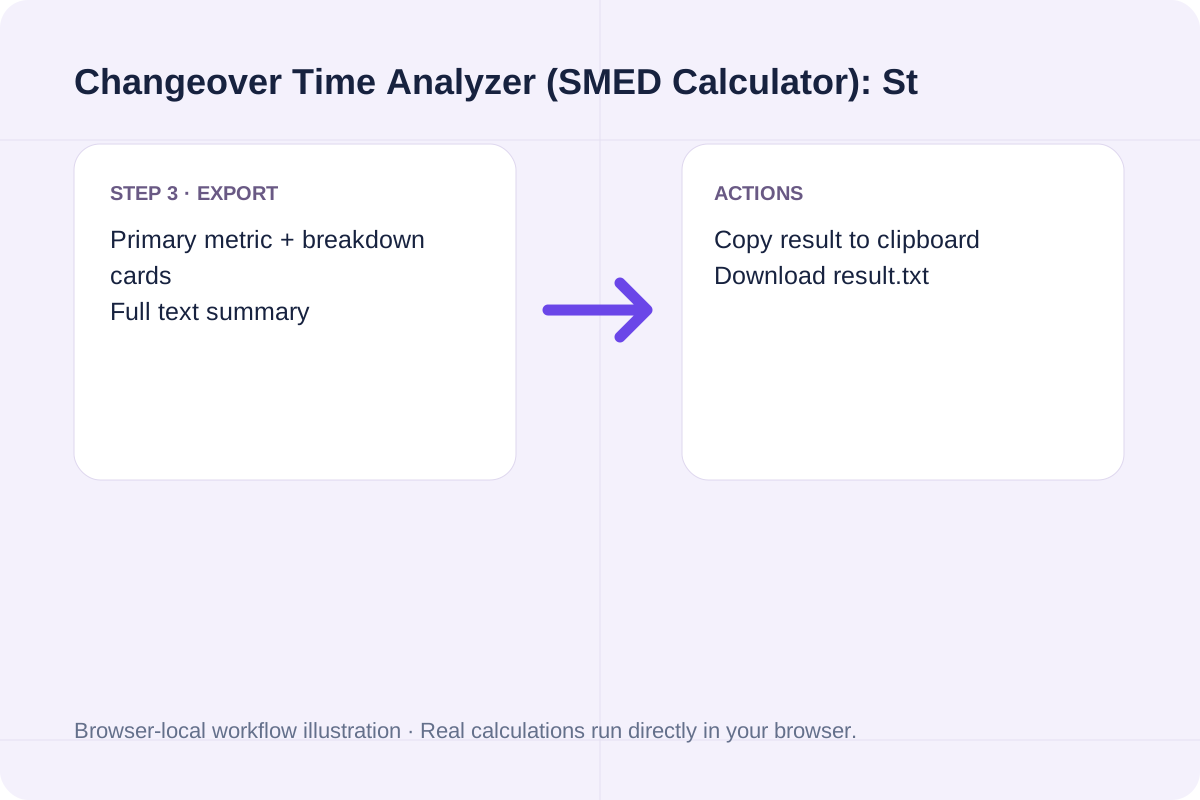
Compare baseline and alternative runs for Changeover Time Analyzer (SMED Calculator) before exporting the result.
Analyze manufacturing changeover and setup times using SMED (Single-Minute Exchange of Die). Break down internal vs. external steps, parallel savings, and downtime reduction %.
Current Machine Downtime = ∑(Internal_i + Convertible_i); Post-SMED Downtime = (∑Internal_i) × (1 − ParallelSpeedup%/100); Downtime Saved = Current Downtime − Post-SMED Downtime; Reduction % = (Downtime Saved / Current Downtime) × 100.
In Shigeo Shingo's SMED methodology, 'Internal' setup occurs while the equipment is stopped, 'Convertible' steps are currently performed while stopped but can be externalized before/after the stop, and 'External' steps occur while the line is producing.
Review the calculated output alongside your entered parameters and unit conventions.
In Shigeo Shingo's SMED methodology, 'Internal' setup occurs while the equipment is stopped, 'Convertible' steps are currently performed while stopped but can be externalized before/after the stop, and 'External' steps occur while the line is producing.
Confirm these three points during your shop-floor observation.
Current Machine Downtime = ∑(Internal_i + Convertible_i); Post-SMED Downtime = (∑Internal_i) × (1 − ParallelSpeedup%/100); Downtime Saved = Current Downtime − Post-SMED Downtime; Reduction % = (Downtime Saved / Current Downtime) × 100. In Shigeo Shingo's SMED methodology, 'Internal' setup occurs while the equipment is stopped, 'Convertible' steps are currently performed while stopped but can be externalized before/after the stop, and 'External' steps occur while the line is producing.
Calculate bottleneck cycle time, Takt time margin, hourly and shift throughput, line balance efficiency, flow efficiency, and Little's Law WIP from workstation times.
Open tool
Free On-Time In-Full (OTIF / DIFOT) supply chain calculator. Audit order-level and unit-level OT%, IF%, OTIF%, SLA compliance, and failure root causes in your browser.
Open tool
Analyze warehouse fulfillment performance from order line data: compute unit fill rate, line fill rate, order fill rate, and backorder recovery with explicit gross vs. net denominators.
Open toolChoose another tool for your next calculation, conversion, or text task.

Calculate team productive capacity, utilization percentage, and FTE surplus or deficit from headcount, workdays, PTO, and focus factor.
Open tool
Find total running steps per minute from counted footfalls and elapsed time.
Open tool
Determine reaction order (0th, 1st, or 2nd) from time-concentration data by linearizing [A], ln[A], and 1/[A] vs. time t, comparing R² and RMSE, and calculating rate constant k and half-life.
Open tool
Calculate OEE from planned time, downtime, total output, rejected output and ideal cycle time.
Open toolAnswers about using Changeover Time Analyzer (SMED Calculator) and understanding its results.
Internal setup time covers activities that can only be performed while the machine or production line is completely stopped (such as removing a die or locking out a press). External setup time covers preparation and cleanup tasks that can be completed while the machine is still running the previous or next batch (such as fetching tools, pre-heating molds, or returning old fixtures to the crib).
A Convertible step is a task that operators currently perform while the machine is stopped (counting toward current downtime), but which can be shifted to External time during SMED Stage 2—for example, searching for bolts, pre-heating a manifold, or pre-setting stops on a shadow board before shutting the line down.
Coined by Toyota industrial engineer Shigeo Shingo, 'Single-Minute' does not mean a 60-second changeover; it means reducing internal machine downtime to a single-digit number of minutes (under 10.0 minutes, i.e., 9 minutes 59 seconds or less).
In SMED Stage 3 (Streamlining Internal Setup), remaining internal tasks are shortened using quick-release quarter-turn clamps, standardized die heights, and two operators working simultaneously on opposite sides of the machine. The Parallel Crew Speedup % models this percentage reduction on the remaining non-convertible internal steps.
Choose another tool for your next calculation, conversion, or text task.