
Day of Year Calculator
Find whether a date is day 1 through 365 or 366 of its calendar year.
Open toolEstimate a due date from the first day of the last menstrual period and a regular-cycle length. The date is provisional and can be revised by a clinician.
Update the inputs to see your result.
Result will appear here
A calendar-day offset is adjusted by the entered regular-cycle length.
The tool adds 280 days to the last-period start date, then adjusts that offset by the entered cycle length minus 28 days. Calendar arithmetic uses UTC dates; the estimated date is not a clinical finding.
This is a rough estimate based on a regular cycle. Ultrasound and a clinician's assessment may change the due date. It should not guide medical decisions.
Reference: ACOG: Methods for Estimating the Due Date.

Enter the first day of the last period and the assumed average cycle length.
Choose the first day of the last menstrual period and enter a whole-number average cycle length from 21 to 45 days. The date cannot be in the future. This model assumes a regular cycle and does not collect clinical measurements.
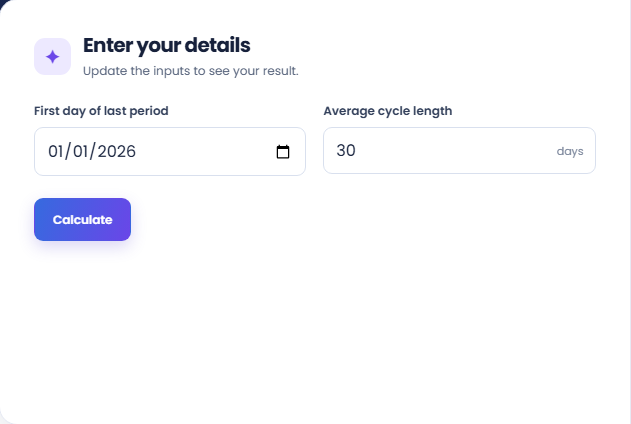
Select Calculate to read the estimated due date. The date is derived from the entered period start and cycle-length adjustment. Check those inputs if the output is unexpected; the page does not measure conception or confirm fetal development.
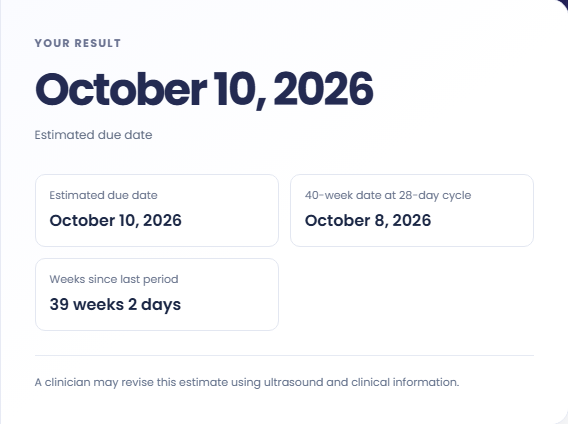
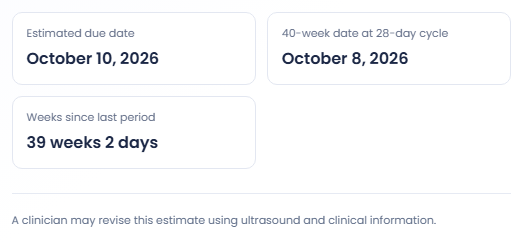
Compare the estimate with the separate 40-week date for a 28-day cycle. Where displayed, weeks since the last period reflect the calendar-date basis. Keep the labels with the dates; a clinician may revise a provisional estimate using clinical information.
These uses concern a calendar estimate and do not replace pregnancy care.
Use the result to check whether the calendar input matches the intended first day of the last period. An accidental month or year change can still produce a valid calendar date, so the form's validity check cannot catch every entry mistake.

Compare the selected cycle length with the twenty eight day basis shown in the result. The difference between those dates reflects the entered cycle assumption. It does not establish conception timing or explain an individual pregnancy's development.

Keep the entered date and cycle assumption with the rough estimate if discussing it with a clinician. Clinical information and ultrasound can change the assessment. The page does not collect examination findings or provide a plan for medical care.

Read the provisional dates with their period-start and cycle assumptions.
The main date includes the entered cycle adjustment. The separate forty week date keeps the twenty eight day basis, making that assumption visible. These are calculated estimates and should not guide medical decisions.
When shown, weeks since last period count elapsed calendar time from the entered date to today. That line depends on the current date and does not establish a clinical assessment of gestational age.

Check the calendar inputs and keep the model’s clinical limits visible.
Use a valid calendar date on or before today. A blank date, a future first day or a cycle length outside the field range prevents calculation. Recheck the date picker rather than changing inputs merely to obtain a result.
The method assumes a regular cycle. It does not assess irregular cycles or incorporate ultrasound information. A clinician may revise the estimate; use their assessment for care decisions instead of relying on this page alone.

Find whether a date is day 1 through 365 or 366 of its calendar year.
Open tool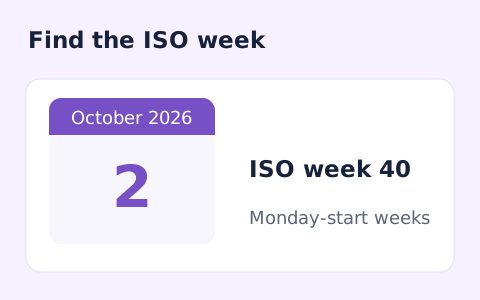
Calculate a date's ISO 8601 week number, week-year, and weekday.
Open tool
Count weekdays between two dates, including both endpoints and excluding Saturdays and Sundays.
Open toolChoose another tool for your next calculation, conversion, or text task.
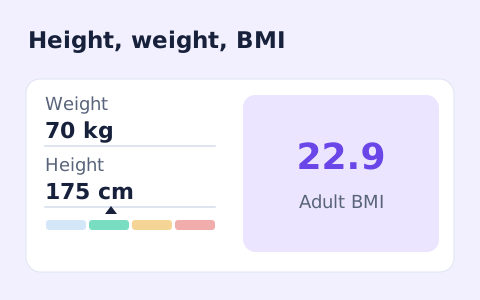
A free adult BMI calculator with metric inputs, a clear BMI category, and the calculation shown.
Open tool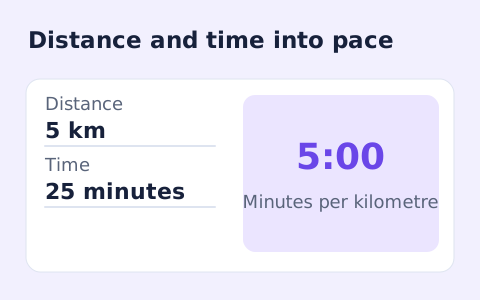
Calculate running pace per kilometre and per mile from a distance and elapsed time.
Open tool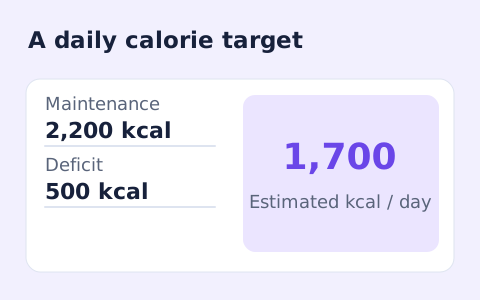
Estimate adult TDEE and a daily calorie target using body measurements, activity, and a chosen deficit.
Open tool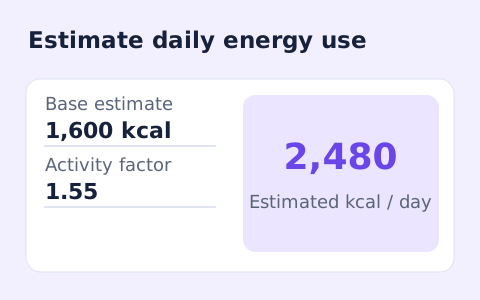
Estimate resting energy expenditure and TDEE using the Mifflin–St Jeor equation and an activity factor.
Open toolEstimate a due date from the first day of the last menstrual period and a regular-cycle length.
Answers about using Pregnancy Due Date Calculator and understanding its results.
A 40-week estimate from the first day of the last menstrual period is the standard convention for a 28-day cycle.
Yes. A clinician may revise it using an early ultrasound or other clinical information.
The cycle-length field accepts whole numbers from 21 to 45 days. The model assumes a regular cycle.
No. It uses the last-period date and cycle-length convention to estimate a due date. It does not measure conception or fetal development.