
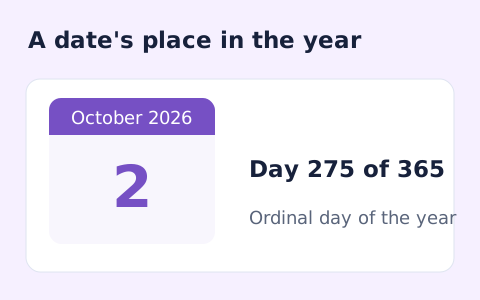
Day of Year Calculator
Find whether a date is day 1 through 365 or 366 of its calendar year.
Open toolFind the ISO week number, week-year, and weekday for a selected date. Keep the week-year with the number when dates fall near New Year.
Update the inputs to see your result.
Result will appear here
The week’s Thursday determines its ISO week-year and Monday-based number.
The selected date is shifted to the Thursday of its ISO week to determine the week-year. The week number is then counted within that year, and Monday is represented as ISO weekday one.
A date near New Year can belong to the previous or next ISO week-year.

Select a calendar date and read its ISO week number together with the ISO week year.
Select the calendar date and check its year, month, and day. This tool uses the ISO 8601 Monday-based week convention. It does not offer a Sunday-first or institution-specific week-number mode.
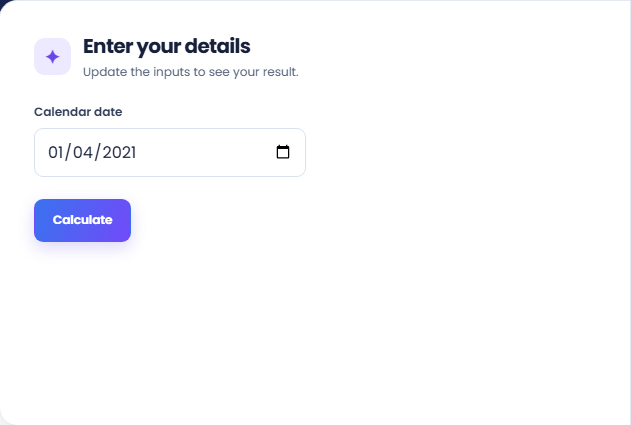
Select Calculate and read the ISO week number. The calculation uses the Thursday of the selected week to identify its week-year. A date near New Year can therefore belong to a different week-year from its calendar year.
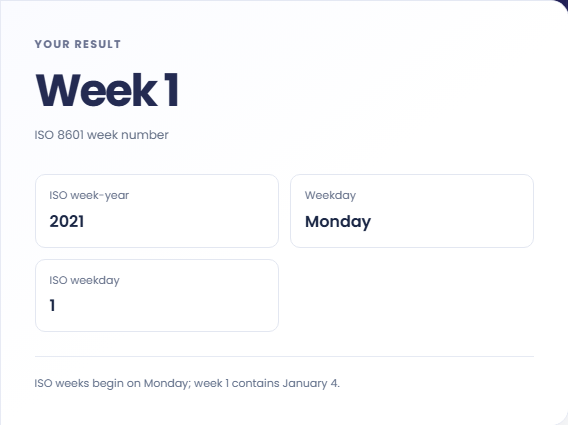
Review ISO week-year, Weekday, and ISO weekday alongside the main week number. Monday has ISO weekday one. Retain the week-year in a weekly report so a boundary date is not accidentally placed in the wrong annual sequence.
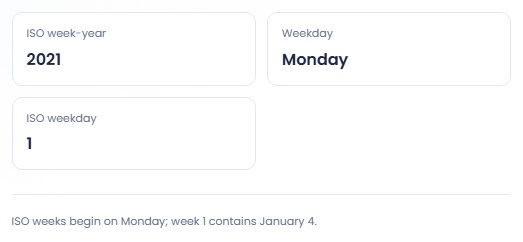
Keep the calendar convention explicit when comparing weekly records.
Use the week number and ISO week year as a pair in a report that follows this convention. The page does not generate report files or group records automatically. It provides the calendar values needed for a label you prepare elsewhere.

January first 2021 belongs to ISO week fifty three of 2020. This calendar example shows why the selected year and displayed week year can differ. Include both values when checking a boundary date rather than assuming the page has changed the year incorrectly.

If another calendar gives a different week number, check its first weekday and definition of the first week. This calculator uses the ISO convention. A locally configured calendar can follow a different convention without either system using an invalid date.

Keep ISO week-year and calendar year distinct around year boundaries.
Week one is the week containing January fourth, and weeks start on Monday. A date at the beginning or end of a calendar year can therefore belong to an adjacent ISO week year.
The weekday details identify the chosen calendar date; the ISO week year identifies its week grouping. These are distinct labels. The calculator does not display a whole week grid or convert a local time between zones.

Check the date and week convention before labelling a weekly record.
The form requires a valid calendar date. For a disagreement near New Year, inspect the ISO week year first. Adding a calendar year to a bare ISO week number can create a label that describes the wrong week.
Use Day of Year Calculator for an ordinal day and Business Days Calculator for a weekday count across a range. Neither result substitutes for an ISO week identifier, even when all three tools use the same selected date.

Find whether a date is day 1 through 365 or 366 of its calendar year.
Open tool
Count weekdays between two dates, including both endpoints and excluding Saturdays and Sundays.
Open tool
Plan a dated meeting across IANA time zones and check typical weekday office hours.
Open toolChoose another tool for your next calculation, conversion, or text task.
Convert signed Unix timestamps and ISO date-times with explicit time-zone offsets.
Open tool
Convert dated local times between IANA zones while handling daylight saving transitions.
Open tool
A free adult BMI calculator with metric inputs, a clear BMI category, and the calculation shown.
Open tool
Convert hourly pay to gross annual, monthly, and weekly salary using your own working hours and weeks.
Open toolFind the ISO week number, week-year, and weekday for a selected date.
Answers about using Week Number Calculator and understanding its results.
ISO week 1 must contain January 4, so some early-January dates remain in the prior week-year.
Monday.
Yes. A late-December date can fall in ISO week one of the following week-year. Read the separate week-year output rather than assuming the calendar year.
No. This page implements ISO 8601 weeks, which begin on Monday. It does not offer an alternate week convention.