

Email Extractor
Extract and deduplicate common ASCII email-address candidates from supplied text.
Open toolPaste emails, CRM notes, or web text into the Phone Number Extractor below to pull out domestic and international phone numbers, normalize them to E.164 format, and remove duplicates.
Enter the inputs, then select Extract Phone Numbers.
Result will appear here
The Phone Number Extractor scans your text for phone-shaped digit groups, filters out ISO calendar dates, checks that each candidate contains between 7 and 15 digits (the ITU-T E.164 standard range), and formats matches to your chosen output style.
Valid E.164 candidate length: 7 <= digit_count <= 15; 10-digit national -> +<default_cc><10_digits>.
Deduplication compares the normalized digit sequence so '(415) 555-0192' and '+1-415-555-0192' collapse into a single unique entry when default country code is +1.
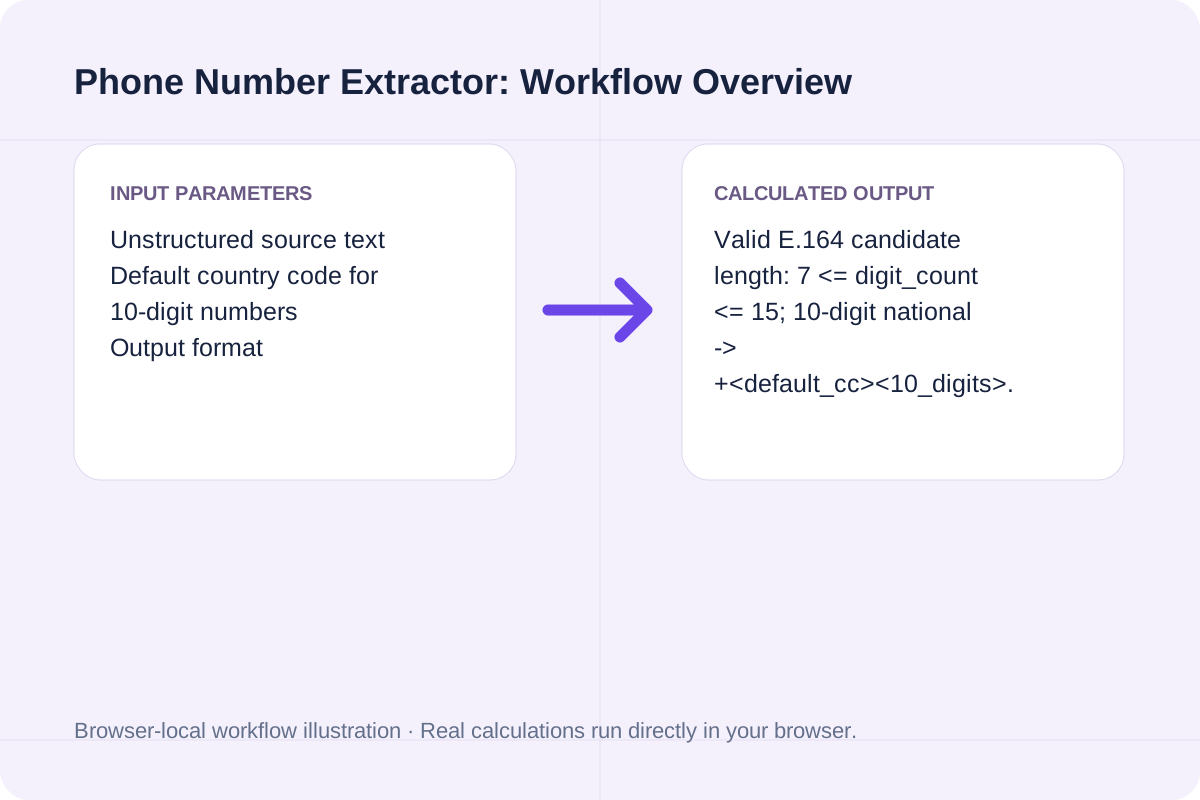
Review the input parameters, allowed value ranges, and worked reference cases for the Phone Number Extractor below before running your calculation.
| Parameter / Scenario | Default / Sample Value | Rule or Allowed Range | Output / Usage Note |
|---|---|---|---|
| Input: Unstructured source text | Call support at (415) 555-0192 or... | Text containing domestic or international phone numbers. | Required workspace parameter |
| Input: Default country code for 10-digit numbers | +1 | Prefix applied when a 10-digit national number has no leading '+' country code. | Required workspace parameter |
| Input: Output format | e164 | Options: E.164 normalized (+14155550192), Exact matched string from text, Digits only (14155550192) | Required workspace parameter |
| Input: Duplicate handling | yes | Options: Deduplicate by normalized digits, Keep all occurrences in appearance order | Required workspace parameter |
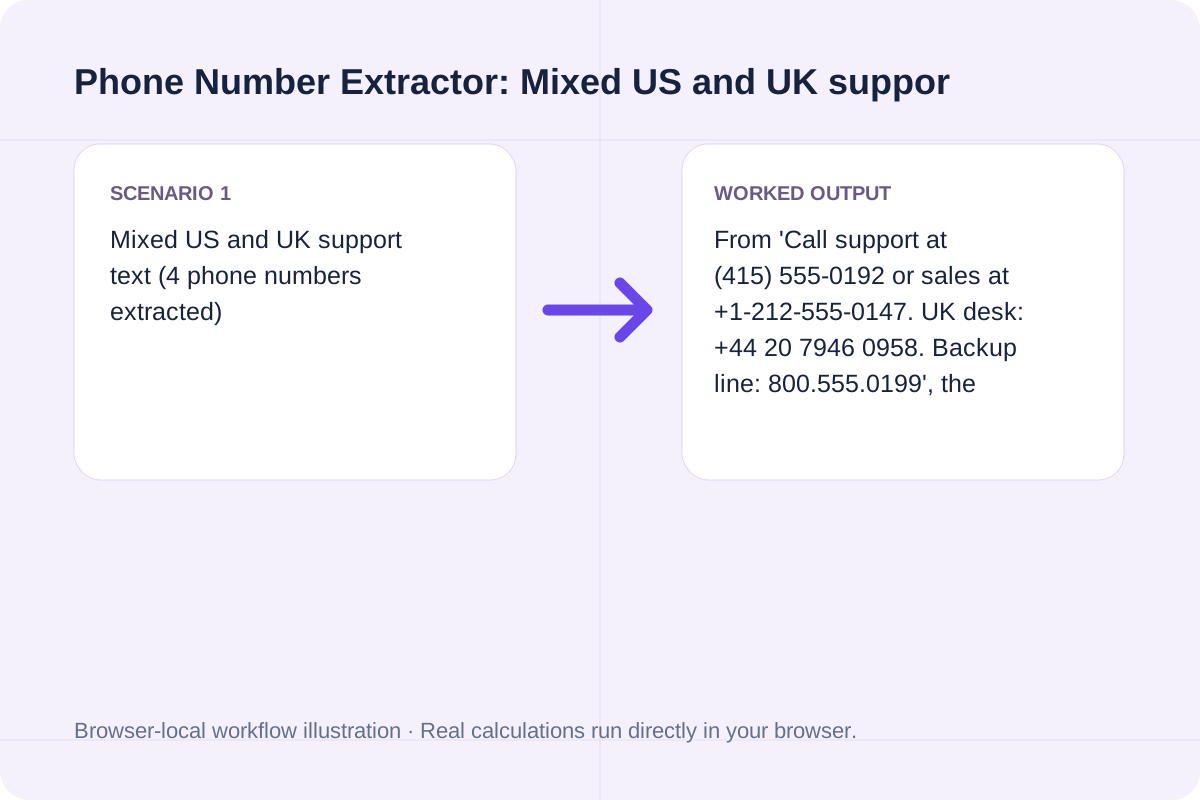
| Worked Case 1: Mixed US and UK support text (4 phone numbers extracted) | Preloaded / test values | Matches phone candidates with 7 to 15 digits (ITU-T E.164 range); 10-digit unprefixed numbers receive the default country code in E.164 mode | From 'Call support at (415) 555-0192 or sales at +1-212-555-0147. UK desk: +44 20 7946 0958. Backup line: 800.555.0199', the tool extracts +14155550192, +12125550147, +442079460958, and +18005550199. |
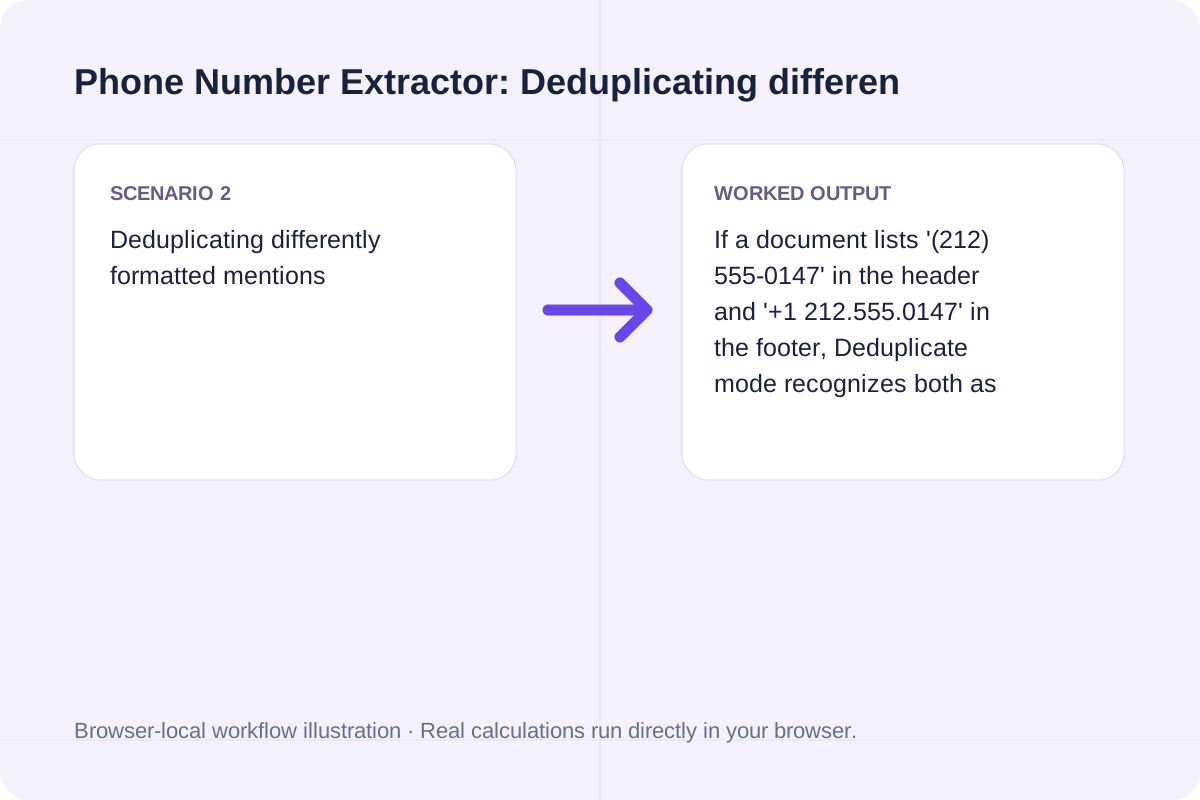
| Worked Case 2: Deduplicating differently formatted mentions | Preloaded / test values | Matches phone candidates with 7 to 15 digits (ITU-T E.164 range); 10-digit unprefixed numbers receive the default country code in E.164 mode | If a document lists '(212) 555-0147' in the header and '+1 212.555.0147' in the footer, Deduplicate mode recognizes both as +12125550147 and outputs it once. |
Copy any block of raw text containing contact details and configure your preferred output format.
Paste raw text from emails, support tickets, directories, or scraped HTML into the source text box.
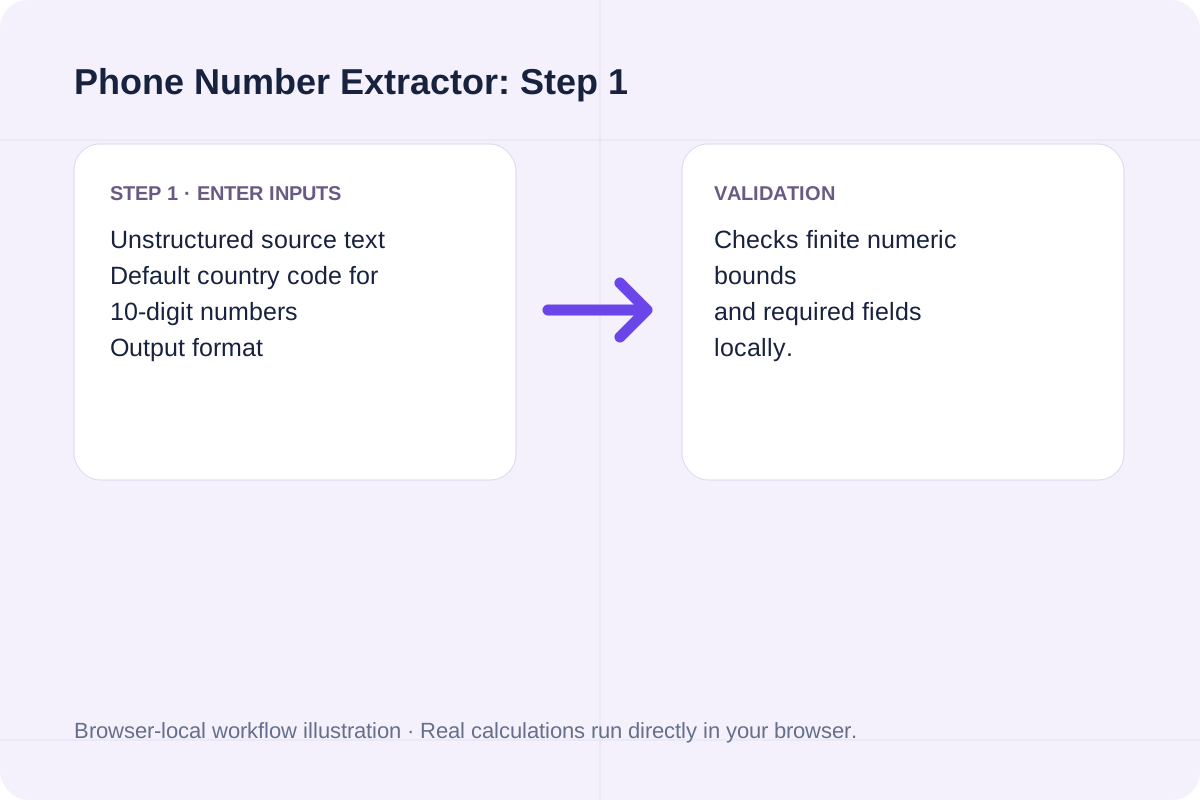
Specify the Default country code (e.g., +1) for unprefixed 10-digit numbers and select E.164, Raw match, or Digits-only output.
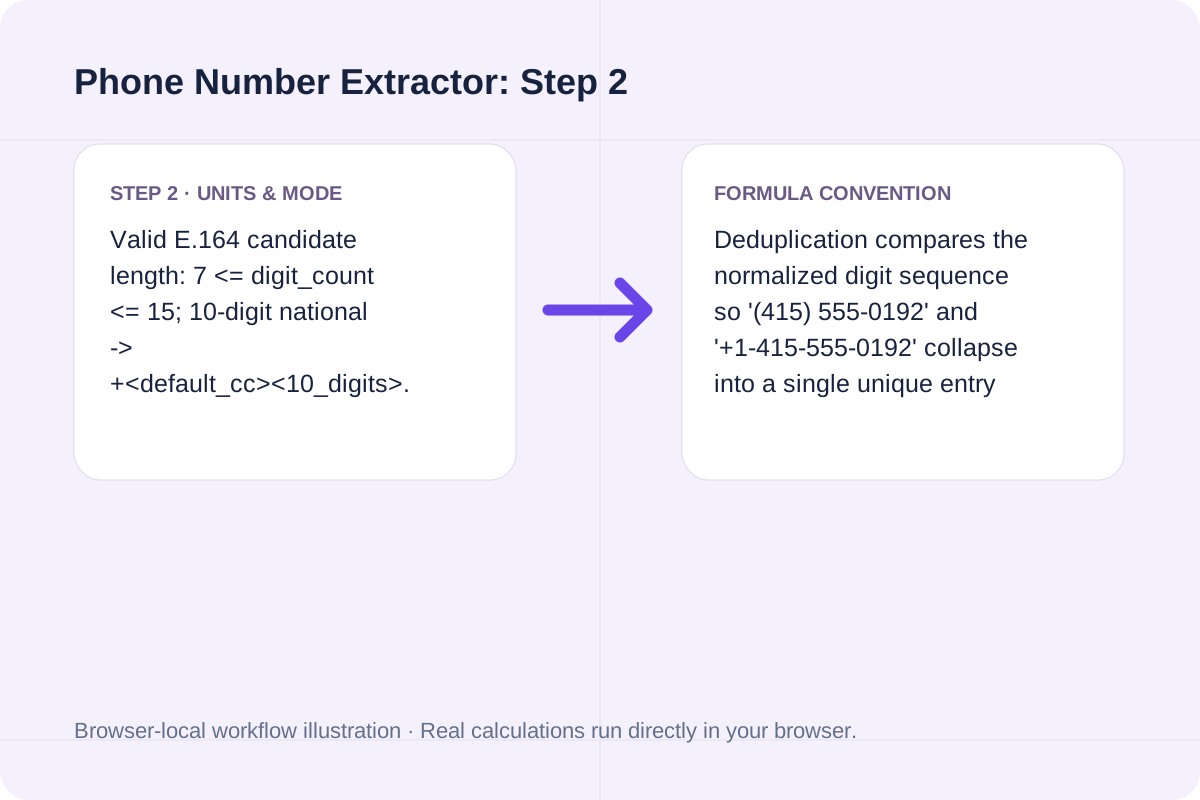
Click Extract Phone Numbers to list every unique candidate, view international vs. local counts, and copy or download the clean list.
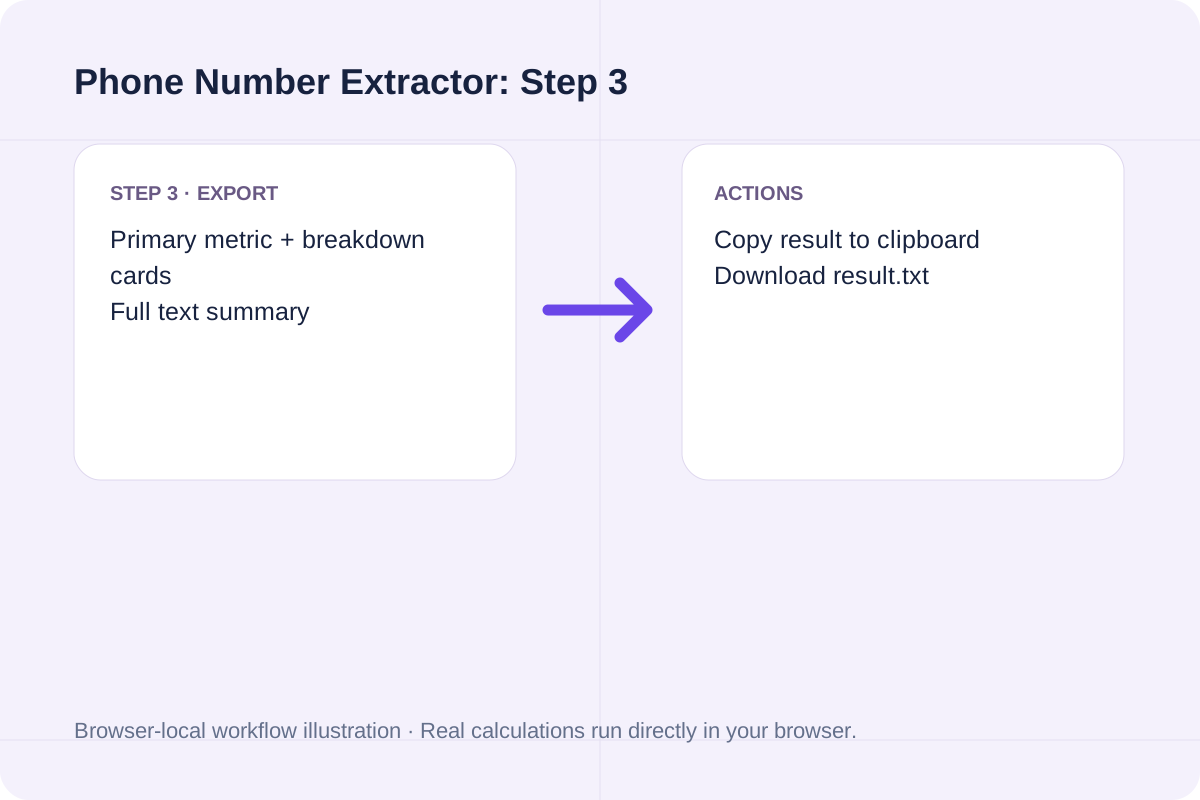
See how mixed domestic and international contact strings are extracted and normalized.
From 'Call support at (415) 555-0192 or sales at +1-212-555-0147. UK desk: +44 20 7946 0958. Backup line: 800.555.0199', the tool extracts +14155550192, +12125550147, +442079460958, and +18005550199.
If a document lists '(212) 555-0147' in the header and '+1 212.555.0147' in the footer, Deduplicate mode recognizes both as +12125550147 and outputs it once.
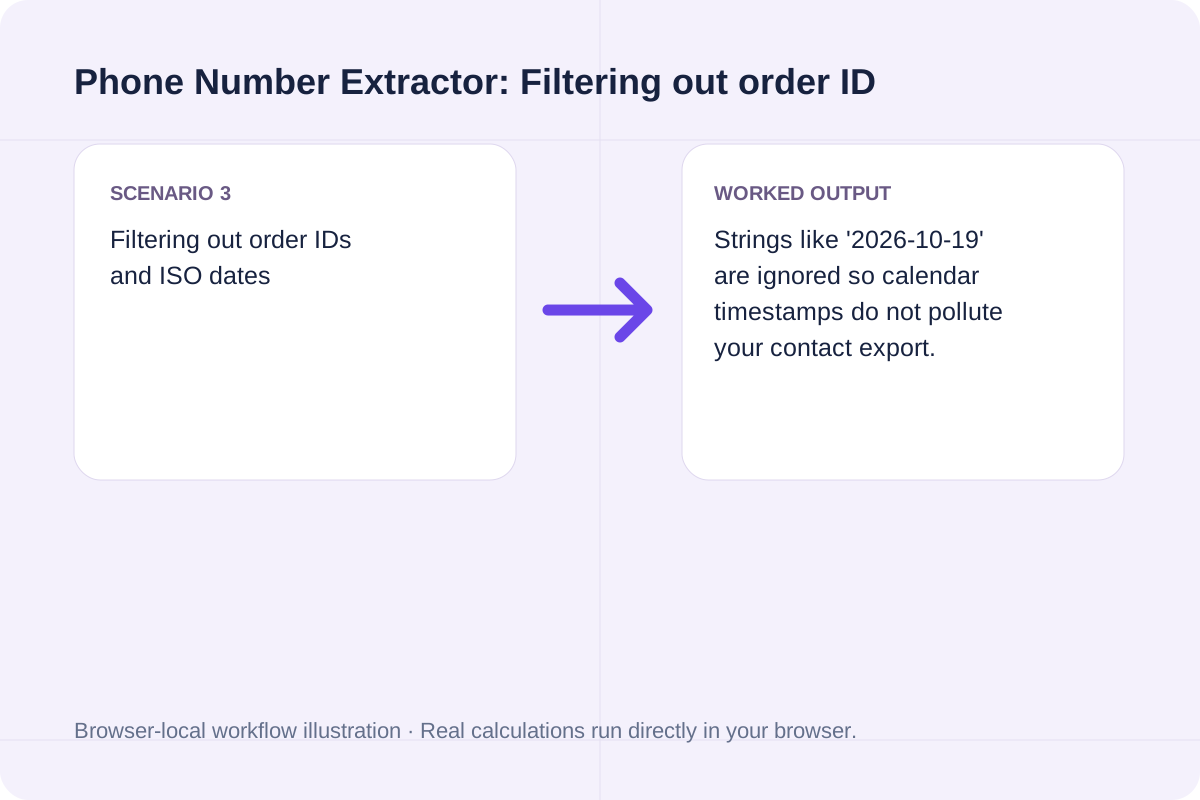
Strings like '2026-10-19' are ignored so calendar timestamps do not pollute your contact export.
Review the extracted list and candidate breakdown before importing into a dialer or CRM.
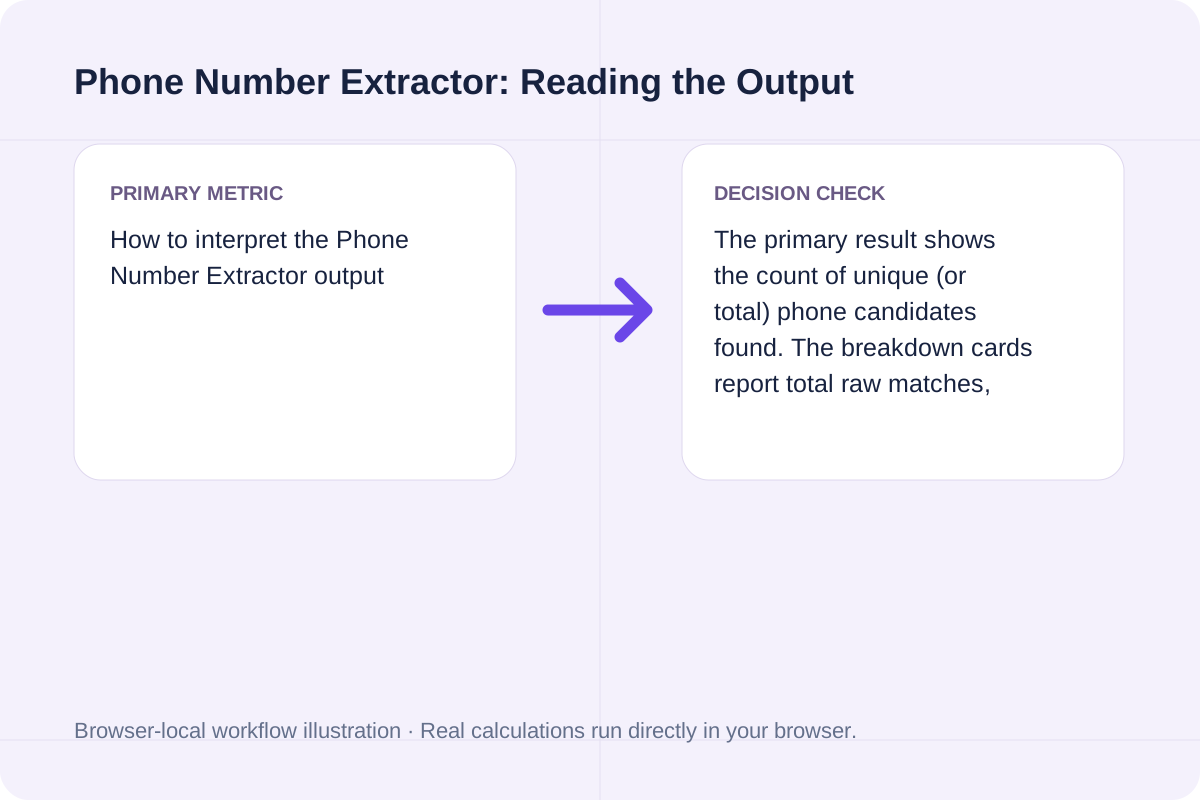
The primary result shows the count of unique (or total) phone candidates found. The breakdown cards report total raw matches, unique normalized numbers, explicit international (+) matches, and national numbers that used your default country code.
Verify ambiguous numeric strings such as serial numbers or account IDs before bulk dialing.
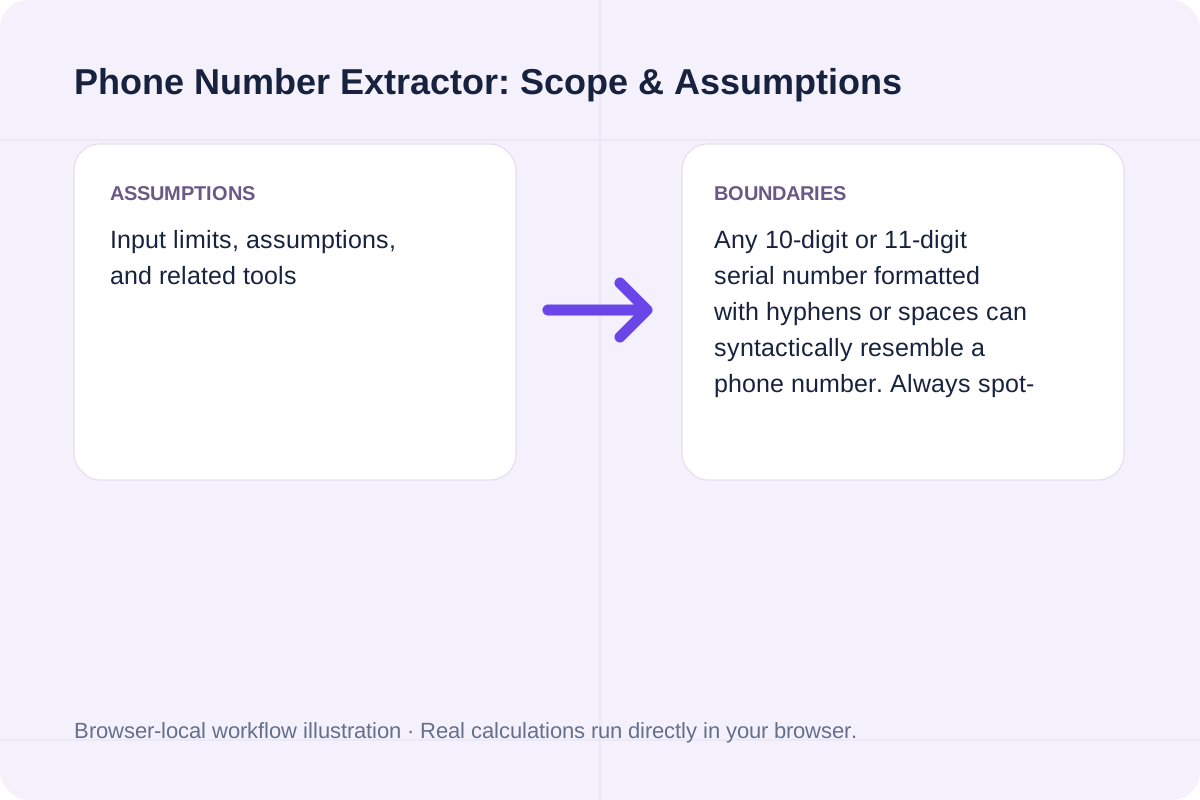
Any 10-digit or 11-digit serial number formatted with hyphens or spaces can syntactically resemble a phone number. Always spot-check extracted candidates against your source context, and note that extensions (like 'ext 42') are stripped from the E.164 number.
Extract and deduplicate common ASCII email-address candidates from supplied text.
Open tool
A PDF containing selected pages in your order. Parse 1-based page numbers and ranges, then copy the selected pages into a new PDF.
Open tool
Extract plain subtitle text from SRT cues and download a transcript without cue numbers or timestamps.
Open toolChoose another tool for your next calculation, conversion, or text task.

Convert Quarto (.qmd) files into standard Markdown (.md) in your browser. Transform ::: {.callout-*} blocks into GFM alerts, normalize {python}/{r} code fences, and clean #| cell options.
Open tool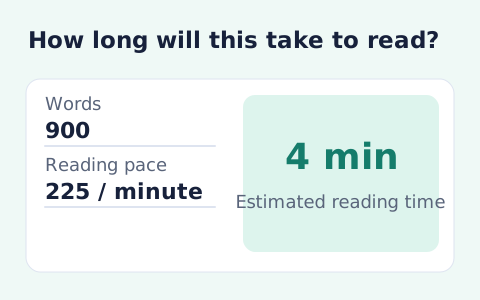
Estimate how long a passage will take to read.
Open tool
Extract HTTP and HTTPS URLs from text, remove duplicate normalized addresses and filter by protocol or exact hostname.
Open tool
Normalize the supplied seed to ASCII letters and digits, then append a random four-digit suffix.
Open toolAnswers about using Phone Number Extractor and understanding its results.
It detects international numbers starting with '+' (7 to 15 digits per ITU-T E.164) as well as parenthesized, hyphenated, dotted, or spaced national numbers such as (415) 555-0192, 415-555-0192, and 800.555.0199.
The parser excludes 8-digit YYYY-MM-DD date strings and requires 7 to 15 total digits with valid phone grouping boundaries.
When a matched candidate has 10 digits and no leading '+' sign, the tool prepends your Default country code (such as +1 for US/Canada) to produce +14155550192.
No. It performs local syntactic pattern extraction and E.164 formatting in your browser without sending numbers to external carrier lookup APIs.
Choose another tool for your next calculation, conversion, or text task.