

Phone Number Extractor
Extract phone numbers from unstructured text, normalize 10-digit and international numbers to E.164 format, and deduplicate matches.
Open toolExtract and deduplicate common ASCII email-address candidates from supplied text. Provide Text containing email candidates to compute results directly in your browser. Pattern-based ASCII local part and DNS-style domain candidates, not comprehensive RFC mailbox validation, international mailbox support, deliverability checking or website crawling. Case-insensitive duplicate key; preserves first spelling. No separate candidate-count cap within the 100,000 UTF-16-unit input limit; maximum supported result is 1,000,000 UTF-16 code units.
Enter the inputs, then select Extract emails.
Result will appear here
The Email Extractor evaluates Text containing email candidates in client-side JavaScript using the deterministic rule below and updates the output panel immediately without uploading data to a server.
Extract and deduplicate common ASCII email-address candidates from supplied text.
Pattern-based ASCII local part and DNS-style domain candidates, not comprehensive RFC mailbox validation, international mailbox support, deliverability checking or website crawling. Case-insensitive duplicate key; preserves first spelling. No separate candidate-count cap within the 100,000 UTF-16-unit input limit; maximum supported result is 1,000,000 UTF-16 code units.
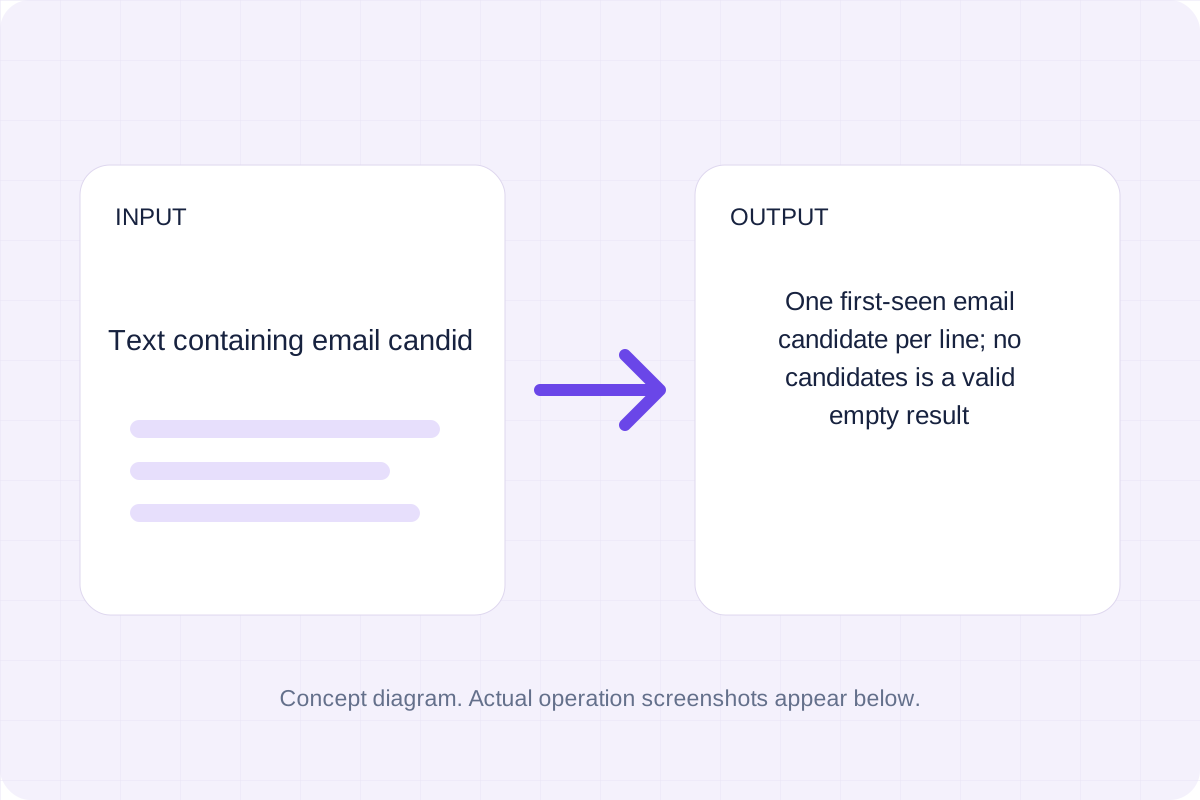
Review the input parameters, allowed value ranges, and worked reference cases for the Email Extractor below before running your calculation.
| Parameter / Scenario | Default / Sample Value | Rule or Allowed Range | Output / Usage Note |
|---|---|---|---|
| Input: Text containing email candidates | Contact alice@example.com or bob@... | Up to 100,000 UTF-16 code units; processed in this browser. Empty input is supported. | Optional workspace parameter |
| Worked Case 1: Baseline run (Text containing email candidates = Contact) | Preloaded / test values | Extract and deduplicate common ASCII email-address candidates from supplied text | Text containing email candidates = Contact alice@example.com or bob@example.org. alice@example.com. The displayed output is alice@example.com bob@example.org. |
| Worked Case 2: Comparison scenario (email extractor 1.6) | Preloaded / test values | Extract and deduplicate common ASCII email-address candidates from supplied text | Text containing email candidates = Two: z@example.net and a+tag@example.com; z@example.net. The displayed output is z@example.net a+tag@example.com. |
Follow these three steps to configure Text containing email candidates, verify unit and boundary rules, and export your Email Extractor output.
Enter text containing email candidates. Up to 100,000 UTF-16 code units; processed in this browser. Empty input is supported.
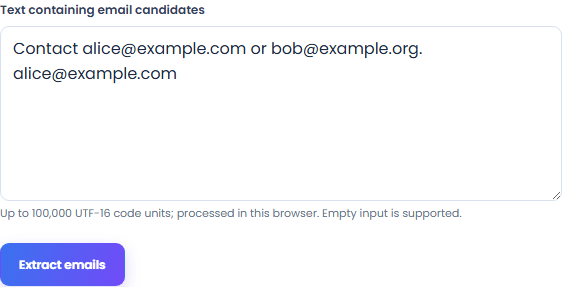
Pattern-based ASCII local part and DNS-style domain candidates, not comprehensive RFC mailbox validation, international mailbox support, deliverability checking or website crawling.
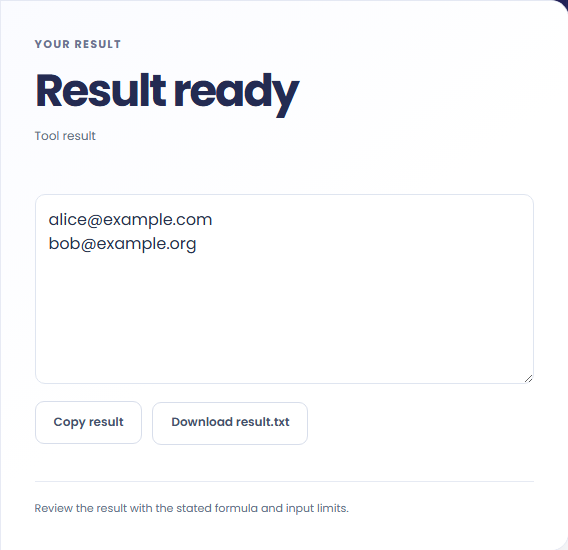
Select Extract emails to see the first-seen email-address candidates. Copy result copies this text; Download saves it as a TXT file.
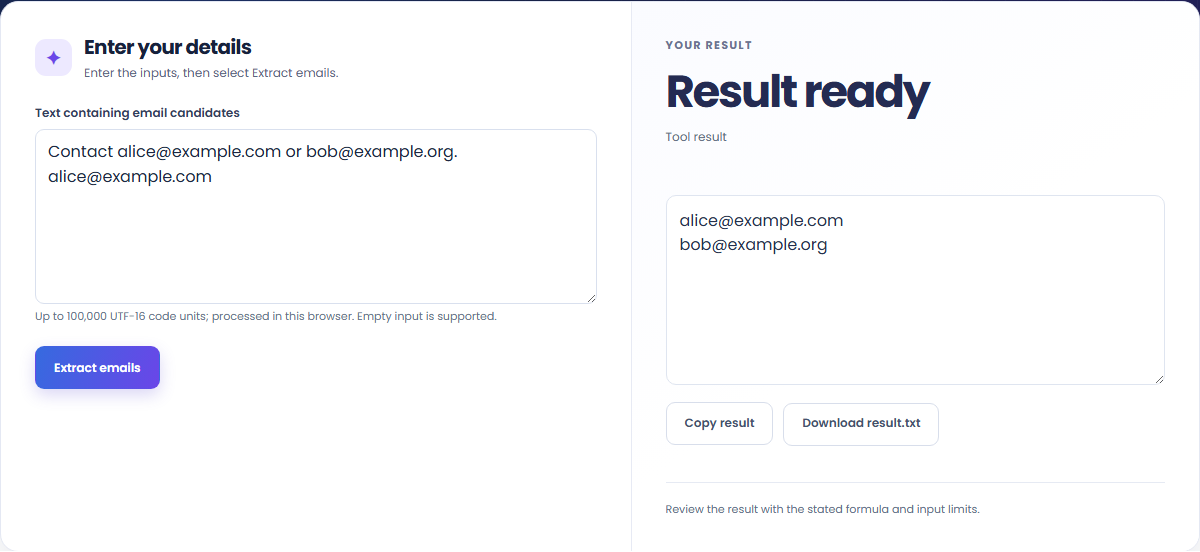
These concrete scenarios illustrate how the Email Extractor processes baseline inputs, comparison checks, and boundary constraints.
Text containing email candidates = Contact alice@example.com or bob@example.org. alice@example.com. The displayed output is alice@example.com bob@example.org.

Text containing email candidates = Two: z@example.net and a+tag@example.com; z@example.net. The displayed output is z@example.net a+tag@example.com.

When solving for 'email extractor', verify that Text containing email candidates use consistent units and stay within the documented scope: Pattern-based ASCII local part and DNS-style domain candidates, not comprehensive RFC mailbox validation, international mailbox support, deliverability checking or website crawling. Case-insensitive duplicate key; preserves first spelling. No separate candidate-count cap within the 100,000 UTF-16-unit input limit; maximum supported result is 1,000,000 UTF-16 code units.

The output panel reports the exact result derived from Text containing email candidates alongside any unit or formatting notes.
The result is the first-seen email-address candidates. Prepare an address list from text you paste.
Pattern matches are candidates; the page does not verify mailbox existence or delivery.

Review these boundary constraints and validation rules before relying on the Email Extractor output.
Operational scope: Pattern-based ASCII local part and DNS-style domain candidates, not comprehensive RFC mailbox validation, international mailbox support, deliverability checking or website crawling. Case-insensitive duplicate key; preserves first spelling. No separate candidate-count cap within the 100,000 UTF-16-unit input limit; maximum supported result is 1,000,000 UTF-16 code units. Inputs that violate minimum/maximum bounds or required format rules are rejected with a clear diagnostic prompt.
Need an adjacent calculation in Text Tools? Use the related tools linked below to chain your workflow without leaving your browser.

Extract phone numbers from unstructured text, normalize 10-digit and international numbers to E.164 format, and deduplicate matches.
Open tool
A reflowable EPUB 3 book from supported Word blocks. Extract sanitized DOCX structure, then build an EPUB package with supplied title and author.
Open tool
Extract HTTP and HTTPS URLs from text, remove duplicate normalized addresses and filter by protocol or exact hostname.
Open toolChoose another tool for your next calculation, conversion, or text task.

One self-contained HTML file in EPUB spine order. Read an unencrypted EPUB package, sanitize chapter markup and join its reading-order content.
Open tool
A legacy MOBI6 text ebook. Extract supported EPUB chapter text and write a Palm database with a MOBI6 header and UTF-8 HTML records.
Open tool
Normalize the supplied seed to ASCII letters and digits, then append a random four-digit suffix.
Open tool
A basic APA-style website or book reference. Format the author, date, title, publisher or site and URL supplied in the form.
Open toolAnswers about using Email Extractor and understanding its results.
The Email Extractor applies the rule: Extract and deduplicate common ASCII email-address candidates from supplied text. Enter Text containing email candidates into the workspace and the tool computes the exact output in your browser.
Yes. Provide Text containing email candidates using the documented units and format shown in the quick reference table above. Preloaded default values let you test the workflow immediately.
Pattern-based ASCII local part and DNS-style domain candidates, not comprehensive RFC mailbox validation, international mailbox support, deliverability checking or website crawling. Case-insensitive duplicate key; preserves first spelling. No separate candidate-count cap within the 100,000 UTF-16-unit input limit; maximum supported result is 1,000,000 UTF-16 code units. Confirm that your inputs fall within the allowed ranges before exporting the result.
Yes. All calculations for the Email Extractor execute 100% locally in your browser's JavaScript runtime. No inputs or results are uploaded to any external server.
Choose another tool for your next calculation, conversion, or text task.