AI Tools Free

Effect Size Calculator (Cohen's d, Hedges' g & Glass's Δ)

Compute **Cohen's `d`**, bias-corrected **Hedges' `g`**, control-referenced **Glass's `Δ`**, point-biserial correlation **`r`**, **95% confidence intervals**, **Cohen's `U3`**, and **Common Language Effect Size (`CLES`)** from two group means, standard deviations, and sample sizes.

Free to useNo sign-upRuns in your browser
Enter your details

Enter the inputs, then select Calculate Effect Size.

Sample mean of Group 1.

Sample standard deviation of Group 1 (must be > 0).

Number of observations in Group 1 (integer >= 2).

Sample mean of Group 2.

Sample standard deviation of Group 2 (must be > 0).

Number of observations in Group 2 (integer >= 2).

Your result
Enter your details

Result will appear here

How the Effect Size Calculator Works

Enter the summary statistics (`Mean`, `SD`, and `n`) for both groups to compute parametric and probability-overlap effect sizes.

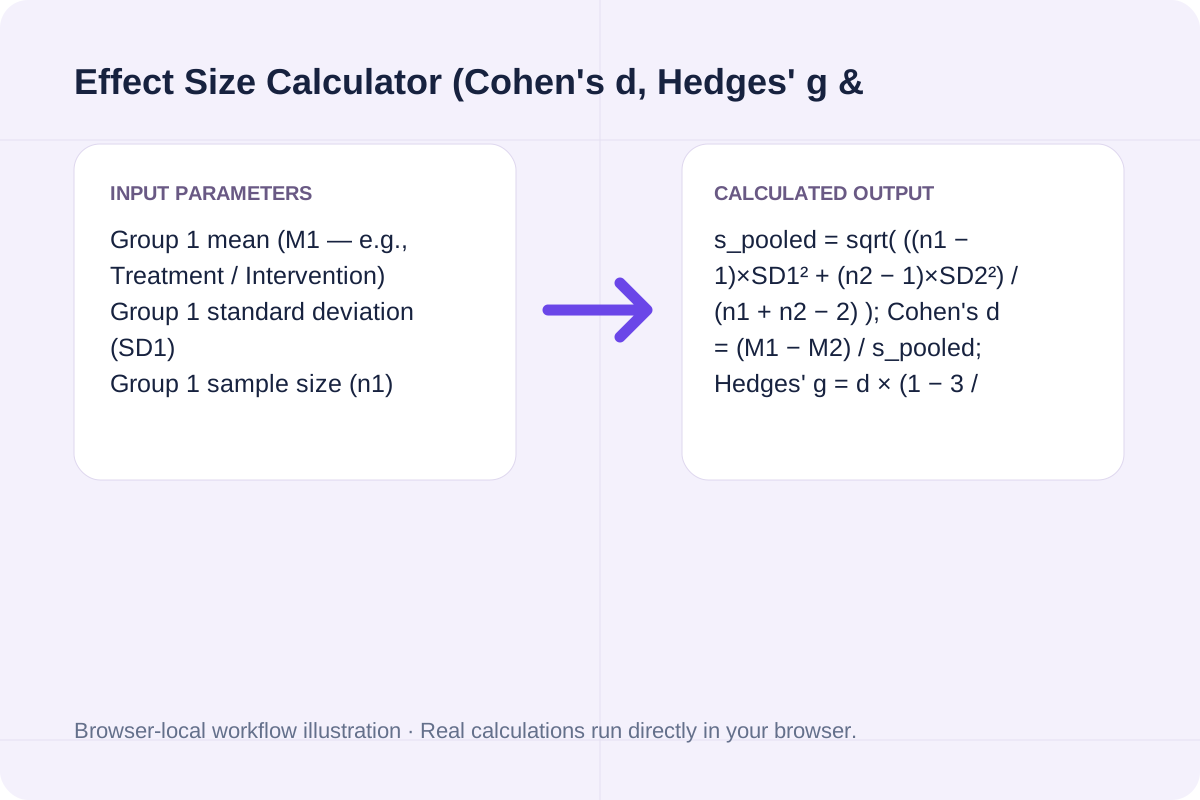
s_pooled = sqrt( ((n1 − 1)×SD1² + (n2 − 1)×SD2²) / (n1 + n2 − 2) ); Cohen's d = (M1 − M2) / s_pooled; Hedges' g = d × (1 − 3 / (4×(n1 + n2 − 2) − 1)); Glass's Δ = (M1 − M2) / SD2; r = d / sqrt(d² + (n1 + n2)² / (n1×n2)).

Computes pooled-variance Cohen's d, root-mean-square d_av, small-sample unbiased Hedges' g, control-group Glass's Δ, correlation r, 95% confidence interval, Cohen's U3, and Common Language Effect Size (CLES).

Effect Size Calculator (Cohen's d, Hedges' g & Glass's Δ) workflow overview
Workflow overview for Effect Size Calculator (Cohen's d, Hedges' g & Glass's Δ).

Effect Size Formulas & Jacob Cohen Magnitude Benchmarks Reference Table

Comparison of standardized effect size estimators and probability-of-superiority equivalents across standard magnitude thresholds.

Effect Size Metric / TierFormula / ThresholdCohen's U3 (% Above Control Mean)CLES (Probability of Superiority)When to Report
Small Effect (`|d| = 0.20`)`(M1 − M2) / s_pooled = 0.20``57.9%``55.6%`Subtle behavioral or large-scale epidemiological shifts
Medium Effect (`|d| = 0.50`)`(M1 − M2) / s_pooled = 0.50``69.1%``63.8%`Visible educational, clinical, or UX improvement
Default Sample (`|d| = 0.608`)`M1=82.4, M2=75.8, s_p=10.86`**`72.8%`****`66.6%`**Default worked example (`Hedges' g = 0.603`, `95% CI [0.18, 1.03]`)
Large Effect (`|d| = 0.80`)`(M1 − M2) / s_pooled = 0.80``78.8%``71.4%`Strong experimental manipulation or high-impact intervention

How to use Effect Size Calculator (Cohen's d, Hedges' g & Glass's Δ) step by step

Enter the values for your scenario, verify the units, and run the calculation.

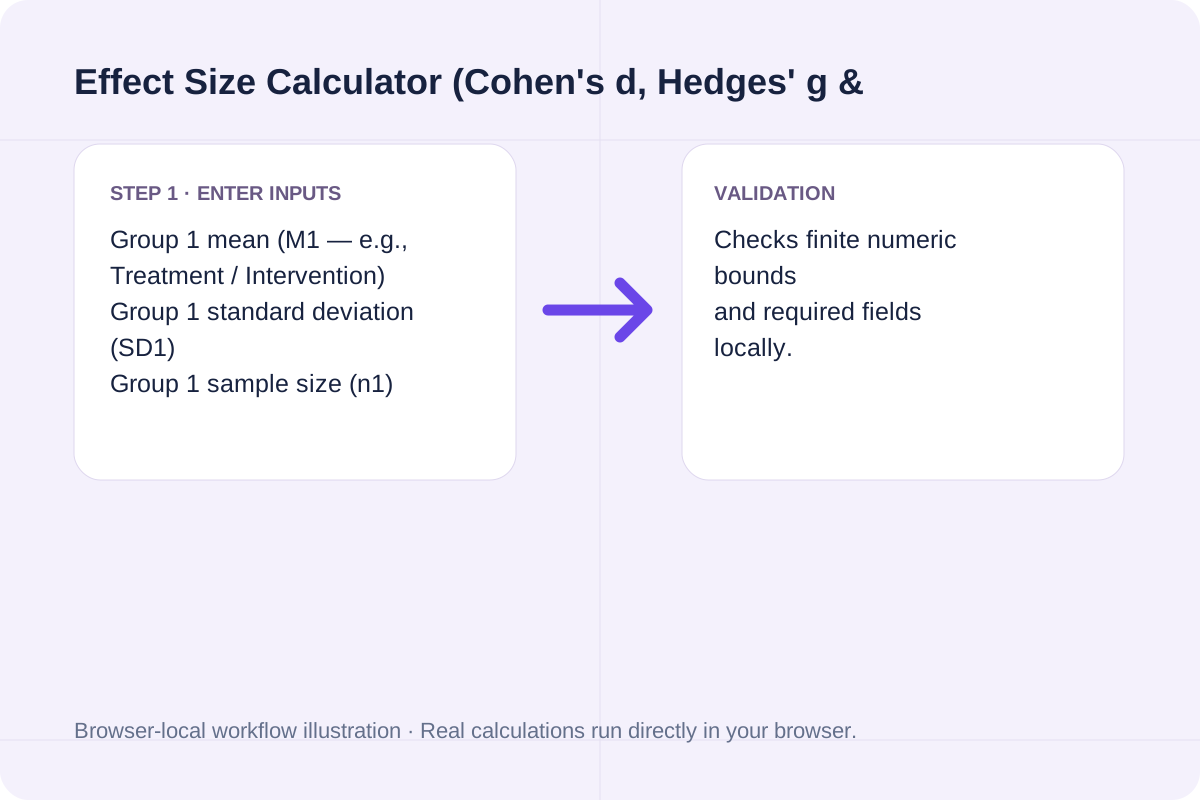
Enter the inputs

Start by entering the required fields in the Effect Size Calculator (Cohen's d, Hedges' g & Glass's Δ) form above.

Effect Size Calculator (Cohen's d, Hedges' g & Glass's Δ) step 1: Enter the inputs
Step 1 workflow overview for Effect Size Calculator (Cohen's d, Hedges' g & Glass's Δ).

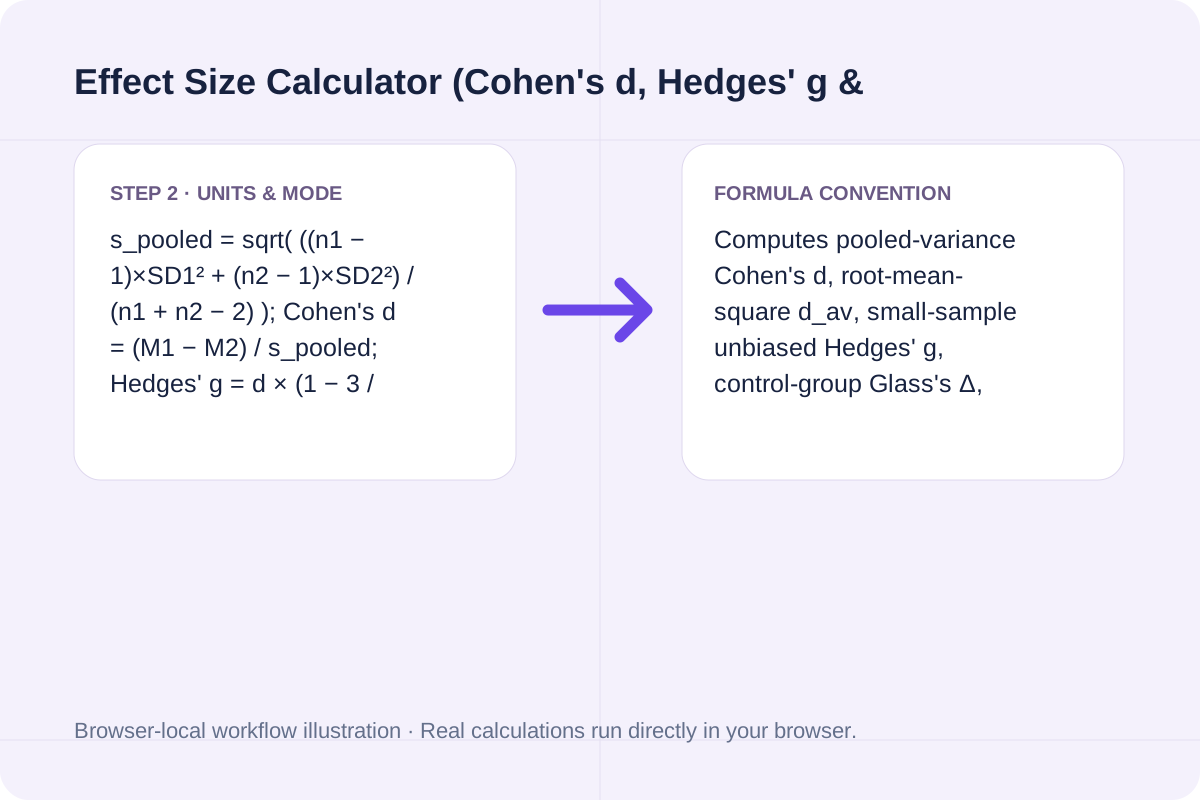
Verify units and assumptions

Match each value to the unit or format shown next to the input box before running the calculation.

Effect Size Calculator (Cohen's d, Hedges' g & Glass's Δ) step 2: Verify units and assumptions
Step 2 workflow overview for Effect Size Calculator (Cohen's d, Hedges' g & Glass's Δ).

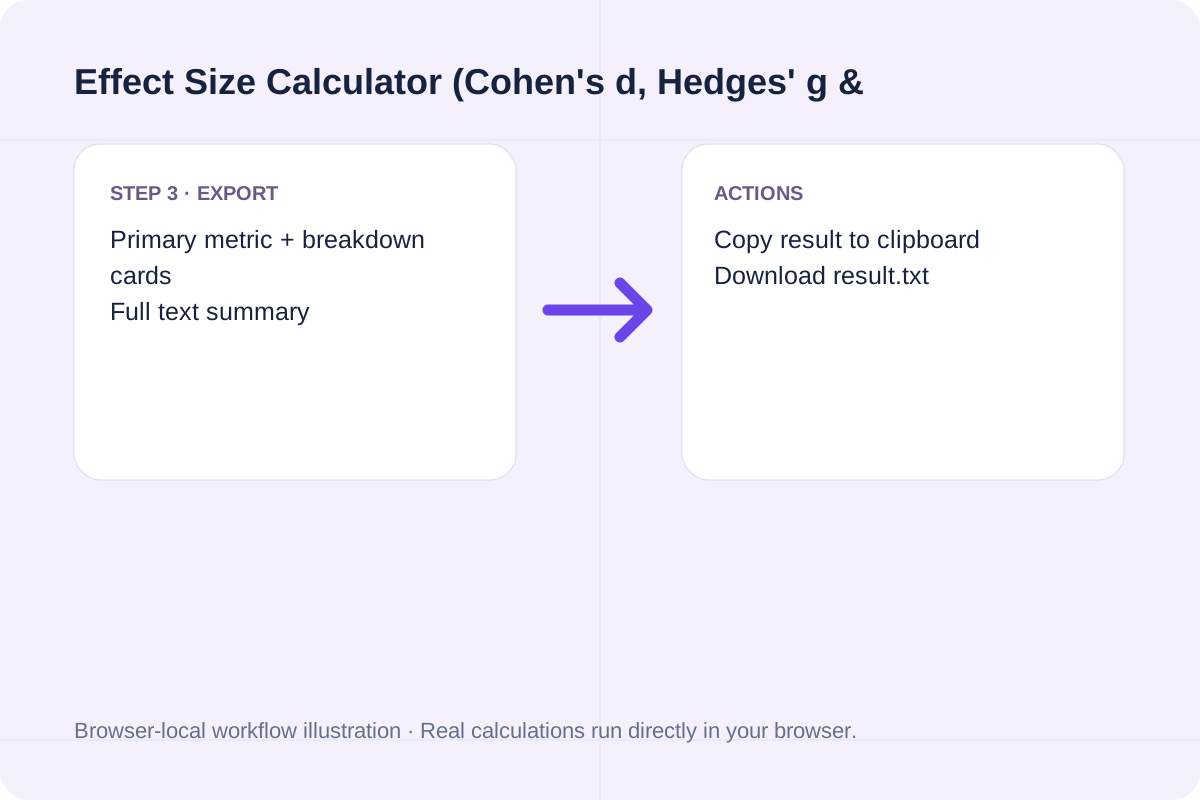
Run and export your result

Select Calculate Effect Size, inspect the primary metric and breakdown cards, then use Copy result or Download result.txt.

Effect Size Calculator (Cohen's d, Hedges' g & Glass's Δ) step 3: Run and export your result
Step 3 workflow overview for Effect Size Calculator (Cohen's d, Hedges' g & Glass's Δ).

Worked examples for Effect Size Calculator (Cohen's d, Hedges' g & Glass's Δ)

Compare baseline and alternative runs for Effect Size Calculator (Cohen's d, Hedges' g & Glass's Δ) before exporting the result.

Baseline example

Calculate Cohen's d, Hedges' g, Glass's delta, correlation r, 95% confidence interval, and Cohen's U3 / CLES from group means, standard deviations, and sample sizes.

Effect Size Calculator (Cohen's d, Hedges' g & Glass's Δ) example 1: Baseline example
Worked example 1 for Effect Size Calculator (Cohen's d, Hedges' g & Glass's Δ).

Comparison scenario

s_pooled = sqrt( ((n1 − 1)×SD1² + (n2 − 1)×SD2²) / (n1 + n2 − 2) ); Cohen's d = (M1 − M2) / s_pooled; Hedges' g = d × (1 − 3 / (4×(n1 + n2 − 2) − 1)); Glass's Δ = (M1 − M2) / SD2; r = d / sqrt(d² + (n1 + n2)² / (n1×n2)).

Effect Size Calculator (Cohen's d, Hedges' g & Glass's Δ) example 2: Comparison scenario
Worked example 2 for Effect Size Calculator (Cohen's d, Hedges' g & Glass's Δ).

Boundary check before exporting

Computes pooled-variance Cohen's d, root-mean-square d_av, small-sample unbiased Hedges' g, control-group Glass's Δ, correlation r, 95% confidence interval, Cohen's U3, and Common Language Effect Size (CLES).

Effect Size Calculator (Cohen's d, Hedges' g & Glass's Δ) example 3: Boundary check before exporting
Worked example 3 for Effect Size Calculator (Cohen's d, Hedges' g & Glass's Δ).

How to interpret the Effect Size Calculator (Cohen's d, Hedges' g & Glass's Δ) output

Review the calculated output alongside your entered parameters and unit conventions.

Computes pooled-variance Cohen's d, root-mean-square d_av, small-sample unbiased Hedges' g, control-group Glass's Δ, correlation r, 95% confidence interval, Cohen's U3, and Common Language Effect Size (CLES).

How to interpret Effect Size Calculator (Cohen's d, Hedges' g & Glass's Δ) results
Result interpretation guide for Effect Size Calculator (Cohen's d, Hedges' g & Glass's Δ).

Effect Size Reporting Checklist

Verify these three details before publishing your effect size.

s_pooled = sqrt( ((n1 − 1)×SD1² + (n2 − 1)×SD2²) / (n1 + n2 − 2) ); Cohen's d = (M1 − M2) / s_pooled; Hedges' g = d × (1 − 3 / (4×(n1 + n2 − 2) − 1)); Glass's Δ = (M1 − M2) / SD2; r = d / sqrt(d² + (n1 + n2)² / (n1×n2)). Computes pooled-variance Cohen's d, root-mean-square d_av, small-sample unbiased Hedges' g, control-group Glass's Δ, correlation r, 95% confidence interval, Cohen's U3, and Common Language Effect Size (CLES).

Scope limits and assumptions for Effect Size Calculator (Cohen's d, Hedges' g & Glass's Δ)
Assumptions and input boundaries for Effect Size Calculator (Cohen's d, Hedges' g & Glass's Δ).

Effect Size Calculator (Cohen's d, Hedges' g & Glass's Δ): common questions

Answers about using Effect Size Calculator (Cohen's d, Hedges' g & Glass's Δ) and understanding its results.

What is the difference between Cohen's d, Hedges' g, and Glass's Δ?

All three measure the standardized mean difference (M1 − M2) in standard deviation units, but they use different denominators or bias corrections: Cohen's d divides by the pooled standard deviation (s_pooled); Hedges' g multiplies Cohen's d by the exact degrees-of-freedom correction factor J = 1 − 3/(4×df − 1) to remove upward small-sample bias (especially important when n1 + n2 < 50); and Glass's Δ divides strictly by the control group's standard deviation (SD2) when the treatment alters group variance.

How do I interpret Small, Medium, and Large Cohen's d benchmarks?

Jacob Cohen's classic rule-of-thumb benchmarks classify |d| ≈ 0.20 as a Small effect, |d| ≈ 0.50 as a Medium effect, and |d| ≈ 0.80 (or above) as a Large effect. Always interpret these thresholds alongside domain norms and the 95% confidence interval.

What do Cohen's U3 and Common Language Effect Size (CLES) tell me?

Cohen's U3 = Φ(d) reports the percentage of Group 1 that exceeds the mean (50th percentile) of Group 2. Common Language Effect Size (CLES = Φ(|d| / √2)) gives the probability that a randomly selected score from the higher-mean group exceeds a randomly selected score from the lower-mean group.

How is the 95% confidence interval for Cohen's d calculated?

The standard error of Cohen's d is SE_d = sqrt( (n1 + n2)/(n1 × n2) + d² / (2 × (n1 + n2)) ), and the 95% confidence interval is d ± 1.95996 × SE_d. If the 95% CI does not cross 0, the standardized difference is statistically significant at two-sided α = 0.05.

Try your own values

Choose another tool for your next calculation, conversion, or text task.

Calculate Effect Size