

CSV to ICS Converter
Build an iCalendar file from a CSV event list. Use UTC timestamps or all-day dates, review each event and import the downloaded file into your calendar.
Open toolEnter your local average last spring frost date, seed-packet weeks to start indoors, outdoor transplant offset, hardening-off duration, and days to maturity below to generate a complete planting calendar.
Enter the inputs, then select Calculate planting dates.
Result will appear here
The Seed Starting Calculator uses UTC calendar arithmetic to count backward from your last spring frost date for indoor sowing and forward for hardening off, transplanting, and first harvest.
Sow Indoors = Frost Date − (Weeks × 7) days; Harden Off = Transplant Date − Hardening Days; Harvest = Transplant Date + Days to Maturity.
Negative transplant offsets (down to -60 days) are supported for cold-hardy crops planted before the last spring frost.
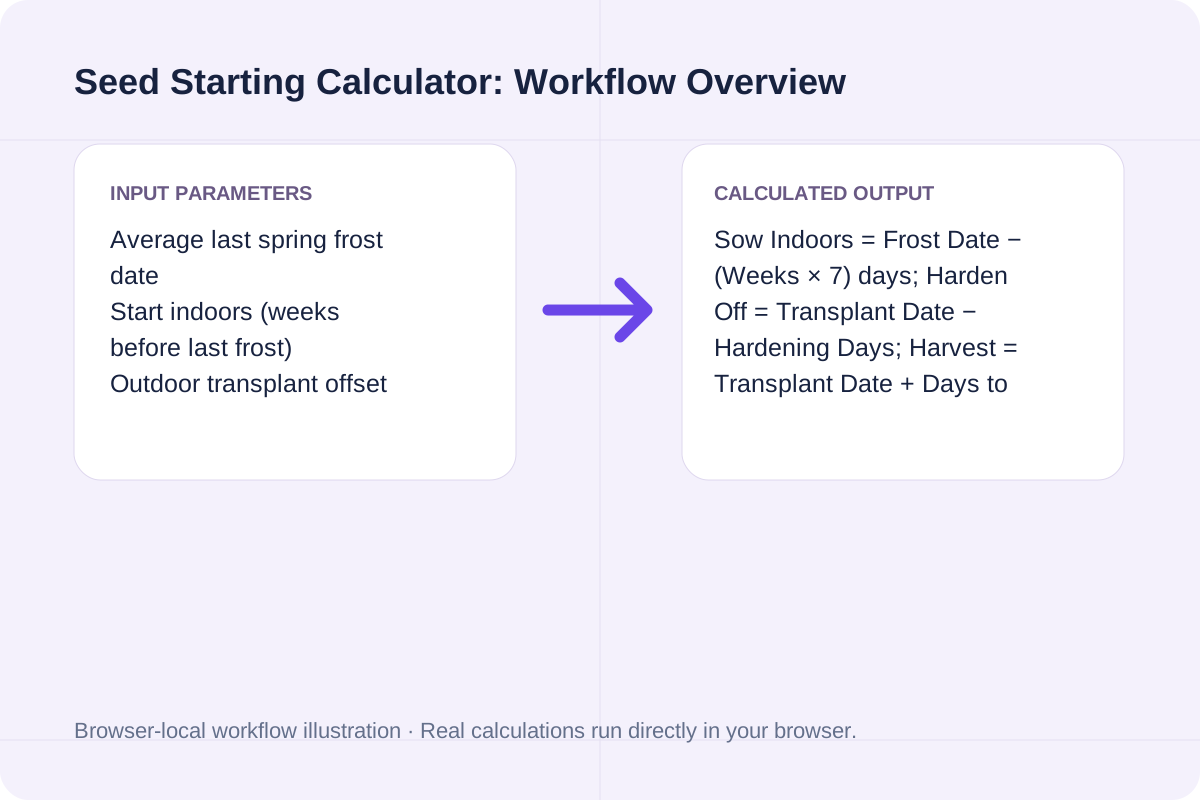
Review the input parameters, allowed value ranges, and worked reference cases for the Seed Starting Calculator below before running your calculation.
| Parameter / Scenario | Default / Sample Value | Rule or Allowed Range | Output / Usage Note |
|---|---|---|---|
| Input: Average last spring frost date | 2026-04-20 | Enter your local average last spring frost date (YYYY-MM-DD). | Required workspace parameter |
| Input: Start indoors (weeks before last frost) | 6 | Range: 1 to 24 | Required workspace parameter |
| Input: Outdoor transplant offset from frost date | 14 | Range: -60 to 90 | Required workspace parameter |
| Input: Hardening-off period before transplant | 7 | Range: 0 to 30 | Required workspace parameter |
| Worked Case 1: Baseline run (Tomatoes with April 20 last frost date) | Preloaded / test values | Indoor Sow Date = Last Frost Date − round(Weeks Before Frost × 7); Transplant Date = Last Frost Date + Transplant Offset Days; Harden-Off Start = Transplant Date − Hardening Days | With a 2026-04-20 last frost date, sowing 6 weeks (42 days) before frost sets the Indoor Seed Start Date at 2026-03-09. Transplanting 14 days after frost sets the Outdoor Transplant Date at 2026-05-04, with Hardening Off starting 2026-04-27 and First Harvest around 2026-07-13 (70 days to maturity). |
| Worked Case 2: Cool-season brassica crop (Broccoli transplanted 21 days before frost) | Preloaded / test values | Indoor Sow Date = Last Frost Date − round(Weeks Before Frost × 7); Transplant Date = Last Frost Date + Transplant Offset Days; Harden-Off Start = Transplant Date − Hardening Days | Using a 2026-04-20 frost date, 6 weeks indoor lead time, and a -21 day transplant offset sets Indoor Sowing at 2026-03-09, Hardening Off at 2026-03-23, Outdoor Transplanting at 2026-03-30, and First Harvest at 2026-05-29 (60 days to maturity). |
Check the back of your seed packet for indoor lead time and days to maturity, then enter your local frost date.
Pick your local average last spring frost date using the calendar input.
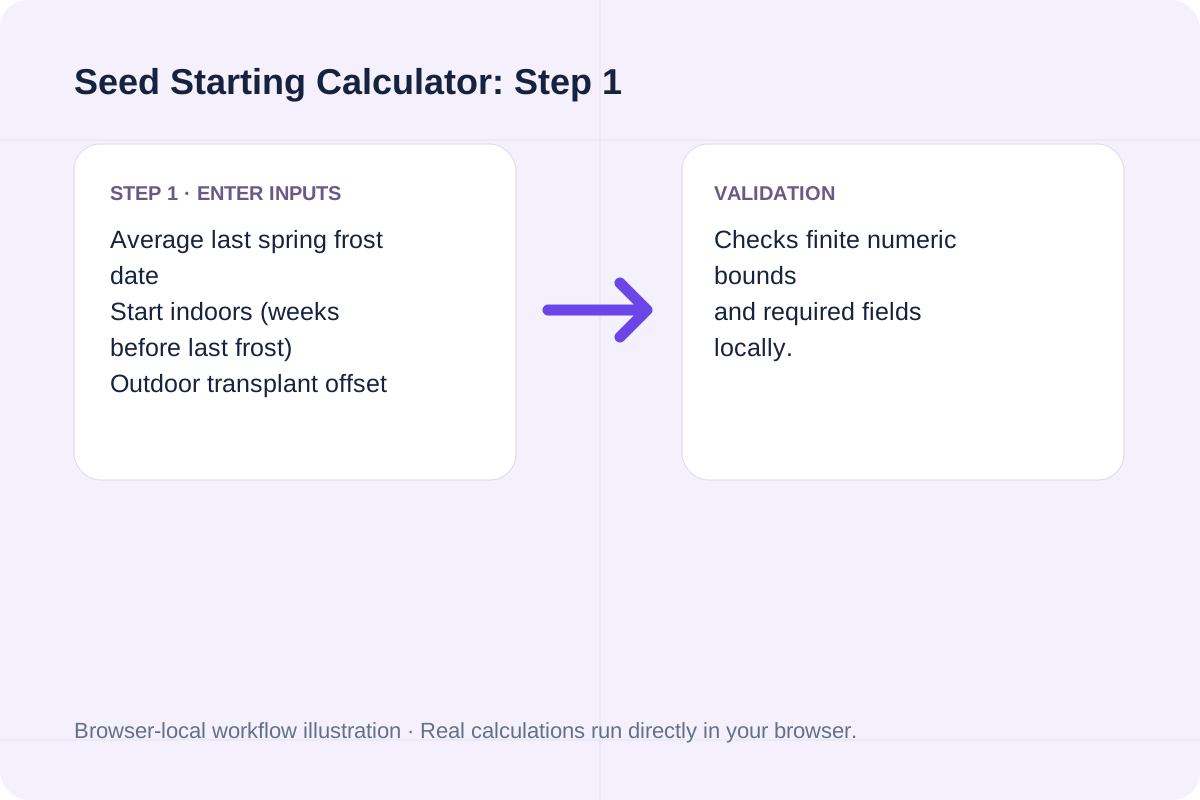
Enter how many weeks before the last frost to sow indoors, plus the number of days after frost (positive) or before frost (negative) to transplant outdoors.
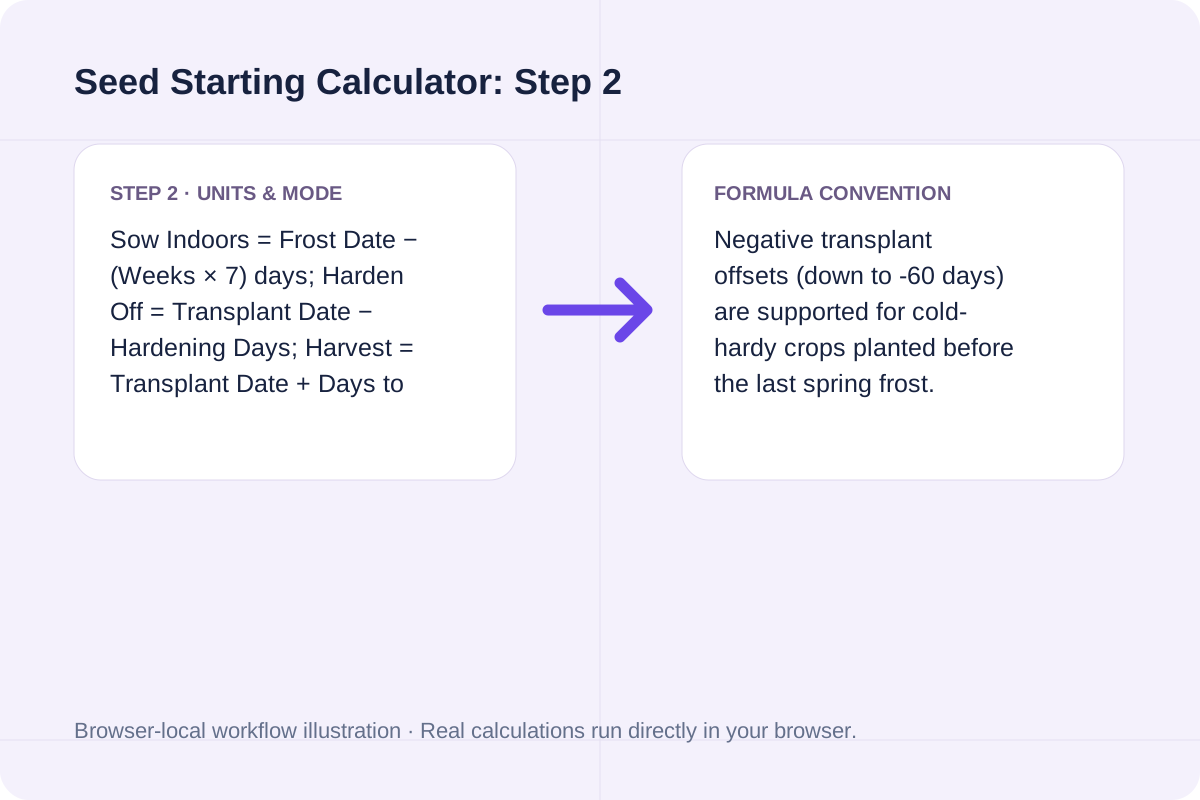
Set your hardening-off window (usually 7 to 10 days) and days to maturity, then click Calculate planting dates.
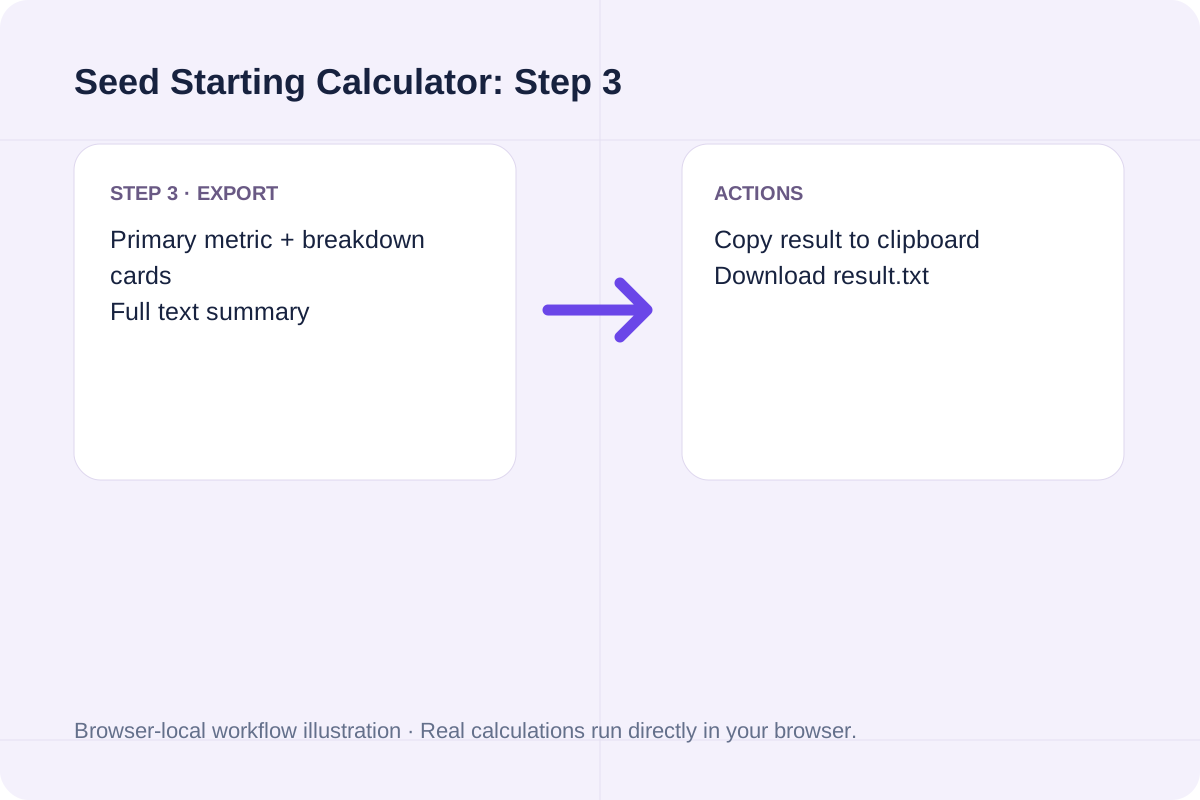
Compare a warm-season tomato schedule against an early-spring broccoli schedule.
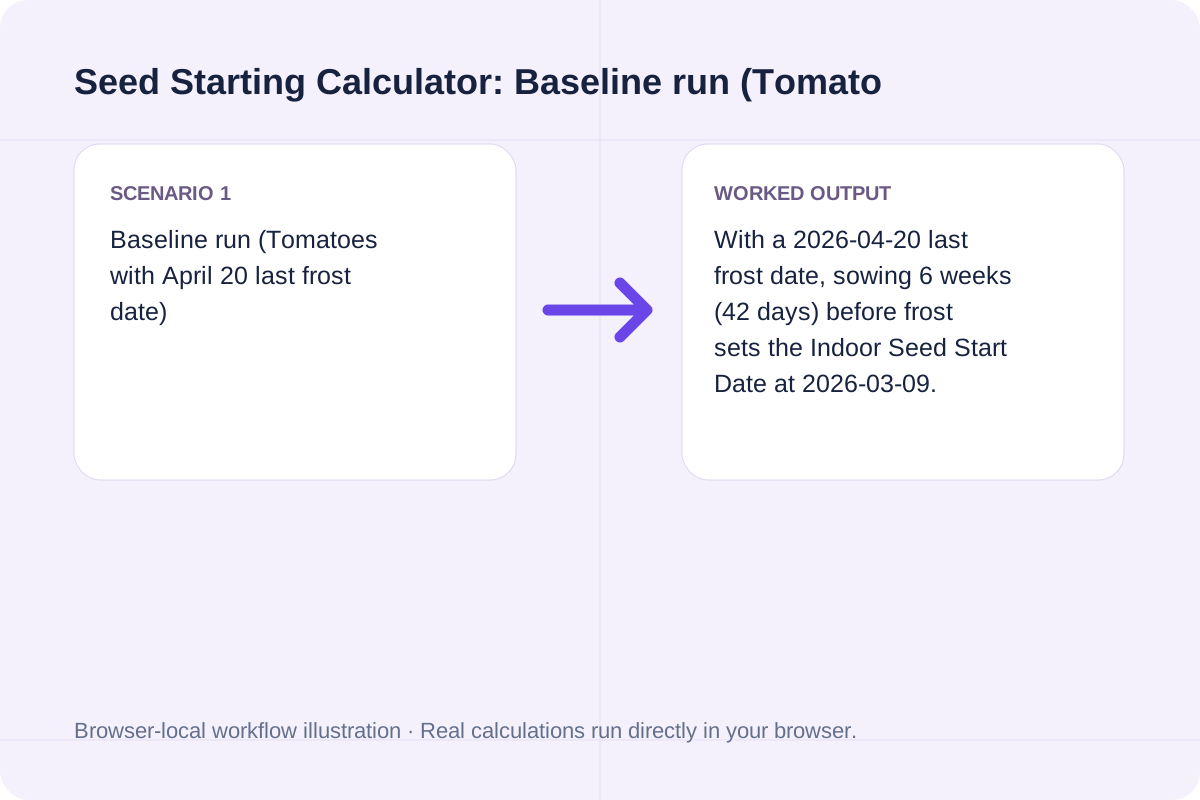
With a 2026-04-20 last frost date, sowing 6 weeks (42 days) before frost sets the Indoor Seed Start Date at 2026-03-09. Transplanting 14 days after frost sets the Outdoor Transplant Date at 2026-05-04, with Hardening Off starting 2026-04-27 and First Harvest around 2026-07-13 (70 days to maturity).
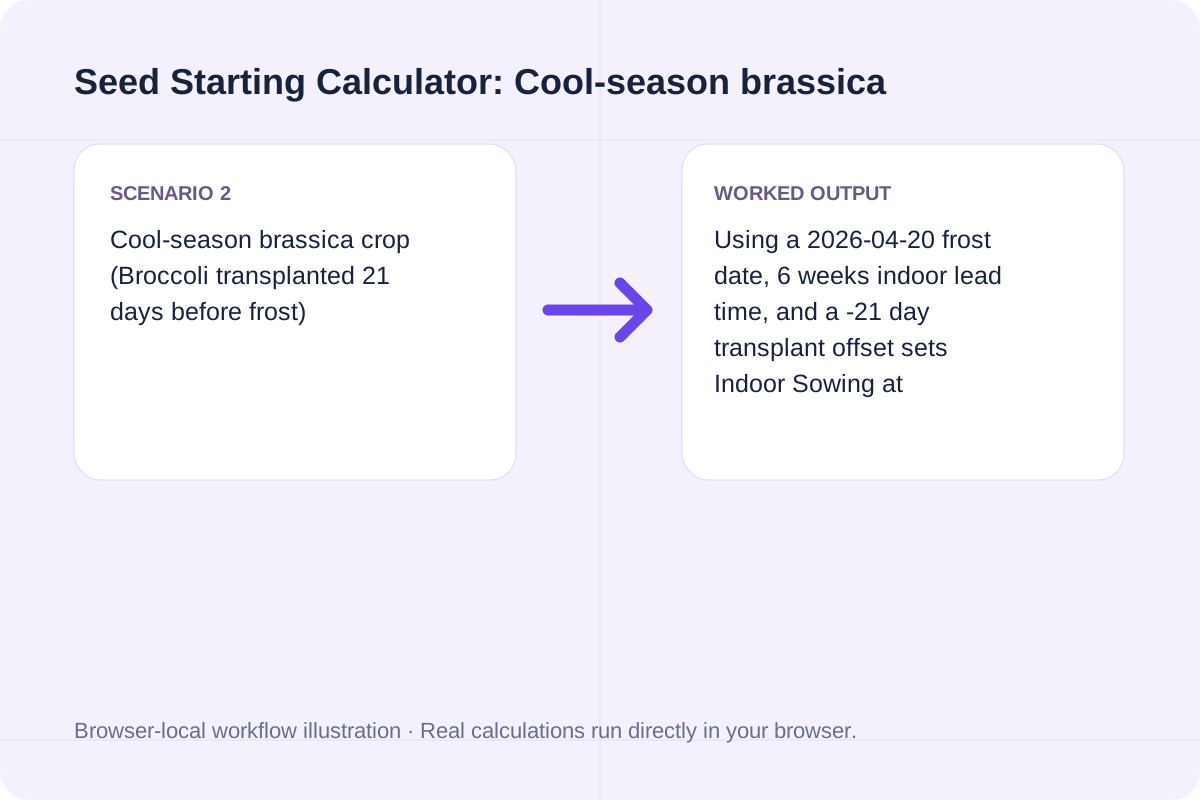
Using a 2026-04-20 frost date, 6 weeks indoor lead time, and a -21 day transplant offset sets Indoor Sowing at 2026-03-09, Hardening Off at 2026-03-23, Outdoor Transplanting at 2026-03-30, and First Harvest at 2026-05-29 (60 days to maturity).
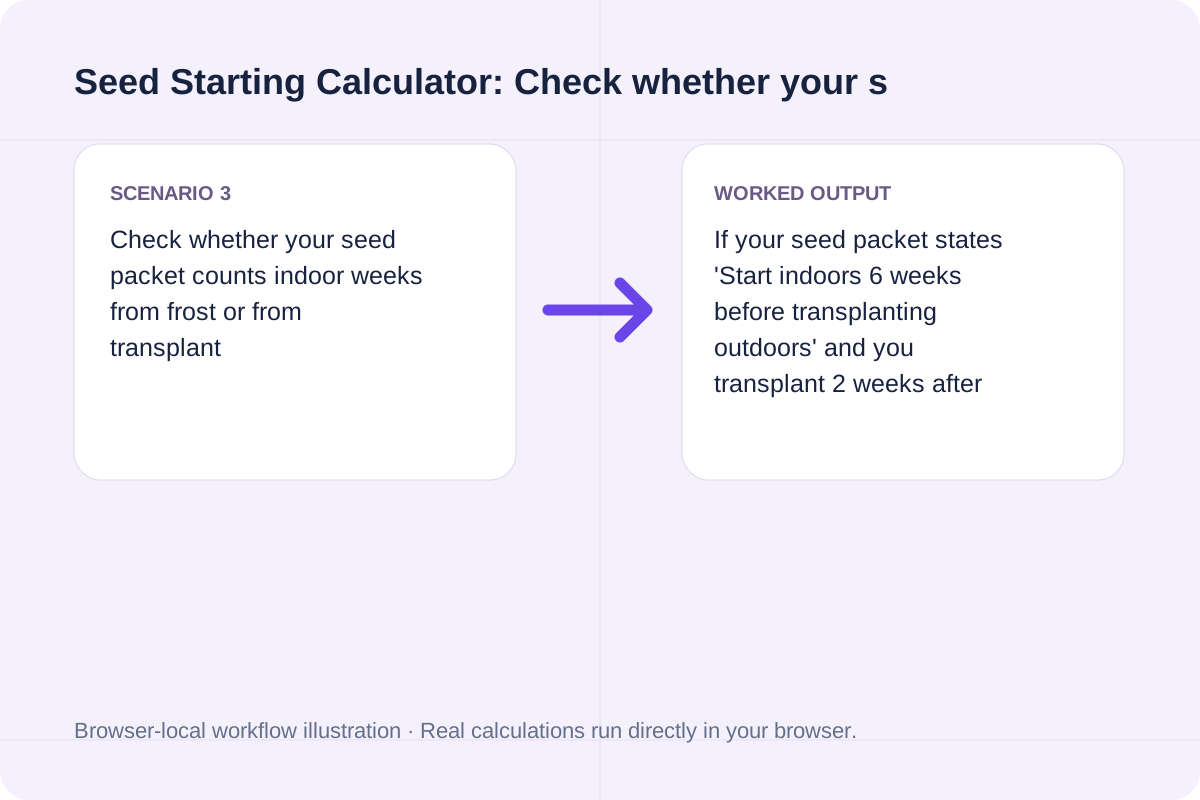
If your seed packet states 'Start indoors 6 weeks before transplanting outdoors' and you transplant 2 weeks after frost, enter 4 weeks before last frost so seedlings do not become root-bound in small cell trays.
Review total indoor tray duration alongside the four milestone dates.
The calculator reports Total Indoor Tray Time (the span from indoor sowing to outdoor transplanting). If your indoor weeks plus a positive transplant offset keep seedlings in trays for more than 8 to 9 weeks, plan to pot up seedlings into 3.5-inch or 4-inch containers midway through indoor growth.
Treat frost dates as historical probabilities rather than guaranteed weather cutoffs.
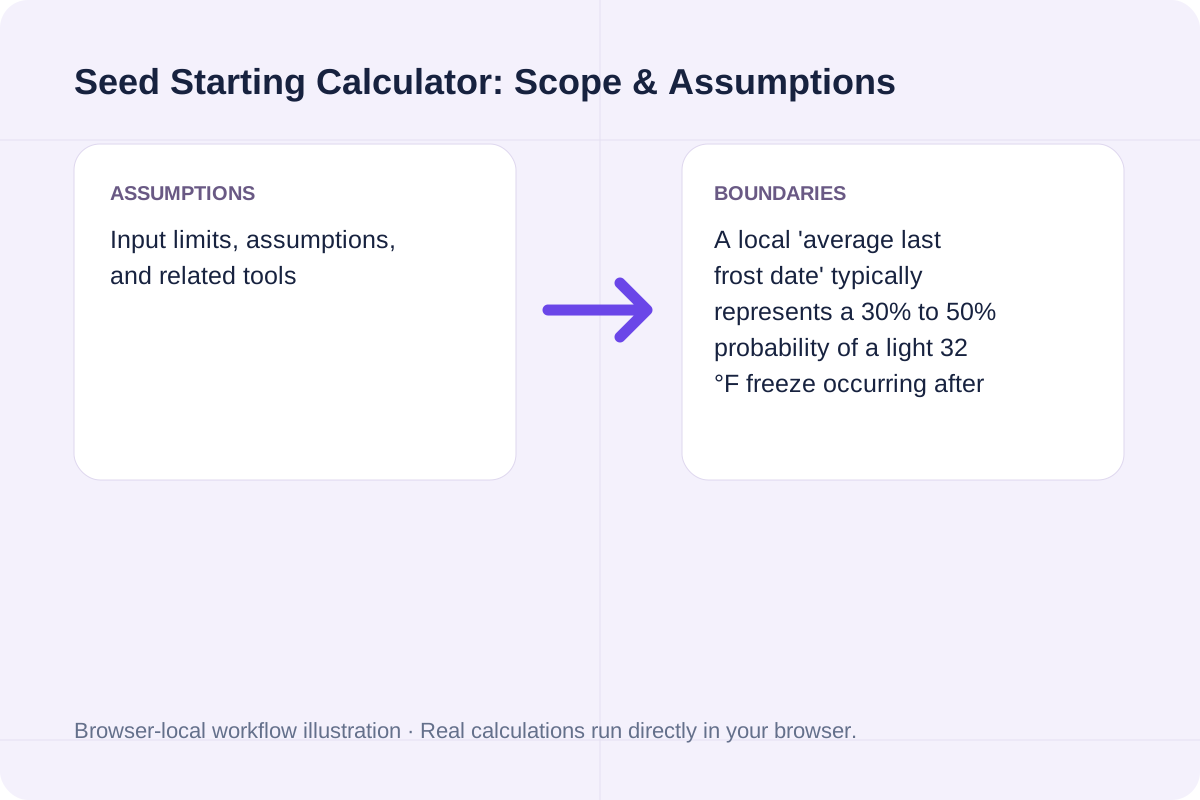
A local 'average last frost date' typically represents a 30% to 50% probability of a light 32 °F freeze occurring after that date. Keep frost cloth or row covers ready during your first two weeks after transplanting.
Build an iCalendar file from a CSV event list. Use UTC timestamps or all-day dates, review each event and import the downloaded file into your calendar.
Open tool
Convert Excel date serial numbers to calendar dates, HH:MM:SS times, and Unix timestamps (or vice versa) with Lotus 1-2-3 1900 leap-year bug handling.
Open tool
Generate random dates within an inclusive calendar range with weekend and repeat rules.
Open toolChoose another tool for your next calculation, conversion, or text task.

Calculate daily new flashcards, peak review load, study minutes, and FSRS v4.5/v5 vs. Anki SM-2 intervals from total cards, exam days, and desired retention.
Open tool
Subtract two 24-hour clock times; optionally move an earlier end time into the next day.
Open tool
Calculate remaining school days, total calendar days, weekend days, and instructional weeks between start and end dates minus holidays.
Open tool
Find complete calendar years and months using end-of-month clamping, then count remaining UTC calendar days.
Open toolAnswers about using Seed Starting Calculator and understanding its results.
Count backward from your local average last spring frost date by the number of weeks listed on your seed packet (for example, 6 weeks = 42 days before your last frost date).
Warm-season crops such as tomatoes, peppers, and basil need warm night air and soil temperatures, so gardeners transplant them 7 to 14 days after the last frost date (+7 to +14 days). Cool-season crops like broccoli, kale, and cabbage tolerate light frost and can be transplanted 14 to 28 days before the last frost (-14 to -28 days).
Begin hardening off 7 to 10 days before your planned outdoor transplant date by placing trays in filtered outdoor shade for a few hours per day and gradually increasing sunlight and breeze exposure.
Yes. All date calculations run locally in your browser. Click Copy result or Download result.txt to save your sowing, hardening-off, transplant, and harvest dates.
Choose another tool for your next calculation, conversion, or text task.