

School Days Countdown
Calculate remaining school days, total calendar days, weekend days, and instructional weeks between start and end dates minus holidays.
Open toolPlan your flashcard deck before review backlogs pile up: calculate required daily new cards, peak daily due reviews, study minutes, and exact FSRS v4.5/v5 vs. Classic SM-2 interval ladders for Anki decks, the 7,298-word Word Atlas IELTS dataset, or any exam countdown.
Enter the inputs, then select Calculate Study Schedule.
Result will appear here
Adding 40 new flashcards a day never means reviewing only 40 cards a day. Every new cohort echoes forward across future days according to your scheduler's interval equation.
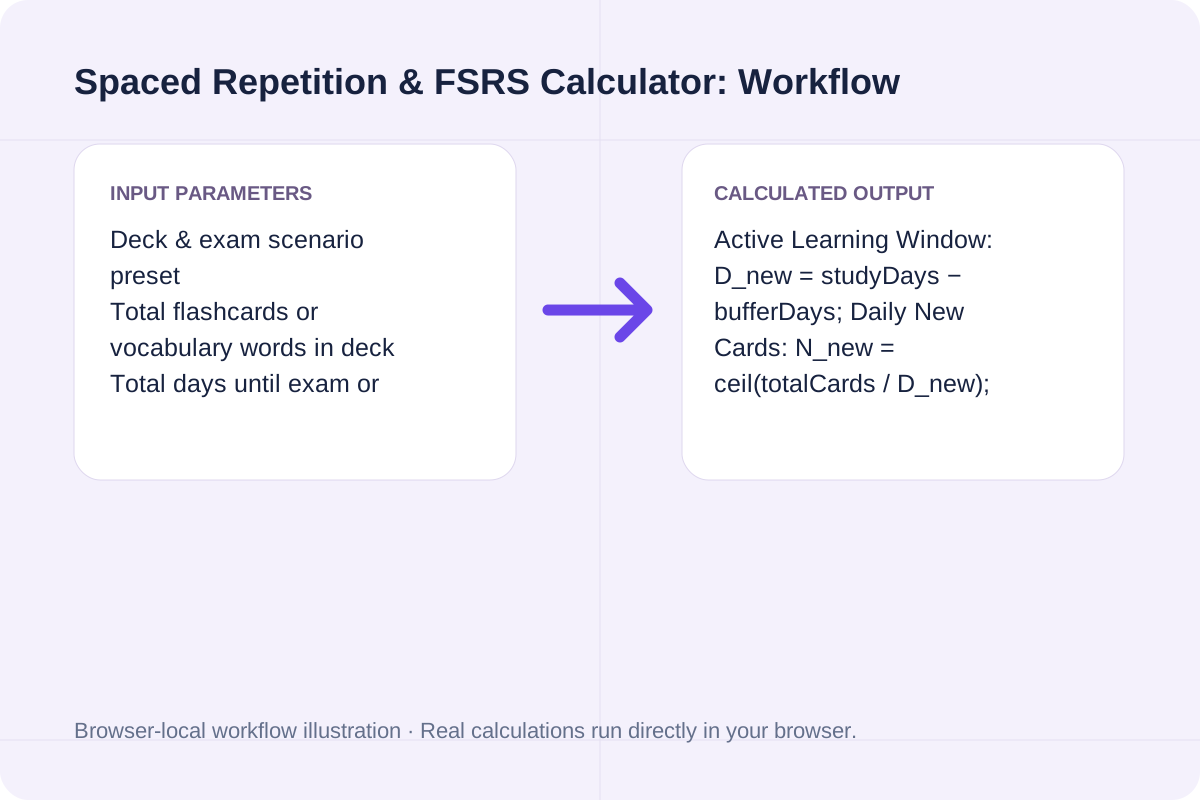
Active Learning Window: D_new = studyDays − bufferDays; Daily New Cards: N_new = ceil(totalCards / D_new); FSRS Power-Law Interval: I(S, R) = round(S × (81 / 19) × (R^(−2) − 1)), where initial stability S_0 = 3.173d and post-review stability S' = S × (1 + e^(1.8722) × (11 − D) × S^(−0.1666) × (e^(0.796 × (1 − R)) − 1)); Daily Workload: cohort simulation summing new introductions + scheduled due reviews + expected lapse re-reviews across studyDays.
Simulates deterministic cohort review loads assuming consistent daily attendance and medium card difficulty (D = 5.0 in FSRS; EF = 2.50 in SM-2). Real review counts vary with individual lapse rates and deck complexity. This page is an independent pacing calculator on AI Tools Free, not the external Word Atlas or Anki application.
Exact cohort simulation results across four standard flashcard benchmarks, comparing FSRS v4.5/v5 against legacy Anki SM-2 and Leitner boxes.
| Study Scenario / Deck | New Cards / Day (Active Window) | First 5 Intervals (Days) | Avg / Peak Daily Load | Total Study Time (FSRS vs. SM-2) |
|---|---|---|---|---|
| **IELTS 7,298 Words (Word Atlas Preset)** (`180d total`, `14d buffer`, `FSRS R=0.90`, `8s/card`) | `44 new/day` (`166 active days`) | `3d -> 12d -> 37d -> 102d -> 254d` | `175.31 avg/d` (`23.37 min`) • `245 peak` (`32.67 min`) | `70.12 hrs` (`31,556 reps`) vs. `89.93 hrs` in SM-2 (`22.02% saved`) |
| **GRE / Academic 3,000 Words** (`90d total`, `10d buffer`, `FSRS R=0.90`, `8s/card`) | `38 new/day` (`80 active days`) | `3d -> 12d -> 37d -> 102d -> 254d` | `125.88 avg/d` (`16.78 min`) • `168 peak` (`22.40 min`) | `25.18 hrs` (`11,329 reps`) vs. `32.26 hrs` in SM-2 (`21.95% saved`) |
| **High-Volume Exam 10,000 Cards** (`240d total`, `20d buffer`, `FSRS R=0.85`, `10s/card`) | `46 new/day` (`220 active days`) | `5d -> 26d -> 109d -> 376d -> 1128d` | `163.62 avg/d` (`27.27 min`) • `213 peak` (`35.50 min`) | `109.08 hrs` (`39,269 reps`) vs. `156.67 hrs` in SM-2 (`30.38% saved`) |
| **Language Core 1,500 Words (Classic SM-2)** (`60d total`, `7d buffer`, `SM-2 R=0.90`, `8s/card`) | `29 new/day` (`53 active days`) | `1d -> 6d -> 15d -> 38d -> 94d` | `106.02 avg/d` (`14.14 min`) • `132 peak` (`17.60 min`) | `14.14 hrs` (`6,361 reps` in SM-2) vs. `11.01 hrs` (`4,956 reps` in FSRS) |
| **Physical Leitner 5-Box (1,500 Words)** (`60d total`, `7d buffer`, `Leitner`, `8s/card`) | `29 new/day` (`53 active days`) | `1d -> 2d -> 4d -> 8d -> 16d -> 32d` | `156.18 avg/d` (`20.82 min`) • `201 peak` (`26.80 min`) | `20.82 hrs` (`9,371 reps`) due to fixed doubling intervals |
Enter the values for your scenario, verify the units, and run the calculation.
Start by entering the required fields in the Spaced Repetition & FSRS Calculator form above.
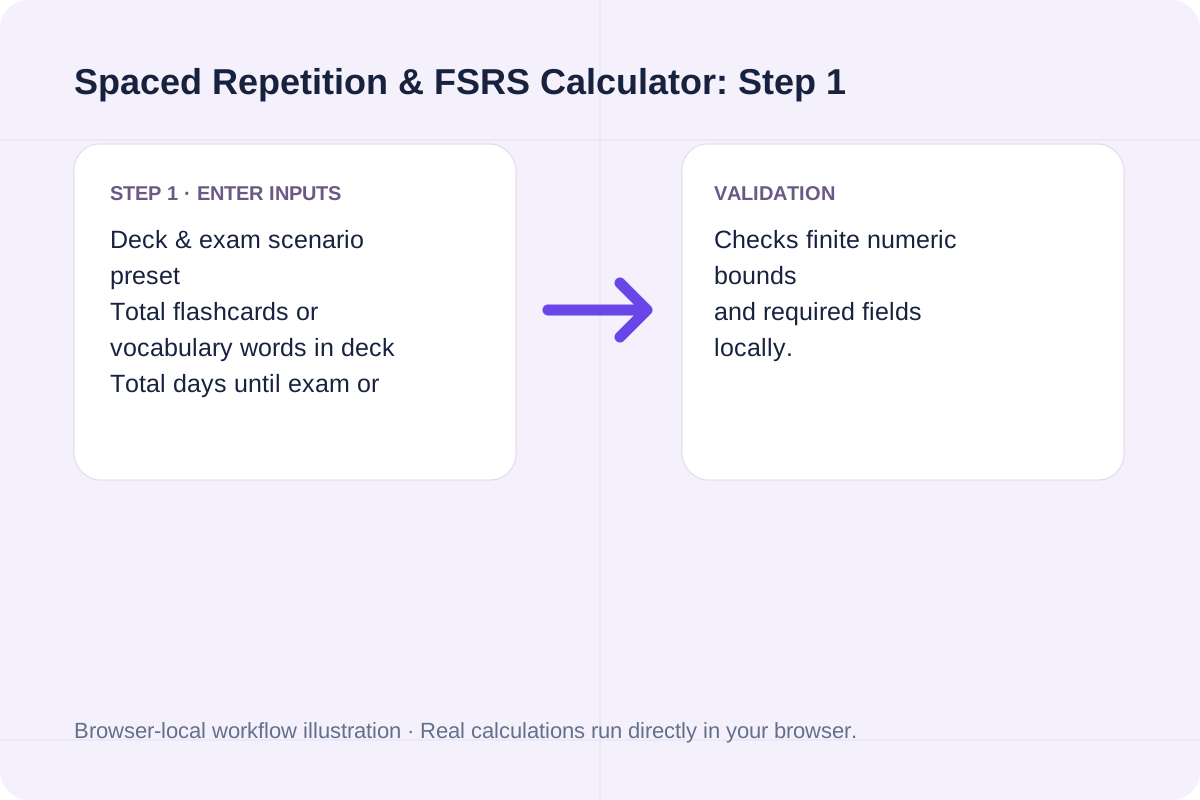
Match each value to the unit or format shown next to the input box before running the calculation.
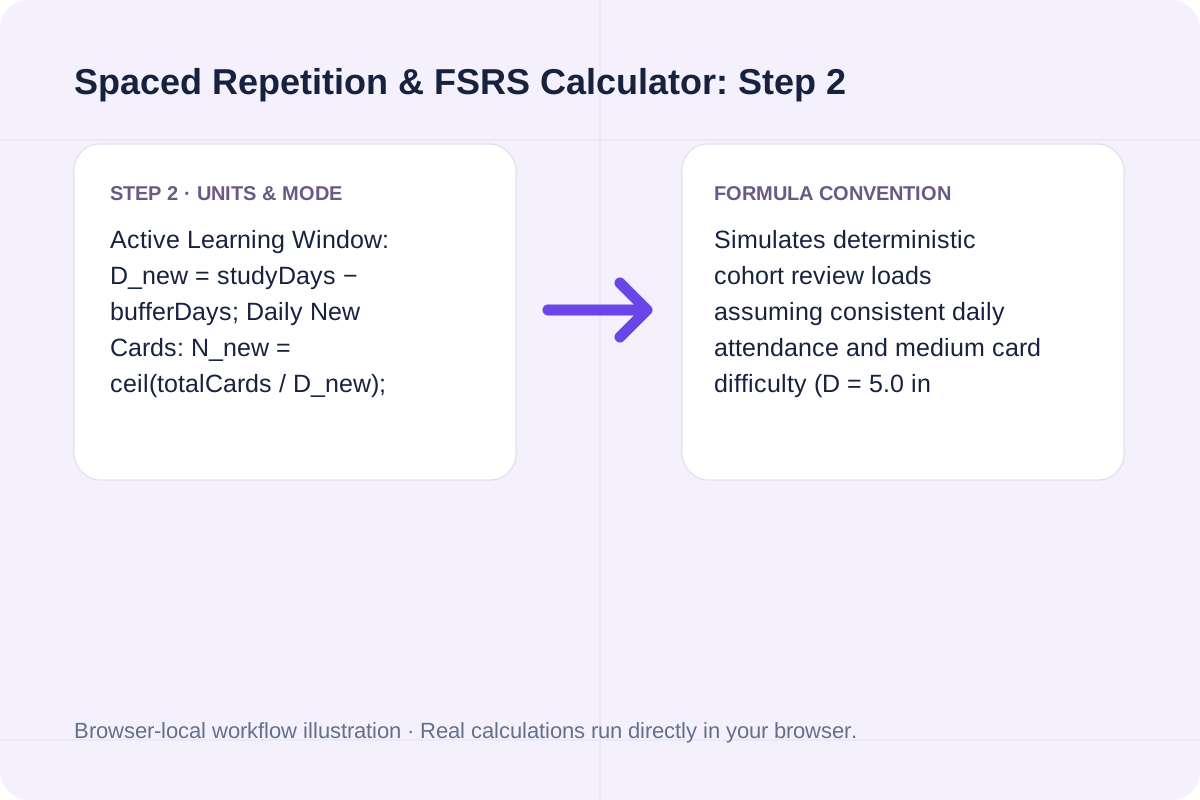
Select Calculate Study Schedule, inspect the primary metric and breakdown cards, then use Copy result or Download result.txt.
Compare baseline and alternative runs for Spaced Repetition & FSRS Calculator before exporting the result.
Calculate daily new flashcards, peak review load, study minutes, and FSRS v4.5/v5 vs. Anki SM-2 intervals from total cards, exam days, and desired retention.
Active Learning Window: D_new = studyDays − bufferDays; Daily New Cards: N_new = ceil(totalCards / D_new); FSRS Power-Law Interval: I(S, R) = round(S × (81 / 19) × (R^(−2) − 1)), where initial stability S_0 = 3.173d and post-review stability S' = S × (1 + e^(1.8722) × (11 − D) × S^(−0.1666) × (e^(0.796 × (1 − R)) − 1)); Daily Workload: cohort simulation summing new introductions + scheduled due reviews + expected lapse re-reviews across studyDays.
Simulates deterministic cohort review loads assuming consistent daily attendance and medium card difficulty (D = 5.0 in FSRS; EF = 2.50 in SM-2). Real review counts vary with individual lapse rates and deck complexity. This page is an independent pacing calculator on AI Tools Free, not the external Word Atlas or Anki application.
Review the calculated output alongside your entered parameters and unit conventions.
Simulates deterministic cohort review loads assuming consistent daily attendance and medium card difficulty (D = 5.0 in FSRS; EF = 2.50 in SM-2). Real review counts vary with individual lapse rates and deck complexity. This page is an independent pacing calculator on AI Tools Free, not the external Word Atlas or Anki application.
Verify these three rules so your daily flashcard queue never spirals into a missed-day backlog.
Active Learning Window: D_new = studyDays − bufferDays; Daily New Cards: N_new = ceil(totalCards / D_new); FSRS Power-Law Interval: I(S, R) = round(S × (81 / 19) × (R^(−2) − 1)), where initial stability S_0 = 3.173d and post-review stability S' = S × (1 + e^(1.8722) × (11 − D) × S^(−0.1666) × (e^(0.796 × (1 − R)) − 1)); Daily Workload: cohort simulation summing new introductions + scheduled due reviews + expected lapse re-reviews across studyDays. Simulates deterministic cohort review loads assuming consistent daily attendance and medium card difficulty (D = 5.0 in FSRS; EF = 2.50 in SM-2). Real review counts vary with individual lapse rates and deck complexity. This page is an independent pacing calculator on AI Tools Free, not the external Word Atlas or Anki application.
Calculate remaining school days, total calendar days, weekend days, and instructional weeks between start and end dates minus holidays.
Open tool
Budget your 168-hour week across sleep, work, commute, chores, and exercise to calculate remaining free hours and category percentages.
Open tool
Subtract UTC date-only timestamps and divide by 86,400,000 milliseconds.
Open toolChoose another tool for your next calculation, conversion, or text task.

Subtract two 24-hour clock times; optionally move an earlier end time into the next day.
Open tool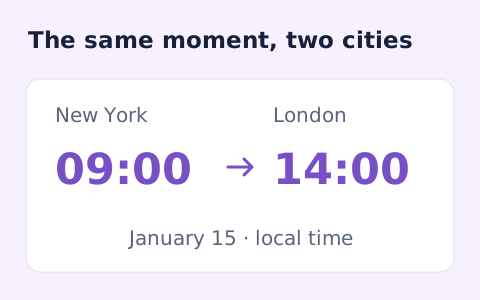
Convert a local date and time between IANA time zones.
Open tool
Track and analyze daily or multi-day screen time by app and category: calculate total hours, daily budget surplus/overage, productive focus share, and pickup interval.
Open tool
Find complete calendar years and months using end-of-month clamping, then count remaining UTC calendar days.
Open toolAnswers about using Spaced Repetition & FSRS Calculator and understanding its results.
Over a 180-day (6-month) study window with a 14-day pre-exam review buffer (166 active new-card days), you need to learn ceil(7,298 / 166) = 44 new words per day. Under FSRS at 90% desired retention (R = 0.90) and 8 seconds per card, your workload averages 175.31 total reviews per day (23.37 minutes/day) and peaks at 245 cards on Day 155 (32.67 minutes/day) before tapering down during the 14-day buffer.
Classic SM-2 forces fixed initial steps (1 day, then 6 days) before multiplying intervals by 2.5x, which over-reviews medium cards early on. FSRS (Free Spaced Repetition Scheduler, developed by Jarrett Ye and built into Anki 23.10+ and open-source vocabulary apps like Word Atlas) models memory stability with a power-law forgetting curve: R(t, S) = (1 + (19/81) × t/S)^(-0.5). Starting at S_0 = 3.17 days for a Good rating at R = 0.90, FSRS spaces reviews at 3d, 12d, 37d, 102d, and 254d, cutting total 180-day reviews on a 7,298-word deck from 40,468 (SM-2) to 31,556 (FSRS), a 22.02% workload reduction.
Because the FSRS interval multiplier scales with (R^(-2) - 1), raising target retention from 0.90 to 0.95 cuts the interval factor by more than half (from 1.00x stability down to 0.46x stability, with intervals of 1d, 3d, 7d, 14d, 27d, and 49d). For a 5% gain in recall probability, your total review workload roughly doubles. For most language and professional exams, R between 0.85 and 0.90 gives the highest words-remembered per hour of study.
If you introduce new flashcards right up to the day before your exam, the final week's cohorts only get 1 or 2 repetitions and coincide with your highest accumulated review backlog. Setting a 10-to-21-day buffer stops new card introductions early so every word completes at least its first 3d and 12d stability jumps before test day, while daily review time drops steadily during your final practice-test week.
Word Atlas (github.com/designfuchen/word-atlas) is an open-source IELTS vocabulary project released under a CC BY 4.0 dataset license containing 7,298 core IELTS words, 14,596 contextual example sentences, UK/US audio, custom illustrations, and native FSRS scheduling. We include its exact 7,298-word count as the default benchmark preset so IELTS test-takers can plan how many daily words and review minutes are needed before their exam date.
Choose another tool for your next calculation, conversion, or text task.