
BMI Calculator Online
A free adult BMI calculator with metric inputs, a clear BMI category, and the calculation shown.
Open toolUse rejection sampling on browser cryptographic random bytes to draw unbiased integers. Whole-number bounds only, with minimum no greater than maximum.
Enter the inputs, then select Generate random numbers.
Result will appear here
Use rejection sampling on browser cryptographic random bytes to draw unbiased integers.
Whole-number bounds only, with minimum no greater than maximum. Up to 1,000 draws. Sampling is with replacement, so duplicates are possible.
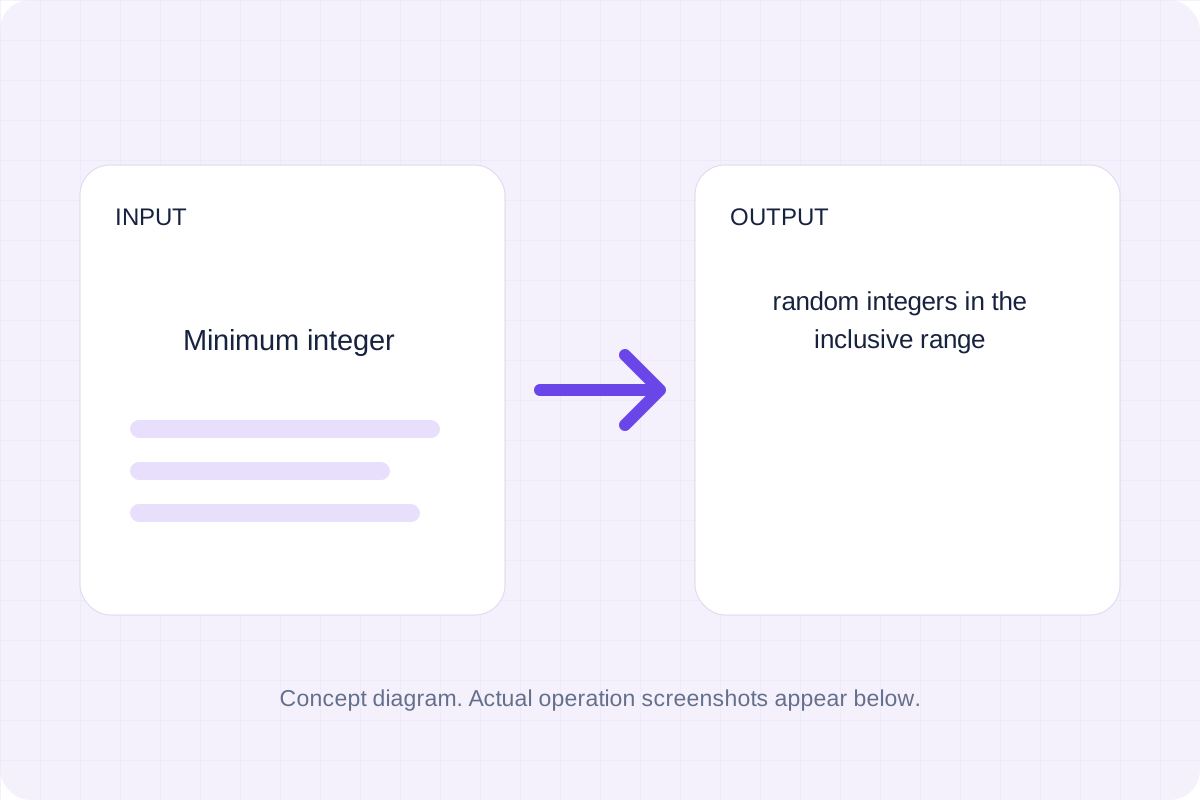
Start with your own input.
Replace the example with the minimum integer you want to process. Whole-number bounds only, with minimum no greater than maximum.
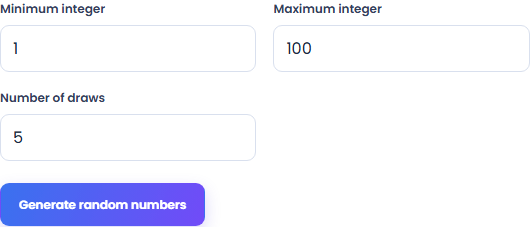
Set maximum integer, number of draws. These values determine the result.
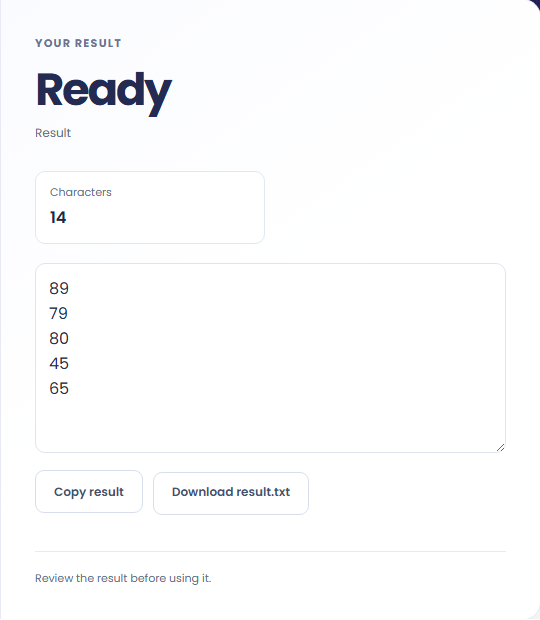
Select Generate random numbers. Review random integers in the inclusive range, then use Copy result or Save result.
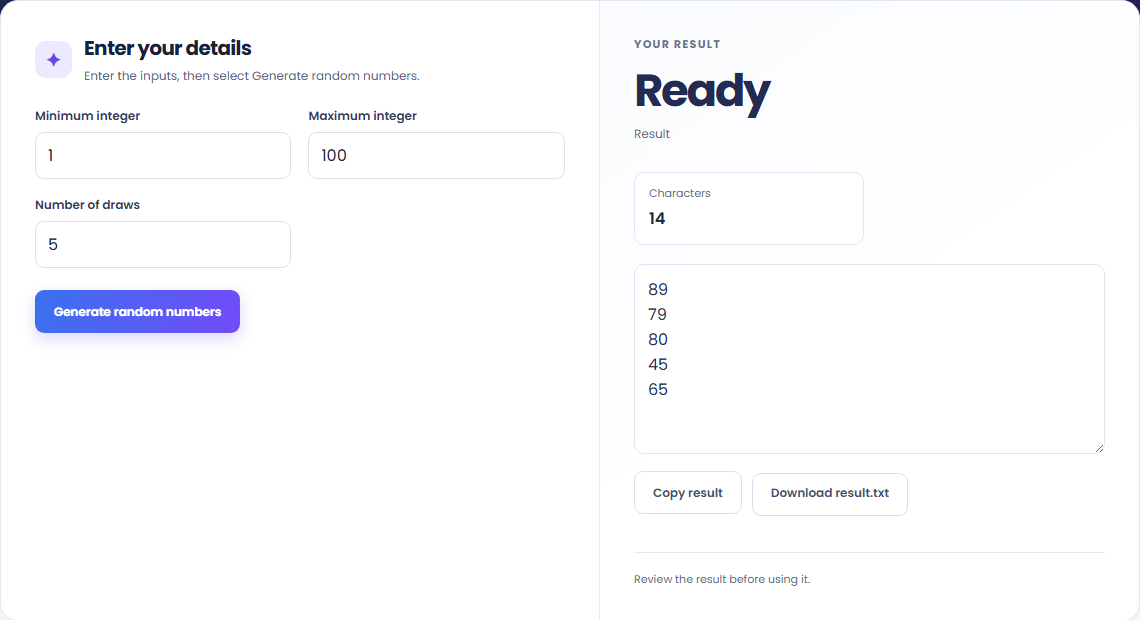
To draw practice examples, start with minimum integer. Use rejection sampling on browser cryptographic random bytes to draw unbiased integers.

To simulate a bounded integer sample, start with minimum integer. Whole-number bounds only, with minimum no greater than maximum.

To select a random numbered item, start with minimum integer. Copy the result into your working document, or save a local file for later review.

Check what the output means.
Random integers in the inclusive range. Use rejection sampling on browser cryptographic random bytes to draw unbiased integers.
Whole-number bounds only, with minimum no greater than maximum. Up to 1,000 draws. Sampling is with replacement, so duplicates are possible.

Check the format before processing.
Whole-number bounds only, with minimum no greater than maximum. Up to 1,000 draws. Sampling is with replacement, so duplicates are possible.
Inputs and results are processed locally. Keep your source and save the output you need before leaving.

A free adult BMI calculator with metric inputs, a clear BMI category, and the calculation shown.
Open tool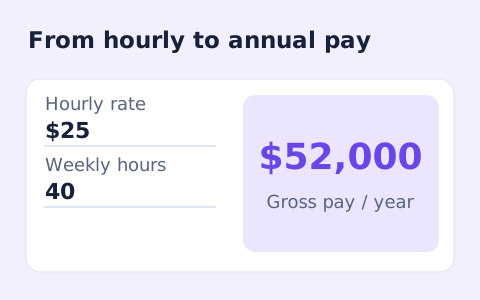
Convert hourly pay to gross annual, monthly, and weekly salary using your own working hours and weeks.
Open tool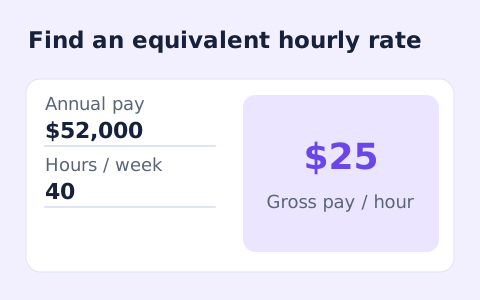
Convert annual gross salary into an hourly rate from your hours per week and paid weeks per year.
Open toolChoose another tool for your next calculation, conversion, or text task.
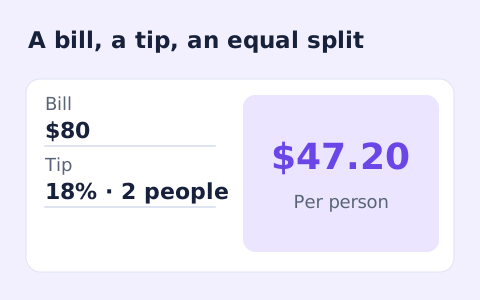
Quickly split a bill with a percentage tip. See the tip amount, total, and per-person amount.
Open tool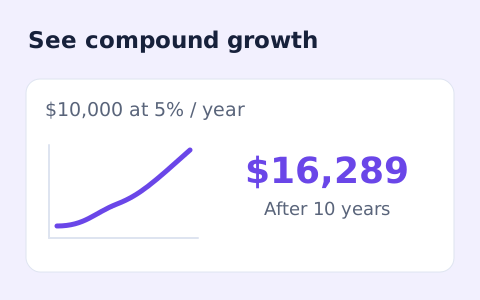
Estimate compound growth from a starting balance, monthly contribution, annual rate, and compound frequency.
Open tool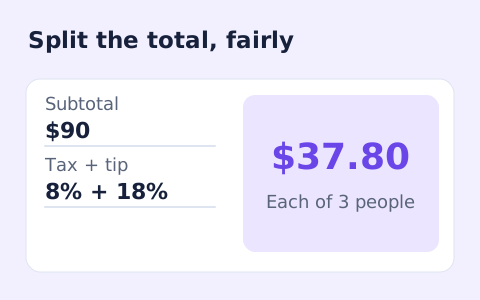
Split a bill among friends using a subtotal, sales tax, tip, and number of people.
Open tool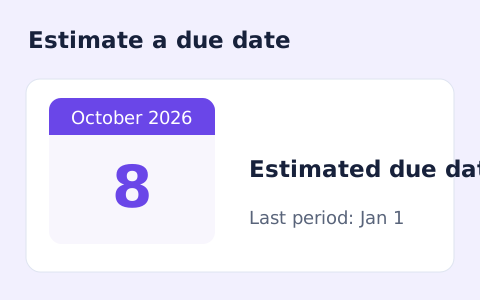
Estimate a pregnancy due date using the first day of the last menstrual period and cycle length.
Open toolCheck the result and copy or save the output.
Answers about using Random Number Generator and understanding its results.
Random integers in the inclusive range. Whole-number bounds only, with minimum no greater than maximum. Up to 1,000 draws. Sampling is with replacement, so duplicates are possible.
Yes. Use Copy result or Save result after processing. Inputs and results are handled in this browser; save what you need before leaving.