
CSV to TSV Converter
Convert comma-separated records to tab-separated text. Quoted commas, tabs and line breaks remain inside their cells; download the TSV for your next import.
Open toolWrite CSV records into a real Parquet file with UTF-8 string columns. Numbers and dates remain text, preserving leading-zero identifiers for later processing.
Enter the inputs, then select Convert to Parquet.
Result will appear here
Parse CSV headers and store every cell as a UTF-8 string in Parquet columns.
Processing uses bundled libraries in this browser. The download contains the generated source or document, rather than a link to a conversion service.
Start with the supported input, then check the generated result.

Read the supported input format and size limits before submitting.
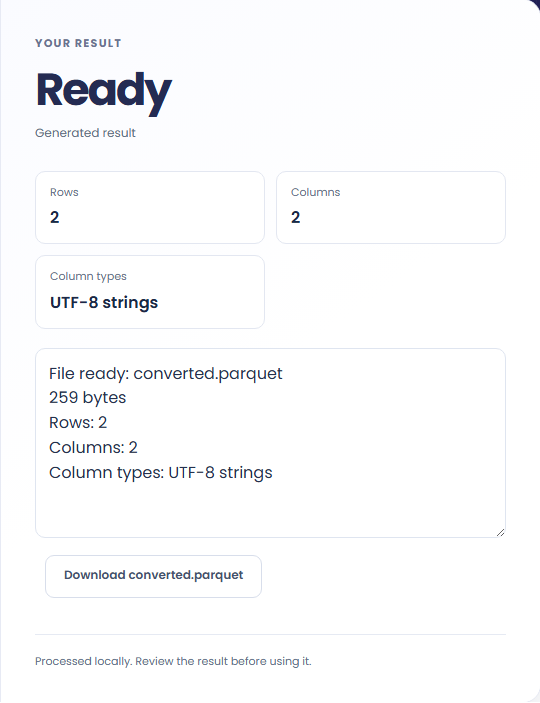
Review a valid uncompressed Parquet file. Download the generated file and check it in the application where you plan to use it.
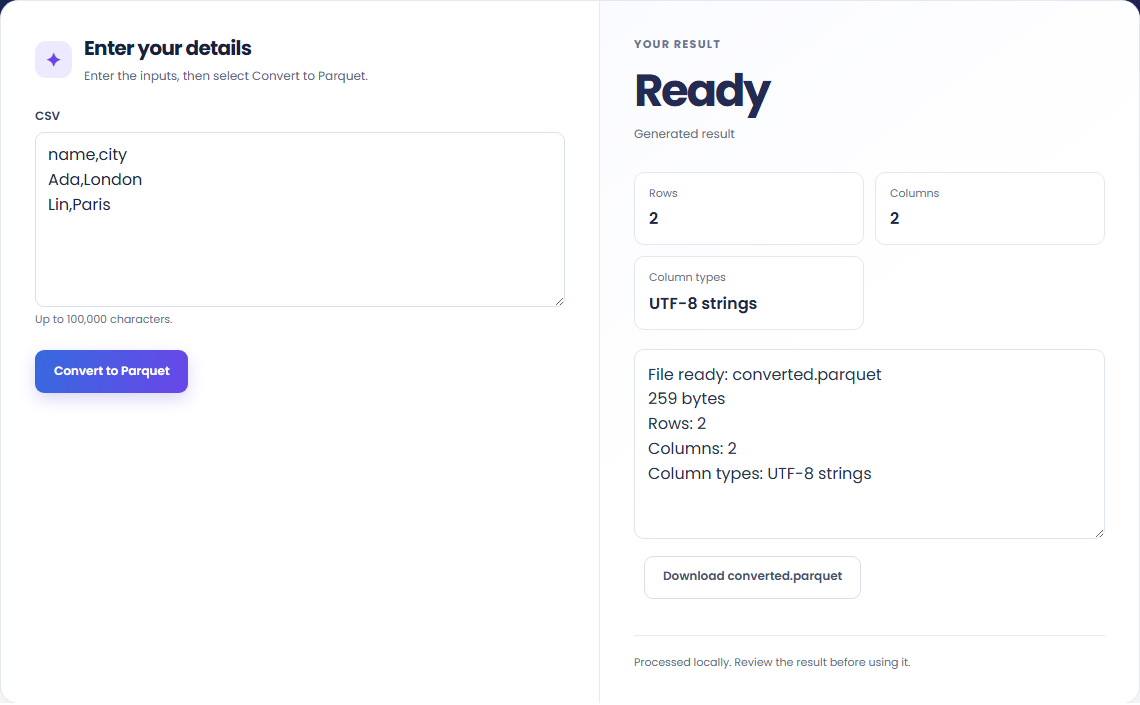
These workflows use the formats and behavior supported by this implementation.
Create a standards-based Parquet file when the next workflow expects columns instead of delimited text.

An identifier such as 001 remains a string instead of becoming the number 1. Dates and numbers also remain UTF-8 strings.

Assign types later in your data system when you know the intended schema. This converter does not guess column types from cell values.

Keep the output format and conversion policy in view.
A valid uncompressed Parquet file. Parse CSV headers and store every cell as a UTF-8 string in Parquet columns.
Compare the result with the original before replacing a source file. Conversion limits are listed below.

Check these conditions before relying on the result.
All columns are strings, including numbers and dates, so identifiers retain leading zeros. Unique nonempty headers required. Up to 5,000 rows and 100 columns; no type inference.
Input and results are not stored after leaving or reloading. Keep the original and download any output you need.

Convert comma-separated records to tab-separated text. Quoted commas, tabs and line breaks remain inside their cells; download the TSV for your next import.
Open tool
Turn a repeated XML element into CSV rows. Choose the record tag, then review flattened nested fields and attribute columns before saving the file.
Open tool
Create a real Excel workbook from repeated XML records. Nested fields and attributes become text columns; choose a record tag and review the worksheet before saving.
Open toolChoose another tool for your next calculation, conversion, or text task.
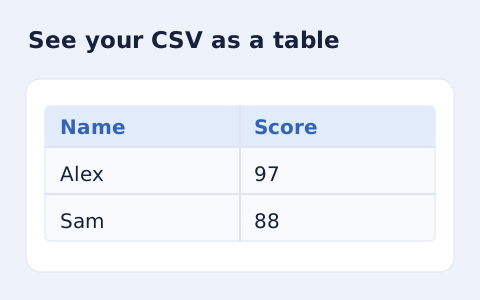
Inspect quoted CSV cells in a readable table without uploading your data.
Open tool
Check CSV quoting and consistent column counts, then review the record count and selected delimiter.
Open tool
Compare two JSON values by structure. See changed paths without treating object key order as a difference.
Open tool
Validate JSON against a draft-07 or 2020-12 schema. Review error paths without sending the documents to a server.
Open toolGenerate the supported output, review it, and save a copy for your next step.
Answers about using CSV to Parquet Converter and understanding its results.
It produces a valid uncompressed Parquet file. All columns are strings, including numbers and dates, so identifiers retain leading zeros. Unique nonempty headers required. Up to 5,000 rows and 100 columns; no type inference.
Processing runs in this browser with local bundled libraries. No input is sent to a conversion server. Download your result before leaving the page.