

JSON Formatter
Parse strict JSON and serialize it with the chosen indentation.
Open toolMistral Large 4 (widely known by its community nickname 'Le Chonk' and released on Hugging Face as mistralai/Mistral-Large-4-1T-A52B) is Mistral AI's flagship ~1-trillion-parameter sparse Mixture-of-Experts (MoE) multimodal model with ~49-52B active parameters, a 1M-token context window, and open weights under the Mistral Ecosystem Open-Weight License.
Mistral Large 4 (Mistral-Large-4-1T-A52B) is a ~1-trillion-parameter sparse MoE model and does not execute inference in your browser. Use this planner to compare approximate memory footprints by quantization tier (cited from Hugging Face & Unsloth docs) and verify license eligibility.
Result will appear here
When Mistral AI previewed and subsequently released the open weights for Mistral Large 4 in late October 2026 (officially announced around October 29, 2026), developers and researchers across Hugging Face and Hacker News dubbed the checkpoint 'Le Chonk'. The nickname nods both to Mistral's French roots and to the sheer physical size of the mistralai/Mistral-Large-4-1T-A52B checkpoint: roughly 1 trillion total parameters stored on disk, paired with 49 to 52 billion active parameters per token. Note: this page is an independent model guide and approximate memory planner; it does not run live model inference in your browser.
ApproxTotalMemory_GB = BaseWeights_GB(QuantTier) + (TargetContext_K * ConcurrentSessions * ApproxKVCachePerK_GB); ActiveParamsPerToken = 49B to 52B (~1,000B Total Sparse MoE).
For official architecture details and release notes, read the Mistral Large 4 open-weight release announcement and inspect mistralai/Mistral-Large-4-1T-A52B on Hugging Face. When building structured tool-calling prompts for the model, you can format and inspect payloads locally with our JSON Formatter.
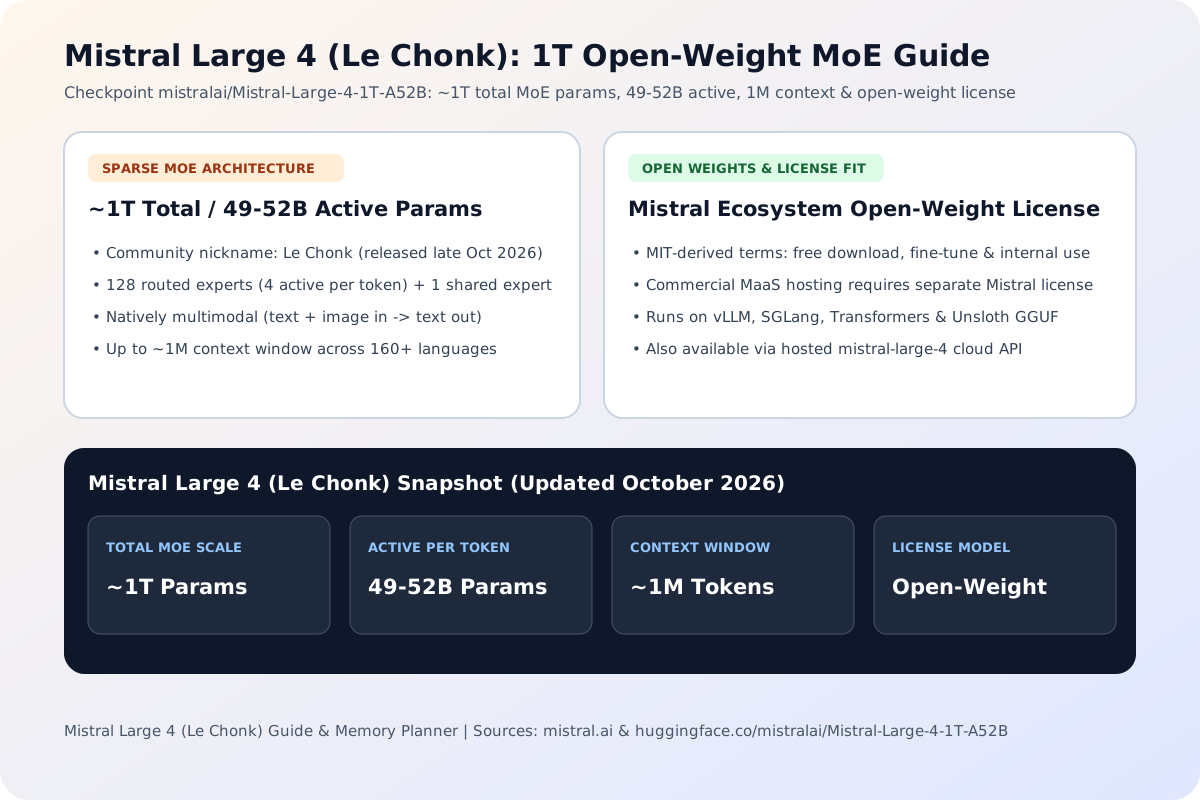
Public specifications and approximate memory planning tiers compiled from Mistral AI, Hugging Face, and Unsloth documentation (updated October 2026). Hardware figures are approximate estimates, not exact fitness guarantees.
| Specification / Tier | Mistral Large 4 (Le Chonk) | Technical Details & Deployment Notes |
|---|---|---|
| Official Name & Nickname | Mistral Large 4 ('Le Chonk') | Checkpoint ID: mistralai/Mistral-Large-4-1T-A52B; open-weight release announced October 29, 2026 following earlier October preview |
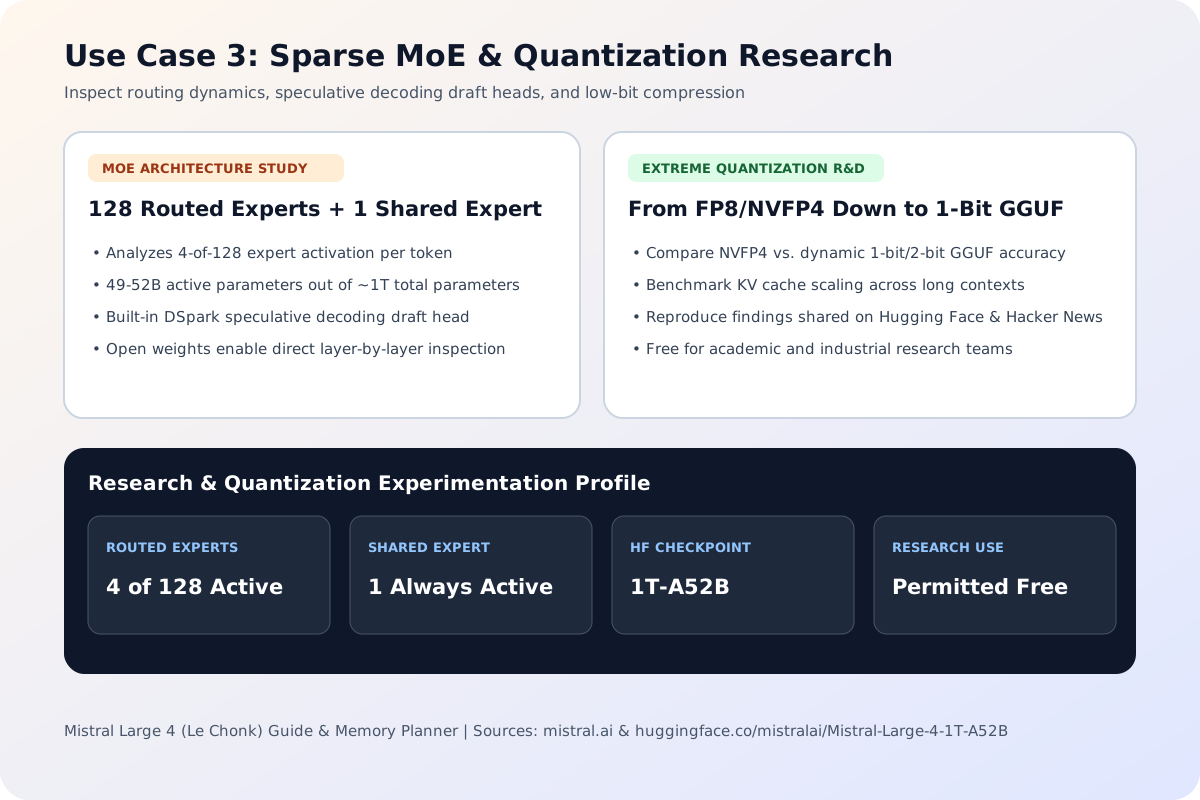
| MoE Scale & Active Params | ~1T Total / ~49-52B Active | Sparse Mixture-of-Experts (128 routed experts, 4 active per token + 1 shared expert); active compute matches a ~50B model while holding 1T capacity |
| Modalities & Context Window | Text + Image In -> Text Out (~1M Context) | Natively multimodal with visual grounding, configurable reasoning effort (low, medium, high), and support for 160+ languages |
| License & MaaS Restriction | Mistral Ecosystem Open-Weight License | MIT-derived open-weight terms: free to download, modify, and fine-tune, but commercial Model-as-a-Service (MaaS) hosting requires a separate Mistral license (not OSI open source) |
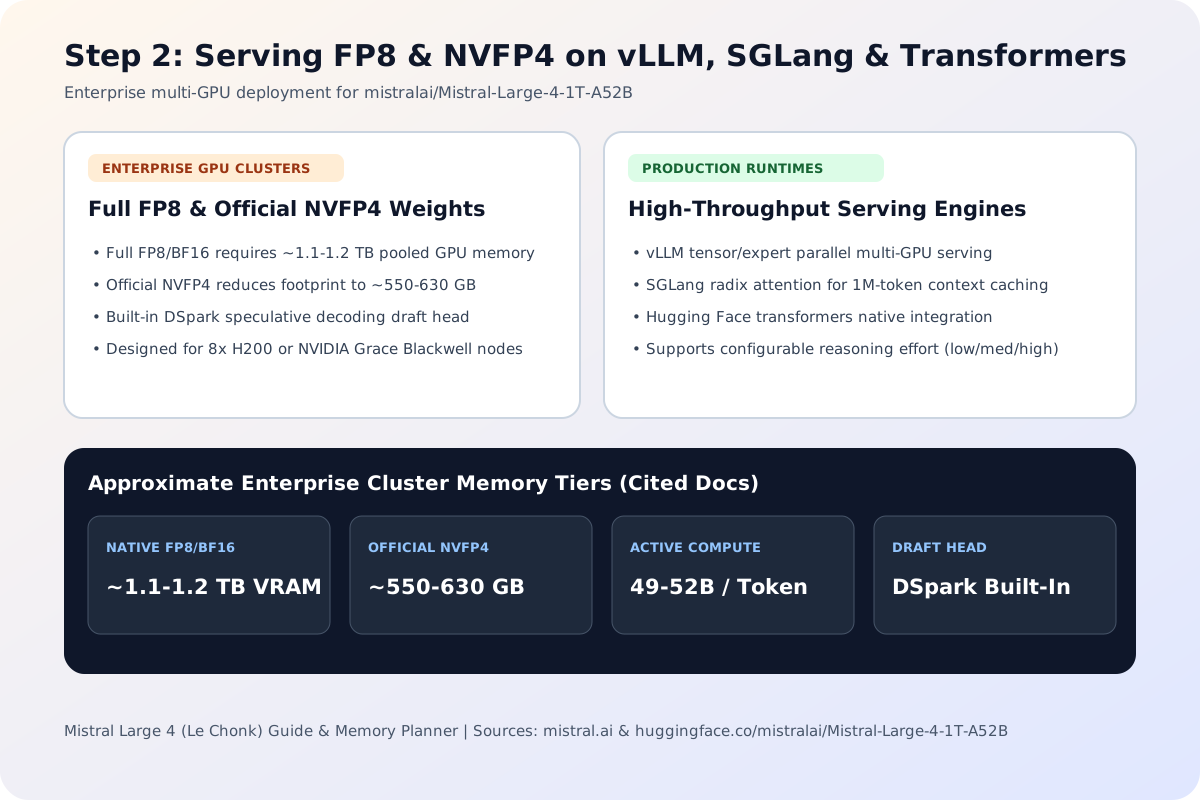
| Full FP8 / BF16 Footprint (Approx.) | ~1.1 TB - 1.2 TB Pooled VRAM | Targeted at multi-GPU enterprise nodes (such as 8x H200 or NVIDIA Grace Blackwell setups) running vLLM or SGLang |
| NVFP4 & 3-Bit/4-Bit Quants (Approx.) | ~435 GB - 630 GB Memory | Official NVFP4 weights (with built-in DSpark speculative decoding draft head) and 3-bit/4-bit community quantizations |
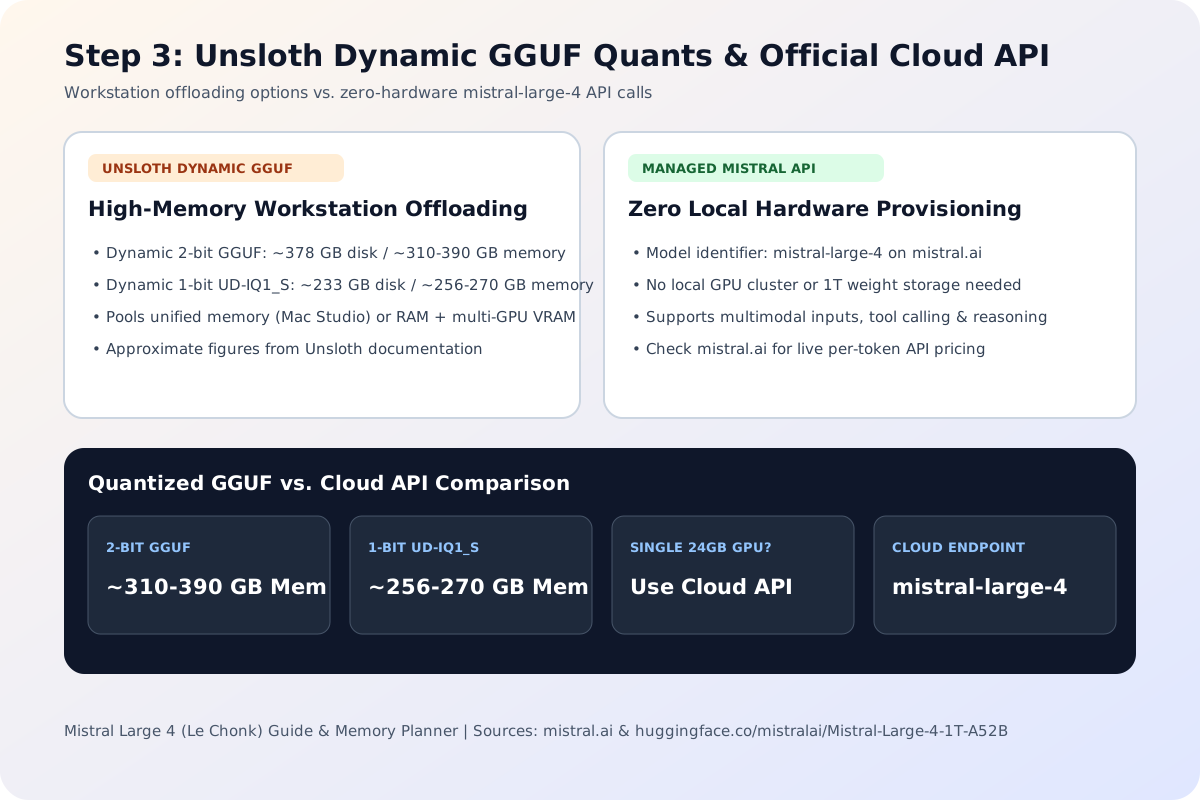
| Unsloth Dynamic GGUF Quants (Approx.) | 1-Bit: ~256-270 GB | 2-Bit: ~310-390 GB | Unsloth UD-IQ1_S (~233 GB disk) and Dynamic 2-bit (~378 GB disk) for high-memory workstations or multi-node llama.cpp offloading |
| Managed Cloud API | mistral-large-4 on mistral.ai | Zero local GPU hardware required; check official mistral.ai pricing pages for live per-token input and output rates |
Review the difference between open-weight self-hosting and commercial MaaS restrictions before choosing your inference stack.
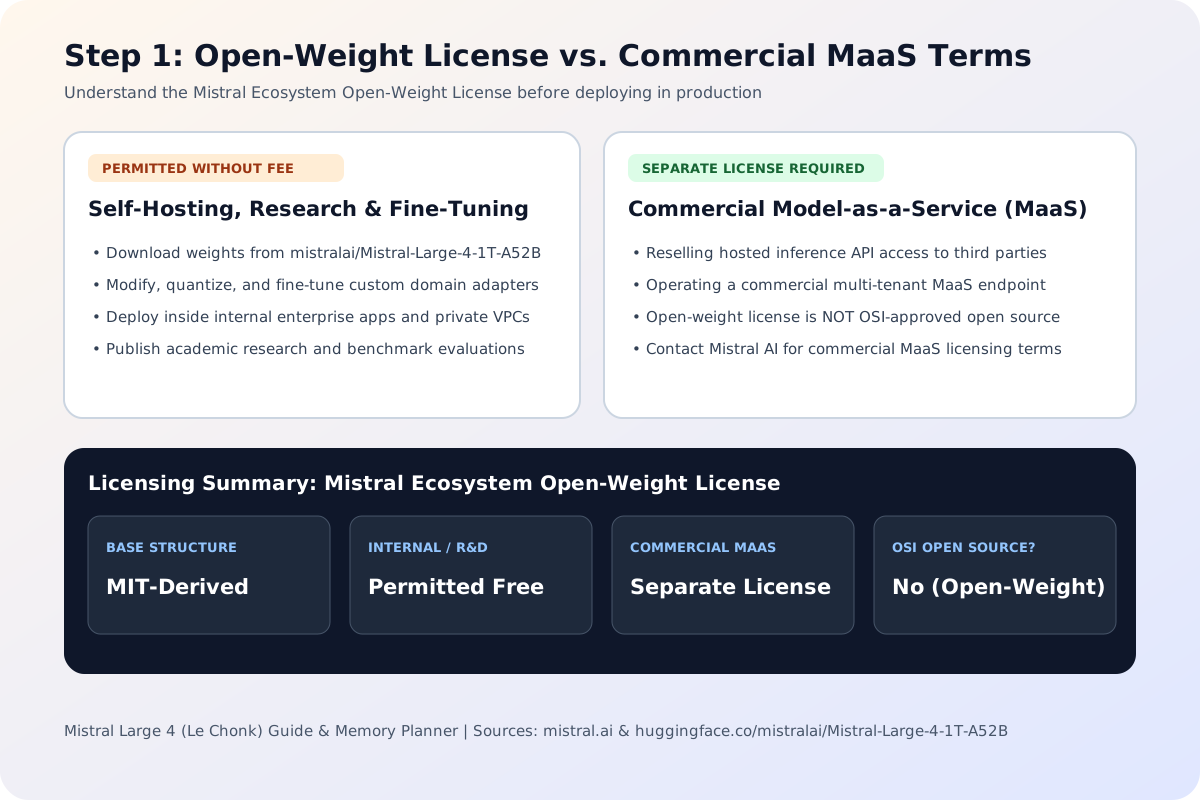
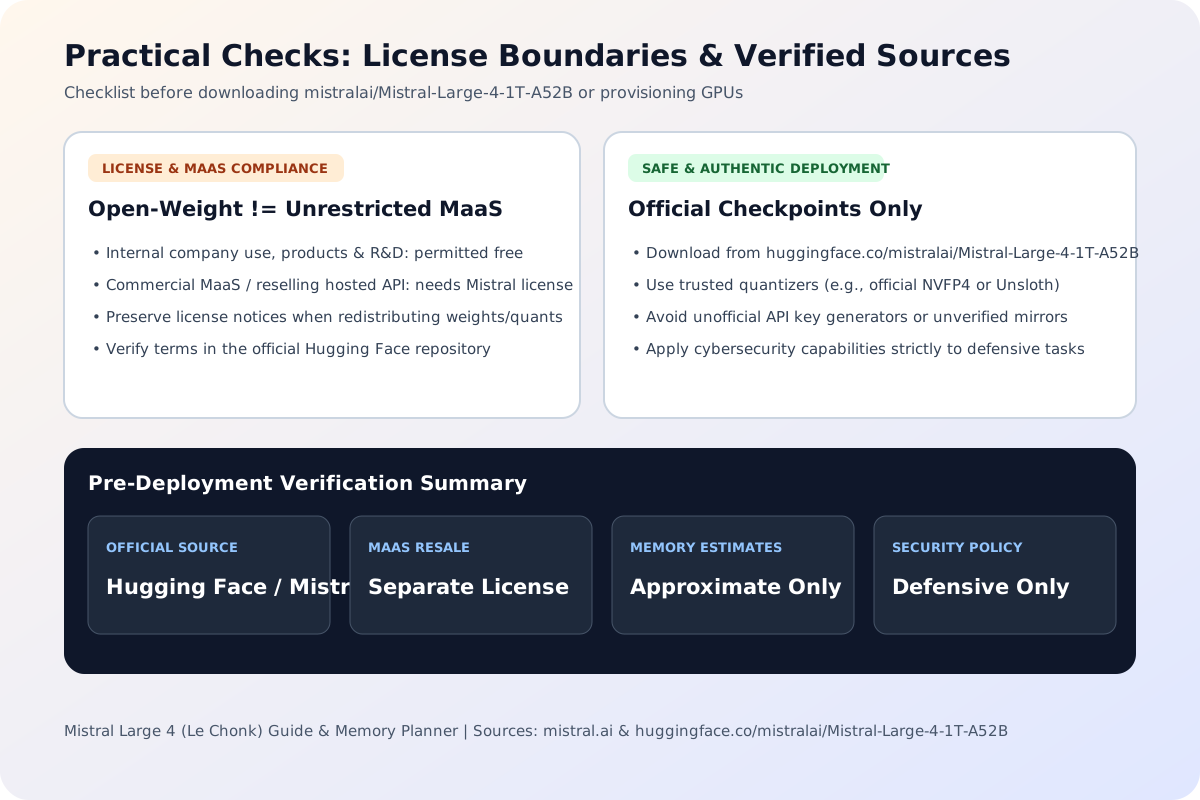
Mistral Large 4 is distributed under the Mistral Ecosystem Open-Weight License, an MIT-derived agreement that permits downloading, modifying, fine-tuning, and deploying the weights inside your own products, internal workflows, and academic research. However, it is an open-weight license rather than an OSI-approved open-source license: offering the model commercially as a hosted Model-as-a-Service (MaaS) or reselling third-party inference API access requires a separate commercial license from Mistral AI.
As documented in the Hugging Face Mistral Large 4 blog post, enterprise teams can serve the full FP8 checkpoint or official NVFP4 quantized weights using vLLM, SGLang, or Hugging Face transformers. Because all ~1 trillion MoE parameters must reside in memory even though only ~49-52B activate per token, production clusters typically use 8x H200 or NVIDIA Blackwell nodes and leverage the built-in DSpark speculative decoding draft head. You can verify structured output contracts for your vLLM endpoints with our JSON Schema Validator.
For researchers using high-RAM workstations, dual-node setups, or unified-memory systems, community quantizations such as Unsloth Dynamic GGUFs reduce disk footprint to roughly 378 GB (2-bit, ~310-390 GB total memory) or 233 GB (1-bit UD-IQ1_S, ~256-270 GB total memory). If you do not want to manage multi-hundred-gigabyte hardware, call the mistral-large-4 model ID directly via Mistral's hosted platform (check mistral.ai for current token pricing) and model your infrastructure vs. API payback in our AI ROI Calculator.
Practical engineering and research scenarios suited to a 1T open-weight Mixture-of-Experts model.
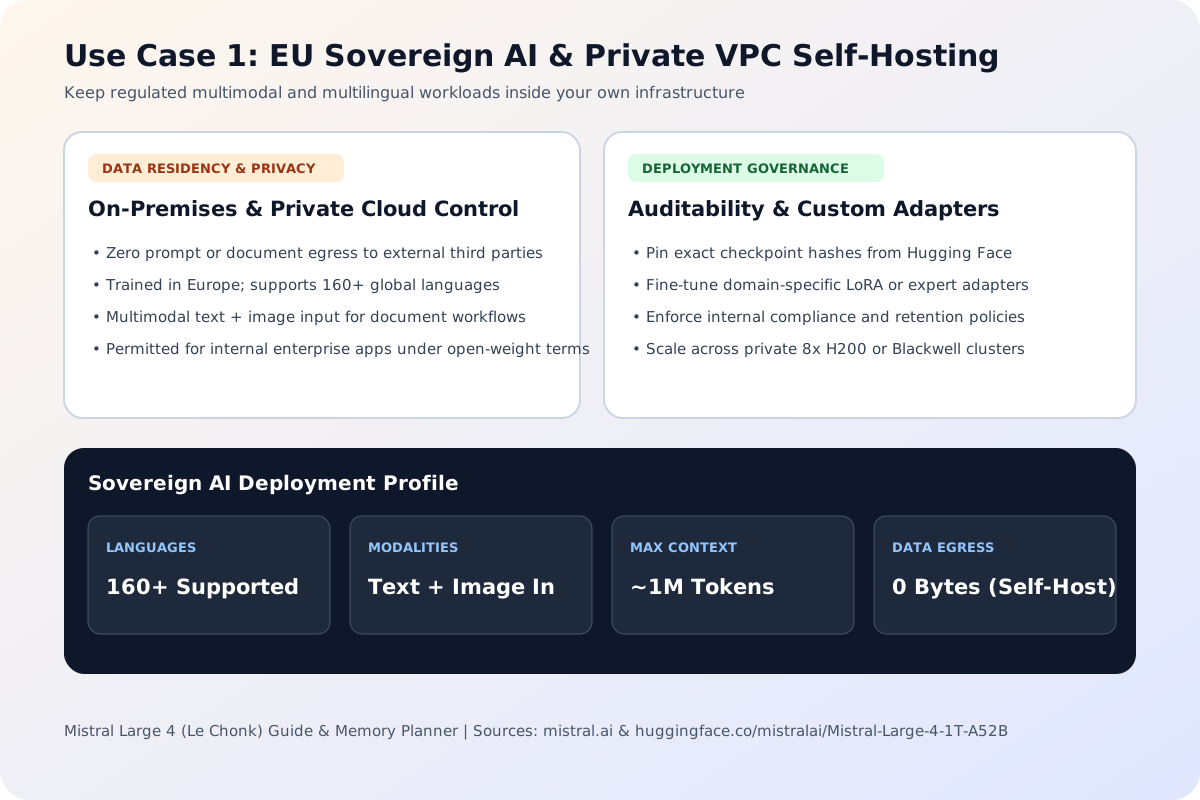
Organizations in regulated European and global industries that require strict data residency can self-host Mistral Large 4 inside private cloud clusters or air-gapped data centers. With native support for 160+ languages and multimodal text-plus-image inputs, teams retain full control over prompt logs and fine-tuned adapters.
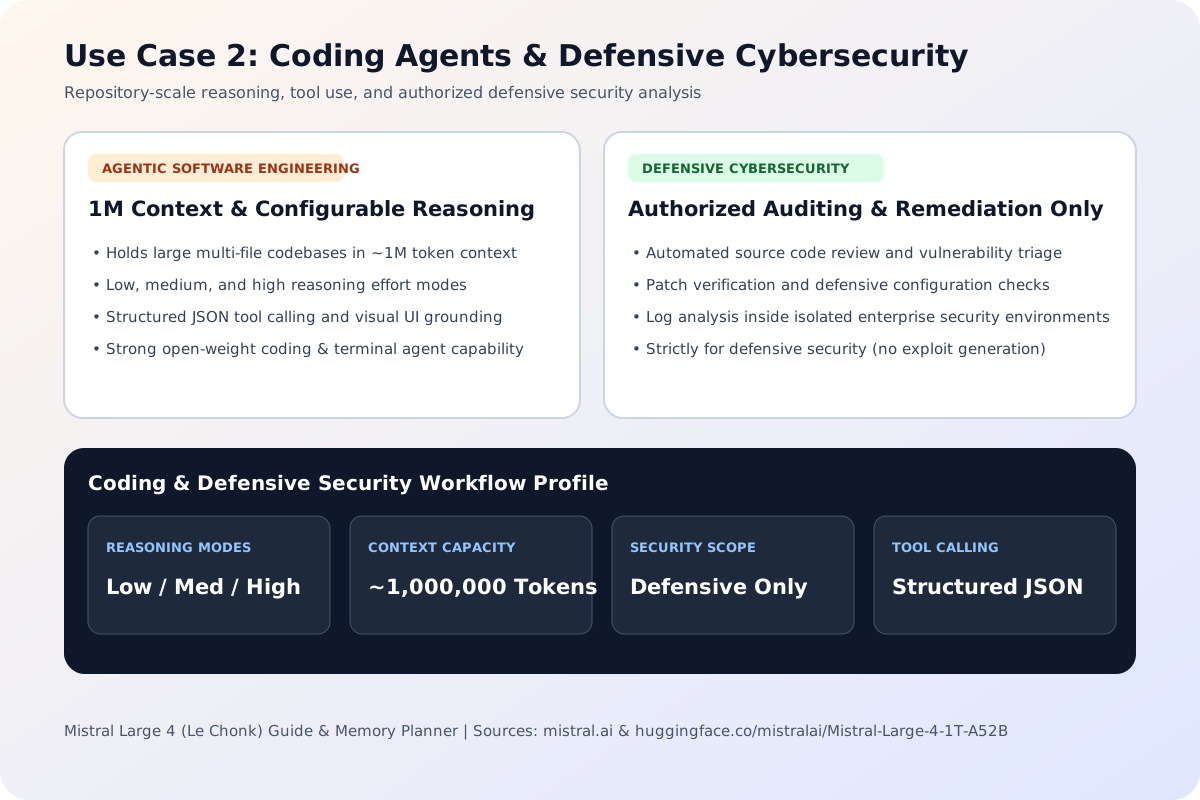
Mistral AI highlights coding, complex agentic workflows, visual grounding, and defensive cybersecurity (such as automated source code auditing, vulnerability triage, and patch verification) as core strengths among open-weight models across its 1M-token context window. If you are wiring agent outputs into external SaaS webhooks or planning unit economics, compare orchestration options in our IFTTT.ai vs. Zapier automation guide and our AI App Playbook.
ML researchers and systems engineers exploring sparse MoE routing (49-52B active parameters out of ~1T total), speculative decoding draft heads, or 1-bit to 4-bit quantization trade-offs can inspect the weights directly, a topic widely analyzed in the Hacker News release discussion.
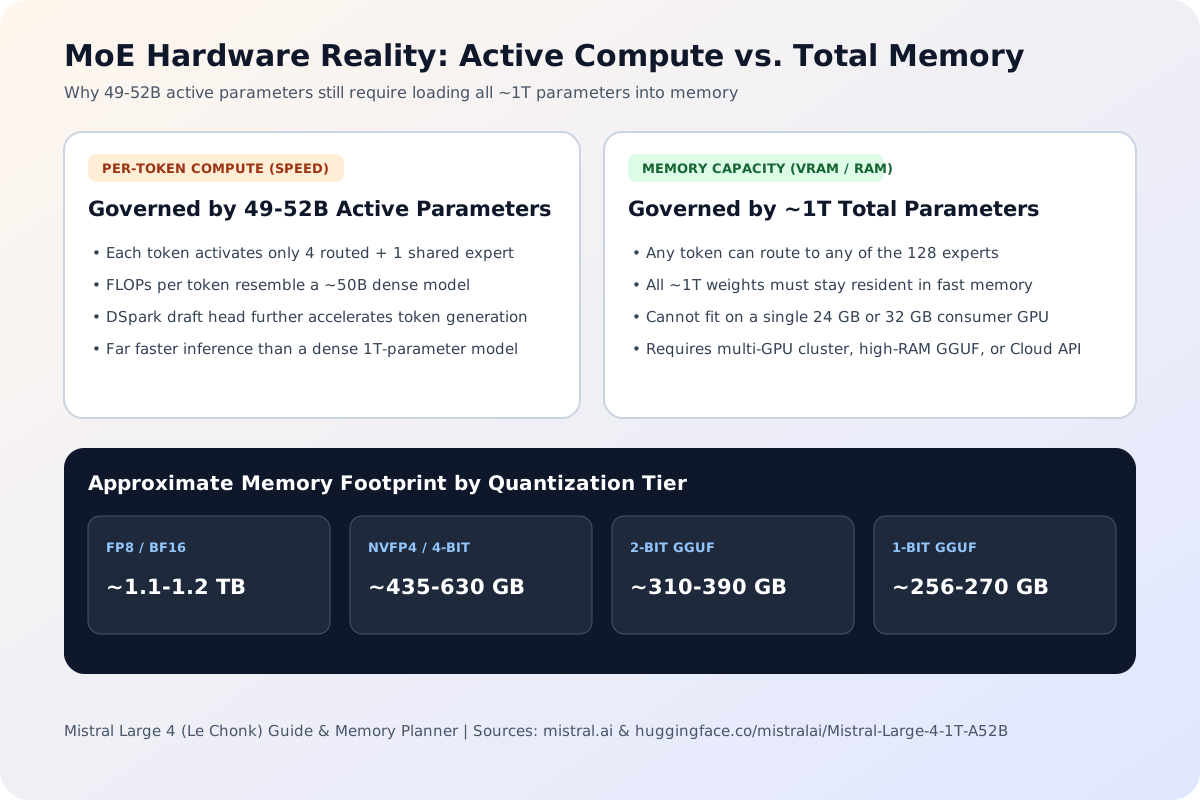
Why active parameter count governs token speed while total parameter count governs VRAM capacity.
Why 49-52B Active Parameters Still Need 1T Weight Memory: A frequent point of confusion around 'Le Chonk' is how a model with ~49-52B active parameters behaves on hardware. During generation, each token routes through only a small subset of experts (4 out of 128 routed experts plus 1 shared expert), which keeps per-token compute FLOPs much closer to a 50B model than a dense 1T model. However, because consecutive tokens can activate any expert across the network, the entire ~1T parameter table must stay loaded in VRAM or unified memory. That is why full FP8 weights require roughly 1.1-1.2 TB of memory, 3-bit to 4-bit quantizations require roughly 435-630 GB, and even 1-bit Unsloth dynamic GGUFs require roughly 256-270 GB.
Mistral Large 4 Open Weights vs. Closed Frontier APIs: Closed proprietary models require no local GPU provisioning and charge per token over a vendor API, but they do not allow weight inspection, on-premises air-gapped hosting, or custom weight-level fine-tuning. Mistral Large 4 bridges both worlds: teams can start immediately on the hosted mistral-large-4 API at mistral.ai, and organizations with sufficient GPU cluster capacity can transition to self-hosted open weights under the Mistral Ecosystem Open-Weight License.
Confirm these licensing, hardware, and security boundaries before deploying Mistral Large 4.
1. Verify MaaS Commercial Licensing Rules: Do not confuse the Mistral Ecosystem Open-Weight License with unrestricted OSI open source. While internal company use, product integration, research, and fine-tuning are free under the MIT-derived open-weight terms, operating a commercial Model-as-a-Service (MaaS) platform that resells hosted Mistral Large 4 inference to third parties requires a separate commercial agreement from Mistral AI.
2. Download Only from Verified Sources & Keep Security Defensive: Always pull checkpoints directly from mistralai/Mistral-Large-4-1T-A52B on Hugging Face or verified quantization maintainers such as Unsloth, and authenticate API requests exclusively through official mistral.ai endpoints. Avoid unofficial 'unlimited API' proxies, pirated mirror archives, or jailbreak scripts; any cybersecurity use should remain strictly focused on authorized defensive analysis, code hardening, and remediation.
Parse strict JSON and serialize it with the chosen indentation.
Open tool
Validate JSON against a draft-07 or 2020-12 schema. Review error paths without sending the documents to a server.
Open tool
Estimate AI tool subscription and API token costs against hours saved, hourly labor value, and setup payback months. Free browser-based calculator, no sign-up.
Open toolChoose another tool for your next calculation, conversion, or text task.

Free interactive AI App Playbook calculator and checklist. Score your app niche (25/35 gate), model $2.70/download funnel unit economics, compare Lean vs. Popular stack costs, and export an AGENTS.app.md brief.
Open tool
Check a local Swagger 2.0, OpenAPI 3.0 or OpenAPI 3.1 document for schema errors and broken internal references. Read the reported paths without querying your API.
Open tool
Inspect the header and payload of a compact JWT without verifying its signature.
Open tool
Validate CNCF CloudEvents v1.0 and v0.3 structured JSON payloads or HTTP binary headers (ce-*). Check required attributes, RFC 3339 timestamps, URI-references, and extension naming.
Open toolAnswers about using Mistral Large 4 (Le Chonk): 1T Open-Weight MoE Specs, VRAM & License Guide and understanding its results.
Le Chonk is the affectionate community nickname used by developers and researchers for Mistral Large 4 (checkpoint mistralai/Mistral-Large-4-1T-A52B). It refers to the model's massive ~1-trillion-parameter total Mixture-of-Experts weight footprint combined with Mistral AI's French heritage.
Mistral Large 4 is an open-weight model released under the Mistral Ecosystem Open-Weight License (an MIT-derived license), not an OSI-approved open-source license. You can freely download, modify, fine-tune, and use the model internally or in applications, but offering it commercially as a hosted Model-as-a-Service (MaaS) requires a separate commercial license from Mistral AI.
Mistral Large 4 is a natively multimodal (text and image input to text output) sparse Mixture-of-Experts model with roughly 1 trillion total parameters, 49 to 52 billion active parameters per token, a 1-million-token context window, configurable reasoning effort levels (low, medium, high), and support for 160+ languages.
No. Even though only 49-52B parameters are active per token, all ~1T parameters must fit in memory. Full FP8 weights need ~1.1-1.2 TB of VRAM, 4-bit quants need ~435-630 GB, and even extreme 1-bit Unsloth GGUF quants (UD-IQ1_S, ~233 GB on disk) require roughly 256-270 GB of combined RAM and VRAM. On a single consumer GPU, use the hosted mistral-large-4 API on mistral.ai instead.
For multi-GPU servers (such as 8x H200 or NVIDIA Blackwell nodes), vLLM, SGLang, and Hugging Face transformers support the official FP8 and NVFP4 checkpoints (including the DSpark speculative decoding draft head). For quantized GGUF execution across high-memory workstations, llama.cpp and Unsloth Dynamic GGUF builds are supported.
Because cloud token pricing and batch discounts can change over time, check the official pricing page on https://mistral.ai/ for current input, output, and cached token rates for the mistral-large-4 API endpoint.
No. This page is an independent technical reference, license summary, and approximate VRAM/RAM capacity planner. To download the weights or run cloud inference, visit https://huggingface.co/mistralai/Mistral-Large-4-1T-A52B or https://mistral.ai/news/mistral-large-4-oss/.
Choose another tool for your next calculation, conversion, or text task.