
URL Parser
Parse an absolute HTTP or HTTPS URL with the browser URL API and list its components and query entries.
Open toolApply an explicit small set of browser and OS token rules to the supplied User-Agent string. Heuristic parsing, not proof of a device identity.
Enter the inputs, then select Parse user agent.
Result will appear here
Apply an explicit small set of browser and OS token rules to the supplied User-Agent string.
Heuristic parsing, not proof of a device identity. Spoofed and reduced strings may be ambiguous; unsupported tokens are labelled Unknown.
Start with your own input.
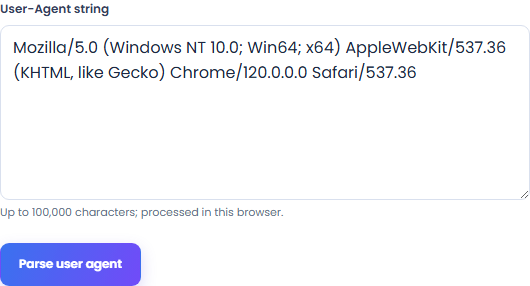
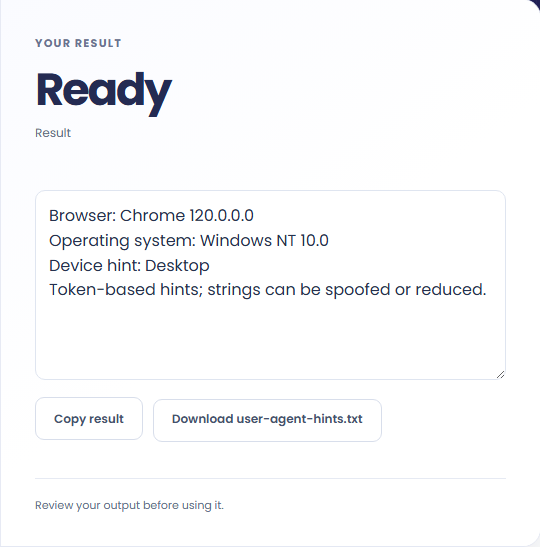
Select Parse user agent. Review recognized browser, operating system and device hints, then use Copy result or download the result file.
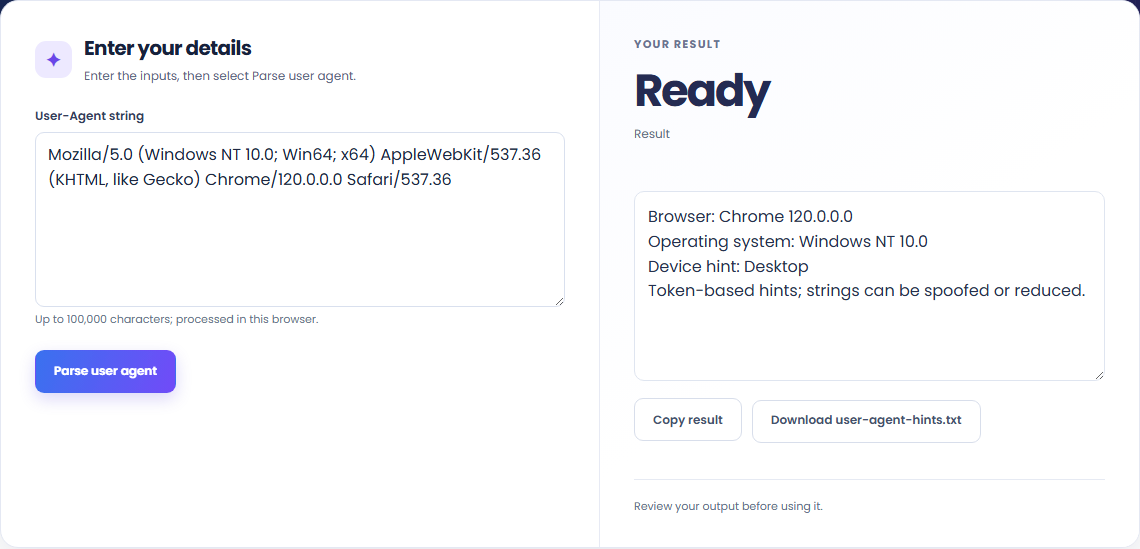
To inspect a copied header, start with user-agent string. Apply an explicit small set of browser and OS token rules to the supplied User-Agent string.

To read familiar browser tokens, start with user-agent string. Heuristic parsing, not proof of a device identity.

To compare desktop and mobile examples, start with user-agent string. Review recognized browser, operating system and device hints, then use Copy result or download the result file.

Check what the output means.
Recognized browser, operating system and device hints. Apply an explicit small set of browser and OS token rules to the supplied User-Agent string.
Heuristic parsing, not proof of a device identity. Spoofed and reduced strings may be ambiguous; unsupported tokens are labelled Unknown.

Check the format before processing.
Heuristic parsing, not proof of a device identity. Spoofed and reduced strings may be ambiguous; unsupported tokens are labelled Unknown.
Inputs and results are handled in this browser.

Parse an absolute HTTP or HTTPS URL with the browser URL API and list its components and query entries.
Open tool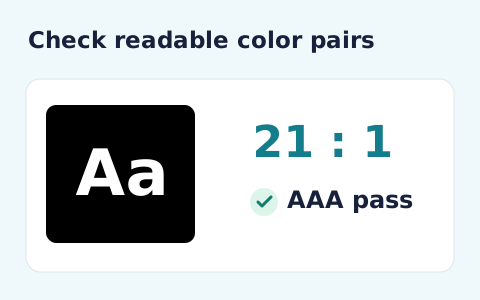
Calculate the WCAG 2 contrast ratio and AA/AAA results for normal and large text.
Open tool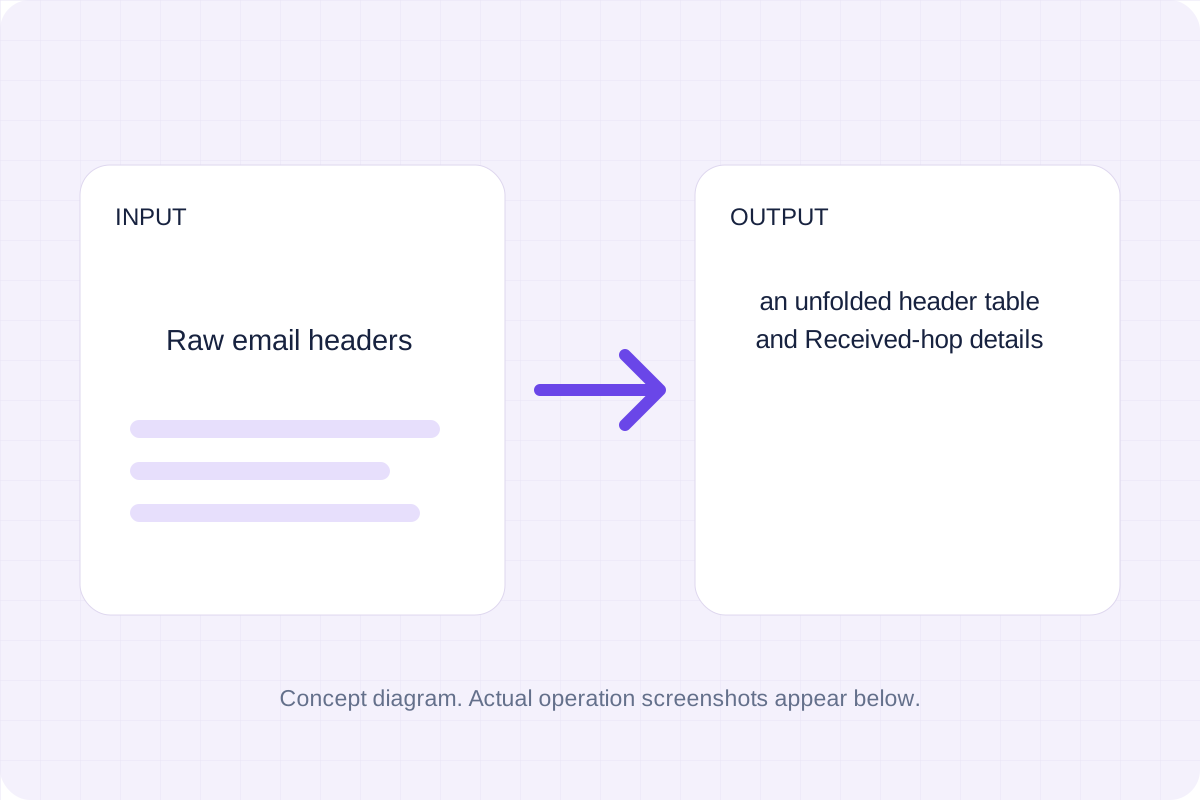
Read unfolded email headers and recorded delivery hops. Inspect authentication claims as pasted text; this page does not independently verify SPF, DKIM or DMARC.
Open toolChoose another tool for your next calculation, conversion, or text task.
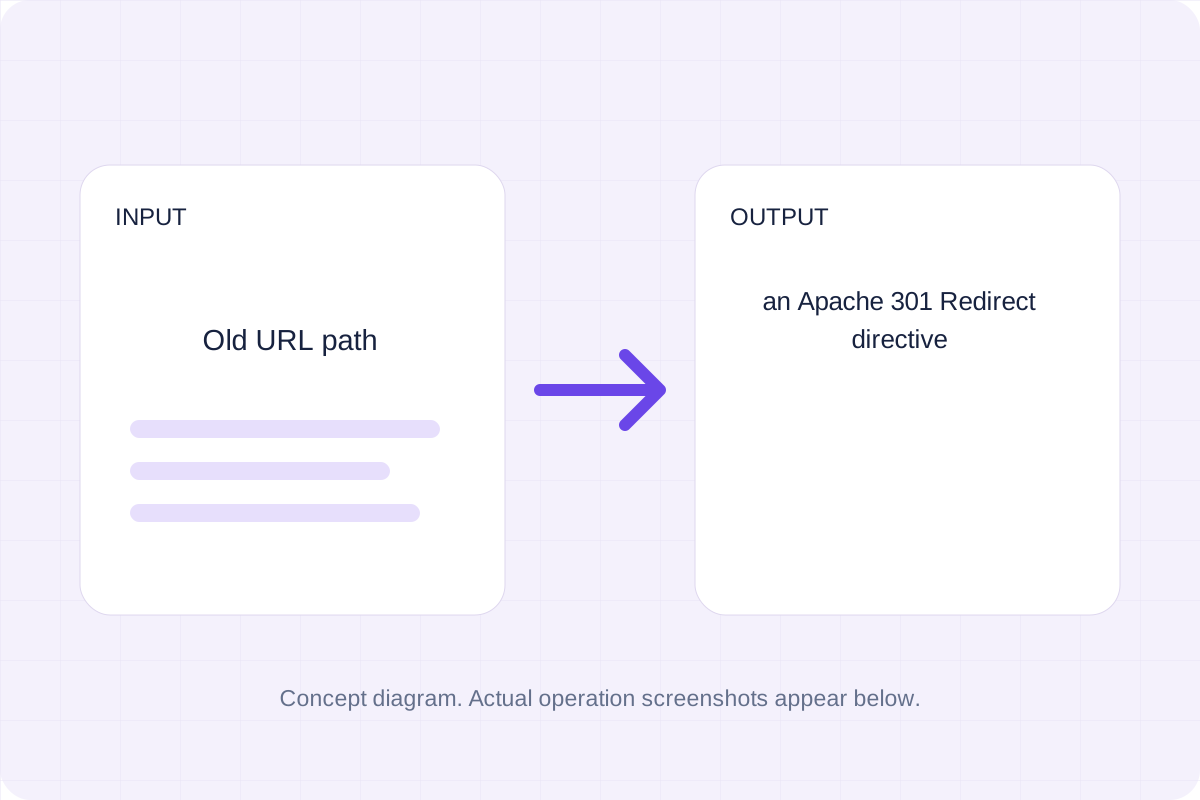
Validate a simple source path and destination, then generate a mod_alias Redirect directive.
Open tool
Match the requested Unicode word sequence case-insensitively and divide occurrences by the number of possible token windows.
Open tool
Draft three meta descriptions from your own page facts. Local text rules combine the supplied name, phrase and description within a chosen character limit.
Open tool
Escape supplied text and write title, description and canonical HTML elements.
Open toolReview recognized browser, operating system and device hints, then use Copy result or download the result file.
Answers about using User Agent Parser and understanding its results.
Heuristic parsing, not proof of a device identity. Spoofed and reduced strings may be ambiguous; unsupported tokens are labelled Unknown.
Yes. Download the result file after processing. Text results also have Copy result. Processing uses local browser code; no account is required.