

CloudEvents v1.0 Validator & Binary Header Converter
Validate CNCF CloudEvents v1.0 and v0.3 structured JSON payloads or HTTP binary headers (ce-*). Check required attributes, RFC 3339 timestamps, URI-references, and extension naming.
Open toolCompute exact UART / USART baud rate divisors, register values (`UBRR = N - 1`, `16550 DLL/DLM`, and `STM32 USART_BRR` hex), actual achieved baud rate, bit-timing error percentage, and 10-bit frame sampling drift for any microcontroller clock.
Enter the inputs, then select Calculate UART Divisor & Error.
Result will appear here
A UART receiver oversamples the incoming RX line at `OSR` ticks per bit (typically 16x or 8x) to detect the falling start-bit edge and take a majority vote at the middle of each data bit.
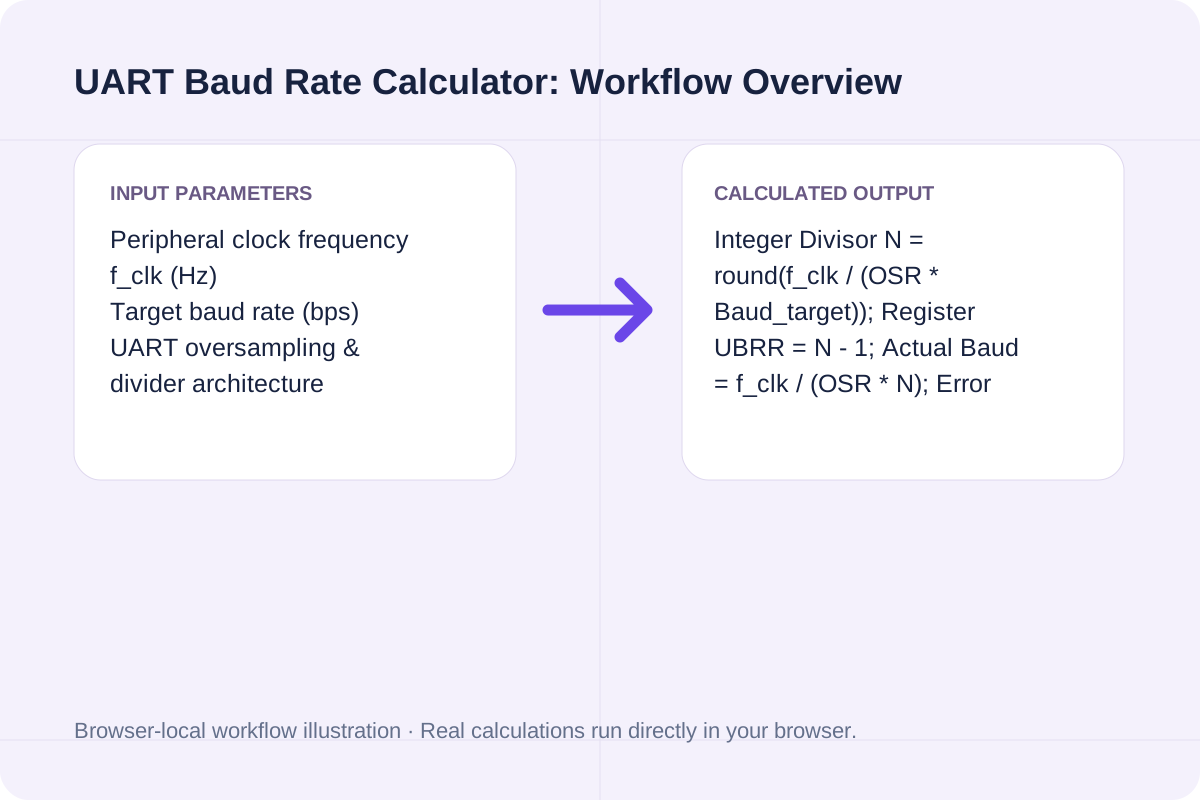
Integer Divisor N = round(f_clk / (OSR * Baud_target)); Register UBRR = N - 1; Actual Baud = f_clk / (OSR * N); Error % = ((Baud_actual - Baud_target) / Baud_target) * 100.
Computes nearest integer divisor N, zero-based register value (N - 1 for AVR UBRR / PIC SPBRG), STM32 USART_BRR hex value, bit period in microseconds, and cumulative sample-point shift across a 10-bit 8N1 frame.
Compare integer 16x, integer 8x (`U2X=1`), and STM32 fractional dividers at `115,200 bps` across standard MCU oscillators.
| Clock Frequency (f_clk) | Oversampling Mode | Divisor N (UBRR = N-1) | Actual Baud Rate | Error % | 8N1 Reliability |
|---|---|---|---|---|---|
| `11.0592 MHz` (UART Crystal) | 16x Integer | `N = 6` (`UBRR = 5`) | `115,200 bps` | `0.00%` | Exact zero-drift match |
| `16.0000 MHz` (AVR / HSI) | 16x Integer | `N = 9` (`UBRR = 8`) | `111,111 bps` | `-3.55%` | Marginal / framing errors likely |
| `16.0000 MHz` (AVR `U2X=1`) | 8x Integer | `N = 17` (`UBRR = 16`) | `117,647 bps` | `+2.12%` | Borderline acceptable (RC osc risky) |
| `16.0000 MHz` (STM32 `BRR`) | 16x Fractional | `8.6875` (`0x008B`) | `115,108 bps` | `-0.08%` | Excellent (< 0.1% error) |
| `72.0000 MHz` (STM32 APB2) | 16x Fractional | `39.0625` (`0x0271`) | `115,200 bps` | `0.00%` | Exact zero-drift match |
Enter the values for your scenario, verify the units, and run the calculation.
Start by entering the required fields in the UART Baud Rate Calculator form above.
Match each value to the unit or format shown next to the input box before running the calculation.
Select Calculate UART Divisor & Error, inspect the primary metric and breakdown cards, then use Copy result or Download result.txt.
Compare baseline and alternative runs for UART Baud Rate Calculator before exporting the result.
Calculate UART / USART baud rate register divisors, fractional BRR hex values, actual baud rate, percentage clock error, and maximum error tolerance for STM32, AVR, PIC, and 16550 UARTs.
Integer Divisor N = round(f_clk / (OSR * Baud_target)); Register UBRR = N - 1; Actual Baud = f_clk / (OSR * N); Error % = ((Baud_actual - Baud_target) / Baud_target) * 100.
Computes nearest integer divisor N, zero-based register value (N - 1 for AVR UBRR / PIC SPBRG), STM32 USART_BRR hex value, bit period in microseconds, and cumulative sample-point shift across a 10-bit 8N1 frame.
Review the calculated output alongside your entered parameters and unit conventions.
Computes nearest integer divisor N, zero-based register value (N - 1 for AVR UBRR / PIC SPBRG), STM32 USART_BRR hex value, bit period in microseconds, and cumulative sample-point shift across a 10-bit 8N1 frame.
Confirm these three details in your MCU reference manual before writing the baud register.
Integer Divisor N = round(f_clk / (OSR * Baud_target)); Register UBRR = N - 1; Actual Baud = f_clk / (OSR * N); Error % = ((Baud_actual - Baud_target) / Baud_target) * 100. Computes nearest integer divisor N, zero-based register value (N - 1 for AVR UBRR / PIC SPBRG), STM32 USART_BRR hex value, bit period in microseconds, and cumulative sample-point shift across a 10-bit 8N1 frame.
Validate CNCF CloudEvents v1.0 and v0.3 structured JSON payloads or HTTP binary headers (ce-*). Check required attributes, RFC 3339 timestamps, URI-references, and extension naming.
Open tool
Encode ASCII characters as space-separated decimal code values.
Open tool
Encode UTF-8 text or hex bytes as RFC 4648 Base32, or decode canonical Base32 into hex, text and a byte file.
Open toolChoose another tool for your next calculation, conversion, or text task.

Generate Linux and macOS find commands with -name/-iname globs, file type (-type f/d), size, modification time (-mtime), -maxdepth, and -exec actions.
Open tool
Convert Apple XML .plist (Property List) files to formatted or minified JSON online, mapping <dict>, <array>, <string>, <integer>, <real>, and <true/>/<false/>.
Open tool
Convert hex, decimal, or binary byte arrays to UTF-8 strings with strict validation, or encode text into hex, decimal, and JSON byte arrays.
Open tool
Calculate Docker image uncompressed size, gzip/zstd registry pull size, and shared base-layer disk savings across multiple containers on a host node.
Open toolAnswers about using UART Baud Rate Calculator and understanding its results.
In a 10-bit UART frame (1 start bit, 8 data bits, 1 stop bit) sampled at the midpoint of each bit (50% bit width), the receiver loses synchronization if cumulative drift exceeds ±50% of a bit period over 10 bits—about ±4.5% total combined error between transmitter and receiver, or roughly ±2.0% maximum error on each device.
At f_clk = 16,000,000 Hz and 16x oversampling, the ideal divisor is 16,000,000 / (16 * 115,200) = 8.6806. Rounding to the nearest integer N = 9 (UBRR = 8) produces an actual baud rate of 111,111 bps (-3.55% error). Enabling 8x double-speed mode (U2X0 = 1) changes the ideal divisor to 17.36 -> N = 17 (UBRR = 16), reducing error to +2.12% (117,647 bps).
11,059,200 Hz and 14,745,600 Hz are exact integer multiples of 16 × 115,200 (1,843,200 Hz). Dividing 11,059,200 Hz by (16 × 115,200) yields an exact integer divisor N = 6 (UBRR = 5) with 0.00% baud rate error across all standard baud rates (9600, 19200, 38400, 57600, 115200).
Instead of rounding the 16x divisor to a whole integer, STM32's USART_BRR register stores a 12-bit integer mantissa in bits [15:4] and a 4-bit fractional numerator (in sixteenths) in bits [3:0]. That effectively gives 1x clock resolution (N_ticks = round(f_clk / Baud_target)), keeping error below 0.36% even at 16 MHz / 115,200 bps.
Choose another tool for your next calculation, conversion, or text task.