
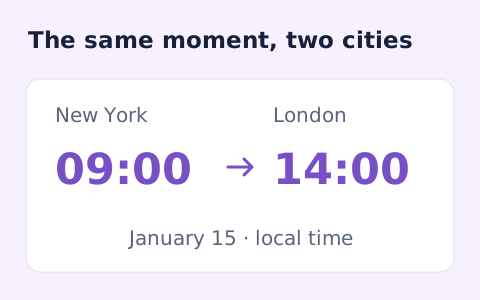
Timezone Converter
Convert a local date and time between IANA time zones.
Open toolCompute Greenwich Mean Sidereal Time (`GMST`), Local Sidereal Time (`LST`), Julian Date (`JD`), and equatorial mount Hour Angle (`HA = LST - RA`) using the IAU / Meeus J2000.0 astronomical formula.
Enter the inputs, then select Calculate Sidereal Time.
Result will appear here
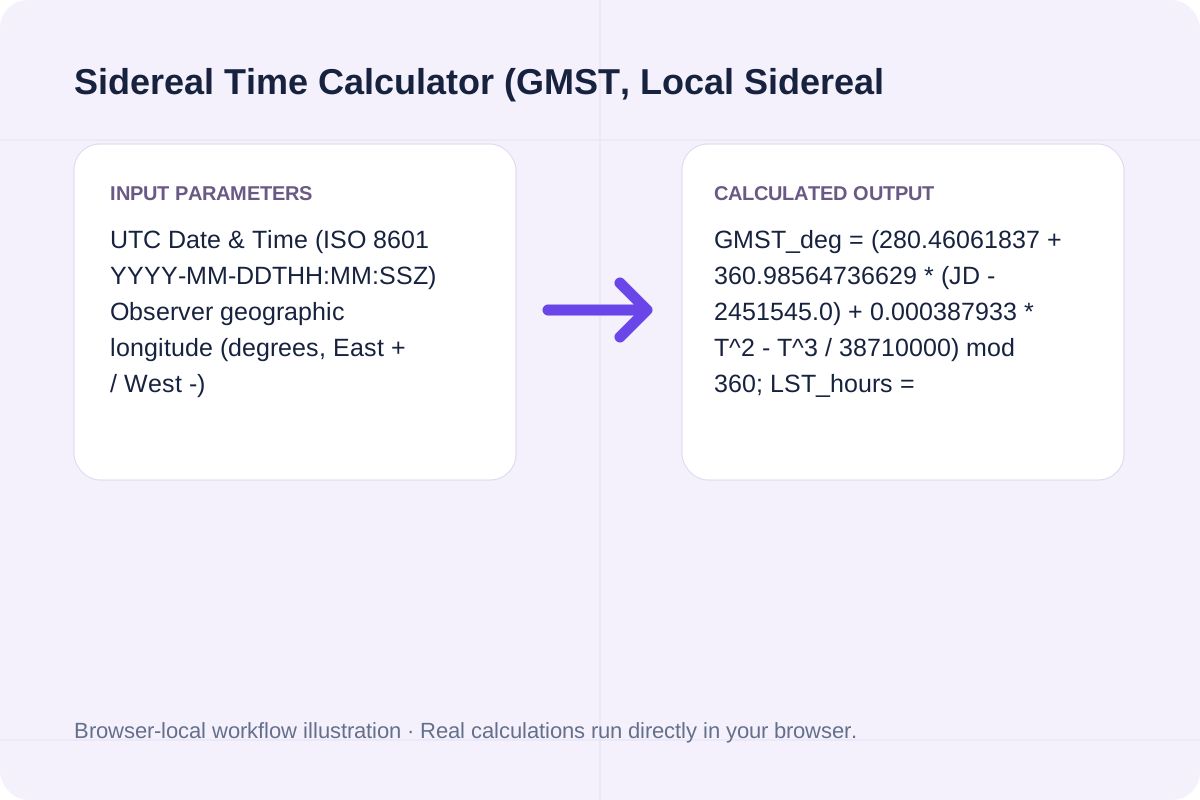
The calculator converts your UTC timestamp to continuous Julian Date (JD) and applies Jean Meeus's IAU 1982 sidereal rotation series.
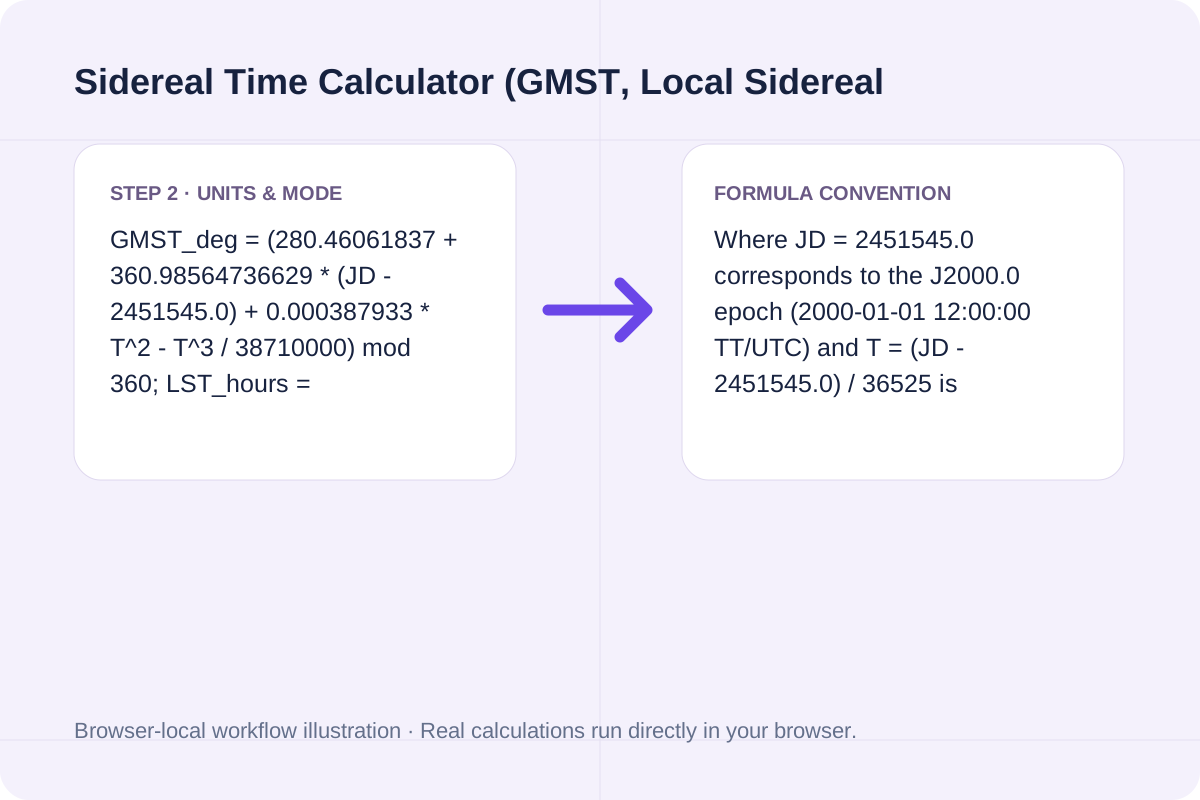
GMST_deg = (280.46061837 + 360.98564736629 * (JD - 2451545.0) + 0.000387933 * T^2 - T^3 / 38710000) mod 360; LST_hours = ((GMST_deg + Longitude_deg) mod 360) / 15
Where JD = 2451545.0 corresponds to the J2000.0 epoch (2000-01-01 12:00:00 TT/UTC) and T = (JD - 2451545.0) / 36525 is Julian centuries from J2000.0.
Exact GMST and Local Sidereal Time (`LST`) at `2026-03-20T00:00:00Z` (`JD = 2461119.50000`) across major longitudes, plus M42 Orion Nebula (`RA = 05h 35m 17s`) Hour Angle.
| Location / Longitude | Longitude Offset (λ / 15) | Sidereal Time (HMS & Decimal) | M42 Orion (`RA 5.5881h`) Hour Angle |
|---|---|---|---|
| **Greenwich Royal Observatory (`0.0000°`)** | `0.0000 h` (`00h 00m 00s`) | **`11h 50m 09.9s`** (`11.8361 h` GMST) | `+6.2480 h` (`+06h 14m 52.8s` West / Setting) |
| **New York City (`-74.0060° W`, Default)** | `-4.9337 h` (`-04h 56m 01.4s`) | **`06h 54m 08.5s`** (`6.9024 h` LST) | `+1.3143 h` (`+01h 18m 51.3s` West of Meridian) |
| **Mauna Kea Observatory (`-155.4681° W`)** | `-10.3645 h` (`-10h 21m 52.3s`) | **`01h 28m 42.1s`** (`1.4783 h` LST) | `-4.1098 h` (`-04h 06m 35s` East / Rising) |
| **Tokyo (`+139.6917° E`)** | `+9.3128 h` (`+09h 18m 46.0s`) | **`21h 09m 20.4s`** (`21.1557 h` LST) | `-8.4324 h` (Below horizon) |
Enter three parameters to align your equatorial mount or plan an astro-imaging session.
Provide the UTC date and time in ISO format (e.g. 2026-03-20T00:00:00Z). Convert local clock time to UTC first.
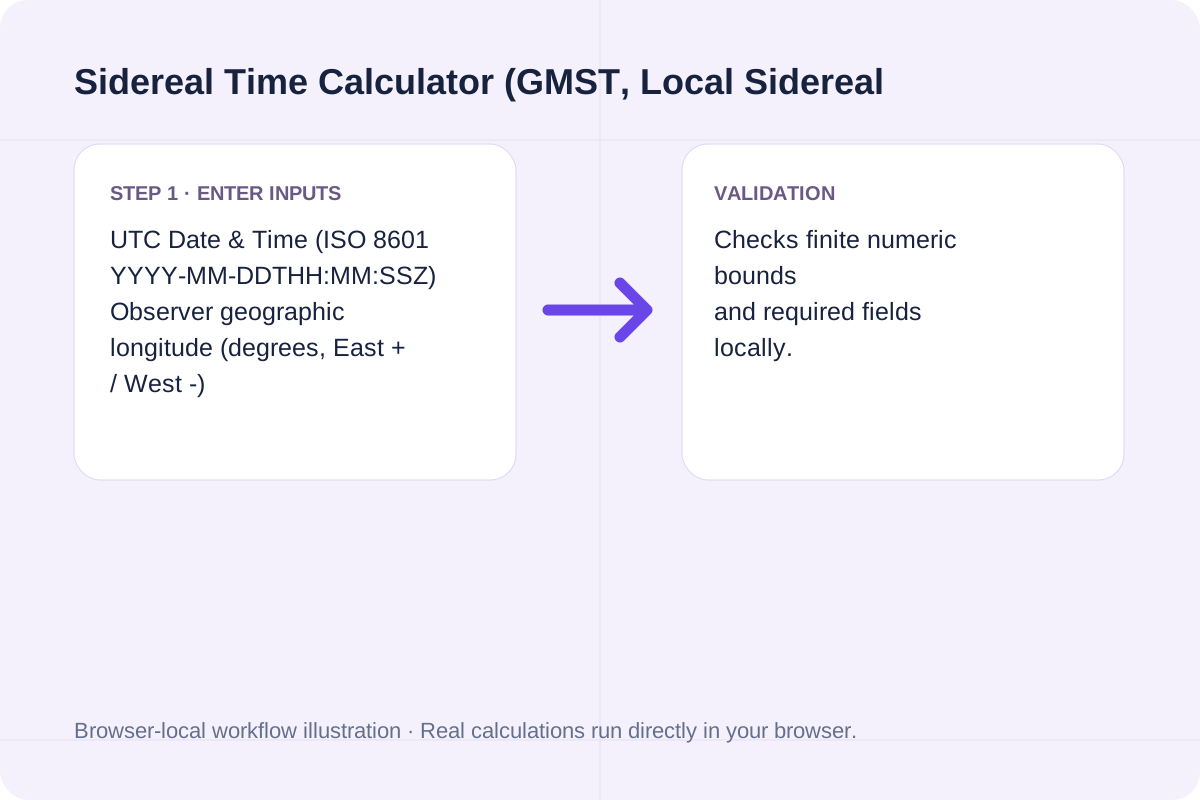
Enter your GPS longitude in decimal degrees: negative for the Americas (-74.006 for New York) and positive for Europe/Asia (+139.6917 for Tokyo).
Enter your target's Right Ascension in decimal hours (e.g. 5.5881 h for M42) to see its exact Hour Angle (HA = LST - RA) and time until meridian flip.
See how GMST, LST, and Hour Angle behave across longitudes.
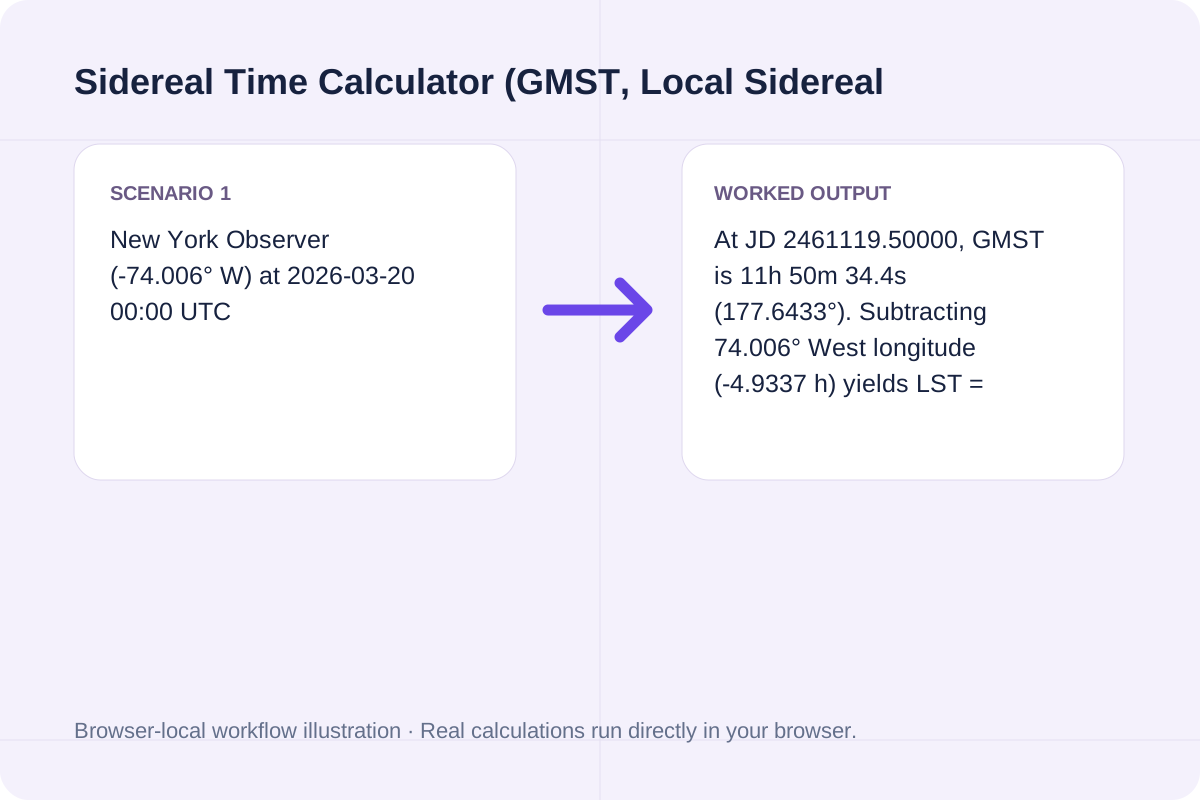
At JD 2461119.50000, GMST is 11h 50m 34.4s (177.6433°). Subtracting 74.006° West longitude (-4.9337 h) yields LST = 06h 54m 33.0s (6.9092 h). For Orion Nebula M42 (RA 5.5881 h), HA = +1.3211 h (+01h 19m 16s past meridian).
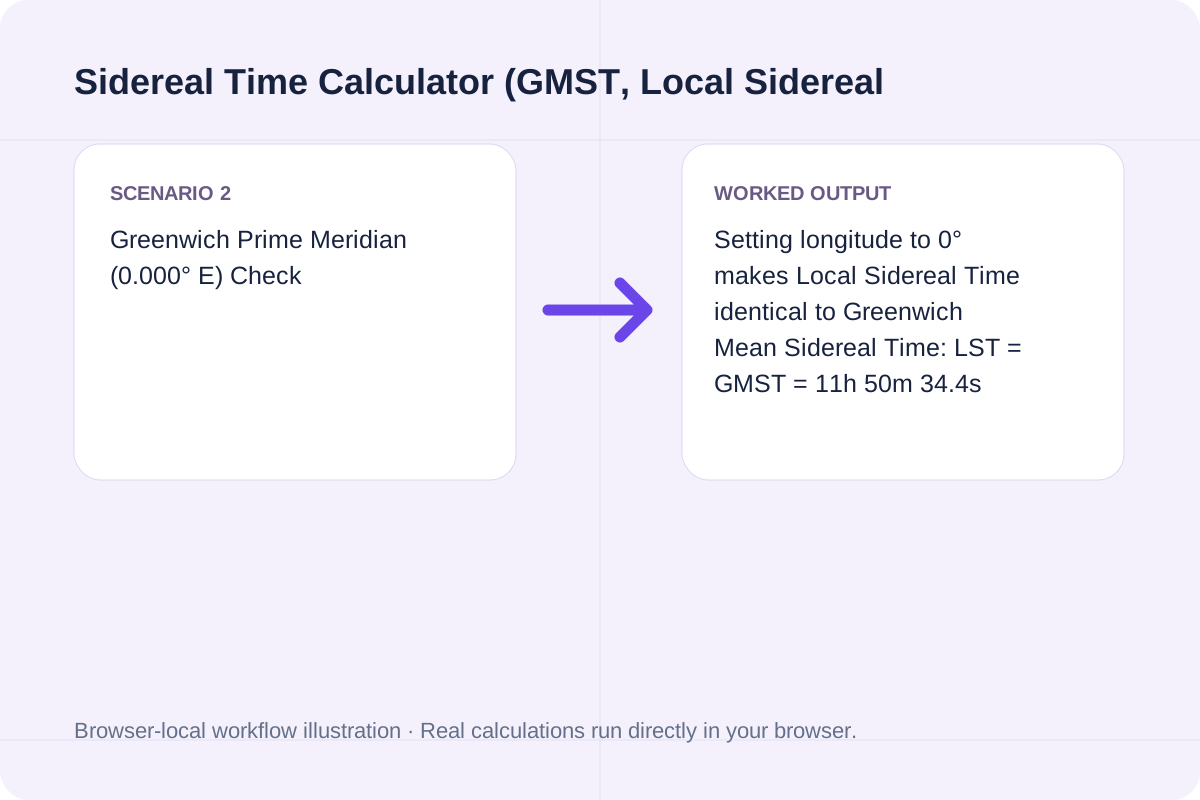
Setting longitude to 0° makes Local Sidereal Time identical to Greenwich Mean Sidereal Time: LST = GMST = 11h 50m 34.4s (11.8429 h).
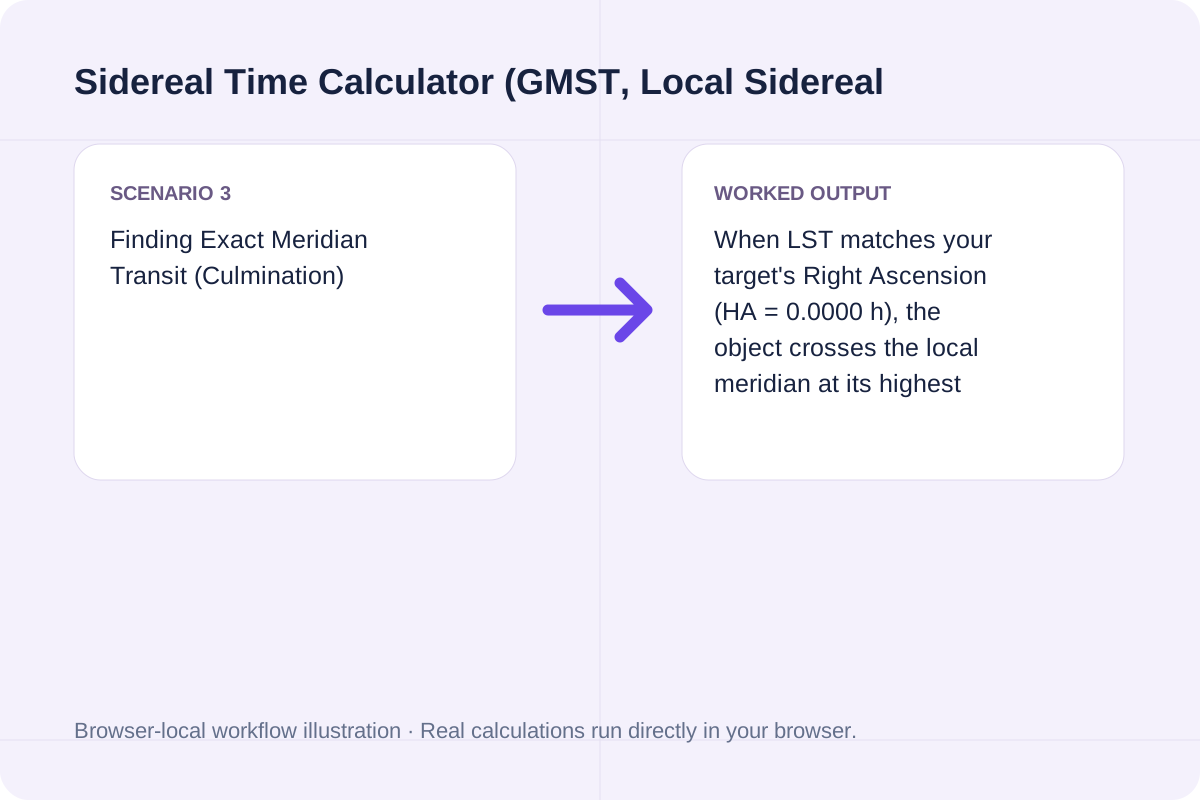
When LST matches your target's Right Ascension (HA = 0.0000 h), the object crosses the local meridian at its highest elevation angle above the horizon.
Both sexagesimal (`HHh MMm SS.s`) and decimal hour/degree values are provided.
The primary result shows your Local Sidereal Time (LST) and Greenwich Mean Sidereal Time (GMST) in hours-minutes-seconds alongside decimal hours.
The detail audit displays the exact Julian Date (JD), days since J2000.0 (d), longitude offset in hours, and signed Hour Angle (HA in [-12h, +12h]) indicating whether the target is East (rising) or West (setting) of the meridian.
Understand the sub-second nutation difference when pointing research-grade telescopes.
This calculator computes Mean Sidereal Time (GMST and LMST). Apparent Sidereal Time (GAST/LAST) adds the Equation of the Equinoxes (nutation in longitude multiplied by cos ε), which oscillates by at most ±1.1 seconds of time (±16.5 arcseconds).
For amateur equatorial mounts, plate solving, and meridian-flip planning, GMST/LMST is accurate to well within 0.3 arcminutes.
Convert a local date and time between IANA time zones.
Open tool
Subtract UTC date-only timestamps and divide by 86,400,000 milliseconds.
Open tool
Compute driving time, total trip duration including rest breaks, effective average speed, and fuel cost in miles or kilometers.
Open toolChoose another tool for your next calculation, conversion, or text task.

Calculate a credit-weighted GPA on a 4.0 scale.
Open tool
Create a printable multiplication table or blank practice grid with chosen row and column ranges and a CSV answer table.
Open tool
Budget your 168-hour week across sleep, work, commute, chores, and exercise to calculate remaining free hours and category percentages.
Open tool
Calculate mechanical bicycle trail from wheel radius, head angle and fork offset.
Open toolAnswers about using Sidereal Time Calculator (GMST, Local Sidereal Time LST & Hour Angle) and understanding its results.
Mean solar time (UTC) tracks the Sun's apparent motion relative to Earth (24h 00m 00s per solar day). Because Earth orbits the Sun once per year (~0.9856° per day), Earth completes a 360° rotation relative to the distant background stars in 23 hours 56 minutes 4.0905 seconds of solar time—making sidereal clocks gain 3 minutes 55.91 seconds per day over UTC.
By definition, Local Sidereal Time (LST) equals the Right Ascension (RA) of celestial objects currently crossing your local meridian (highest altitude due South in the Northern Hemisphere). If your LST is 06h 54m, any star or nebula with RA = 06h 54m is at culmination (Hour Angle HA = 00h 00m).
Earth rotates 360° in 24 sidereal hours, which equals exactly 15° of longitude per sidereal hour (or 1° every 4 sidereal minutes). Adding your East longitude (or subtracting West longitude) divided by 15 converts Greenwich Mean Sidereal Time (GMST) to Local Sidereal Time: LST_hours = (GMST_hours + Longitude_deg / 15) mod 24.
Hour Angle is defined as HA = LST - RA (normalized to -12h to +12h). A negative HA (e.g. -01h 30m) means the object is East of the meridian and rising (1.5 sidereal hours before meridian transit); a positive HA (e.g. +01h 25m) means the object has already crossed the meridian and is descending in the West.
Choose another tool for your next calculation, conversion, or text task.