

Carpet Calculator
Calculate carpet needed in square feet, square yards, and square meters, linear roll length, and cost from room dimensions and waste %.
Open toolEnter your horse count, daily hay and grain rations, bale weight and price, bag price, and hay waste allowance below to calculate daily, 30-day monthly, and annual feed costs.
Enter the inputs, then select Calculate feed cost.
Result will appear here
The Horse Feed Cost Calculator converts daily pounds of forage and concentrate into bale and bag consumption rates, adjusts hay purchases for feeding waste, and totals your cost across 1, 30, and 365 days.
Monthly Cost (30 days) = 30 × [ (Horses × Hay_lb × (1 + Waste%/100) ÷ Bale_lb × Bale_$) + (Horses × Grain_lb ÷ Bag_lb × Bag_$) ].
Along with dollar totals, the calculator reports monthly hay bales and grain bags needed so you can plan storage space and bulk orders.
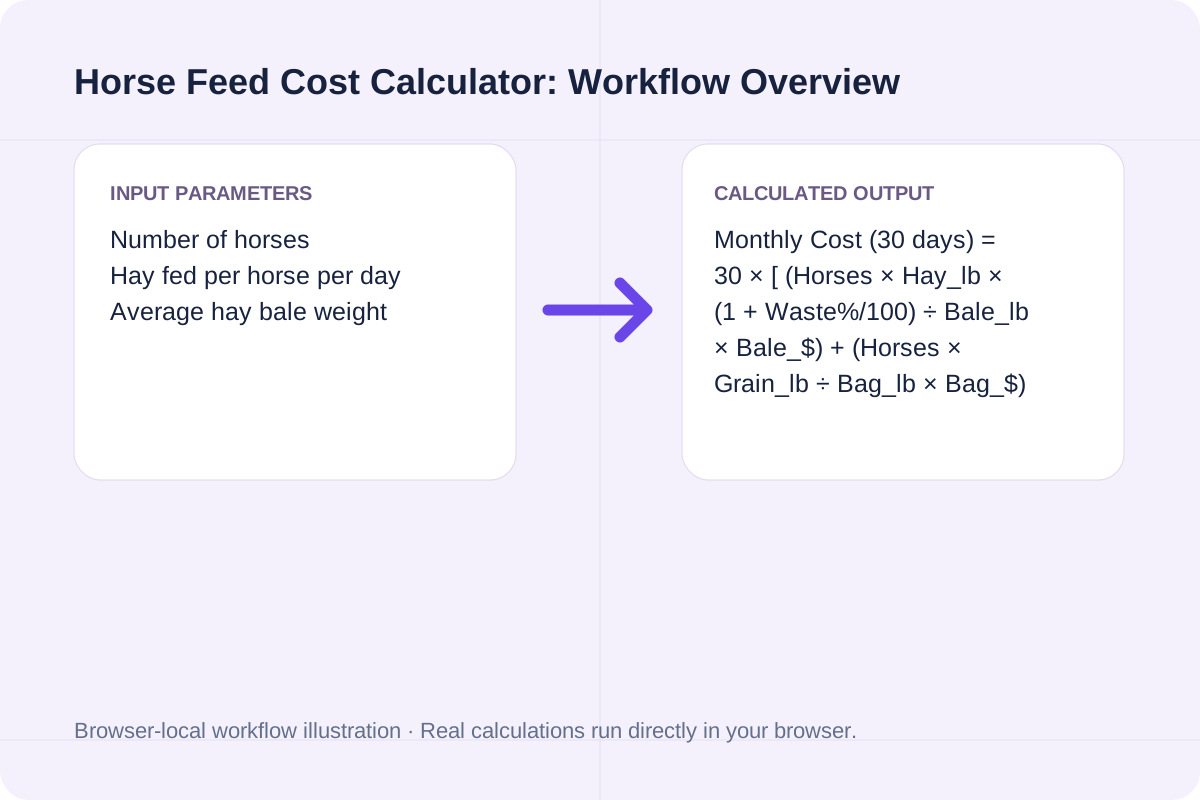
Review the input parameters, allowed value ranges, and worked reference cases for the Horse Feed Cost Calculator below before running your calculation.
| Parameter / Scenario | Default / Sample Value | Rule or Allowed Range | Output / Usage Note |
|---|---|---|---|
| Input: Number of horses | 2 | Range: 1 to 500 | Required workspace parameter |
| Input: Hay fed per horse per day | 20 | Range: 0 to 100 | Required workspace parameter |
| Input: Average hay bale weight | 50 | Range: 1 to 2500 | Required workspace parameter |
| Input: Price per hay bale | 12 | Range: 0 to 1000 | Required workspace parameter |
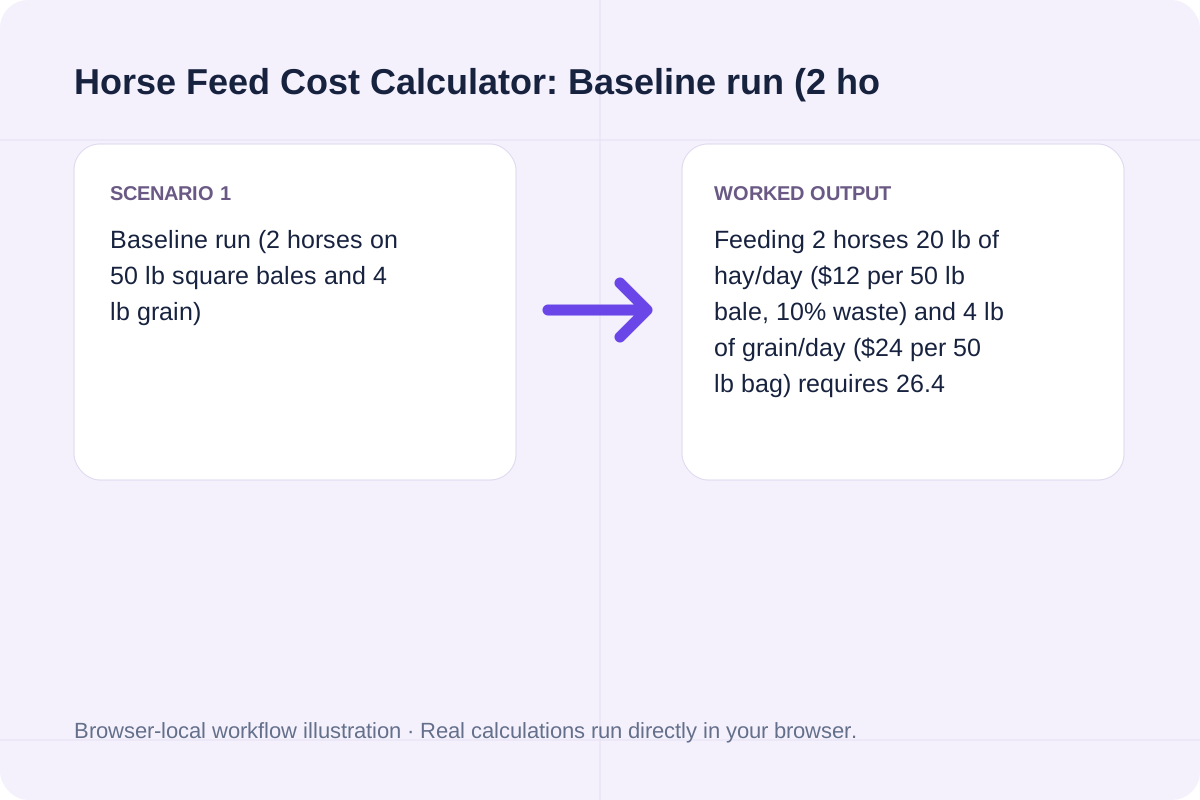
| Worked Case 1: Baseline run (2 horses on 50 lb square bales and 4 lb grain) | Preloaded / test values | Daily Hay Purchased = Horses × Hay(lb/day) × (1 + Waste%/100); Daily Cost = (Daily Hay / Bale Weight × Bale Price) + (Horses × Grain(lb/day) / Bag Weight × Bag Price) | Feeding 2 horses 20 lb of hay/day ($12 per 50 lb bale, 10% waste) and 4 lb of grain/day ($24 per 50 lb bag) requires 26.4 bales and 4.8 bags per 30-day month, costing $14.40/day, $432.00/month, and $5,256.00/year. |
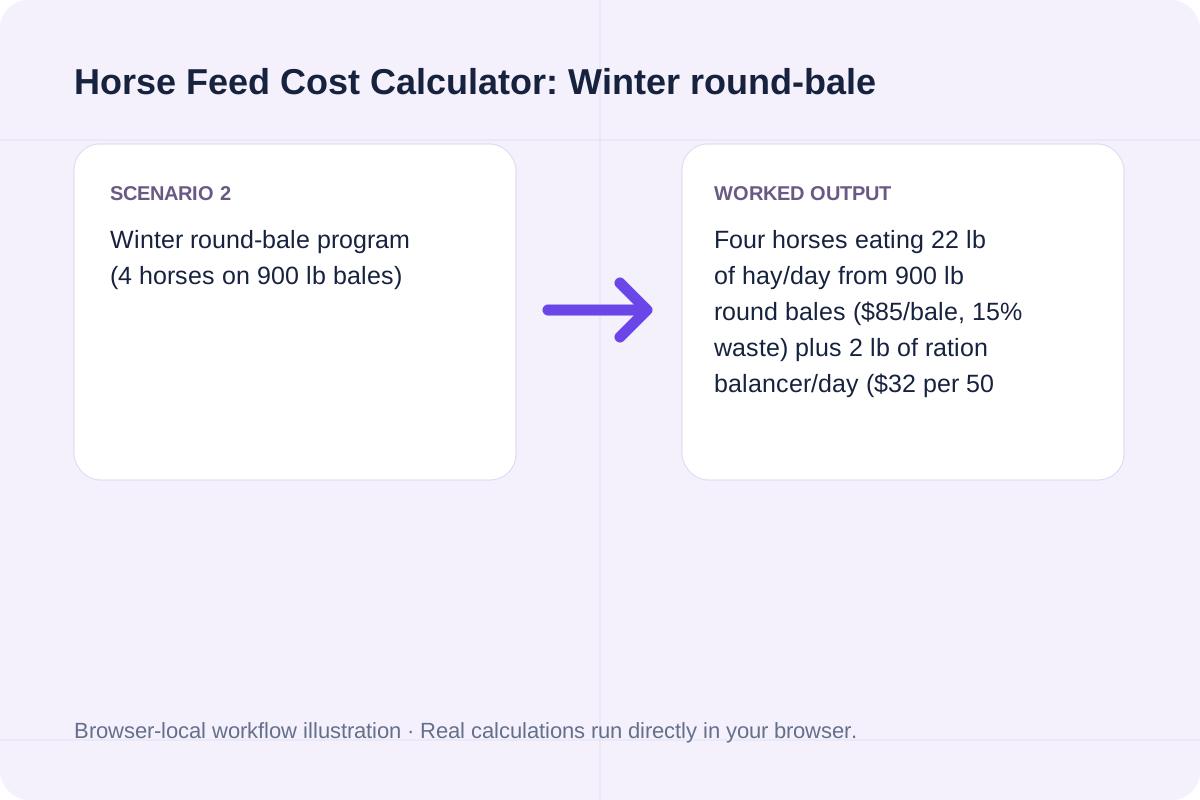
| Worked Case 2: Winter round-bale program (4 horses on 900 lb bales) | Preloaded / test values | Daily Hay Purchased = Horses × Hay(lb/day) × (1 + Waste%/100); Daily Cost = (Daily Hay / Bale Weight × Bale Price) + (Horses × Grain(lb/day) / Bag Weight × Bag Price) | Four horses eating 22 lb of hay/day from 900 lb round bales ($85/bale, 15% waste) plus 2 lb of ration balancer/day ($32 per 50 lb bag) use 3.37 round bales and 4.8 bags per month, totaling $440.48/month. |
Weigh a typical hay flake and grain scoop at your barn, then enter your local bale and bag prices.
Set the number of horses and the daily pounds of hay fed per horse, along with your average bale weight and price per bale.
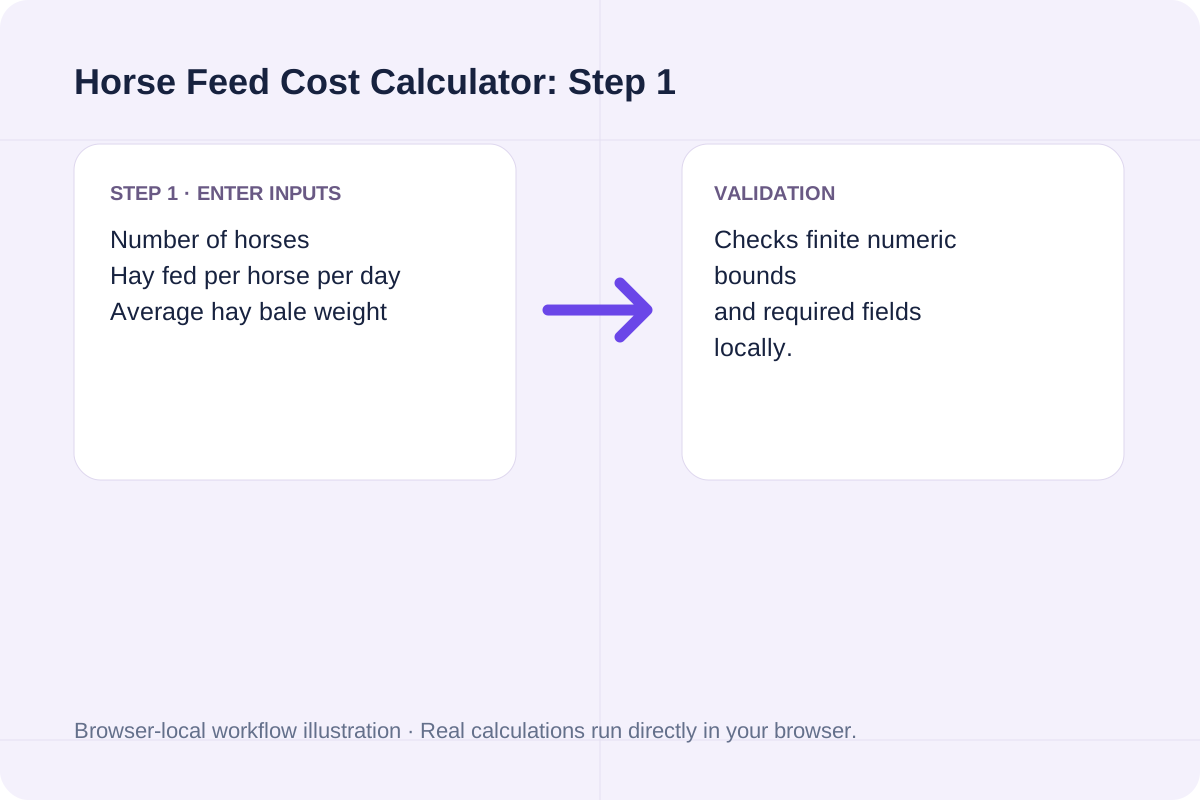
Enter daily pounds of grain or pelleted concentrate per horse, the standard bag weight (usually 50 lb), and the price per bag.
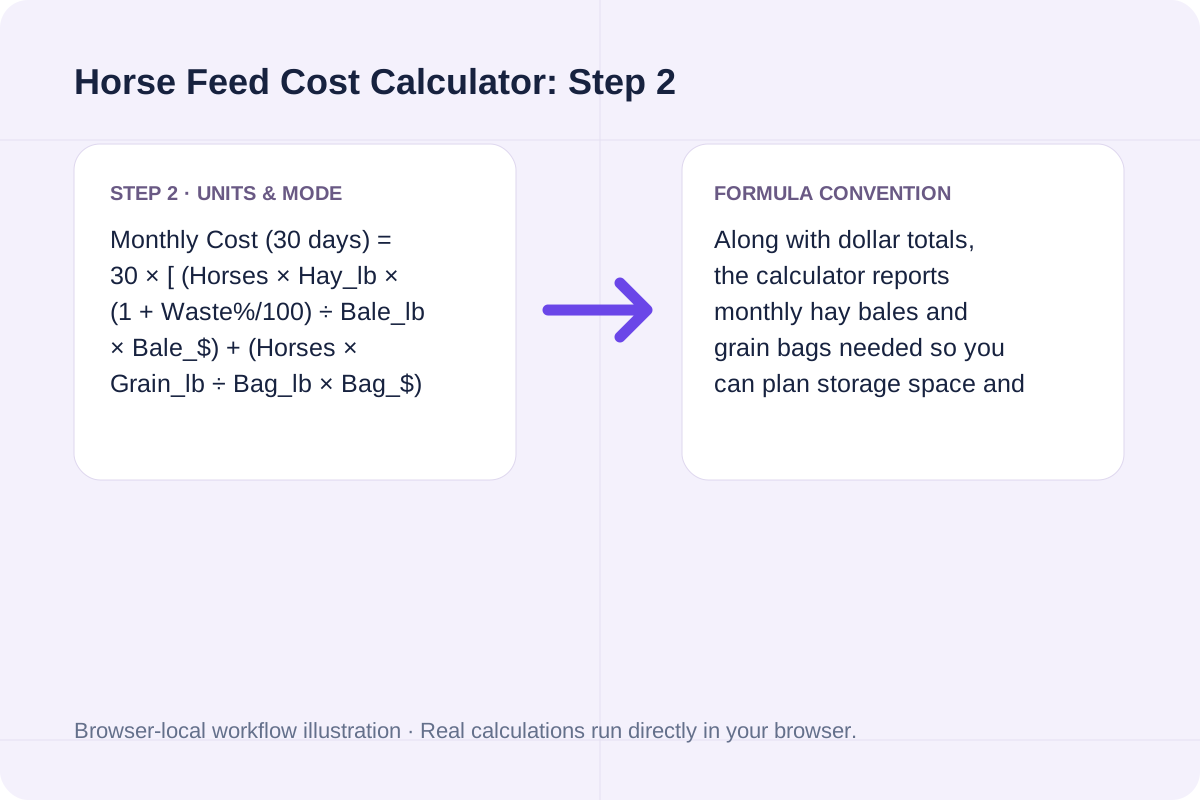
Set a realistic hay waste percentage (such as 10% for slow-feed nets or 15% for ground feeding), then click Calculate feed cost.
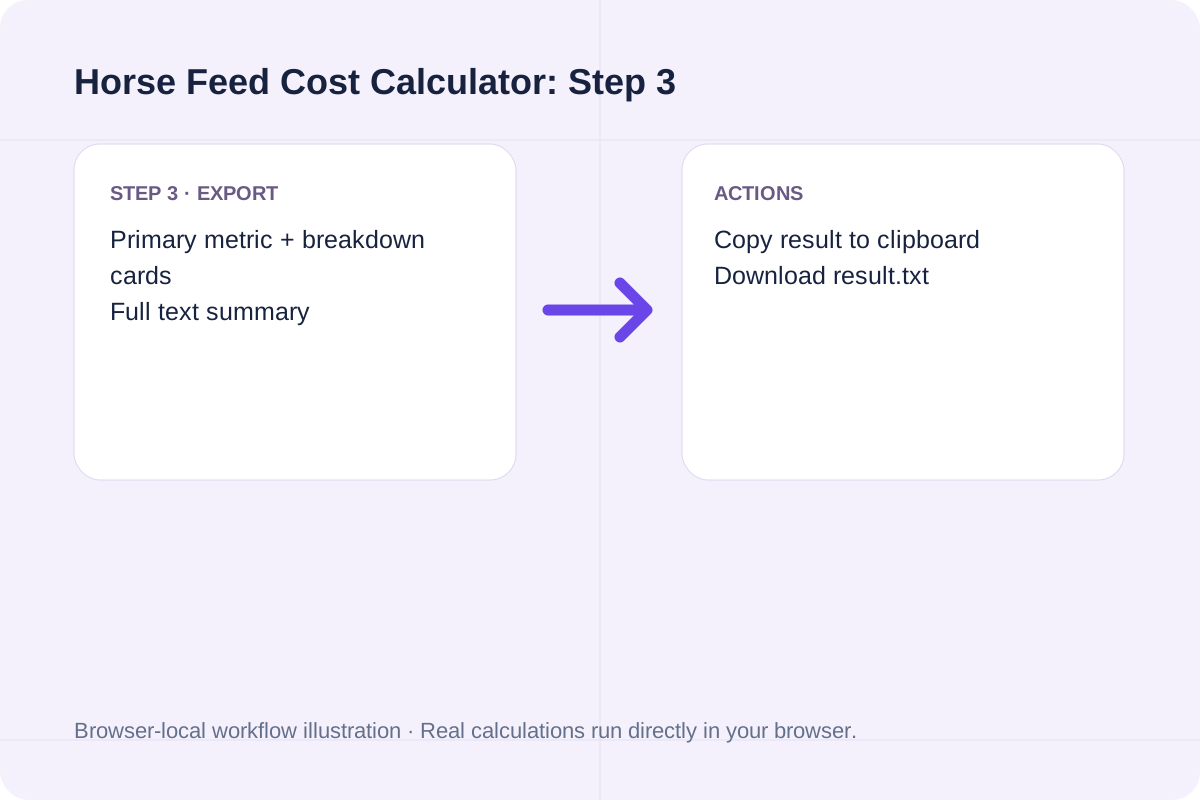
Compare a two-horse small-bale program against a four-horse round-bale setup.
Feeding 2 horses 20 lb of hay/day ($12 per 50 lb bale, 10% waste) and 4 lb of grain/day ($24 per 50 lb bag) requires 26.4 bales and 4.8 bags per 30-day month, costing $14.40/day, $432.00/month, and $5,256.00/year.
Four horses eating 22 lb of hay/day from 900 lb round bales ($85/bale, 15% waste) plus 2 lb of ration balancer/day ($32 per 50 lb bag) use 3.37 round bales and 4.8 bags per month, totaling $440.48/month.
Small square bales marketed as 50 lb often weigh between 42 lb and 55 lb depending on cutting and moisture. Weighing three sample bales with a luggage scale prevents winter hay shortfalls.
Use the 30-day bale and bag counts alongside the dollar figures to plan feed room storage and seasonal hay contracts.
The primary result shows your 30-day monthly feed outlay, while the breakdown cards separate daily hay cost from daily grain cost and list exact monthly bales and bags required. If hay accounts for more than 70% of your budget, reducing ground waste with a hay feeder or slow-feed net often saves more than switching grain brands.
Review the ration assumptions before applying these estimates to boarding rates or annual barn budgets.
This calculator models a uniform daily ration across all entered horses for 30-day months and 365-day years. If your herd includes easy keepers on ration balancers alongside hard keepers on senior feed, run each feeding group separately and sum the exported text files.
Calculate carpet needed in square feet, square yards, and square meters, linear roll length, and cost from room dimensions and waste %.
Open tool
Calculate bracelet size, inner circumference, bead-diameter allowance, and bead count from wrist circumference, fit ease, and bead size.
Open tool
Calculate a discounted bundle price, total cost and gross profit.
Open toolChoose another tool for your next calculation, conversion, or text task.

Find measured average hose flow from a timed bucket fill.
Open tool
Find total dough hydration including starter and additional water needed for a supplied target.
Open tool
Calculate waist radius, outer hem radius, hem sweep, and fabric yardage for full, 3/4, half, or quarter circle skirts with seam allowance.
Open tool
Calculate how many deck boards, linear feet of decking, and deck screws you need from deck length, width, board width, gap, and waste %.
Open toolAnswers about using Horse Feed Cost Calculator and understanding its results.
Most adult horses require 1.5% to 2.5% of their body weight in forage dry matter daily, which equals 15 to 25 lb of hay per day for a 1,000 lb horse when pasture grazing is unavailable.
Horses scatter, trample, or refuse stems when fed on the ground or in open racks. Accounting for 5% to 15% hay waste ensures your monthly bale order and budget match actual barn consumption.
Yes. For round bales, enter the bale weight (for example, 900 lb) and price per bale. If you buy hay by the short ton, enter 2,000 lb as the bale weight and the per-ton price as the bale price.
Yes. All calculations run locally in your browser with no account required. Click Copy result or Download result.txt to save the monthly and annual bale, bag, and cost breakdown.
Choose another tool for your next calculation, conversion, or text task.