

Net Promoter Score Calculator
Calculate NPS and detractor, passive and promoter shares from counts or raw scores.
Open toolCalculate your exact exam percentage, number of correct answers, and total points earned from total questions, wrong answers, and points per question.
Enter the inputs, then select Calculate.
Result will appear here
Enter the total question count, the number of missed questions, and the point weight per question to compute both percentage score and raw point totals.
Correct Questions = Total - Wrong. Percentage Score = ((Total - Wrong) / Total) x 100%. Earned Points = (Total - Wrong) x Points per Question, out of Maximum Points = Total x Points per Question.
All questions are weighted equally. Wrong questions must be a whole number between 0 and Total questions, and outputs display up to 12 significant digits.
Instant percentage lookup for common quiz and exam lengths when 1 to 5 questions are missed.
| Total Questions | 1 Wrong | 2 Wrong | 3 Wrong | 4 Wrong | 5 Wrong |
|---|---|---|---|---|---|
| 10 Questions | 90.0% (9/10) | 80.0% (8/10) | 70.0% (7/10) | 60.0% (6/10) | 50.0% (5/10) |
| 15 Questions | 93.33% (14/15) | 86.67% (13/15) | 80.0% (12/15) | 73.33% (11/15) | 66.67% (10/15) |
| 20 Questions | 95.0% (19/20) | 90.0% (18/20) | 85.0% (17/20) | 80.0% (16/20) | 75.0% (15/20) |
| 25 Questions | 96.0% (24/25) | 92.0% (23/25) | 88.0% (22/25) | 84.0% (21/25) | 80.0% (20/25) |
| 30 Questions | 96.67% (29/30) | 93.33% (28/30) | 90.0% (27/30) | 86.67% (26/30) | 83.33% (25/30) |
| 40 Questions | 97.5% (39/40) | 95.0% (38/40) | 92.5% (37/40) | 90.0% (36/40) | 87.5% (35/40) |
| 50 Questions | 98.0% (49/50) | 96.0% (48/50) | 94.0% (47/50) | 92.0% (46/50) | 90.0% (45/50) |
| 100 Questions | 99.0% (99/100) | 98.0% (98/100) | 97.0% (97/100) | 96.0% (96/100) | 95.0% (95/100) |
Set the quiz length, enter the missed count, and specify how many points each question carries.
Type the total number of equally weighted items on the exam or worksheet (for example, 20, 35, or 75 questions).
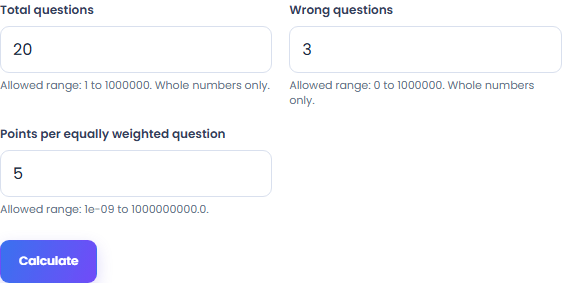
Enter how many questions were marked wrong. If you already know the number of correct answers instead, subtract correct from total to get the wrong count.

Keep Points per equally weighted question at 1 (or set a custom weight such as 2.5 or 5 points per item) and select Calculate result.
Compare standard classroom quizzes, custom point weights, and target passing score checks.
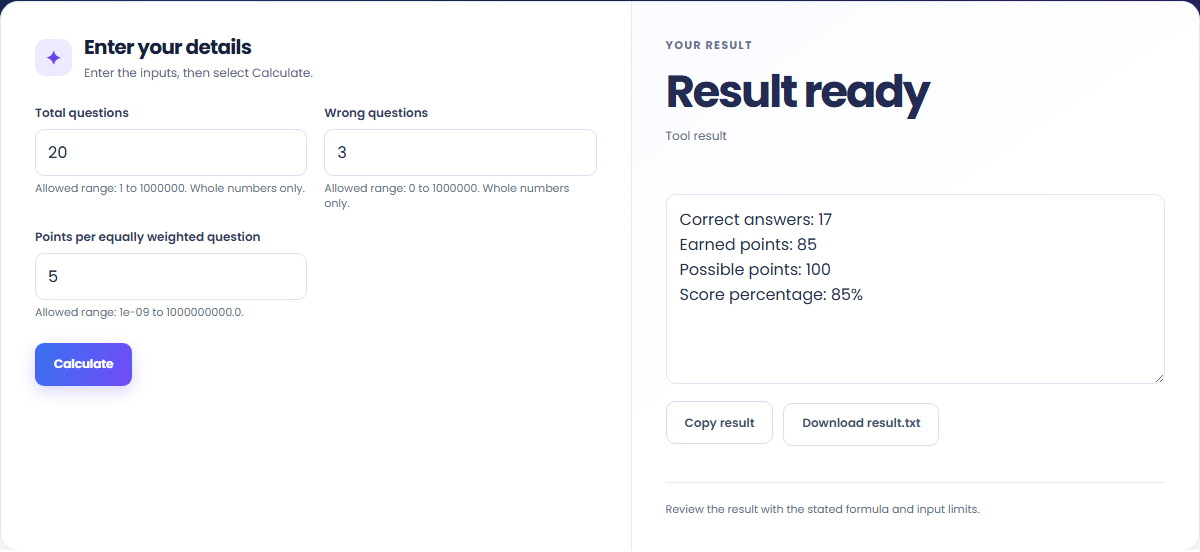
With 20 total questions and 3 wrong, you have 17 correct answers. That equals (17 / 20) x 100 = 85% and 17 x 5 = 85 points out of 100.

Missing 4 out of 35 leaves 31 correct answers. The percentage score is (31 / 35) x 100 = 88.5714%, with each question worth 2.8571% of the grade.

On a 25-question test, each question is worth 4%. Missing 5 questions leaves 20/25 = 80%, so 5 is the maximum wrong count that still holds an 80% threshold.

Understand how question weight affects raw points versus percentage score.
The result is the correct count, points and percentage. Calculate an equally weighted test result from question counts.
All questions use one point value; partial credit and grading scales are not inferred.
Numerical output shows up to 12 significant digits. Floating-point arithmetic and display rounding can affect the last digits.

Check how equally weighted scoring differs from multi-part or partial-credit exams.
This calculator assumes every question carries the exact same point value. Total questions and wrong questions must be whole numbers, and wrong answers cannot exceed total questions.
If your test includes half-point deductions (such as 0.5 wrong on a short-answer item) on an otherwise equally weighted test, multiply both Total questions and Wrong questions by 2 so both inputs are whole numbers.

Calculate NPS and detractor, passive and promoter shares from counts or raw scores.
Open tool
Calculate baker percentages and rescale all ingredients to a target flour mass.
Open tool
Calculate saddle-stitch or signature booklet page counts, blank padding pages, duplex sheets, paper weight, and imposition spread order.
Open toolChoose another tool for your next calculation, conversion, or text task.

Find a regular tetrahedron surface area as sqrt(3) × edge².
Open tool
Find a regular tetrahedron volume as edge³/(6 sqrt(2)).
Open tool
Calculate a weighted circular mean, resultant length and circular variance from angles.
Open tool
Calculate standard deviation as a percentage of a positive mean.
Open toolAnswers about using Test Score Calculator and understanding its results.
Subtract the number of wrong questions from the total number of questions to get your correct count, divide by the total number of questions, and multiply by 100. For example, 3 wrong on a 20-question test is (20 - 3) / 20 x 100 = 85%.
Divide 100% by the total number of questions. On a 20-question test, each question is worth 5%. On a 25-question test, each is worth 4%. On a 40-question test, each is worth 2.5%.
No. When every question has the same weight, the point value cancels out in the ratio. Setting 5 points per question on a 20-question test changes the raw score to 85/100 points while keeping the percentage at 85%.
Subtract your correct answers from the total question count and enter that difference in the Wrong questions field.
Choose another tool for your next calculation, conversion, or text task.