
Correlation Coefficient Calculator
Find the Pearson correlation coefficient of paired observations.
Open toolCalculate standard deviation as a percentage of a positive mean. Standard deviation must be nonnegative and mean positive.
Enter the inputs, then select Calculate.
Result will appear here
Calculate standard deviation as a percentage of a positive mean.
Standard deviation must be nonnegative and mean positive. CV comparison is meaningful for ratio-scale measurements with a nonzero natural origin. Finite real inputs; output uses up to 12 significant digits. Floating-point results may be rounded.
Follow the labelled inputs.
Replace the example with standard deviation. The field labels specify the expected format and units.
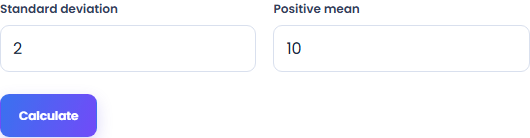
Set positive mean. Standard deviation must be nonnegative and mean positive.
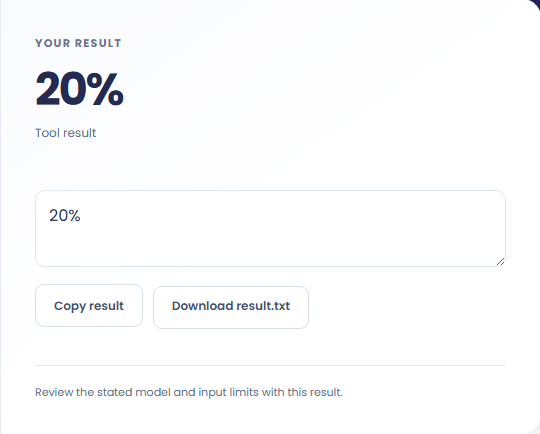
Select Calculate. Review the calculated result, then copy it or download the result text.
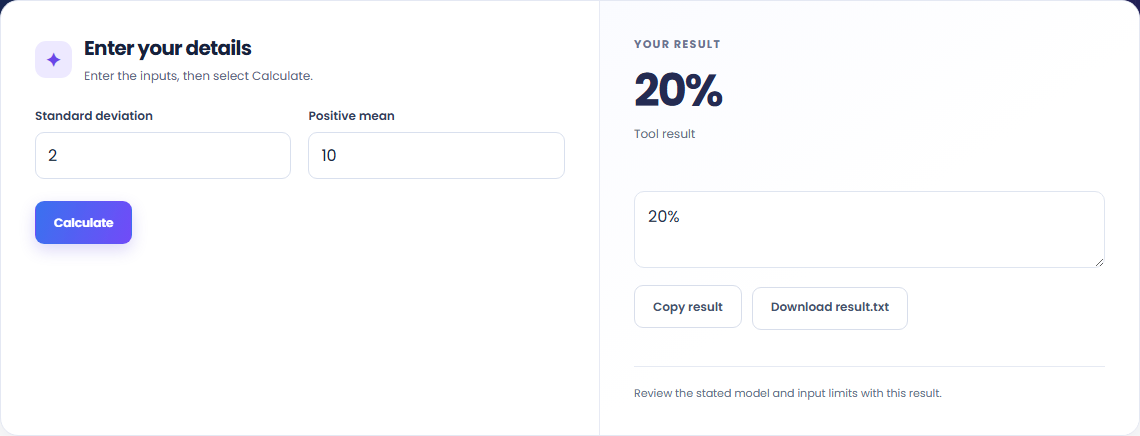
The starting example produces 20%. Calculate standard deviation as a percentage of a positive mean.

Read the labels for standard deviation and positive mean. Standard deviation must be nonnegative and mean positive.

Copy the calculated result into your notes. Keep the formula and assumptions with it if someone else needs to reproduce the calculation.

Read the units and assumptions with the output.
Calculate standard deviation as a percentage of a positive mean.
Standard deviation must be nonnegative and mean positive. CV comparison is meaningful for ratio-scale measurements with a nonzero natural origin. Finite real inputs; output uses up to 12 significant digits. Floating-point results may be rounded.

Check the stated scope before you run it.
Standard deviation must be nonnegative and mean positive. CV comparison is meaningful for ratio-scale measurements with a nonzero natural origin. Finite real inputs; output uses up to 12 significant digits. Floating-point results may be rounded.
The input stays in this browser. Copy result and Download save the same displayed text.

Find the Pearson correlation coefficient of paired observations.
Open tool
Convert absorbed radiation dose between the listed units.
Open tool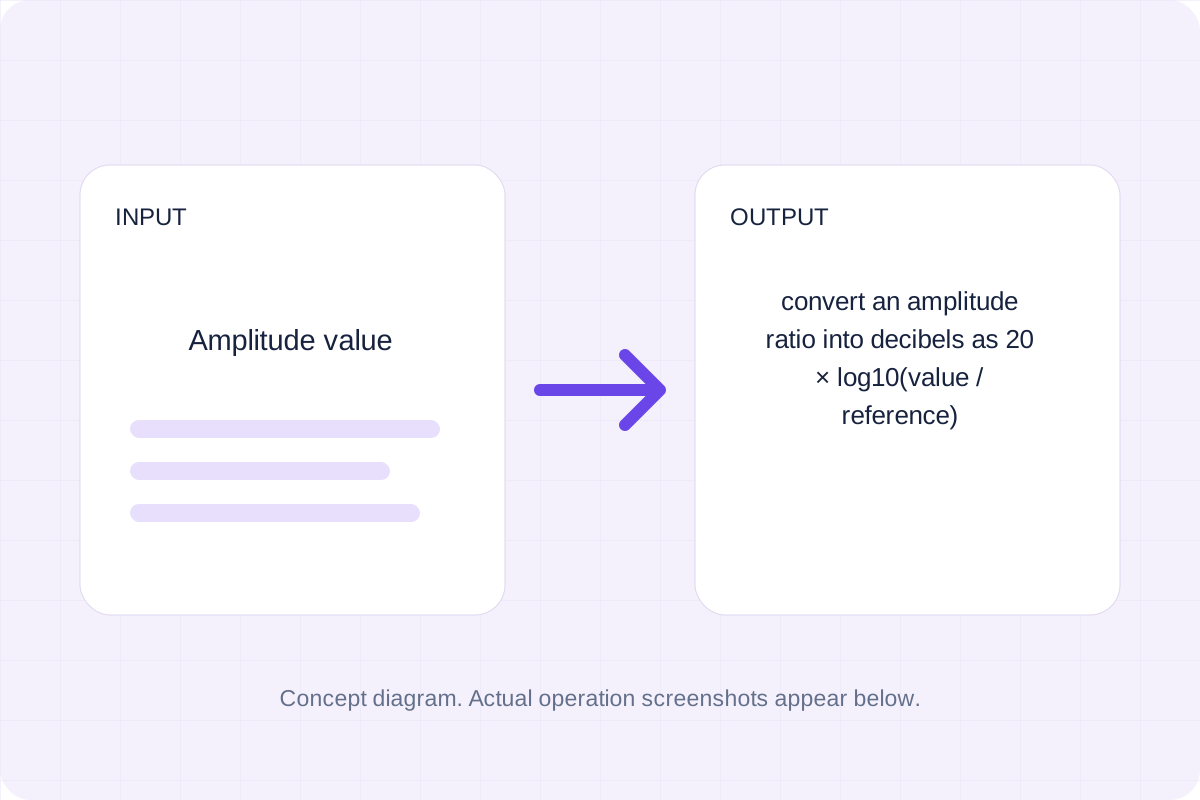
Convert an amplitude ratio into decibels as 20 × log10(value / reference).
Open toolChoose another tool for your next calculation, conversion, or text task.
Convert angular speed between the listed units.
Open tool
Average angular velocity = angular displacement / time.
Open tool
Find ring area as π × (outer radius² − inner radius²).
Open tool
Buoyant force = fluid density × displaced volume × gravity.
Open toolAnswers about using Coefficient Of Variation Calculator and understanding its results.
Standard deviation must be nonnegative and mean positive. CV comparison is meaningful for ratio-scale measurements with a nonzero natural origin. Finite real inputs; output uses up to 12 significant digits. Floating-point results may be rounded.
Use Copy result to copy the displayed text, or Download to save it as a text file. The tool runs in your browser and does not require an account.
Check the calculated result, then copy or download it.