Cone Surface Area Calculator
Find total area of a closed right circular cone.
Open toolConvert surface tension between the listed units. Surface tension is force per length, not pressure.
Enter the inputs, then select Convert units.
Result will appear here
Convert surface tension between the listed units.
Surface tension is force per length, not pressure. Finite real inputs; output uses up to 12 significant digits. Floating-point results may be rounded.
Follow the labelled inputs.
Replace the example with quantity. The field labels specify the expected format and units.
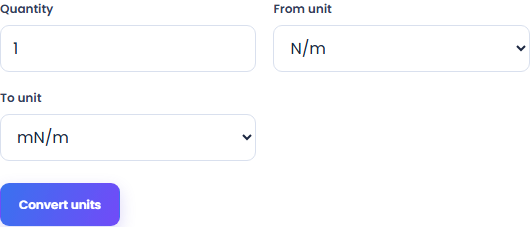
Set from unit, to unit. Surface tension is force per length, not pressure.
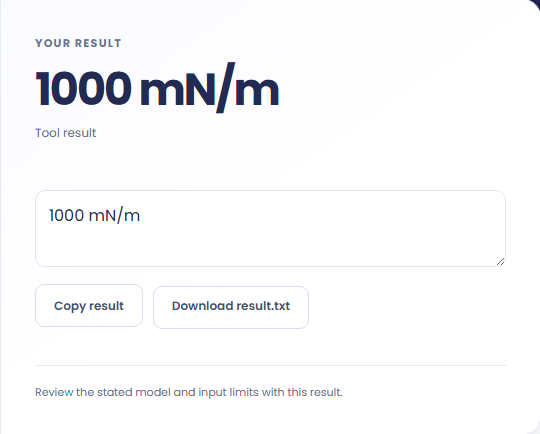
Select Convert units. Review the converted quantity and its destination unit, then copy it or download the result text.
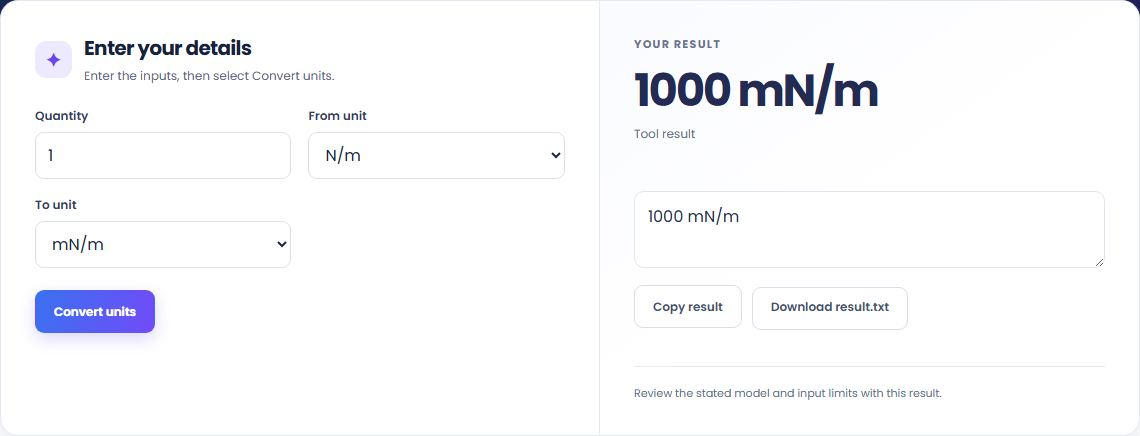
Enter the stated quantity and its source unit. The output retains the destination-unit label, so you can compare it with the original specification.

Convert the readings to the same unit before comparing them. Surface tension is force per length, not pressure.

Copy the quantity with its unit or download the text. Convert surface tension between the listed units.

Read the units and assumptions with the output.
Convert surface tension between the listed units.
Surface tension is force per length, not pressure. Finite real inputs; output uses up to 12 significant digits. Floating-point results may be rounded.

Check the stated scope before you run it.
Surface tension is force per length, not pressure. Finite real inputs; output uses up to 12 significant digits. Floating-point results may be rounded.
The input stays in this browser. Copy result and Download save the same displayed text.

Choose another tool for your next calculation, conversion, or text task.
Find total area of a closed right square pyramid.
Open tool
Find curved spherical cap area 2πRh.
Open tool
Find ring torus area as 4π²Rr.
Open tool
Closed cylinder surface area = 2 × π × radius × (radius + height).
Open toolAnswers about using Surface Tension Converter and understanding its results.
Surface tension is force per length, not pressure. Finite real inputs; output uses up to 12 significant digits. Floating-point results may be rounded.
Use Copy result to copy the displayed text, or Download to save it as a text file. The tool runs in your browser and does not require an account.
Check the converted quantity and its destination unit, then copy or download it.