

Music Tempo Calculator
Find quarter-note BPM and beat duration from supplied complete bars and elapsed time.
Open toolFind the conventional PERT expected duration and variance from three supplied estimates. Provide Optimistic duration, Most likely duration, Pessimistic duration to compute results directly in your browser. Require optimistic <= most likely <= pessimistic and one time unit. Mean=(O+4M+P)/6, variance=((P-O)/6)^2; model estimates, not a completion probability or delivery guarantee. Inputs and results use floating-point numbers; output shows up to 12 significant digits. Rounding can occur. Common search workflows supported include "pert calculator", "pert estimate calculator".
Enter the inputs, then select Calculate.
Result will appear here
The PERT Calculator evaluates Optimistic duration, Most likely duration, Pessimistic duration in client-side JavaScript using the deterministic rule below and updates the output panel immediately without uploading data to a server.
Find the conventional PERT expected duration and variance from three supplied estimates.
Require optimistic <= most likely <= pessimistic and one time unit. Mean=(O+4M+P)/6, variance=((P-O)/6)^2; model estimates, not a completion probability or delivery guarantee. Inputs and results use floating-point numbers; output shows up to 12 significant digits. Rounding can occur.
Review the input parameters, allowed value ranges, and worked reference cases for the PERT Calculator below before running your calculation.
| Parameter / Scenario | Default / Sample Value | Rule or Allowed Range | Output / Usage Note |
|---|---|---|---|
| Input: Optimistic duration | 1 | Range: 0 to 1000000000.0 | Required workspace parameter |
| Input: Most likely duration | 2 | Range: 0 to 1000000000.0 | Required workspace parameter |
| Input: Pessimistic duration | 3 | Range: 0 to 1000000000.0 | Required workspace parameter |
| Worked Case 1: Baseline run (Optimistic duration = 1) | Preloaded / test values | Find the conventional PERT expected duration and variance from three supplied estimates | Optimistic duration = 1; Most likely duration = 2; Pessimistic duration = 3. The displayed output is Expected duration: 2 Variance: 0.111111111111. |
| Worked Case 2: Comparison scenario (pert calculator compound interest) | Preloaded / test values | Find the conventional PERT expected duration and variance from three supplied estimates | Optimistic duration = 2; Most likely duration = 5; Pessimistic duration = 8. The displayed output is Expected duration: 5 Variance: 1. |
Follow these three steps to configure Optimistic duration, Most likely duration, Pessimistic duration, verify unit and boundary rules, and export your PERT Calculator output.
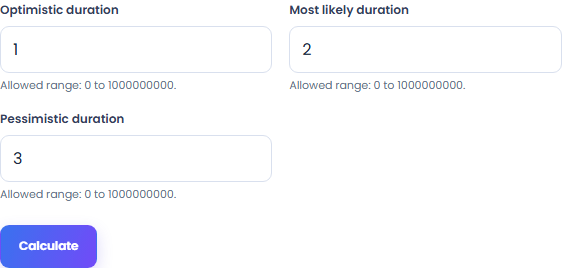
Set most likely duration, pessimistic duration. Enter optimistic, most likely and pessimistic durations in that order and in one time unit.

Select Calculate to see the conventional PERT expected duration and variance. Copy result copies this text; Download saves it as a TXT file.
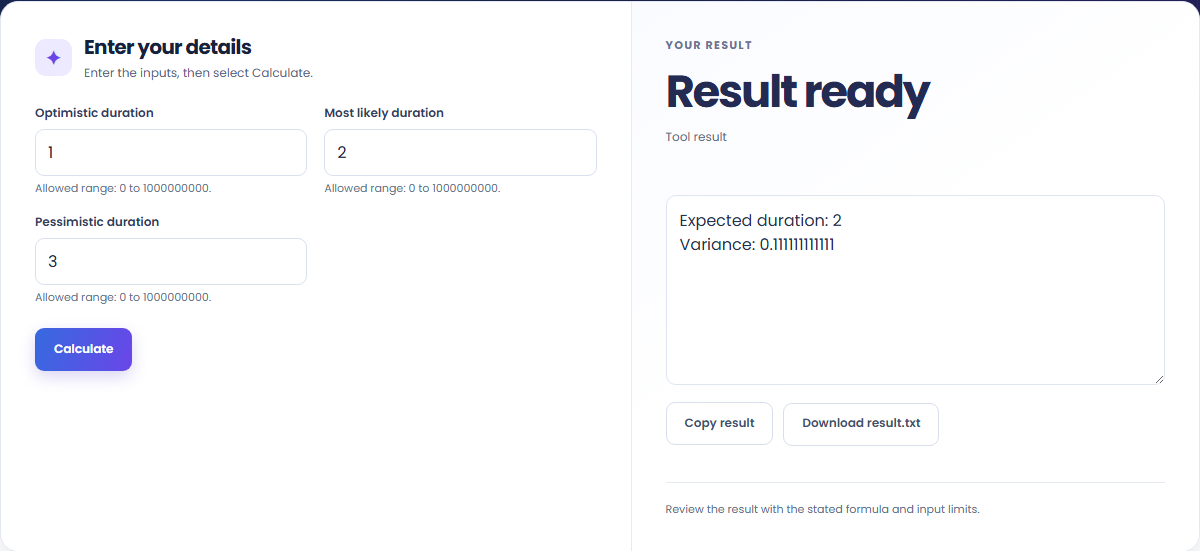
These concrete scenarios illustrate how the PERT Calculator processes baseline inputs, comparison checks, and boundary constraints.
Optimistic duration = 1; Most likely duration = 2; Pessimistic duration = 3. The displayed output is Expected duration: 2 Variance: 0.111111111111.

Optimistic duration = 2; Most likely duration = 5; Pessimistic duration = 8. The displayed output is Expected duration: 5 Variance: 1.

When solving for 'pert calculator', verify that Optimistic duration, Most likely duration, Pessimistic duration use consistent units and stay within the documented scope: Require optimistic <= most likely <= pessimistic and one time unit. Mean=(O+4M+P)/6, variance=((P-O)/6)^2; model estimates, not a completion probability or delivery guarantee. Inputs and results use floating-point numbers; output shows up to 12 significant digits. Rounding can occur.

The output panel reports the exact result derived from Optimistic duration, Most likely duration, Pessimistic duration alongside any unit or formatting notes.
The result is the conventional PERT expected duration and variance. Combine three duration estimates with the stated PERT weighting.
The estimate uses the supplied values; it does not calculate a project's completion probability or a guaranteed delivery date.
Numerical output shows up to 12 significant digits. Floating-point arithmetic and display rounding can affect the last digits.

Review these boundary constraints and validation rules before relying on the PERT Calculator output.
Operational scope: Require optimistic <= most likely <= pessimistic and one time unit. Mean=(O+4M+P)/6, variance=((P-O)/6)^2; model estimates, not a completion probability or delivery guarantee. Inputs and results use floating-point numbers; output shows up to 12 significant digits. Rounding can occur. Inputs that violate minimum/maximum bounds or required format rules are rejected with a clear diagnostic prompt.
Need an adjacent calculation in Everyday Math? Use the related tools linked below to chain your workflow without leaving your browser.

Find quarter-note BPM and beat duration from supplied complete bars and elapsed time.
Open tool
Find attributed advertising cost of sales and its difference from a supplied target.
Open tool
Find stable angular separation between supplied celestial or spherical coordinates.
Open toolChoose another tool for your next calculation, conversion, or text task.

Estimate pH as minus log10 of hydrogen-ion concentration.
Open tool
Find photon energy as Planck constant × speed of light / vacuum wavelength.
Open tool
Find target apparent magnitude relative to a supplied reference flux and magnitude.
Open tool
Find current and projected attendance plus additional fully attended classes needed for a supplied target.
Open toolAnswers about using PERT Calculator and understanding its results.
The PERT Calculator applies the rule: Find the conventional PERT expected duration and variance from three supplied estimates. Enter Optimistic duration, Most likely duration, Pessimistic duration into the workspace and the tool computes the exact output in your browser.
Yes. Provide Optimistic duration, Most likely duration, Pessimistic duration using the documented units and format shown in the quick reference table above. Preloaded default values let you test the workflow immediately.
Require optimistic <= most likely <= pessimistic and one time unit. Mean=(O+4M+P)/6, variance=((P-O)/6)^2; model estimates, not a completion probability or delivery guarantee. Inputs and results use floating-point numbers; output shows up to 12 significant digits. Rounding can occur. Confirm that your inputs fall within the allowed ranges before exporting the result.
Yes. All calculations for the PERT Calculator execute 100% locally in your browser's JavaScript runtime. No inputs or results are uploaded to any external server.
Choose another tool for your next calculation, conversion, or text task.