


Semitone Calculator
Find the signed equal-tempered interval between two positive frequencies.
Open toolFind gcd and integer Bézout coefficients for two positive integers. Provide First positive integer, Second positive integer to compute results directly in your browser. Positive integers at most one billion. Outputs one pair x,y satisfying ax + by = gcd(a,b); other valid pairs exist. Common search workflows supported include "extended euclidean calculator".
Enter the inputs, then select Calculate.
Result will appear here
The Extended Euclidean Algorithm Calculator evaluates First positive integer, Second positive integer in client-side JavaScript using the deterministic rule below and updates the output panel immediately without uploading data to a server.
Find gcd and integer Bézout coefficients for two positive integers.
Positive integers at most one billion. Outputs one pair x,y satisfying ax + by = gcd(a,b); other valid pairs exist.

Review the input parameters, allowed value ranges, and worked reference cases for the Extended Euclidean Algorithm Calculator below before running your calculation.
| Parameter / Scenario | Default / Sample Value | Rule or Allowed Range | Output / Usage Note |
|---|---|---|---|
| Input: First positive integer | 30 | Range: 1 to 1000000000 | Required workspace parameter |
| Input: Second positive integer | 18 | Range: 1 to 1000000000 | Required workspace parameter |
| Worked Case 1: Baseline run (First positive integer = 30) | Preloaded / test values | Find gcd and integer Bézout coefficients for two positive integers | First positive integer: 30; Second positive integer: 18. The displayed output is gcd: 6 x: -1 y: 2. |
| Worked Case 2: Comparison scenario (extended euclidean algorithm calculator wi) | Preloaded / test values | Find gcd and integer Bézout coefficients for two positive integers | First positive integer: 7; Second positive integer: 3. The displayed output is gcd: 1 x: 1 y: -2. |
Follow these three steps to configure First positive integer, Second positive integer, verify unit and boundary rules, and export your Extended Euclidean Algorithm Calculator output.
Enter first positive integer. Allowed range: 1 to 1,000,000,000. Whole numbers only.
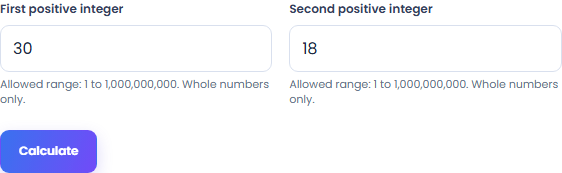
Set second positive integer. Two positive integers up to one billion; output satisfies ax + by = gcd(a,b).

Select Calculate to see the gcd and one pair of Bézout coefficients. Copy result copies this text; Download saves it as a TXT file.
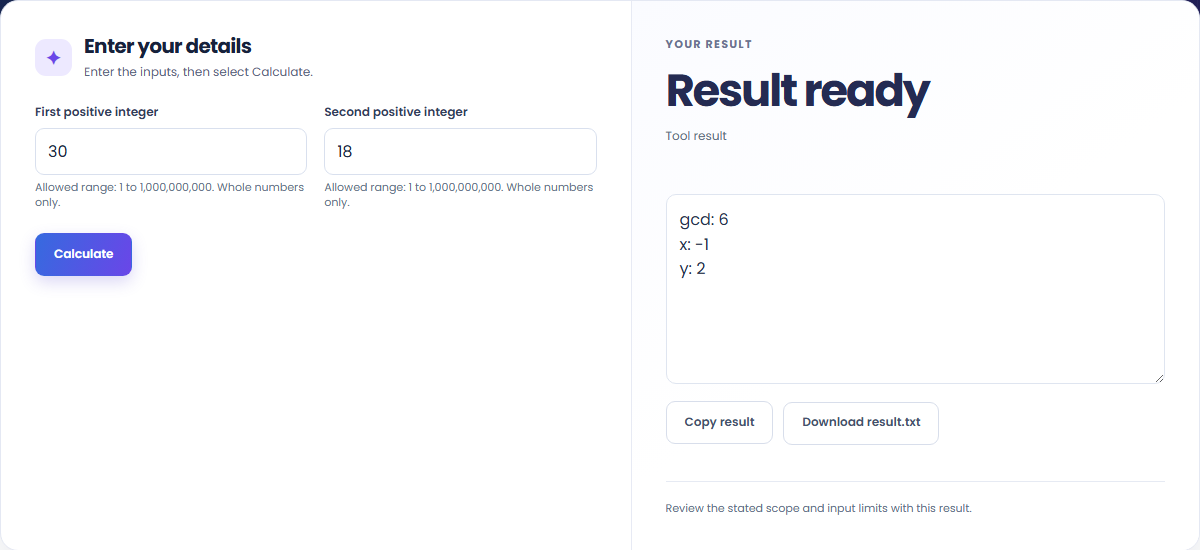
These concrete scenarios illustrate how the Extended Euclidean Algorithm Calculator processes baseline inputs, comparison checks, and boundary constraints.
First positive integer: 30; Second positive integer: 18. The displayed output is gcd: 6 x: -1 y: 2.

First positive integer: 7; Second positive integer: 3. The displayed output is gcd: 1 x: 1 y: -2.

When solving for 'extended euclidean calculator', verify that First positive integer, Second positive integer use consistent units and stay within the documented scope: Positive integers at most one billion. Outputs one pair x,y satisfying ax + by = gcd(a,b); other valid pairs exist.

The output panel reports the exact result derived from First positive integer, Second positive integer alongside any unit or formatting notes.
Review these boundary constraints and validation rules before relying on the Extended Euclidean Algorithm Calculator output.
Operational scope: Positive integers at most one billion. Outputs one pair x,y satisfying ax + by = gcd(a,b); other valid pairs exist. Inputs that violate minimum/maximum bounds or required format rules are rejected with a clear diagnostic prompt.
Need an adjacent calculation in Everyday Math? Use the related tools linked below to chain your workflow without leaving your browser.

Find the signed equal-tempered interval between two positive frequencies.
Open tool
Find the difference between two tone frequencies and play a brief quiet demonstration.
Open tool
Find the probability that at least two people share a birthday category.
Open toolChoose another tool for your next calculation, conversion, or text task.

Analyze banknote serial numbers for collector fancy patterns including Solid, Radar palindrome, Repeater, Ladder, Binary, Low/High serials, and Star Notes.
Open tool
Calculate material mass and whole packages from an entered label rate.
Open tool
Apply a bitwise AND, OR or XOR to two unsigned 32-bit integers.
Open tool
Find the nth Catalan number using an exact integer recurrence.
Open toolAnswers about using Extended Euclidean Algorithm Calculator and understanding its results.
The Extended Euclidean Algorithm Calculator applies the rule: Find gcd and integer Bézout coefficients for two positive integers. Enter First positive integer, Second positive integer into the workspace and the tool computes the exact output in your browser.
Yes. Provide First positive integer, Second positive integer using the documented units and format shown in the quick reference table above. Preloaded default values let you test the workflow immediately.
Positive integers at most one billion. Outputs one pair x,y satisfying ax + by = gcd(a,b); other valid pairs exist. Confirm that your inputs fall within the allowed ranges before exporting the result.
Yes. All calculations for the Extended Euclidean Algorithm Calculator execute 100% locally in your browser's JavaScript runtime. No inputs or results are uploaded to any external server.
Choose another tool for your next calculation, conversion, or text task.