

Complex Number Calculator
Add, subtract, multiply or divide two complex numbers.
Open toolEnter any US Federal Reserve or world banknote serial number below to detect Solid, Radar, Super Radar, Repeater, Ascending/Descending Ladder, True Binary, Trinary, Bookend, Low/High Serial, and Star Note patterns.
Enter the inputs, then select Check Serial Number.
Result will appear here
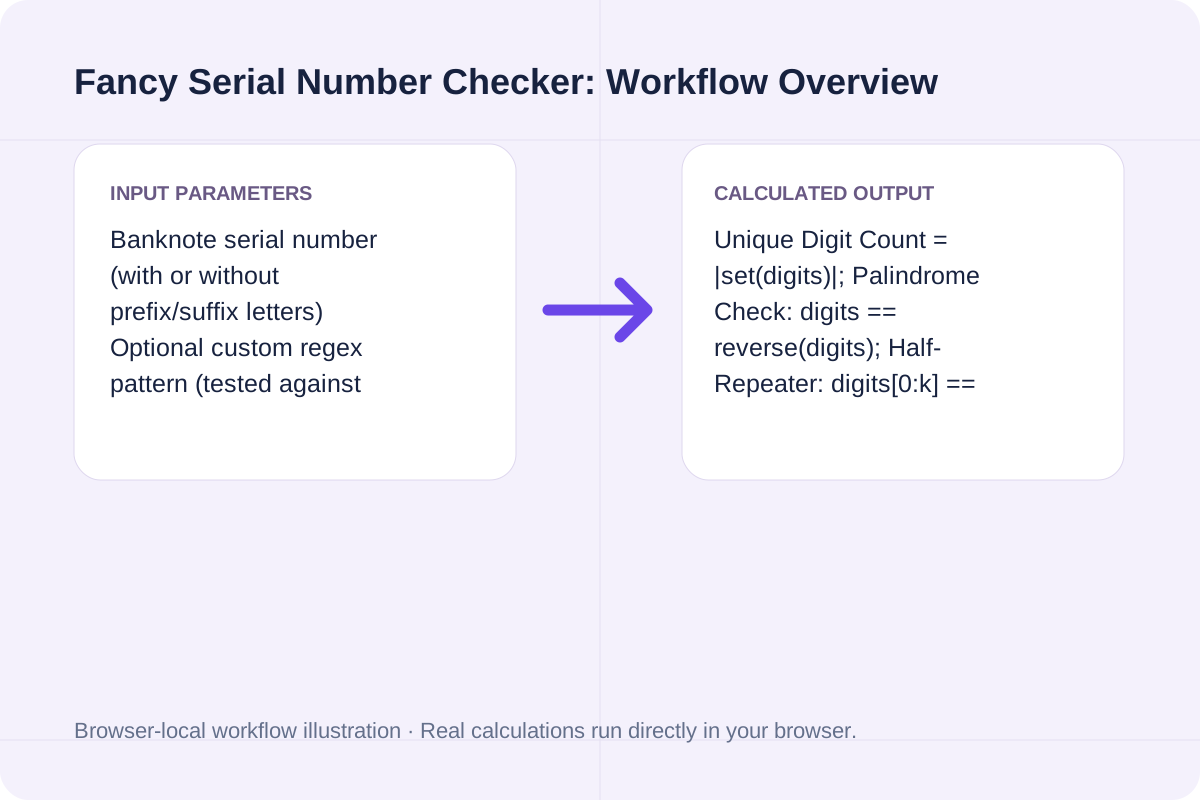
The checker parses optional Federal Reserve prefix/suffix letters and Star Note (*) markers, isolates the core digit sequence, and tests it against 14 deterministic pattern detectors plus your optional regular expression.
Unique Digit Count = |set(digits)|; Palindrome Check: digits == reverse(digits); Half-Repeater: digits[0:k] == digits[k:2k].
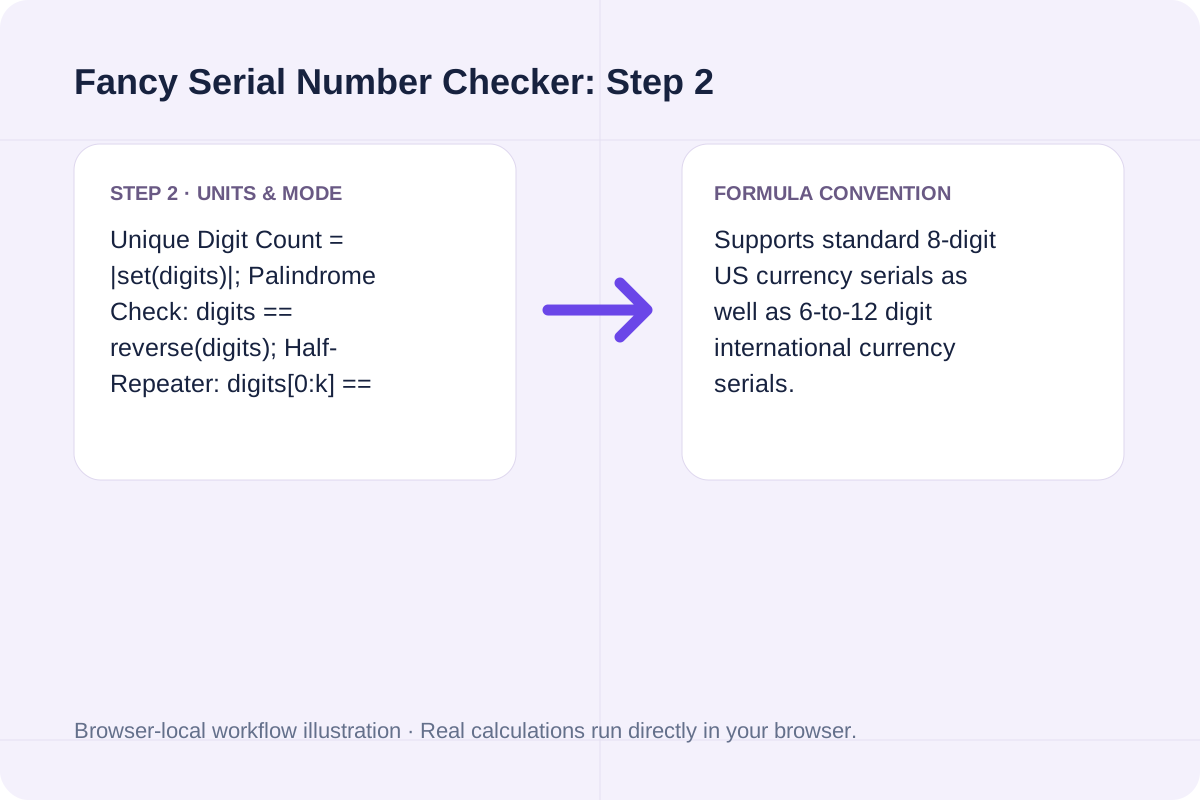
Supports standard 8-digit US currency serials as well as 6-to-12 digit international currency serials.
Compare the major numismatic fancy serial number categories, 8-digit examples, and exact combinatorial frequency per 96,000,000 standard US print run.
| Pattern Name | 8-Digit Example | Combinations per 96M Run | Collector Rarity Tier |
|---|---|---|---|
| Solid | 88888888 | 9 (1 in 10.67M) | Tier S - Extreme Rarity |
| True Full Ladder | 12345678 or 87654321 | 6 (1 in 16.0M) | Tier S - Extreme Rarity |
| Super Radar | 10000001 or 79999997 | 90 (1 in 1.06M) | Tier A - Ultra Rare |
| Super Repeater | 12121212 or 70707070 | 90 (1 in 1.06M) | Tier A - Ultra Rare |
| True Binary (0 & 1 only) | 01011010 | 256 (1 in 375,000) | Tier A - High Demand |
| Low Serial (Under 100) | 00000042 | 99 (1 in 969,697) | Tier A - High Demand |
| Standard Radar / Repeater | 12344321 / 12341234 | 9,990 (1 in 9,610) | Tier B - Classic Fancy |
Test a single banknote serial number and optional custom regex rule in seconds.
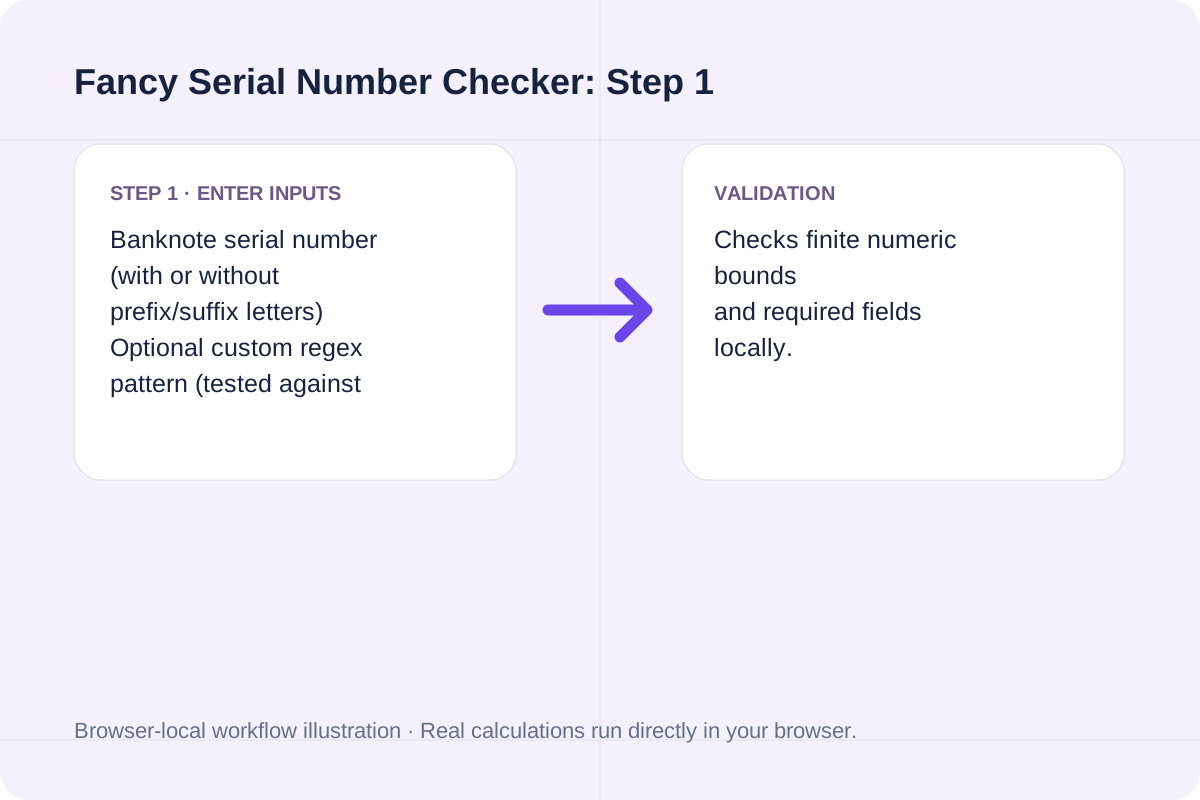
Type the serial number exactly as printed on the note, such as 'L 12344321 *' or '00000420'. Spaces and prefix/suffix letters are parsed automatically.
If you are hunting for a specific sequence (such as birthday dates or triple-7 endings), enter a regex pattern like '777$' in the second field.
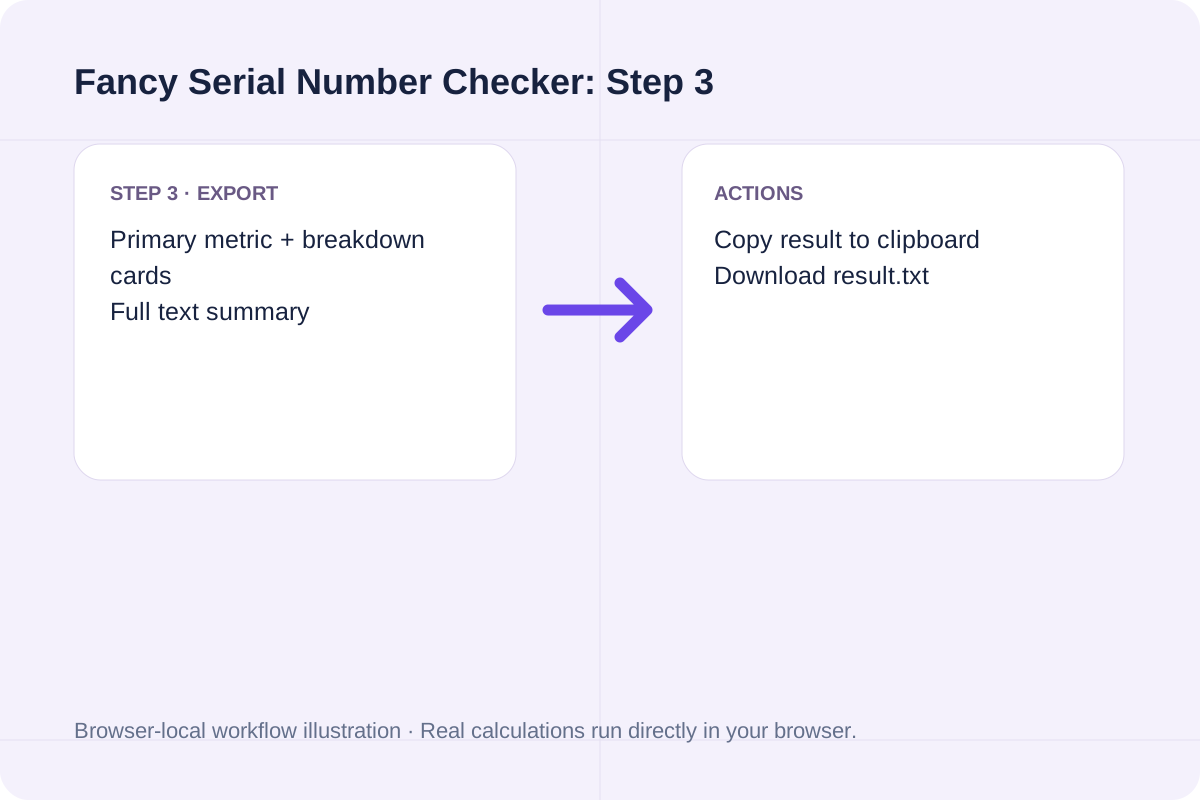
Click Check Serial Number to view every matched fancy classification, the character-by-character index map, and the overall collector tier.
See how real 8-digit serial numbers classify across multiple overlapping rules.
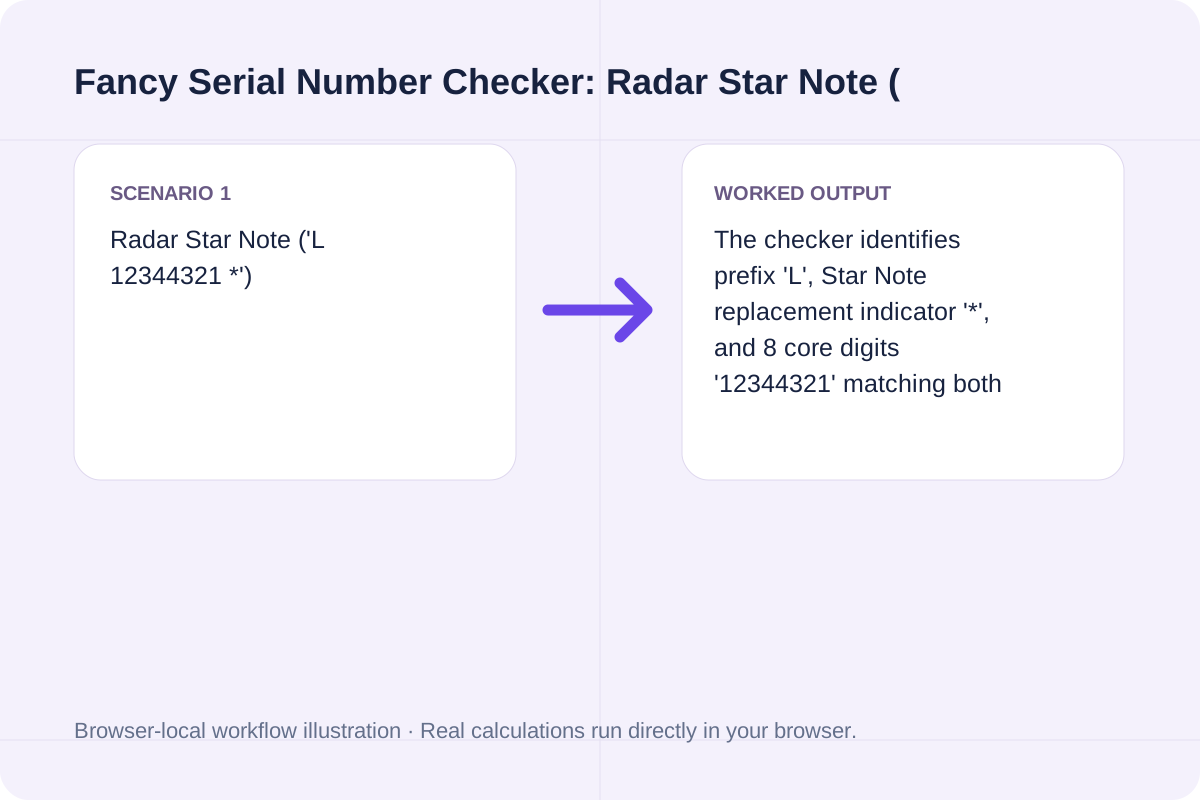
The checker identifies prefix 'L', Star Note replacement indicator '*', and 8 core digits '12344321' matching both the Radar (Palindrome) rule (d[0..3] == reverse(d[4..7])) and 4-unique-digit structure.
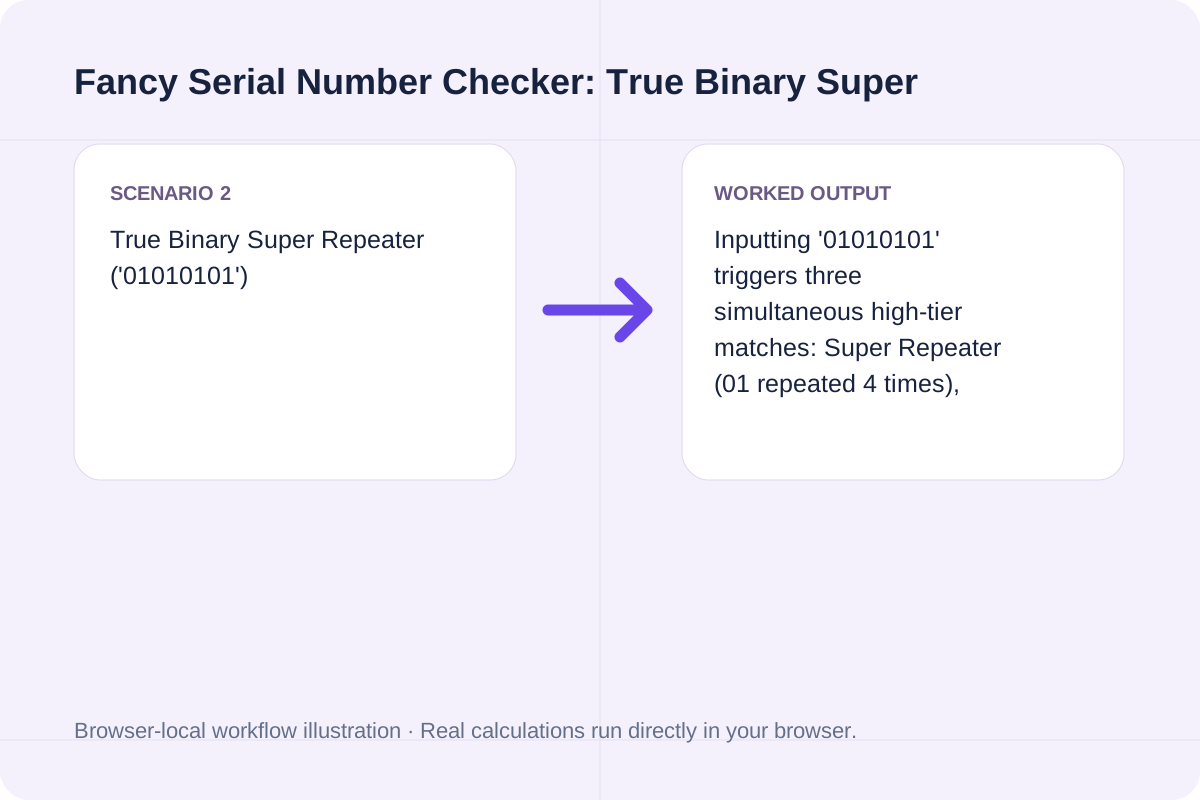
Inputting '01010101' triggers three simultaneous high-tier matches: Super Repeater (01 repeated 4 times), Regular Repeater (0101 == 0101), and True Binary (composed exclusively of 0s and 1s).
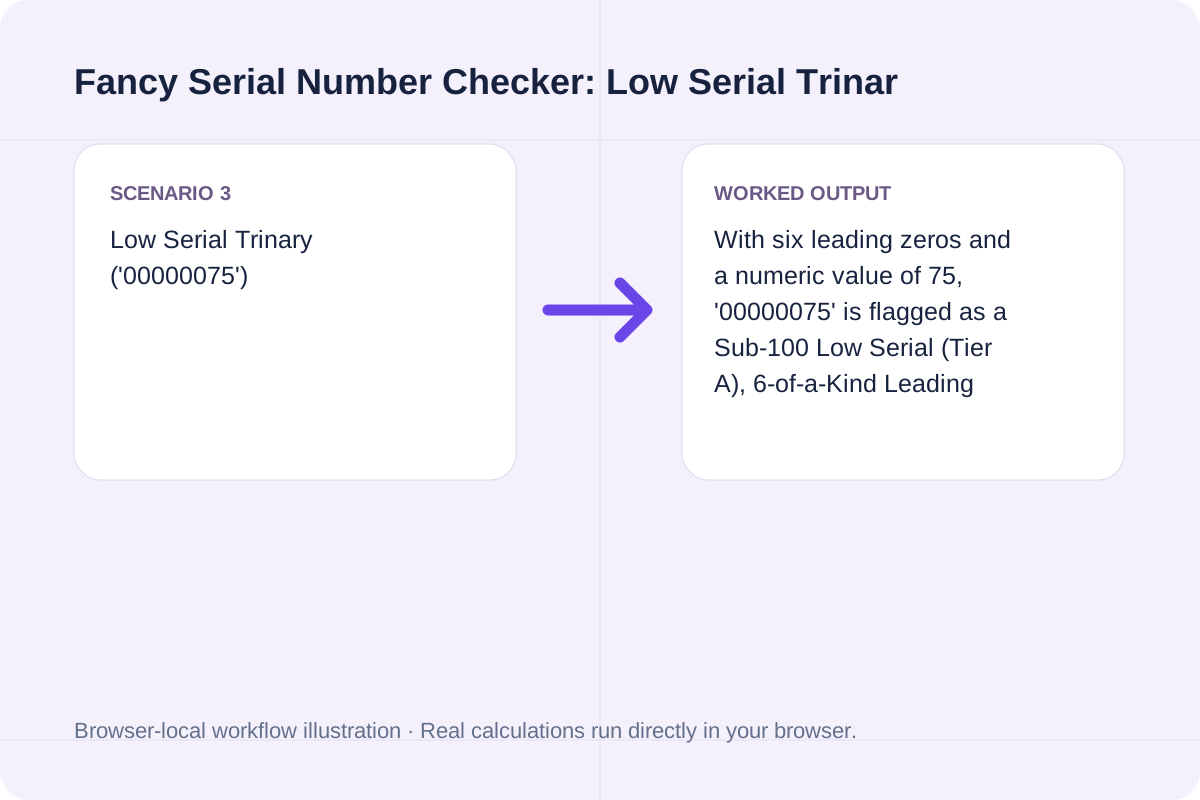
With six leading zeros and a numeric value of 75, '00000075' is flagged as a Sub-100 Low Serial (Tier A), 6-of-a-Kind Leading Run, and Trinary note (only digits 0, 5, and 7).
Notes that combine two or more fancy traits command the strongest collector interest.
The primary result badge displays the highest rarity tier achieved (Tier S Extreme Rarity down to Standard Circulation) alongside the primary pattern name.
The detailed audit lists every individual rule matched, the digit frequency distribution, and the exact character positions [1..8] so you can document the note for grading or listing.
Physical condition (paper crispness, centering, and corners) works alongside serial rarity.
This tool evaluates mathematical serial number scarcity only. Actual market value also depends on denomination ($1 vs. $100), series year, signature combination, and PMG/PCGS paper grade.
Serial numbers with fewer than 6 digits or more than 12 digits are rejected with a clear validation message.
Add, subtract, multiply or divide two complex numbers.
Open tool
Add the finite numbers and divide by their count; also report minimum, maximum and median.
Open tool
Find average binary cross entropy using natural logarithms.
Open toolChoose another tool for your next calculation, conversion, or text task.

Calculate material mass and whole packages from an entered label rate.
Open tool
Find FFT bin spacing, the nearest one-sided bin and its frequency error.
Open tool
Find the nth Catalan number using an exact integer recurrence.
Open tool
Build a binary confusion matrix from counts or paired labels and calculate its basic metrics.
Open toolAnswers about using Fancy Serial Number Checker and understanding its results.
A fancy serial number exhibits a mathematically rare digit arrangement in its 8-digit sequence, such as a Solid (all 8 digits identical, 1 in 11,111,111 notes), a Radar (reads the same forward and backward like 12344321), a Repeater (12341234), a True Ladder (12345678), or a Low Serial (00000001 to 00000999).
A True Binary serial number contains only the digits 0 and 1 (such as 01011010, 256 possible combinations per 100 million notes). A 2-Digit Note (often called a Collector Two-Digit Binary) uses any two distinct digits across all 8 positions (such as 37377337).
A regular Radar is any palindrome where position 1 matches 8, 2 matches 7, 3 matches 6, and 4 matches 5 (e.g. 48299284). A Super Radar has identical outer digits and all six interior digits identical (e.g. 10000001 or 78888887), occurring only 90 times in a 96-million-note print run.
Yes. The Bureau of Engraving and Printing uses a star (*) suffix on replacement notes printed to substitute misprinted sheets. Combining a Star Note with a fancy pattern (like a Radar Star Note) significantly multiplies collector scarcity.
Choose another tool for your next calculation, conversion, or text task.