
Chainmail Ring Calculator
Calculate ring inner/outer diameter and aspect ratio, or solve inner diameter from a supplied ratio.
Open toolConvert an AWG number to round-wire diameter and area, or solve continuous AWG from diameter. Provide Conversion direction, AWG number (continuous or integer), Round-wire diameter (mm) to compute results directly in your browser. d = 0.005 in × 92^((36−AWG)/39), with 1 inch = 25.4 mm. Inverse output includes continuous and nearest integer gauge. This is geometry, not an ampacity, voltage-drop or electrical-safety rating. Numeric output uses up to 12 significant digits; floating-point rounding can occur. Only the source quantity for the selected conversion direction is used. Common search workflows supported include "awg to diameter".
Enter the inputs, then select Calculate.
Result will appear here
The Wire Gauge Diameter Calculator evaluates Conversion direction, AWG number (continuous or integer), Round-wire diameter (mm) in client-side JavaScript using the deterministic rule below and updates the output panel immediately without uploading data to a server.
Convert an AWG number to round-wire diameter and area, or solve continuous AWG from diameter.
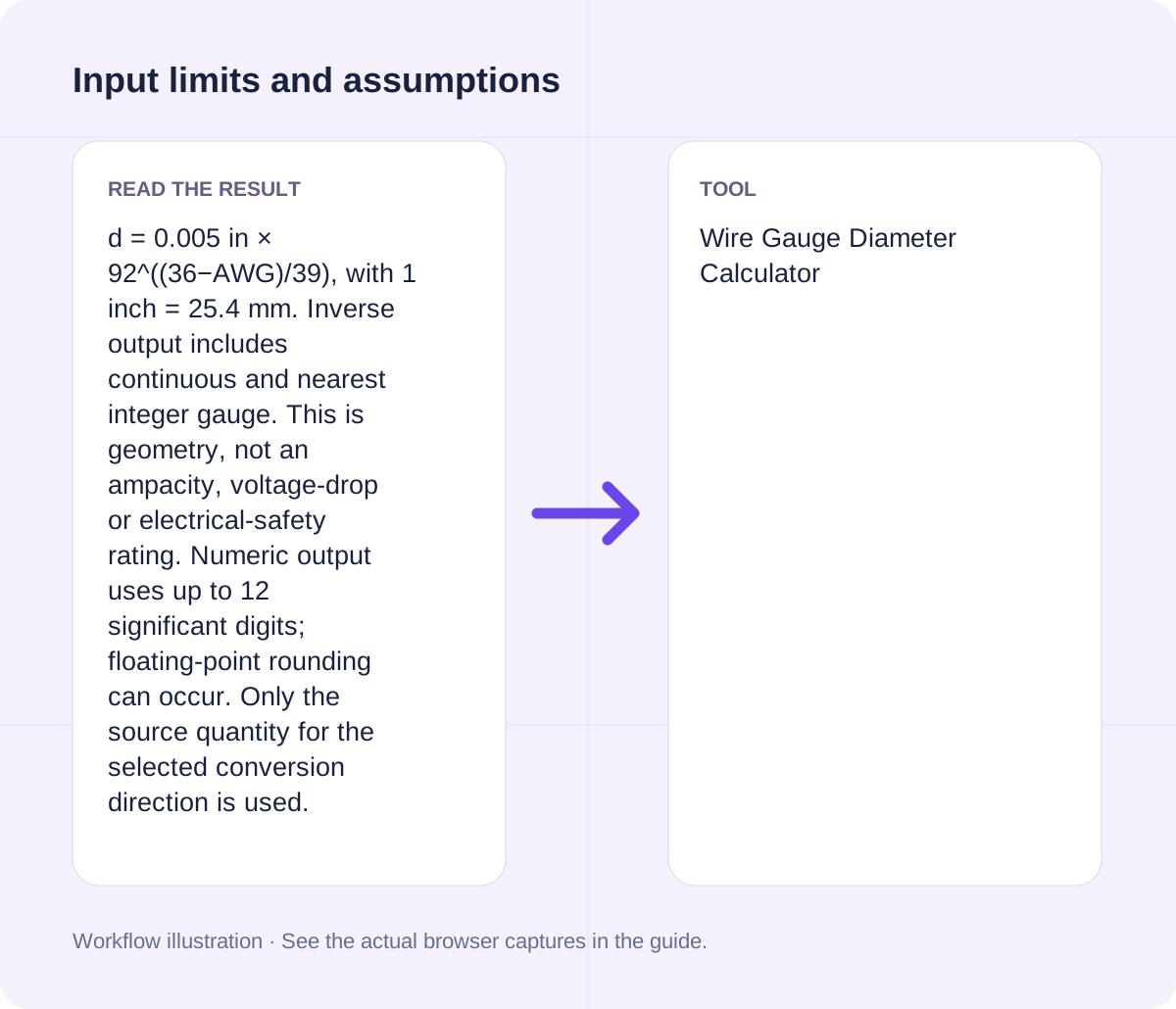
d = 0.005 in × 92^((36−AWG)/39), with 1 inch = 25.4 mm. Inverse output includes continuous and nearest integer gauge. This is geometry, not an ampacity, voltage-drop or electrical-safety rating. Numeric output uses up to 12 significant digits; floating-point rounding can occur. Only the source quantity for the selected conversion direction is used.
Review the input parameters, allowed value ranges, and worked reference cases for the Wire Gauge Diameter Calculator below before running your calculation.
| Parameter / Scenario | Default / Sample Value | Rule or Allowed Range | Output / Usage Note |
|---|---|---|---|
| Input: Conversion direction | AWG to diameter | Options: AWG to diameter, Diameter to AWG | Required workspace parameter |
| Input: AWG number (continuous or integer) | 20 | Range: -10 to 60 | Required workspace parameter |
| Input: Round-wire diameter (mm) | 0.8128 | Range: 1e-06 to 1000 | Required workspace parameter |
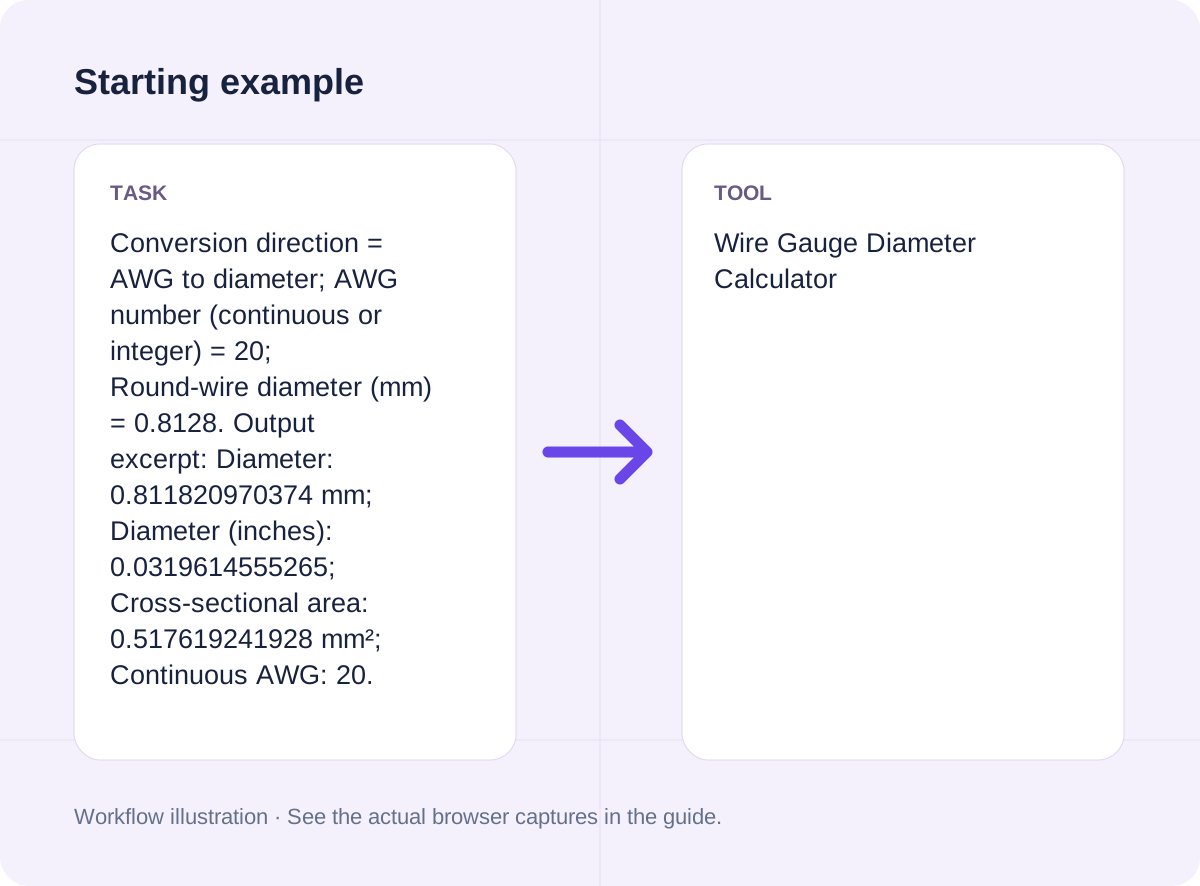
| Worked Case 1: Baseline run (Conversion direction = AWG to diameter) | Preloaded / test values | Convert an AWG number to round-wire diameter and area, or solve continuous AWG from diameter | Conversion direction = AWG to diameter; AWG number (continuous or integer) = 20; Round-wire diameter (mm) = 0.8128. Output excerpt: Diameter: 0.811820970374 mm; Diameter (inches): 0.0319614555265; Cross-sectional area: 0.517619241928 mm²; Continuous AWG: 20. |
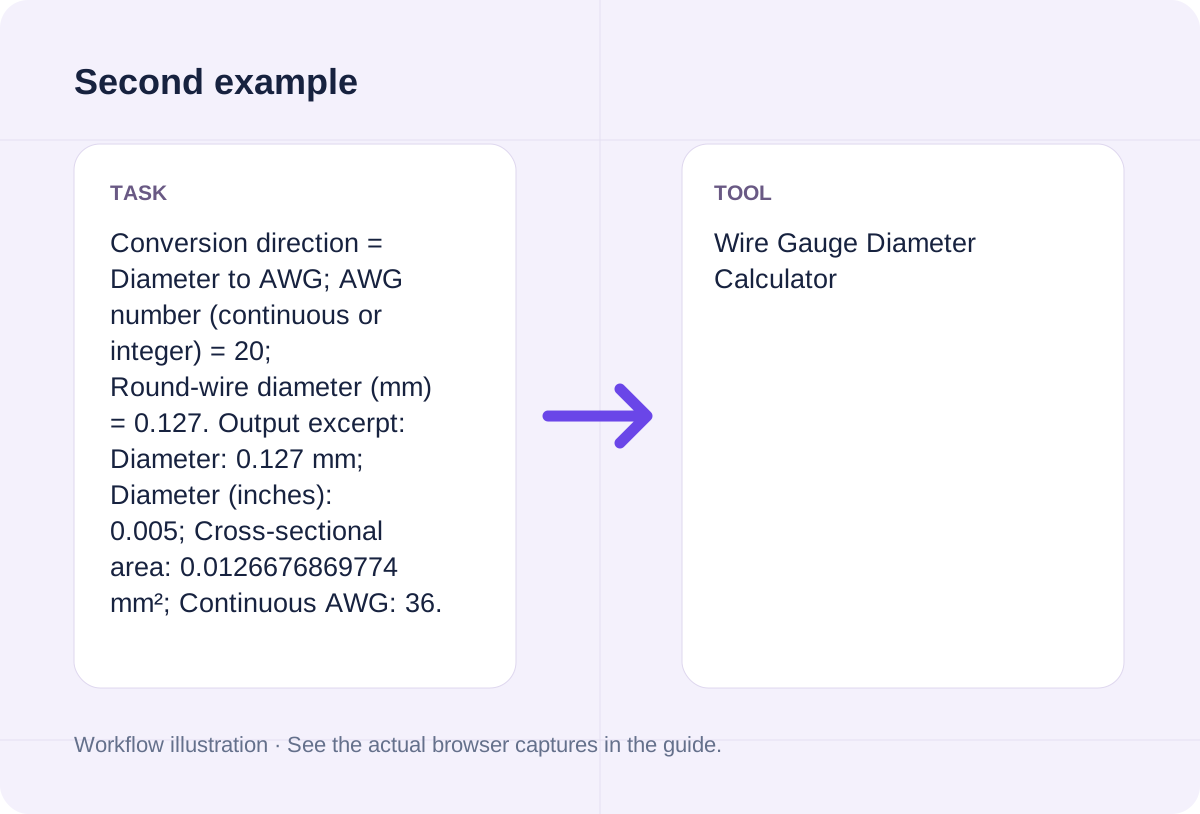
| Worked Case 2: Comparison scenario (Comparison conversion direction check) | Preloaded / test values | Convert an AWG number to round-wire diameter and area, or solve continuous AWG from diameter | Conversion direction = Diameter to AWG; AWG number (continuous or integer) = 20; Round-wire diameter (mm) = 0.127. Output excerpt: Diameter: 0.127 mm; Diameter (inches): 0.005; Cross-sectional area: 0.0126676869774 mm²; Continuous AWG: 36. |
Follow these three steps to configure Conversion direction, AWG number (continuous or integer), Round-wire diameter (mm), verify unit and boundary rules, and export your Wire Gauge Diameter Calculator output.
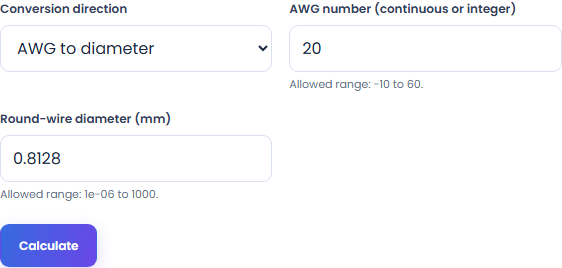
d = 0.005 in × 92^((36−AWG)/39), with 1 inch = 25.4 mm. Inverse output includes continuous and nearest integer gauge. This is geometry, not an ampacity, voltage-drop or electrical-safety rating. Numeric output uses up to 12 significant digits; floating-point rounding can occur. Only the source quantity for the selected conversion direction is used.
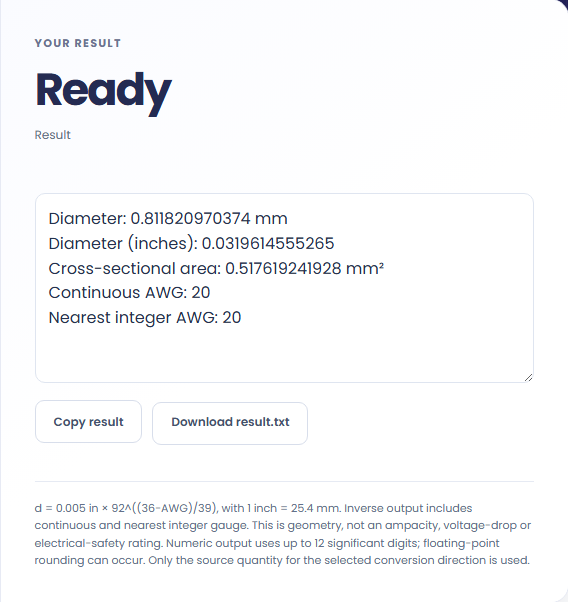
Select Calculate, check the labelled result, then use Copy result or Download result.txt.
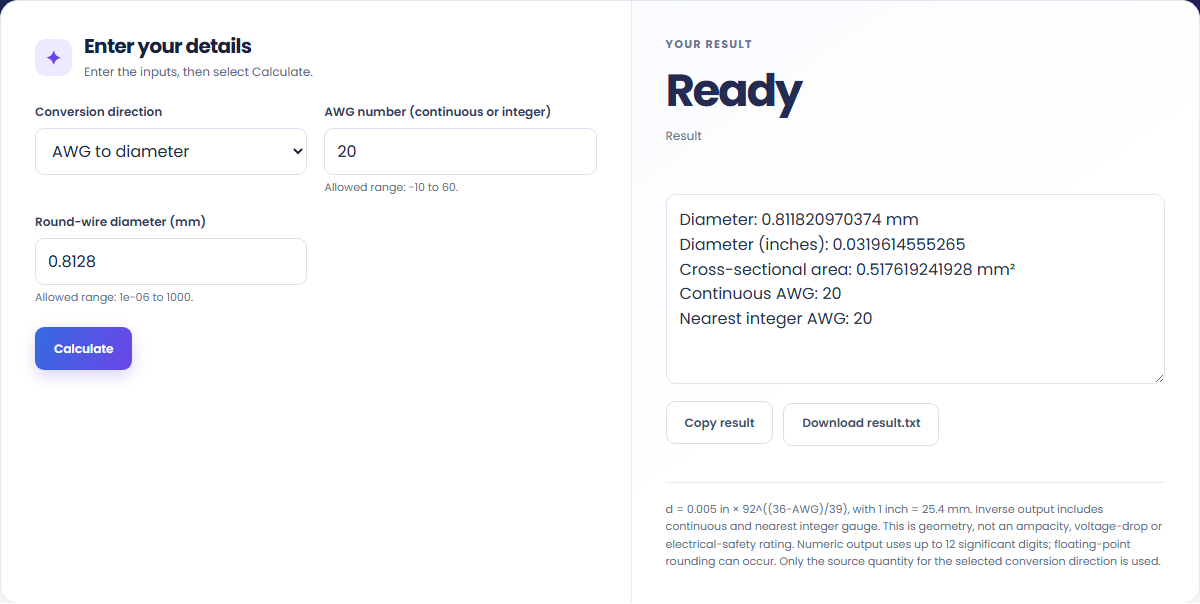
These concrete scenarios illustrate how the Wire Gauge Diameter Calculator processes baseline inputs, comparison checks, and boundary constraints.
Conversion direction = AWG to diameter; AWG number (continuous or integer) = 20; Round-wire diameter (mm) = 0.8128. Output excerpt: Diameter: 0.811820970374 mm; Diameter (inches): 0.0319614555265; Cross-sectional area: 0.517619241928 mm²; Continuous AWG: 20.
Conversion direction = Diameter to AWG; AWG number (continuous or integer) = 20; Round-wire diameter (mm) = 0.127. Output excerpt: Diameter: 0.127 mm; Diameter (inches): 0.005; Cross-sectional area: 0.0126676869774 mm²; Continuous AWG: 36.
When solving for 'awg to diameter', verify that Conversion direction, AWG number (continuous or integer), Round-wire diameter (mm) use consistent units and stay within the documented scope: d = 0.005 in × 92^((36−AWG)/39), with 1 inch = 25.4 mm. Inverse output includes continuous and nearest integer gauge. This is geometry, not an ampacity, voltage-drop or electrical-safety rating. Numeric output uses up to 12 significant digits; floating-point rounding can occur. Only the source quantity for the selected conversion direction is used.
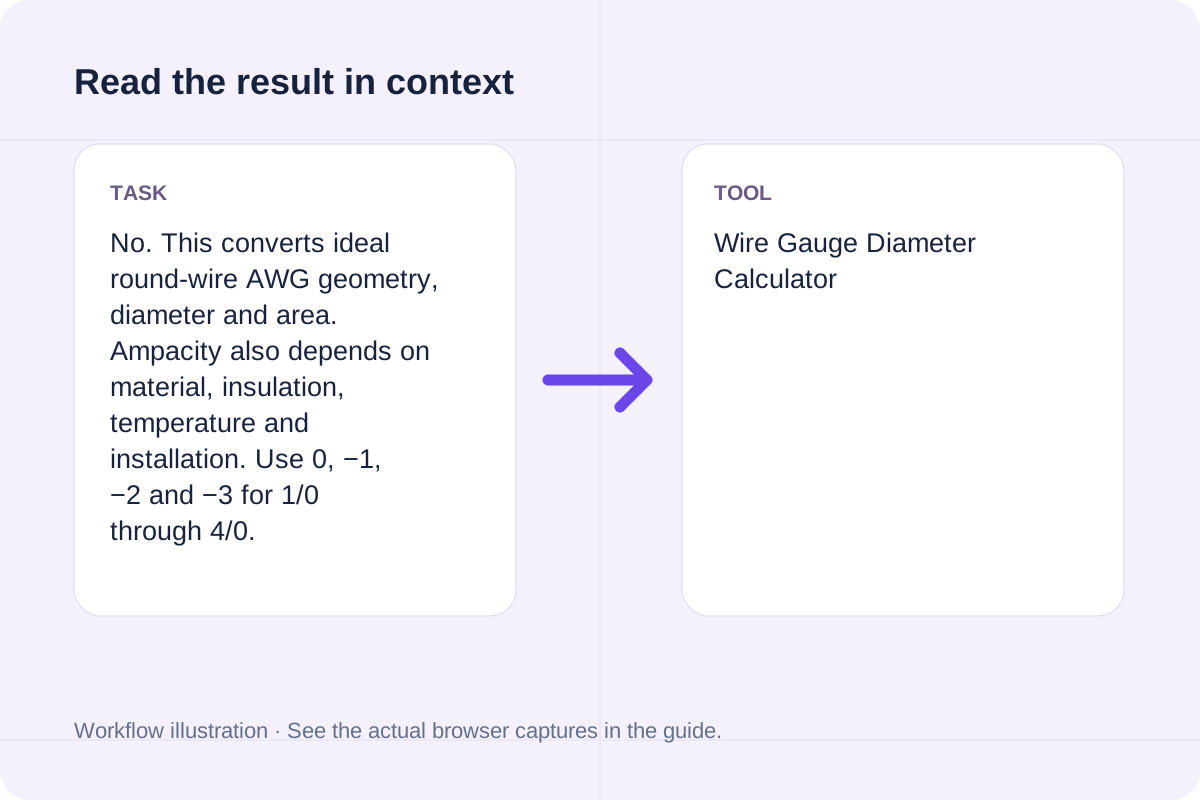
The output panel reports the exact result derived from Conversion direction, AWG number (continuous or integer), Round-wire diameter (mm) alongside any unit or formatting notes.
Every calculation follows the rule: Convert an AWG number to round-wire diameter and area, or solve continuous AWG from diameter. Because JavaScript uses IEEE 754 double-precision floating-point arithmetic, numeric outputs display up to 12 significant digits where applicable.
Always cross-check the displayed result against the scope note (d = 0.005 in × 92^((36−AWG)/39), with 1 inch = 25.4 mm. Inverse output includes continuous and nearest integer gauge. This is geometry, not an ampacity, voltage-drop or electrical-safety rating. Numeric output uses up to 12 significant digits; floating-point rounding can occur. Only the source quantity for the selected conversion direction is used) before applying the value to production specifications, financial models, or lab records.
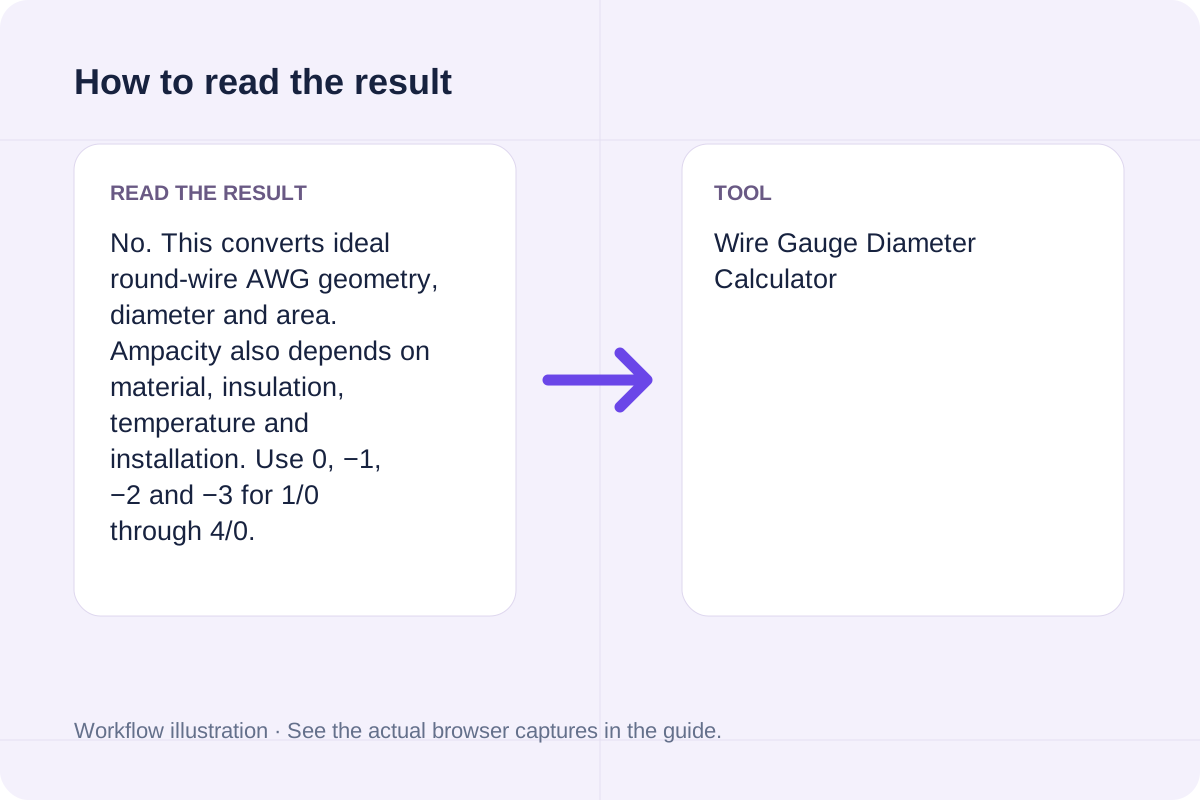
Review these boundary constraints and validation rules before relying on the Wire Gauge Diameter Calculator output.
Operational scope: d = 0.005 in × 92^((36−AWG)/39), with 1 inch = 25.4 mm. Inverse output includes continuous and nearest integer gauge. This is geometry, not an ampacity, voltage-drop or electrical-safety rating. Numeric output uses up to 12 significant digits; floating-point rounding can occur. Only the source quantity for the selected conversion direction is used. Inputs that violate minimum/maximum bounds or required format rules are rejected with a clear diagnostic prompt.
Need an adjacent calculation in Everyday Math? Use the related tools linked below to chain your workflow without leaving your browser.
Calculate ring inner/outer diameter and aspect ratio, or solve inner diameter from a supplied ratio.
Open tool
Find hydraulic diameter as four times flow area divided by wetted perimeter.
Open tool
Find rainfall depth from collected volume and rain-gauge opening area.
Open toolChoose another tool for your next calculation, conversion, or text task.

Find uniform wire resistance as resistivity × length / area.
Open tool
Mechanical work = force × displacement × cos(angle).
Open tool
Convert absorbed radiation dose between the listed units.
Open tool
Convert a quantity using the listed fixed unit factors.
Open toolAnswers about using Wire Gauge Diameter Calculator and understanding its results.
The Wire Gauge Diameter Calculator applies the rule: Convert an AWG number to round-wire diameter and area, or solve continuous AWG from diameter. Enter Conversion direction, AWG number (continuous or integer), Round-wire diameter (mm) into the workspace and the tool computes the exact output in your browser.
Yes. Provide Conversion direction, AWG number (continuous or integer), Round-wire diameter (mm) using the documented units and format shown in the quick reference table above. Preloaded default values let you test the workflow immediately.
d = 0.005 in × 92^((36−AWG)/39), with 1 inch = 25.4 mm. Inverse output includes continuous and nearest integer gauge. This is geometry, not an ampacity, voltage-drop or electrical-safety rating. Numeric output uses up to 12 significant digits; floating-point rounding can occur. Only the source quantity for the selected conversion direction is used. Confirm that your inputs fall within the allowed ranges before exporting the result.
Yes. All calculations for the Wire Gauge Diameter Calculator execute 100% locally in your browser's JavaScript runtime. No inputs or results are uploaded to any external server.
Choose another tool for your next calculation, conversion, or text task.