
Bohr Model Calculator
Calculate an ideal hydrogen-like energy change and photon wavelength between two Bohr levels.
Open toolCalculate the chemical reaction rate constant k from pre-exponential factor A, activation energy Ea, and temperature T, or solve the two-point Arrhenius equation for Ea from (k₁, T₁) and (k₂, T₂).
Enter the inputs, then select Calculate.
Result will appear here
Switch between single-temperature rate constant calculation and two-temperature experimental activation energy determination using the molar gas constant R = 8.314462618 J/(mol·K).
Mode 1 (Rate Constant): k = A x exp(-Ea / (R x T)). Mode 2 (Two-Point Activation Energy): ln(k₂ / k₁) = (Ea / R) x (1/T₁ - 1/T₂), which rearranges to Ea = R x ln(k₂ / k₁) / (1/T₁ - 1/T₂).
Activation energy Ea is entered and returned in joules per mole (J/mol; divide by 1,000 for kJ/mol). Temperatures T, T₁, and T₂ must be in absolute Kelvin (K = °C + 273.15).
Standard units and physical meaning for every variable in the single-point and two-point Arrhenius equations.
| Symbol | Parameter Name | Required Unit in Tool | Conversion / Typical Range |
|---|---|---|---|
| k (or k₁, k₂) | Reaction rate constant | Same units as A (e.g., s⁻¹ or M⁻¹s⁻¹) | k₂ / k₁ is dimensionless in two-point mode |
| A | Pre-exponential (frequency) factor | Same units as k | Typically 10⁸ to 10¹⁴ s⁻¹ for unimolecular reactions |
| Ea | Activation energy | J/mol (joules per mole) | 50 kJ/mol = 50,000 J/mol; 100 kJ/mol = 100,000 J/mol |
| R | Universal gas constant | 8.314462618 J/(mol·K) | Fixed SI CODATA value built into the calculator |
| T (or T₁, T₂) | Absolute temperature | Kelvin (K) | 25 °C = 298.15 K; 300 K = 26.85 °C; 350 K = 76.85 °C |
Choose your known inputs mode and verify that Ea is in J/mol and temperature is in Kelvin.
Choose 'A, activation energy and temperature' to solve for the rate constant k, or choose 'Two measured rate constants and temperatures' to solve for Ea and A from two lab measurements.
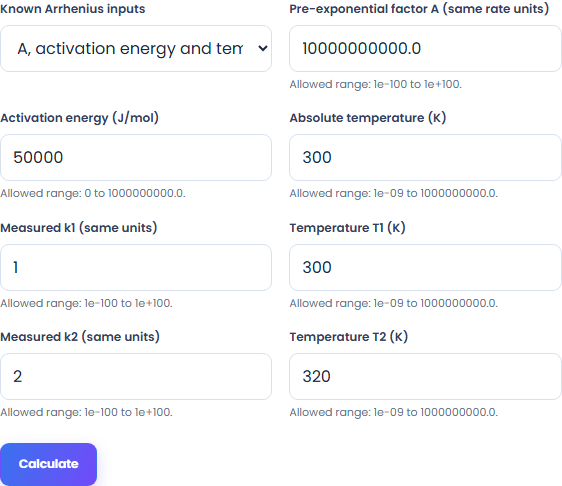
Convert activation energy from kJ/mol to J/mol by multiplying by 1,000 (for example, 50 kJ/mol = 50000 J/mol), and convert Celsius temperatures to Kelvin by adding 273.15.
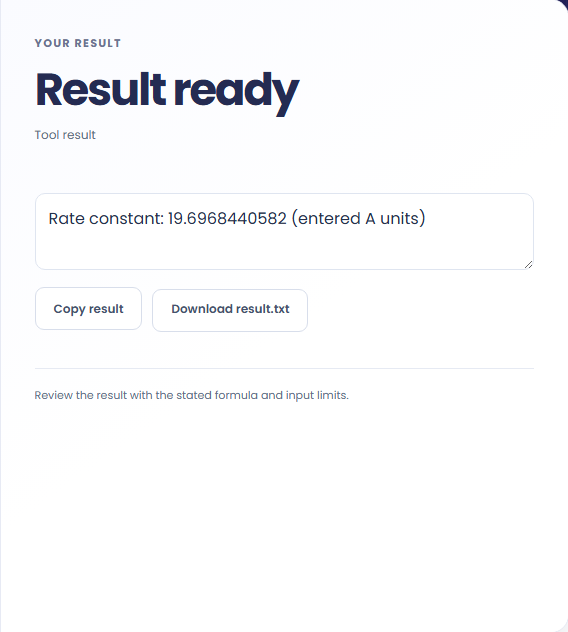
Select Calculate result to get the rate constant k (or activation energy Ea in J/mol and kJ/mol) and copy the output for your lab report.
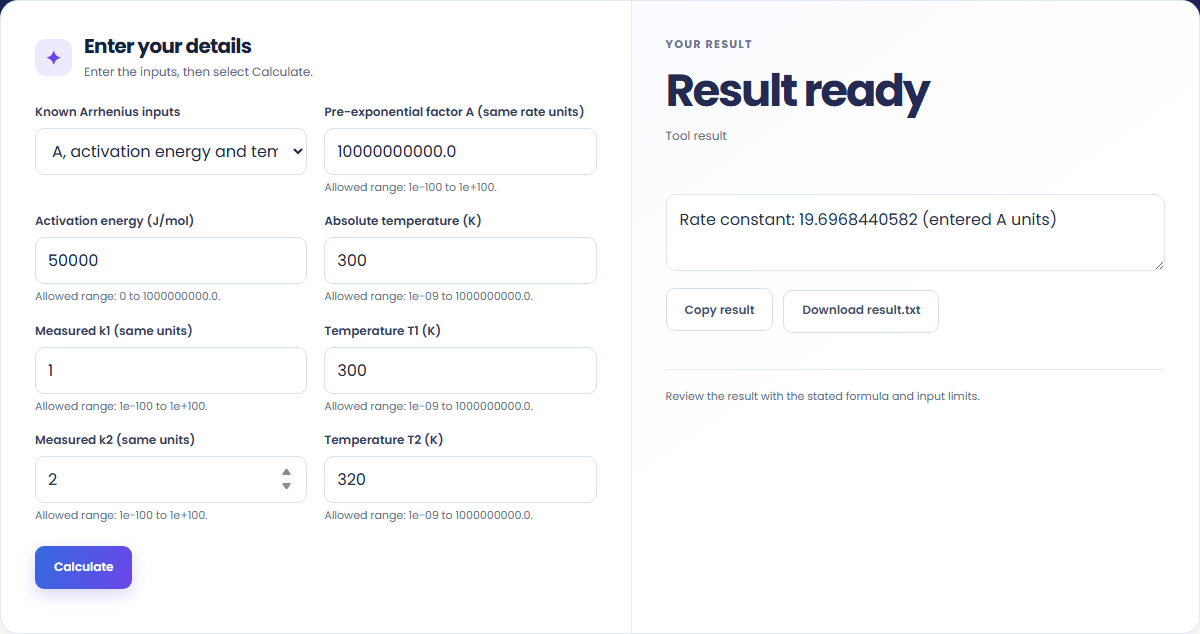
Verify both single-temperature rate constants and the classic 10 °C rate-doubling rule of thumb.
With Ea = 50,000 J/mol and T = 300 K, the dimensionless exponent is Ea / (R x T) = 50,000 / (8.314462618 x 300) = 20.0454. Thus k = 10¹⁰ x exp(-20.0454) = 19.697 s⁻¹.

Setting k₁ = 1, T₁ = 300 K, k₂ = 2, and T₂ = 310 K gives Ea = 8.314462618 x ln(2) / (1/300 - 1/310) = 53,603.5 J/mol (53.60 kJ/mol), illustrating the chemistry rule of thumb near room temperature.

When Ea is 100 kJ/mol (100,000 J/mol), raising T from 300 K to 350 K increases the Boltzmann factor exp(-Ea/RT) by over 300-fold.

Understand the physical meaning of A, Ea, and the fraction of reactive collisions.
The result is the selected rate constant or two-point activation energy. Explore the temperature relationship under an entered Arrhenius model.
Temperatures use kelvin; a two-point estimate is reported with its sign rather than clipped.
Numerical output shows up to 12 significant digits. Floating-point arithmetic and display rounding can affect the last digits.

Check these two unit conversions before trusting an Arrhenius calculation.
The #1 error in chemistry homework is entering Ea in kJ/mol (such as 50) while R is in J/(mol·K) (8.314). Always enter Ea in J/mol (50000 for 50 kJ/mol).
Never enter Celsius or Fahrenheit directly into T, T₁, or T₂. Absolute temperature in Kelvin (K = °C + 273.15) is strictly required (> 0 K).

Calculate an ideal hydrogen-like energy change and photon wavelength between two Bohr levels.
Open tool
Calculate energy delivered by constant power as power × duration.
Open tool
Calculate two plane-wave acoustic impedances and a normal-incidence intensity reflection coefficient.
Open toolChoose another tool for your next calculation, conversion, or text task.
Find arrow front-of-center percentage and show the balance point relative to the midpoint.
Open tool
Reduce integer width and height by their greatest common divisor; scale height to the target width.
Open tool
Calculate the intersection area of two disks.
Open tool
Estimate transfer time as file size in bits divided by a constant bit rate.
Open toolAnswers about using Arrhenius Equation Calculator and understanding its results.
Enter Activation energy in joules per mole (J/mol) so its units match the molar gas constant R = 8.314462618 J/(mol·K). Multiply any kJ/mol value by 1,000 before entering it (for example, 65 kJ/mol = 65000 J/mol).
Switch the top dropdown to 'Two measured rate constants and temperatures', then enter k₁, T₁ (in K), k₂, and T₂ (in K). The tool applies Ea = R x ln(k₂ / k₁) / (1/T₁ - 1/T₂).
Add 273.15 to the Celsius temperature. For example, 0 °C = 273.15 K, 25 °C = 298.15 K, and 100 °C = 373.15 K.
The rate constant k always has the exact same units as the pre-exponential factor A (s⁻¹ for first-order reactions, L·mol⁻¹·s⁻¹ for second-order reactions) because the exponential factor exp(-Ea/RT) is dimensionless.
Choose another tool for your next calculation, conversion, or text task.